A Blog by the Editor of The Middle East Journal

Putting Middle Eastern Events in Cultural and Historical Context

Wednesday, October 9, 2013

US Statement on Aid to Egypt

As expected, the US State Department has announced that the US will be "recalibrating" US aid to Egypt, reducing the military aid component, (For my own preliminary concerns and reservations, see this post from yesterday.)

The State Department announcement is not very detailed and does not mention amounts:
The United States and Egypt have a longstanding partnership and many shared interests, including: promoting a stable, inclusive and prosperous Egypt; securing regional peace; and countering extremism. The United States wants to see Egypt succeed, and we believe the U.S.-Egypt partnership will be strongest when Egypt is represented by an inclusive, democratically elected civilian government based on the rule of law, fundamental freedoms and an open and competitive economy.

As a result of the review directed by President Obama, we have decided to maintain our relationship with the Egyptian government, while recalibrating our assistance to Egypt to best advance our interests. The United States will work with the interim Egyptian government and Congress to continue to provide support that directly benefits the Egyptian people in areas like health, education, and private sector development. We will continue assistance to help secure Egypt’s borders, counter terrorism and proliferation, and ensure security in the Sinai. We will continue to provide parts for U.S.-origin military equipment as well as military training and education. We will, however, continue to hold the delivery of certain large-scale military systems and cash assistance to the government pending credible progress toward an inclusive, democratically elected civilian government through free and fair elections. The United States continues to support a democratic transition and oppose violence as a means of resolving differences within Egypt. We will continue to review the decisions regarding our assistance periodically and will continue to work with the interim government to help it move toward our shared goals in an atmosphere free of violence and intimidation.

Tuesday, October 8, 2013

Middle East Circassians and the Sochi Olympics

This article, by a member of Jordan's Circassian community, discusses the international Circassian diaspora's attitude toward the Winter Olympics in Sochi, once the heart of the Adyghe or Circassian people's homeland.

Between 1860 and 1864, at the end of the Russian conquest of Circassia, there occurred one of the first great ethnic cleansings of the 19th century, one now largely forgotten except by the descendants of the victims. Hundreds of thousands died, and more were deported by Tsarist Russia to the Ottoman Empire, where they formed, and still form, distinct ethnic communities. Turkey, Syria, Lebanon,Jordan, Israel, Iraq and Egypt all have Circassian populations, perhaps most visible in Jordan where the overall population is small and they are a sizable minority. (Some of the "Circassian" communities of the Middle East include other peoples expelled from the Caucasus (particularly Chechens), but I'm speaking here of true Circassians, the Adyghe people.

The article linked to above (despite sometimes spelling Caucasus as "Caucuses," presumably due to a spell-checker) notes how the choice of Sochi for the Olympics has awakened a national solidarity among the Circassian diaspora, one not seen before.

CNN Reporting US Will Cut Some Aid to Egypt

CNN is reporting that the US will cut some (but not all) of its military aid to Egypt in response to the violence of the last weekend. I'm as disgusted by the violence against demonstrators as anyone, but this is our sole remaining leverage with an Egypt increasingly soured on us. I hope we remember how we punished Nasser for his Czech arms deal in the 1950s by cutting funding of the Aswan Dam.

Within a year he nationalized the Suez Canal and the Russians built the dam anyway. We sure showed Nasser. And made an enemy for a generation.

1973's Forgotten Golan Front: Hermonit and "The Valley of Tears," Part One

Syrian T-62 at the Crest of Hermonit; a steep slope is behind it
The 40th anniversary of the 1973 Arab-Israeli war suggests to me another issue: the often neglected Golan front. Let me note from the beginning that when I call (in the post title) the Golan Front in the 1973 war a "forgotten" front I refer to how the war is remembered in much of the outside world, including Egypt (where the war is wholly identified with the "crossing" of the Suez Canal), and in many of the minds and memoirs of the outside world. In Israel and Syria, the Golan Front is not forgotten. The Golan Heights contain a string of Israeli war memorials, a few to 1967 but others to 1973, including the memorial shown above, containing a destroyed Syrian T-62 tank on the mountain ridge known as Hermonit (Little Hermon).

Few war memorials I have visited do as well (though perhaps unintentionally) to remember the heroism of both sides. What is not clear from the photo here but is immediately obvious when one visits the site is that the ground falls off steeply a short distance behind the tank, and that the tank had managed to advance up a very steep ridge against tank and artillery resistance on the high ground, and had arrived at the crest before it was stopped. While the memorial commemorates the outnumbered Israeli defenders on the ridge, the fact that that Syrian tank crew (presumably soon deceased) reached the ridgeline strikes me as a suitable memorial to their heroism as well. When you stand there, wherever your political sympathies may lie, you can't help but feel the sacrifice on both sides. I get a similar feeling from the Clump of Trees at Gettysburg, but the high ground here is much steeper. It was a high water mark in much the same way.

This video gives a better sense of my point and a sense of the position, though from an Israeli perspective only:

The Middle East is largely good country for tanks. And many of the great tank battles of history have been fought there: El Alamein, Kasserine Pass, Sinai 1956, 1967, and 1973. Sinai and the Western Desert are fine tank country; the Golan Heights is anything but. High, broken ground with steep ridges and gorges and the cones of extinct volcanoes, it's hell for tankers. Yet in October 1973 a ferocious tank battle was fought there, leaving the ground riddled with hundreds of Syrian and Israeli burned-out tanks and APCs, many of which, like the one above, have been left as reminders and memorials.

Also, in conjunction with yesterday's post about Moshe Dayan's request to use nuclear weapons if needed on October 7, it is worth emphasizing that the context of that plea was not the crossing of the Golan, but the breakthrough in the Golan. The crossing of the Canal left Israel with a couple of fallback defense lines, first at the mountain passes (Mitla and Giddi) in mid-Sinai, and secondly in the open desert of eastern Sinai and the Negev, before Israel proper would be in danger. There were no such strategic buffers in Golan: if Egypt had reached its initial military objective of the passes, it would still have been hundreds of miles from Israeli population centers; if Syria had broke through in Golan, it would have been in the Hula Valley and threatening Qiryat Shemona. The nuclear option was first invoked there, where the threat seemed truly imminent.
The above is a wider angle scene of the Hermonit war memorial, with the tank previously shown on the left of the memorial. One can get a somewhat better sense of how the land falls off here.

As the battle went on for several days this will occupy several posts. Next: the ground, the antagonists, and the units involved.


Monday, October 7, 2013

Nuclear Weapons and 1973: Avner Cohen Releases the Longer Version of Azaryahu Interview

Last week I published links to and a three-minute video clip of an interview Avner Cohen released the contents of an interview he had with Arnan Azaryahu about Moshe Dayan's suggestion of using nuclear weapons during the 1973 war. Azaryahu reported that Golda Meir refused the suggestion outright. The Dayan suggestion was made on October 7, 1973, the second day of the war and exactly 40 years ago today.

I briefly had a clip of the full 12 minute interview up, but Avner informed me that it had been posted to YouTube inadvertently, and that only the three minute version was for public release, so that is all that appears now in last week's post.

Fortunately, since the longer version contains more anecdotal context, he has now decided to release the longer account (part of a much longer interview on Azaryahu's career). Also I did not previously link to Avner's detailed notes and analysis of the interview, which I really should have done, and which you may read here. "Sini" is Azaryahu's nickname. Again, the leadership meeting under discussion took place 40 years ago today. (Hebrew but English subtitles.)

Shas Party Spiritual Leader Rabbi Ovadia Yosef, 1920-2013

Ovadia Yosef (Wikipedia)
Rabbi Ovadia Yosef, spiritual leader of the Shas Party and one of the most powerful religious figures in Israel, died today at the age of 93.  Yosef. born in Baghdad in 1920, had served as Sephardi Chief Rabbi of Israel from 1973 to 1983, and established and presided over Shas' Council of Torah Sages; under his leadership Shas greatly enhanced the political power of the Sephardic haredi community and of Israel's Jews of Middle Eastern origin in general. He had been ailing for some time. Another obituary here.

Friday, October 4, 2013

October 6: "The Crossing" After 40 Years

This Sunday marks the 40th anniversary of the outbreak of the 1973 Arab-Israeli War (the October War, Yom Kippur War, or Ramadan War). Although Syria also participated in the surprise attack, the date of October 6 has become iconic particularly in Egypt, where "the crossing" (al-‘ubur) of the Suez Canal was the defining moment of Anwar Sadat's Presidency, making possible his later visit to Jerusalem and peace with Israel. This will be the first of several posts on the anniversary of that war.

Sadat had succeeded Gamal Abdel Nasser in 1970 and defeated an effort by hardline Nasserites to oust him in 1971 (the "Corrective Revolution"); but he had not fully emerged from the shadow of Nasser, whose standing up to the British, nationalization of the Suez Canal, and role as leader of the Arab World were so influential. But there was one great blot on Nasser's record was the devastating defeat in the 1967 War, which left Egypt without an Air Force, without Sinai, and with the Suez Canal closed. The War of Attrition across the Canal from 1967 to 1970 left the Canal Cities (Port Said, Ismailia, Suez) destroyed and abandoned.

Unlike the heated rhetoric Nasser had used in the 1967 war, in 1973 the war was not presented as aimed at destroying Israel, but at recovering lost territory.

Though by the end of the war Israel had recovered and recrossed the Canal, the shock of the surprise destroyed the myth of Israeli invulnerability, and of the "impenetrable" Bar-Lev line along the Canal. And it led to negotiations, first at Kilometer 101.

Though by the end of the war Israel's Deversoir salient on the west bank of the Canal cut off supply lines to the Egyptian Third Field Army ("Bonjour, al-‘ubur; bonsoir, Deversoir" went a joke of the time), for Egyptians it was a very different result from 1967, and within a decade Israel and Egypt were ay peace and Sinai had been fully returned.

Sadat and the High Command
October 6 became Egypt's military day. Ironically, it was while watching a Military Day parade at Egypt's Tomb of the Unknown Soldier,  that Sadat was assassinated, giving the day a double and double-edged significance. (And I first met my future wife at an Egyptian Military Day reception.)

Nor did its role as an iconic symbol die with Sadat; Husni Mubarak had been Air Force Commander during what was essentially a return of Egypt's Air Force from the destruction of 1967. Mubarak's role in 1973 was emphasized throughout his Presidency, to the point where Sadat's was actually downplayed. And the habit of seeing the President as the hero of October 6 carried over to the point where last year, one union magazine actually congratulated "President Muhammad Morsi, Leader of the Great October Victory." (Morsi never served in the military and was still in school in 1973. But old habits die hard.)

France Belatedly (as in 70 Years Late) Honors Moroccan Troops Who Fougtht to Liberate Corsica

Hmm . . . first I note the passing of the mastermind of Dien Bien Phu, and now here's another reminder of the former French Empire: "Overdue 'merci' extended to Morocco WWII vets." (Also see France 24 video in English, not embeddable, at this link.)

Seventy years ago today marked the completion of the liberation of Corsica from the Axis by Free French Forces.  As I have noted before, there was a substantial North African colonial presence in the Free French ranks.  Corsica was liberated by the Free French I Army Corps. According to Wikipedia, this was its Order of Battle:
While British and American troops invaded mainland Italy in September 1943, the 1st Army Corps, comprising Headquarters, 4th Moroccan Mountain Division (4e DMM), the 1st Regiment of Moroccan Tirailleurs (1er RTM), the 4th Regiment of Moroccan Spahis (4e RSM) (light tank), the 2nd Group of Moroccan Tabors (2e GTM), the Commandos de Choc battalion and the 3rd Battalion, 69th Mountain Artillery Regiment (69e RAM),[9] landed on the island of Corsica in the same month.
A very heavy Moroccan participation, in other words. The French President and the Moroccan King are honoring several survivors of the Corsican operation with the Legion of Honor, though the France 24 says only about 2% of the Moroccan troops who fought in the war are still living.

A footnote about the word goumier, by which the Moroccan troops were known: France organized its colonial forces into goums (from Arabic qom  قوم); a 200-;man body of troops; hence goumiers.

Vo Nguyen Giap Dies at 102; Theorist of Anti-Colonial War Inspired Many in the Middle East

Vo Nguyen Giap has died at 102. You may think he had nothing to do with the Middle East, but consider this for a moment: His greatest victory, defeating France at the siege of Dien Ben Phu in March to May 1954, defeated French colonialism and drove France out of Indochina. Just six months later, in November 1954, the crown jewel of the French Empire, Algeria, began its war of independence. Giap had shown a colonial European power could be decisively defeated.

Giap had begun his fight against the Japanese, carried on to drive France out of Indochina, and later Americans made his acquaintance as an adversary in the Vietnam or Second Indochina War.

As a theorist of guerrilla war he ranks with Mao Zedong, and his approach was emulated in colonial wars of independence throughout the world. And he lived on to complete his first century, though he came to be somewhat critical of the Vietnamese government's authoritarianism.

Thursday, October 3, 2013

Avner Cohen Reveals New Details on the Nuclear Aspect in the 1973 War

Sunday marks the 40th anniversary of the outbreak of the 1973 Arab-Israeli War, and thus a lot of people are revisiting that event, and I'll be posting more on the subject tomorrow and next week; The Middle East Journal's Autumn issue will feature a piece by Israeli historian Uri Bar-Joseph on the intelligence surprise. Here, however, is another revelation worthy of note.

From the time of the war itself there have been rumors surrounding the early days of the war and the US global nuclear alert which followed, rumors suggesting that Israel considered using its nuclear arsenal. Avner Cohen, who has written more extensively than anyone about Israel's nuclear program, has donated his research materials to the Woodrow Wilson Center in Washington, and the collection reveals new details about the nuclear aspect of 1973. Cohen also has details in an op-ed in The New York Times,  "When Israel Stepped Back from the Brink."

As he notes:
In the four decades since the 1973 war, rumors have blossomed that Israel stood at the nuclear brink during that war’s darkest hours. A number of journalists and scholars have asserted that during a dramatic meeting in one of the war’s early days, a panic-stricken Mr. Dayan persuaded the Israeli war cabinet, including the prime minister, Golda Meir, to arm the country’s weapons with warheads for possible use.
Some analysts have even claimed that Israel used this “nuclear alert” to blackmail the Nixon administration into providing Israel with a huge airlift of military supplies. Although these stories were based on anonymous sourcing and circumstantial evidence, they have become a central part of the lore surrounding the Yom Kippur War.
In 2008, Cohen interviewed Arnan Azrayahu, who in 1973 was an advisor to Yisrael Galili, a Minister without Portfolio and close ally of Golda Meir. Cohen did not release the interview until after Azrayahu's death. According to his account:
Then, as the meeting adjourned, Mr. Dayan, casually leaning against the door and talking as if he were raising only a minor point, asked the prime minister to authorize Mr. Freier to initiate the necessary preparations for a “demonstration option” — that is, a demonstration of Israel’s nuclear weapons capability.
According to Mr. Azaryahu’s account, Mr. Dayan gave the impression that he’d already authorized such a demonstration and all that was needed was Ms. Meir’s approval. Mr. Dayan explained that an immediate authorization of preparatory steps for a nuclear blast would save precious time and allow the order to detonate a bomb to be executed rapidly should the need arise. At that point, Mr. Azaryahu told me, Mr. Galili and the deputy prime minister, Yigal Allon, spoke up to oppose Mr. Dayan’s plan, saying it was premature to consider the nuclear option and that Israel would prevail using conventional weapons.
Siding with her two senior ministers, the prime minister told Mr. Dayan to “forget it.” He responded by saying that he remained unconvinced but that he respected the prime minister’s decision. He then left the room.
So apparently Moshe Dayan did urge a nuclear demonstration, but was firmly overridden by Meir and her allies Galili and Allon. Avner Cohen's op-ed in effect confirms the discussion but also indicates the idea was quickly shot down.

Also see this report of the interview in the Times of Israel, and Cohen's introduction to the collection of interviews at the Wilson Center's website.

Here's a three-minute clip of the key part of Azrayahu's interview (Hebrew with English subtitles). (A longer video that appeared here for a while was apparently not intended for public release and has been taken down by request.)

Study Says Egypt "Second Most Addicted" to Facebook

According to this report, Egypt, though it has fewer Facebook users than other countries, ranks second in the world in number of posts per Facebook user, after only Brazil:
With Facebook crossing the one billion user-line, Socialbakers has released the results of statistics showing the most Facebook-addicted countries on Facebook. Egypt came in second on the list.
 
While the US is one of the most populous countries with a high percentage of its people connected to the internet and having the greatest number of registered Facebook pages, other countries like Brazil and Egypt topped the list of the highest activity on the social networking website.
 
According to the Sociabakers, their findings were based on the number of posts published in each country. Brazil which topped the list publishes a total of almost 86 thousand posts per month, with an average of 103 posts for every registered Facebook page every month.
 
While Egypt has six times fewer pages registered on Facebook than Brazil and eight times fewer than the US (which came third on the list), pages in Egypt publish an average of 380 posts per month for every registered page.

The US ranked third. The only other Middle Eastern country to make the top ten is Turkey.

Wednesday, October 2, 2013

Egyptian Xenophobia and the Misreading of Robin Wright's Map

Last Sunday, veteran Middle East hand Robin Wright published a piece in The New York Times noting, as others have, that the growing sectarian divisions in Syria and Iraq could lead to a redrawing of the map of several Middle Eastern countries: "Imagining a Remapped Middle East."  The article came with a companion map, "How 5 Countries Could Become 14."

I didn't read it as if she were recommending this so much as warning it could be an emerging possibility, but the most dramatic thing about the article was the map, which had a separate title and online URL, so that it was easy to link to the map without actually linking to the article. Unsurprisingly, a lot of Middle Easterners didn't read the article but did see the map:
Now, as you will recall, Egypt has been going through a xenophobic phase in which it has become an article of faith among many that the US supports the Muslim Brotherhood and opposes the military takeover (though the US is still funding the Egyptian military); elaborate conspiracy theories involving former US Ambassador Anne Patterson make the front page of Al-Ahram.

In such a paranoid environment, it's no surprise that Egyptian social media and regular media as well quickly pounced upon the map; here for example is a recent front page of Al-Tahrir with the map prominently featured:


Blogger Zeinobia reports here on the reactions within Egypt. 

Now, neither Robin Wright nor the New York Times is calling for a new partition of the Middle East as any fair reading of the article itself demonstrates; but many people looked at the map but not the article. And Egypt, of course, isn't even  partitioned on the map; the Nile Valley has been pretty much united since the First Dynasty. (In contrast, though, there was a flap back in the 1980s over an alleged "Sharon plan" claiming that Ariel Sharon favored partitioning the Arab world, including creation of a Coptic state in Upper Egypt.)

While the reaction to the map in the Times has been exaggerated, there is, of course, a precedent, and one Middle Easterners are fully aware of: the Sykes-Picot Agreement:
Original Sykes-Picot Map

That 1916 agreement on partition of the Ottoman provinces between Britain, France, and Tsarist Russia is a classic example of colonial powers carving up the world without bothering to consult the local inhabitants; nearly a century later it haunts the region, though of course neither Robin Wright nor the Times were talking about an externally-imposed partition.
F. Georges-Picot


Sir Mark Sykes


Tuesday, October 1, 2013

The Threat(s) to Middle East Area Studies (Yet Again)

As I sit in a Washington with many government services shut down, after months of living under a Federal sequester that has cut funding to the bone, it is hardly cheering to encounter this article in the Chronicle of Higher Education:  "Area-Studies Centers are Vital but Vulnerable." Area studies have always been something of an odd man out in traditional academia, often dependent on government funds and targeted where it was believed threats might emerge. (And I doubt if I need to note my personal biases as I work for an area studies think tank and edit an area studies journal.)

Since World War II (when the need for understanding foreign languages and cultures became obvious, especially in the Pacific Theater), and especially in the Cold War, Federal support for area studies increased enormously, with emphasis on strategic languages and foreign cultures (Russian and Chinese foremost among them, but Arabic and other Middle Eastern languages received attention). With some in traditional academia suspicious of any government funding (another Cold War survival) and all government funding under periodic fire, area studies has always had to fight for survival.

When the Soviet Union dissolved and Francis Fukuyama announced The End of History, area studies weren't needed anymore. The US Defense Intelligence Agency, for one, cut back its Middle East area studies sharply, and it was not alone. Then Saddam Hussein invaded Kuwait, history started up again with a jolt, and a decade later we had 9/11 and everyone was crying out for Pushtu speakers (as long as they weren't actual Pashtuns: it takes too long for the security clearance).

The irony of course has long been that, though the government wants lots of speakers of foreign languages and experts on foreign cultures, their advice on actual policy never quite reaches the policy-making level.

So here we are again, and area studies are threatened again.

But as a companion piece to the Chronicle article linked above, Middle East Area Studies is threatened from another direction: the closing of foreign studies opportunities due to regional turbulence. This article from Mada Masr last month deals with the decision by the Center for Arabic Study Abroad (CASA) to move its students from the American University in Cairo to Amman after the July coup, and also the moves by other language programs such as Middlebury's to cancel their Egyptian operations for the year and/or move them elsewhere, often Amman. Cairo is "the mother of the world", with thousands of years of history; Amman has history, too, but it isn't Cairo.

The death of a young American English teacher based in Alexandria and working for AMIDEAST spurred much of this reaction (or overreaction?), but other issues (growing anti-Americanism and xenophobia, Egypt's crackdown on NGOs) add to the pressures. Second warning of bias: besides working for the Middle East Institute today I was a CASA Fellow and later also a Fellow of the American Research Center in Egypt (ARCE), so I hate to see the programs that helped form my knowledge and experience of that country and its language under threat. Even without the personal investment, I hate to see the next generation of Middle East Studies students deprived of the opportunities we had.

From Nasser to Sisi: Nostalgia for Bonapartism?

September 28 marked the 43rd anniversary of the death of Gamal ‘Abdel Nasser, and it was marked amid growing enthusiasm in Egypt's media for another military man, Gen. ‘Abd al-Fattah al-Sisi. Although General Sisi continues to decline public comment on a possible candidacy and unofficially is said to not want to run for President, a broad range of political figures ranging from Nasserists to various types of liberals are endorsing Sisi even though he has not said he is running, And today, General Sisi called for a faster transitional period in order to restore stability in a speech to the military.

Sisi certainly has seemed a far more charismatic figure since ousting Muhammad Morsi in July than either Morsi or Sisi's military predecessor, the uninspiring Field Marshal Tantawi. But while many supporters of a Sisi Presidency see him as a charismatic leader who saved the country, others look to the Army as providing a guarantor of stability and an end to the widespread violence and lack of security that has plagued the country since the 2011 ouster of Husni Mubarak. After all, every Egyptian leader since 1952, until the year-long interlude of Morsi, came from the Armed Forces (all but Mubarak, who was  Air Force, came from the Army).

Two potential military candidates for the presidency, former Chief of Staff Sami Enan and former Air Force Chief Ahmad Shafiq (who lost narrowly to Morsi in the 2012 elections) have each said that while they are candidates, they will not run if Sisi decides to stand.

Some Egyptian leftists are warning against military rule as "fascist," but the experience of military rule in Egypt, while authoritarian, has never really been fascist. A better term might be Bonapartist, especially given the rising mood of turning to Sisi as a potential military savior who will restore stability after the chaos of the revolutionary period.

Admittedly, at this distance it is hard to judge how widespread and genuine the enthusiasm for Sisi may be, as opposed to how much it is a product of the state-owned media propaganda, though independent papers and television stations are also on the Sisi bandwagon.

Netanyahu on Iran

Binyamin Netanyahu's speech to the UN General Assembly lacked the wonderful Wile E. Coyote-style cartoon bomb that made last year's speech so memorable, but he left no doubt that he is not convinced by Hassan Rouhani's charm offensive, in fact labeling Iran "a wolf in sheep's clothing."

It was vintage Netanyahu, spelling out the dangers of allowing Iran to obtain a nuclear weapon and insisting on a complete dismantling of its nuclear research before any sanctions are eased.

Clearly, Netanyahu is dismayed and displaying considerable anxiety about the US-Iran thaw.

And of course, in keeping with Israel's policy of "ambiguity," there was of course no mention that Israel has a considerable nuclear arsenal.


Monday, September 30, 2013

Assassination Attempt Against Coptic Bishop of Minya

Coptic Bishop Anba Makarious, General Bishop of Minya, escaped an apparent assassination attempt earlier today, one of the highest-ranking Christian figures to come under fire in the sectarian violence that has torn Upper Egypt since August. Bishop Makarious was reportedly visiting a church in the Abu Qurqas region of Minya Governorate when his car was fired upon; he and his driver escaped unharmed.

Minya Governorate has one of the largest populations of Copts in Upper Egypt and is also a hotbed of political Islamists; church burnings in Minya were reported after the crackdown against the Muslim Brotherhood in August.

More Warming with Iran

While Washington is preoccupied with the question of a government shutdown, the US-Iran thaw continues apace, with President Rouhani suggesting a restoration of airline flights, and other elements in the Iranian power structure signing on to the thaw. Robin Wright brings us up to date at USIP's Iran Primer.

Bouteflika Comes Back Fighting

Algerian President Bouteflika chaired a Cabinet meeting  yesterday. (Link is in French.)  The primary reason this is news is that it is his first this year.

You may recall that Bouteflika suffered a stroke in April. There were widespread rumors he was in a coma and periodic rumors he had died. The usual photos of the President in the hospital in France did not appear.  Officially he was said to have suffered only a "mini-stroke" or "transient ischemic attack." But later the media began referring to a "cardiovascular accident," suggesting something more serious. He reappeared in June, and then returned to Algeria in July. He made few public appearances and speculation has been rife about the succession. Before the stroke, there had been signs Bouteflika was planning to run for a fourth term in elections next April. The President, now 76 and the few surviving fighters from the war of independence still active in politics, clearly has been out of the political center for months now.

Until this month, when Bouteflika has come back fighting. On September 11, he reshuffled the Cabinet, naming new Ministers of Foreign Affairs, Interior, and Justice. This has been widely interpreted as reinforcing his own supporters, in order to either give him a fourth term if he chooses to run, or giving him control over the succession.

Even more importantly, he has reportedly moved to strengthen his allies in the Army command against the powerful head of the Army's Department of Intelligence and Security (DRS), the main military intelligence wing, Lt. Gen. Mohamed Mediene. Mediene, usually known by his nom de guerre Toufik,  has led an anticorruption campaign that jas targeted some of the President's allies. According to some reports, he has taken the Police Judiciaire and other agencies and put them directly under the Army Commander,  a Presidential ally.

The indefatigable Algerian blogger Kal at The Moor Next Door offers a summary of the moves that Bouteflika has been making and also has prepared this chart of the reported changes in the DRS, which is copyright by him:


It's still far from clear whether Bouteflika will seek a fourth term or will merely seek to ensure that his allies control the succession, but the wave of moves since September 11 appear to at least confirm that reports of Bouteflika's political death were as premature as reports of his physical death.

Friday, September 27, 2013

Belated Weekend Nostalgia Photo

Boxer Muhammad Ali (ex-Cassius Clay) and Nasser, 1960s?. [Commenter below's link to similar picture says "circa 1964."]

To the best of my knowledge no one has yet claimed the boy is a young General Sisi. (Though I'm sure someone will.)

Hat tip to Paul Sedra on Facebook for this one.

Sudan: Over 50 Dead So Far

The demonstrations continue in Sudan, and the death toll has reportedly passed 50. An Amnesty International Report adds:
Local sources and activists have put the figure much higher, in excess of 100, and at the time of writing the two organizations were still receiving reports of shootings and excessive use of force.
 Apparently the authorities are using live ammunition and lethal force against unarmed demonstrators.

No Handshake, But a Phone Call

So President Obama and President Rouhani have spoken by telephone, the first direct contacts between a US and Iranian leader since 1979.

That's a good sign, but 20 years after the Oslo Accords it is worth remembering that talking to each other, while a precondition for peace, is not in itself peace. Iran's new leader is a lot more personable than his execrable predecessor, but there are still huge gaps between the two sides.

Obama signed off with Khoda Hafez. Let's hope so.

Thursday, September 26, 2013

Metalworking Shopkeepers in Cairo Suqs Using Hebrew words in a Private Language?

Here's a wild and wonderful story if it can be borne out:  Jacky Hugy for Al-Monitor's Israel Pulse writing on "The Secret Language Of Cairo's Jewelry Merchants," quoting research by Hebrew University Professor Gabriel M. Rosenbaum on a secret language used by jewelry merchants in the Khan al-Khalili and other jewelry suqs in Egyptian cities. He thought he recognized a few Hebrew terms when they were speaking in a private patois among themselves (and he's a Professor of Arabic so he wouldn't be fooled by cognates), and claims to have traced it back to the Middle Ages, when most of the metalworkers were Karaite Jews, and apparently used Hebrew jargon as a secret language. Some of the evidence cited:
Thus, for example, in market jargon the word yaffet means "good" or "nice," similar to its meaning in modern Hebrew. The merchants use it to share information about clients who look wealthy or give their opinion of a good product. “The opposite of yaffet is ashfoor,” says Rosenbaum, “a word whose root is unknown, and which does not suggest a Hebrew parallel.”
Some of the merchants use the word zahub, whose origin is the Hebrew word zahav for gold, to refer to one Egyptian lira. When they want to hint to a colleague that he better get rid of a customer, the merchants tell him halakh, or ahalakh, which sounds like halah, the word for "go" in modern Hebrew. Others use the word admoon. It means an "old tool," or a piece of jewelry that was repaired, and that the merchant polished up and shows in his display window as if new. Its origin is in the Hebrew word kadmon, which means "ancient" or "old." In colloquial Egyptian Arabic, the Hebrew letter kof (k) is pronounced as an alef (a silent letter), and thus kadmon became the term admon among Egyptian merchants. The possessive word they use, shal, is also taken from Hebrew. Shali means "in my possession" or "with me," while shalakh means "in your possession" or "with you." But the greatest influence is in the realm of numbers. The merchants and metalsmiths in Egypt’s marketplaces actually count in Hebrew: echad (1), shnayin (2), shlosha (3), shloshin (30), shishin (60), shefin (70), shmonin (80) and so on.
It's credible enough; I know some folks in the market will use various code words, or Nubian, or in one case I heard of Swahili, to talk without their customers' understanding. I rather doubt that today's mostly Muslim and Christian shopkeepers are aware they're using Hebrew words and numbers, though.

Karaite Jews were a sect of Judaism, still found in Israel and a few pockets elsewhere, who accepted the Torah but rejected the Talmud and were once highly prominent in many Middle Eastern societies.

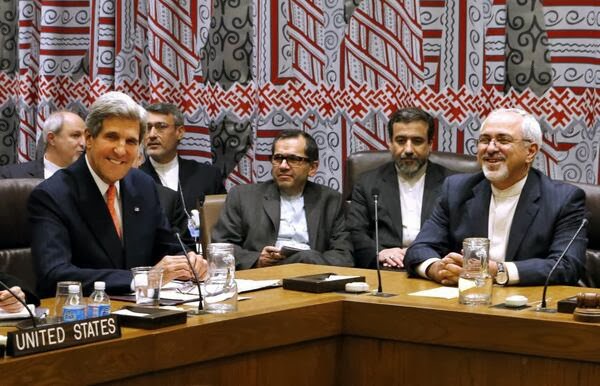
Kerry-Zarif Meeting: At Least They're Smiling

Well, they're both smiling.  Let's hope that's a good sign.

Today's Kerry-Zarif Meeting Could Be Far More Important Than Any Photo-Op Handshake

The expected meeting today between US Secretary of State John Kery and Iranian Foreign Minister Javad Zarif is the first such meeting in several years and the first in a much longer period with any chance (however remote) of making any substantive progress. No one can know what its real chances may be at this time. Both sides suspect (and have historical reasons to suspect) the other's motive, sincerity, and intentions. Both sides, if perceived as conceding too much, would face a political firestorm at home, in the Iranian case, one rooted in the powerful Islamic Revolutionary Guards Corps (IRGC).

But what is abundantly clear is that there are opportunities at least hinted at, that we have not seen in many years. And that if a breakthrough is going to take place it will be through the Kerry-Zarif meeting (perhaps the first of a new round of negotiations?) and not through some imagined summit between the two countries' Presidents,

The huge amount of media hype on Tuesday, when Presidents Obama and Rouhani were at the UN at the same time, over whether the two men would meet, or at least shake hands, or occupy the same room together, led to a disappointment, But high-profile handshakes, however great as photo-ops, do not resolve conflicts of longstanding, ridden with suspicion and recrimination. Neither side trusts the other, and each has its reasons. Diplomatic process will depend on confidence-building, tenacity, determination, and minds that are cautiously open but not gullible. And the ability of each to reach a deal they can sell domestically is far from certain. But this will matter far more than an Obama-Rouhani handshake could have.

Interestingly, Zarif has been posting his travel diary to his Facebook page, and the US Institute for Peace is translating the entries into English. That part, at least, is something new and different.

Wednesday, September 25, 2013

Sudan Erupts

"The People Want the Fall of the Regime.": "Al-Sha‘b yurid isqat al-nizam"  was the iconic chant of the Tunisian and Egyptian revolutions, and now it's being heard in Khartoum and Omdurman. Sudan has endured three days of worsening demonstrations in the wake of a move to lift government subsidies on fuel prices. 

The death toll is rising; the last estimate I saw was 10 dead but that is likely a low estimate. Today the Internet was shut down, at least for a while.

So is Sudan belatedly having its Arab Spring moment? Actually it had demonstrations back in 2011, and has continued to face challenges created by its loss of South Sudan and its persistent economic problems.

Questioning the Tunisian "Sexual Jihad" in Syria Story

You've probably already seen the stories, all over the media, claiming that Tunisian Islamist women are traveling to Syria to wage "sexual jihad" by providing comfort to jihadi fighters in Syria. Even the Tunisian Interior Minister has confirmed the story, saying his Ministry is blocking such travel. But Sana Saeed questions the bona fides of the whole story:

Unfortunately for what seems to be that blind spot people have when it comes to stories on Muslims and sex, there doesn’t seem to be any evidence of Tunisian female warriors going to fight a holy sex war.
Sucks, I know.
Despite the lack of clear evidence of a sex war pandemic, this hasn’t stopped news media outlets all over the world from grabbing, expanding, and running with this story.
She links the story to earlier wild stories about fatwas on sexual issues and notes that the evidence remains scanty and in some cases denied by those being quoted:
In December, Lebanese news channel Al Jadeed reported that hardline and popular Salafi scholar Shaykh Mohamad Al Arefe, a loud and inciting opponent of the Syrian regime, had issued a fatwa (a non-binding religious opinion) allowing the gang rape of non-Sunni Syrian women by rebels. Not only did the scholar vehemently deny expressing any such opinion, on Twitter and in later sermons (both links in Arabic), but the story was debunked by the Electronic Intifada’s Ali Abunimah.
On March 27, 2012, the Pan-Arab news site Al Hayat, published a piece discussing the apparent crisis of young Tunisian girls and what was being referred to as “Sexual Jihad.” It claimed that the impetus behind this was another fatwa from Al Arefe, in which he urged young women to go in engage in the so-called sexual Jihad by offering themselves to the rebels. There was, however, no proof of this fatwa and those close to Al Arefe also thoroughly denied the cleric had ever made such a ridiculous statement.
Usually most of these stories that seem to have no clear  sourcing are not endorsed by the country in question's Interior Minister, admittedly, but Saeed's takedown of the story seems to have some solid points.

"The Rising Profile of Algerian Manga"

Here's a piece by M. Lynx Qualey at Arabic Literature (in English) with a title that grabs attention: "The Rising Profile of Algerian Manga."  While comics and graphics novels are popular throughout the Arab world, Japanese-style manga is not widespread, though she also links to an example from the Emirates. My own familiarity with the genre is limited but my daughter is a fan of both manga and its animated relative, anime. And I noted previously on this blog that the UAE has also experimented with anime.

Tuesday, September 24, 2013

Government to Delay MB Dissolution Until Appeals Exhausted

The Egyptian government will not implement the court-ordered dissolution of the Muslim Brotherhood organization until the appeals process is complete.

This would seem to delay but not avoid a potential new outbreak of violence.


Fouzi El-Asmar, 1937-2013

Facebook Profile Photo
Fouzi El-Asmar, Palestinian and Israeli Arab author of To Be An Arab in Israel (1975) and much else besides, journalist, academic,  and activist, has died. Born in Haifa, he eventually became a prominent dissident voice among Israeli Arabs. With allies such as Israel Shahak and Uri Avnery, he nonetheless spent time in Israeli prisons and eventually settled in the United States, teaching and writing.  Magda Abu-Fadil remembers him at the Huffington Post,


Monday, September 23, 2013

Egyptian Farmer Arrested for Labeling His Donkey "Al-Sisi"

This story would seem to imply that despite the recent proliferation of Sisi sandwiches and other things  (recently, Sisi chocolates have been reported as well), perhaps not everyone is drinking the Sisi brand Kool-Aid(TM)?

Longtime readers may recall that back in the SCAF era, a Member of Parliament quoted a folk saying, "we let the donkey get away while holding on to the saddle" (نترك الحمار ونمسك بالبردعة). He was accused of calling Field Marshal al-Tantawi, Sisi's predecessor, a donkey, though he hadn't really done so exactly. (And the accusation got more publicity than the original quote, just as I imagine this photo would not have gone around the world if the man had not been arrested.)

Himar (donkey) is a standard insult in Egypt.

UPDATED: I just noted the donkey has a sidearm.