
I rarely post on weekends, but the passing of Hasan al-Turabi demands comment. From the 1970s until today, in power or sometimes in prison, he was a major figure in Sudanese politics and society, and a major figure in the spread of Islamist ideology, especially in Africa. Educated in law in Khartoum, London, and Paris with a Ph.D. from the Sorbonne). He was active in the Sudanese wing of the Muslim Brotherhood, In the 1960s he transformed that into the Islamic Charter Front, becoming its Secretary-General. With the 1969 coup by Ja‘far al-Numeiri, Turabi was jailed and later exiled. He returned under a national reconciliation agreement in 1977, and in 1979 became Numeiri's Justice Minister/Attorney General. After Numeiri was overthrown in 1985, the democratic parties united to keep Turabi out of power.
But not for long. After four years, in 1989, another military coup brought President ‘Umar al-Bashir and a military regime to power. It was soon clear that the ideology behind the coup was that of Turabi's movement, now known as the National Islamic Front (NIF).
The NIF was essentially the real power throughout the 1990s. In various roles, including Speaker of Parliament, Turabi was the chief ideologue of the Bashir regime.
In the 1990s, Turabi founded the Popular Arab and Islamic Congress as a sort of Islamist International, and Sudan was soon hosting a number of radical organizations, most famously including Usama bin Laden, but also Abu Nidal. This in turn led to international sanctions and an ostracism of Sudan, including a US air attack in 1998. In 1999, Turabi had a falling out with Bashir, and spent the following decade in and out of prison, and as an open critic of Bashir.
Out of power he advocated democracy, but when in power in the 1990s he was part of a ruthless and oppressive regime and supported radical jihadis like Bin Laden.
Showing posts with label Sudan. Show all posts
Showing posts with label Sudan. Show all posts
Sunday, March 6, 2016


Wednesday, September 9, 2015
As the World Freaks Out About Russian Troops in Syria, Has Anybody Noticed Qatar and Morocco are Sending Ground Trrops to Yemen to Join the GCC Forces Already There?
The Russian buildup in Syria has produced a lot of media attention and expressions of concern, but Syria isn't the only war attracting foreign military intervention. Within days of the death in Yemen of 45 UAE troops (along with 10 Saudi and five Bahraini troops), Qatar announced that it was deploying 1,000 ground troops to Yemen to join the Saudi-led coalition there, its first dispatch of ground troops there, and Bahrain's King Hamad announced that two of his sons would go to Yemen as part of their national service.
All of the GCC states except for Oman are now participating in the Yemen coalition, and with the Qatari deployment all will have ground troops in Yemen except Kuwait, which is contributing aircraft. Egypt, Jordan, and Sudan are also participating militarily in various ways, and now there are reports that Moroccan ground troops will also be joining the coalition. Reports suggest that up to 6,000 Sudanese troops may be coming as well.
At a time when it is still not clear whether the Russian buildup in Syria is intended to participate in combat or is merely there for force protection and regime protection, it is interesting that there is much less attention (at least in the US media) to the growing ground force commitment in Yemen.
All of the GCC states except for Oman are now participating in the Yemen coalition, and with the Qatari deployment all will have ground troops in Yemen except Kuwait, which is contributing aircraft. Egypt, Jordan, and Sudan are also participating militarily in various ways, and now there are reports that Moroccan ground troops will also be joining the coalition. Reports suggest that up to 6,000 Sudanese troops may be coming as well.
At a time when it is still not clear whether the Russian buildup in Syria is intended to participate in combat or is merely there for force protection and regime protection, it is interesting that there is much less attention (at least in the US media) to the growing ground force commitment in Yemen.
Tuesday, May 5, 2015
For Cinco de Mayo, Remember the Egyptian Troops in Maximilian's Mexico
Today
is Cinco de Mayo, a holiday more widely celebrated in the United States
as an excuse to drink Mexican beer, than it is in Mexico, where it's
mostly confined to the state of Puebla. (I can't partake this year as I'm having surgery later this week and must avoid alcohol.)
It commemorates a Mexican victory over the French in 1862. The French, however, came back stronger and eventually installed the Emperor Maximilian. And that gives me an excuse to bring up once again the little-known subject of my 2012 post: "A Sudanese-Egyptian Battalion in Maximilian's Mexico."
I repeat the original post here:
 The caption on the illustration of military uniforms above, left,
though it may be difficult to read, says "Egyptian Battalion in Mexico
1863-1867." This has to be one of the more curious expeditions in the
history of European colonialism.
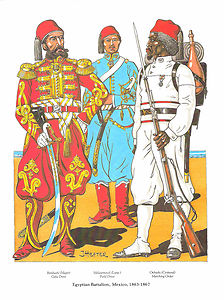
The caption on the illustration of military uniforms above, left,
though it may be difficult to read, says "Egyptian Battalion in Mexico
1863-1867." This has to be one of the more curious expeditions in the
history of European colonialism.
The strange French adventure in Mexico during the American Civil War, in which Louis Napoleon installed a Hapsburg Prince, Maximilian, as Emperor of Mexico, is a strange interlude, one that ended badly for Maximilian (in the firing squad sense of "badly"). Benito Juarez and Mexican Revolutionaries on the one hand, and the United States on the other (which, once the Civil War ended, decided to enforce the Monroe Doctrine and get rid of a European Emperor in Mexico) spelled the end of the strange adventure. But if a Hapsburg Emperor of Mexico installed by a Bonaparte wasn't strange enough, part of Maximilian's Army was a battalion of Egyptian troops (mostly Sudanese enlisted men with Egyptian officers), the bright idea of someone who thought Sudanese troops would be more easily acclimated to the Mexican heat than Frenchmen.
The Egyptian Wali Said Pasha agreed to provide an
"Auxiliary Battalion" of 447 men in four companies. They sailed from
Alexandria on January 9, 1863, aboard the troopship Seine. Said
Pasha died nine days later, succeeded as Wali by his nephew Ismail. (The
title Khedive, though in popular use, was not officially recognized by
the Ottoman Sultan until 1867.)
The expedition suffered severely from disease en
route: a typhus outbreak aboard ship, a yellow fever outbreak after
arrival in Veracruz, that killed the commanding officer, and other bouts
with dysentery and pulmonary diseases. The force did see action against
the Juaristas, and their French commander is said to have
remarked that they fought like lions. The French used some Algerian
troops as translators.
In 1867, the 326 survivors of the Egyptian battalion
sailed from Mexico after the fall of Maximilian. Louis Napoleon reviewed
them in Paris before their return to Egypt. Accounts of the Egyptian
battalion here and here; a contemporary New York Times report here.
It commemorates a Mexican victory over the French in 1862. The French, however, came back stronger and eventually installed the Emperor Maximilian. And that gives me an excuse to bring up once again the little-known subject of my 2012 post: "A Sudanese-Egyptian Battalion in Maximilian's Mexico."
I repeat the original post here:
 The caption on the illustration of military uniforms above, left,
though it may be difficult to read, says "Egyptian Battalion in Mexico
1863-1867." This has to be one of the more curious expeditions in the
history of European colonialism.
The caption on the illustration of military uniforms above, left,
though it may be difficult to read, says "Egyptian Battalion in Mexico
1863-1867." This has to be one of the more curious expeditions in the
history of European colonialism.The strange French adventure in Mexico during the American Civil War, in which Louis Napoleon installed a Hapsburg Prince, Maximilian, as Emperor of Mexico, is a strange interlude, one that ended badly for Maximilian (in the firing squad sense of "badly"). Benito Juarez and Mexican Revolutionaries on the one hand, and the United States on the other (which, once the Civil War ended, decided to enforce the Monroe Doctrine and get rid of a European Emperor in Mexico) spelled the end of the strange adventure. But if a Hapsburg Emperor of Mexico installed by a Bonaparte wasn't strange enough, part of Maximilian's Army was a battalion of Egyptian troops (mostly Sudanese enlisted men with Egyptian officers), the bright idea of someone who thought Sudanese troops would be more easily acclimated to the Mexican heat than Frenchmen.
 |
| Said Pasha, Wali of Egypt 1854-1863 |
 |
| Arrival in Veracruz |
 |
| The Egyptian Battalion Arrives in Paris |
Friday, March 27, 2015
Sudan and the Saudi Coalition: Cooling to Iran, Warming to KSA
Some are expressing surprise that Sudan is contributing aircraft and even ground troops to the Saudi-led coalition bombing the Houthis in Yemen. Sudan has relatively few good friends in the region, and in the past has been one of the rare Sunni Arab countries to maintain friendly relations with Iran. (Oman, which is partly Ibadi, also does, but is not actively participating in the coalition.)
Sudanese President Bashir is wanted by the International Criminal Court, though Egypt has welcomed him on visits in the past and this week he visited King Salman in Saudi Arabia. Gulf press reports have said that Sudan has deployed either two or three aircraft to the coalition, and there are also reports that it has offered ground troops.
Interpreting this as "Sudan changes sides," as some are doing, is probably an exaggeration of reality. As a Red Sea country whose main oil exports pass through the pipeline terminal at Port Sudan, Sudan, like Egypt and Saudi Arabia, obviously has concerns about the stability in Yemen. But its participation is a bit surprising: Egypt and Saudi Arabia are extremely close in the Sisi era, and all the GCC states except Qatar and Oman are also predictable (and Qatar is on board with the coalition. Pakistan has close military ties with the Saudis, and Jordan and Morocco are also frequent allies of their fellow conservative monarchies in the GCC.
But Sudan, despite its obvious concerns as a Red Sea littoral state, is not the most obvious volunteer. But the country's economy is a mess and Bashir is internationally ostracized. It may seem cynical to suggest that the sudden enthusiasm for Saudi Arabia is financially motivated, but Sudan is the least obvious member of the coalition.
Sudanese President Bashir is wanted by the International Criminal Court, though Egypt has welcomed him on visits in the past and this week he visited King Salman in Saudi Arabia. Gulf press reports have said that Sudan has deployed either two or three aircraft to the coalition, and there are also reports that it has offered ground troops.
Interpreting this as "Sudan changes sides," as some are doing, is probably an exaggeration of reality. As a Red Sea country whose main oil exports pass through the pipeline terminal at Port Sudan, Sudan, like Egypt and Saudi Arabia, obviously has concerns about the stability in Yemen. But its participation is a bit surprising: Egypt and Saudi Arabia are extremely close in the Sisi era, and all the GCC states except Qatar and Oman are also predictable (and Qatar is on board with the coalition. Pakistan has close military ties with the Saudis, and Jordan and Morocco are also frequent allies of their fellow conservative monarchies in the GCC.
But Sudan, despite its obvious concerns as a Red Sea littoral state, is not the most obvious volunteer. But the country's economy is a mess and Bashir is internationally ostracized. It may seem cynical to suggest that the sudden enthusiasm for Saudi Arabia is financially motivated, but Sudan is the least obvious member of the coalition.
Thursday, February 12, 2015
Zeppelins in the Middle East: Part I: Military Use in Libya and the Improbable Tale of "Das Afrika-Schiff"
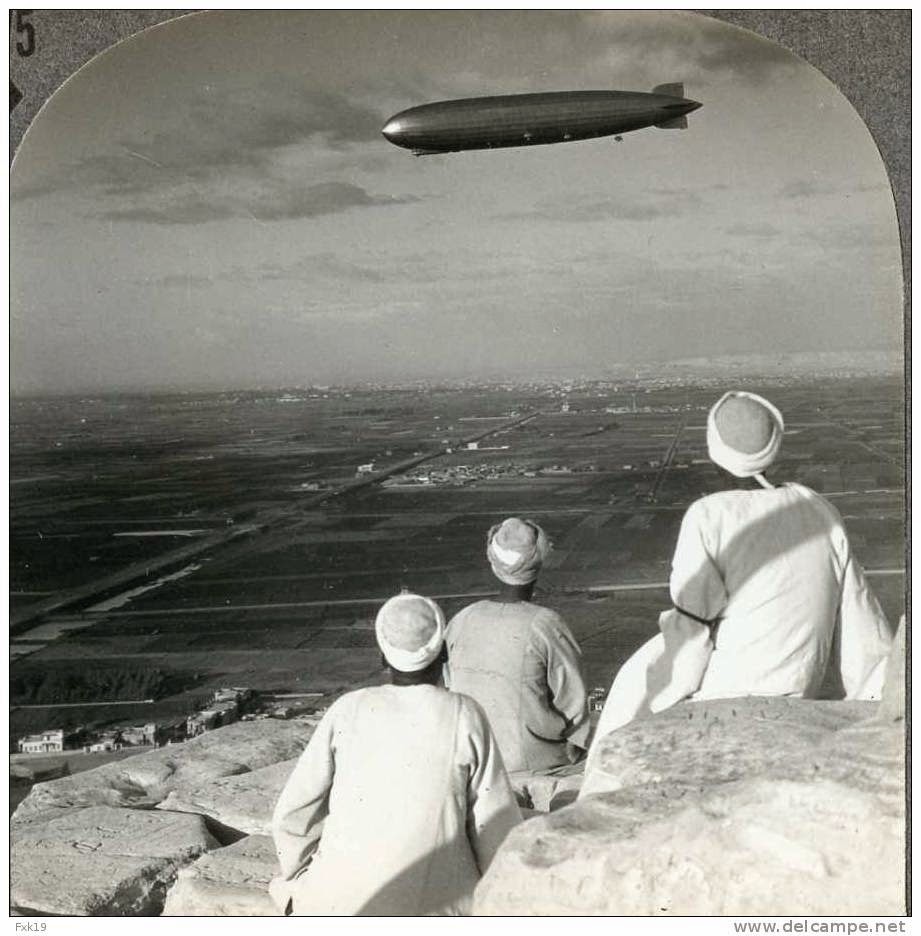 |
| Graf Zeppelin at the Pyramids, 1931 |
The great age of luxury Zeppelin travel was a brief one in the 1920s and 1930s, memorably concluding with the Hindenburg disaster in 1937. The rigid dirigible airship, designed by Count (Graf in German) Ferdinand von Zeppelin in the 1890s, originally was used for military applications through World War I; Count von Zeppelin died in 1917,and the Zeppelin company was taken over by Dr. Hugo Eckener. Barred by the Versailles Treaty from building military Zeppelins, Eckener eventually won the right to build Zeppelins for civilian transport, and created the idea of these luxury liners of the sky for European and American elites, that could carry people across the Atlantic in comfort faster than a ship, at a time when heavier-than air aircraft were not yet ready to carry passengers so far.
Dr. Eckener's gem was the Graf Zeppelin, named for Count von Zeppelin and intended to demonstrate the Zeppelin's capabilities as the airborne version of a luxury liner. As the Weimar Republic struggled to recover from World War I, she became a major showpiece for the reputation of German aeronautical engineering. Later that year she made her first Transatlantic trip, to the US. She would make other high-profile flights, including a round-the world-flight in 1929, but here I wish to discuss her two visits to the Middle East, in 1929 and 1931.
But those trips, including photos, will appear in Part II of this post. Here in Part I, I want to discuss military Zeppelins in the Middle East.
Earlier Zeppelins in the Region
But first, a few words about military Zeppelin use in the Middle East prior to the golden age of luxury Zeppelin travel. During the Italo-Turkish War of 1911-1912, Italy became not only the first country to drop an aerial bomb from a heavier than air airplane, but probably also the first to use dirigibles for bombing. (Some use "Zeppelin" for all rigid dirigible airships, others only for the German products).
 |
| Italian Dirigible Bombing in Libya |
L59: "Das Afrika-Schiff"
At least as far as I am aware, the next use of a Zeppelin over the Middle East was an abortive German attempt to relieve its beleaguered forces in German East Africa (Tanganyika, now the continental part of Tanzania) during World War I. General Paul von Lettow-Vorbeck's force in German East Africa was caught between British forces in Kenya and South African forces under General Jan Smuts. (Film buffs may note that this campaign is the context of the great, fictional, Bogart-Hepburn movie The African Queen.)
Determined to resupply their forces n East Africa, the Germans sent Zeppelin L59 to Bulgaria (a German ally) in November 1917. Its ambitious mission was to overfly British-occupied Egypt and Sudan without being detected, carrying some 25 tons of weapons and supplies to von Lettow-Vorbeck's Schutztruppe. Because hydrogen would be unavailable in East Afrika, it was intended to dismantle her there, cannibalizing her parts to supply troops, including making her skin into tents. (The narrative which follows is based on numerous published and online accounts of the mission.)
 |
| Postwar German Brochure |
The Zeppelin works' Dr. Eckener himself piloted her to Jamboli airfield in Bulgaria, a German ally, where command was handed over to KapitanLeutnant (Lieutenant Commander) Ludwig Bockholt of the German Navy.
 |
| Ludwig Bockholt |
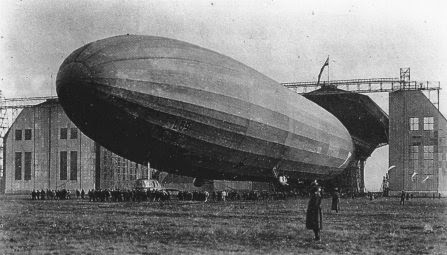 |
| Zeppelin LZ 104/L59 |
 |
| Route of L59 in Africa and After |
She passed over the Farafra and Dakhla oases on course to parallel the Nile from Wadi Halfa. On that afternoon, however, her forward engine seized up. She continued to make good time on her remaining engine, but the forward engine controlled the power to her radio transmitter, so she was from that point on unable to transmit, though she could receive with some difficulty.
While the loss of the transmitter made it impossible to contact Germany, it may have had another benefit: British Intelligence knew the Germans planned to make the attempt, but were unsure of the timing; British fighters in Egypt and stations in Sudan and Kenya were ordered to watch for and intercept her, and were listening for her radio transmissions. Her inadvertent radio silence may have helped her evade detection.
Sundown on the 22nd found L59 over Sudan; she had reached the Nile and was following it southward. the sharp drop in desert temperatures at night caused her hydrogen bags to lose buoyancy and she lost altitude.
At 12:45 AM on the 23rd, L59 finally received the German recall order. There was some debate as some preferred to go on, but Holbock decided to turn back. Meanwhile, about 3 am, her loss of buoyancy due to the cold caused her to stall and nearly crash in the desert, but control was regained.
Finally, about 125 miles west of Khartoum, L59 turned around and headed for home.he had passed over Egypt and half of Sudan, and now had to pass over them again without being detected.
There has been some controversy over the recall message. British Intelligence operative Richard Meinertzhagen would claim that it was a British ruse, broadcast in German naval code and claiming von Lettow-Vorbeck had surrendered. The British may have transmitted recall messages (though days later they were still looking for Zeppelin in East Africa, so they apparently did not know where it was. The recall message was not about a surrender, but a retreat, and the message recorded in L59's log reportedly matches the one sent by the German Navy. Meinertzhagen's recent biographers have called into question his once famous diaries, which appear to be full of fabrications.
L59 successfully avoided detection and reached the Mediterranean. She was not quite home free, having another loss of altitude after night fell and nearly crashed in western Turkey, which was at least friendly ground, but recovered, and landed back at Jamboli at 7:45 am on November 25. She had flown for 95 hours and 4,200 miles without landing, a Zeppelin record that would stand until the great ocean-crossing passenger Zeppelins of the 1920s and 1930s.
Since the original plan was to dismantle L59 once in Africa, and with Lettow-Vorbeck now in Mozambique, the Germans had no immediate plans for L59, so they decided to modify it to carry bombs and keep it in the Mediterranean theater. On March 11-12, 1918, she raided Italy, bombing Naples.
Its next mission was an attempt to bomb Port Said and the Suez Canal.later in March reached a point about three miles from the target, when contrary winds forced a retreat. Unfavorable winds also forced abandoning the backup target, Suda Bay in Crete.
On April 7, 1918, L59, still commanded by Bockholt, took off from Jamboli to bomb the British base at Malta. She crossed the Straaits of Otranto and headed towards Malta. The German submarine UB-53, running on the surface, witnessed her passing low overhead; the U-Boat commander estimated her altitude at 210 meters and reported he could see the details of the Gondola.
A bit after the Zeppelin passed over, the U-Boat commander reported hearing two explosions and then witnessing a giant flame descending into the sea. She was listed as lost to an accident since neither the Italians nor the British claimed to have brought her down; none of the crew of 21, including Bockholt, survived.
Some in the German Navy's Zeppelin service reportedly suspected that UB-53 might have mistaken L59 for an Italian airship and shot her down, then realized their error. This is unproven, and UB-53 herself went down after hitting a mine in Otranto in August 1918.
That's the strange tale of Zeppelins in wartime in the Middle East. Tomorrow, the luxury liners of the sky era: Graf Zeppelin's 1929 and 1931 visits to the region.
Monday, December 15, 2014
Haaretz on "The Forgotten Jews of Sudan"
Haaretz' title sums it up: "The forgotten Jews of Sudan even researchers haven't heard of."
Excerpt:
Excerpt:
In its heyday, the Jewish community in Sudan had fewer than 1,000 members – a drop in the sea compared to the 260,000-strong Moroccan-Jewish community, the 135,000-strong Algerian community, the 125,000 Jews living in Iraq, the 90,000-strong Tunisian community, and the 75,000 Jews who lived in Egypt before Israel was established.
The Jewish community in Sudan dissolved after 1956, when the country became independent and joined the Arab League. An estimated 500 Jews came to Israel, while the rest dispersed around the world.
Tuesday, July 15, 2014
Cecil Rhodes, Please Call Your Office: Virginia Man Wants to be King of Bir Tawil (and I Explain Why No One Claims Bir Tawil)
You probably thought the colonial scramble for Africa was over, didn't you? Think again: "Abingdon Man Claims African Land to Make Good on Promise to Daughter."
Abingdon is in extreme southwest Virginia. Apparently he has promised his daughter she'll be a princess some day, so he wants to be king of something, and has settled on Bir Tawil, on the Egypt-Sudan border. More on the location momentarily. Meanwhile, he has a flag and wants to name it "North Sudan." Sheila Carapico of the University of Richmond told the newspapers that it's unlikely he could get Egypt and Sudan to agree, which is an understatement. They've had some experience with foreign colonial rule. I'm sure Mr. Heaton loves his daughter, but the colonial era doesn't need reviving.
It does, however, provide me with an excuse to explain why neither Egypt nor Sudan claims Bir Tawil. And that requires me to discuss the dispute over the Hala'ib Triangle.
I was going to say it is the flip-side of the dispute over the Hala'ib Triangle, but then I realized that those too young to remember 45-RPM vinyl records won't know what a flip-side is, and then when I searched this blog in order to link to previous posts about Hala'ib, I discovered I've apparently never done a post about it. The fact that both Egypt and Sudan dispute control of the Hala'ib Triangle is the reason neither one of them claims Bir Tawil, which I guess could be called the Bir Tawil trapezoid. So the rest of this post will deal with both enclaves.
Anyway, you will recall that after that thing with the Mahdi and Gordon of Khartoum, Sudan was made subject to an Anglo-Egyptian condominium known as the Anglo-Egyptian Sudan. The 1899 agreement that set up the condominium drew the international boundary between Egypt and Sudan along the 22nd parallel of latitude. Since Britain was effectively running Egypt, the condominium had its limits.
In 1902, as an administrative convenience, Britain drew an "Administrative Boundary" separate from the international boundary. An area along the Red Sea coast north of 22°N was used as grazing land by the Beja of northeastern Sudan; a smaller enclave south of the line was used for grazing by the Ababda subtribe of Beja living on the Egyptian side. It made perfect sense, so long as the sun never set on the British Empire.
The area north of the line came to be known as the Hala'ib Triangle, after its most important town, or the "Sudan Government Administration Area"; the smaller enclave is Bir Tawil.
 When Sudan became independent in 1956, it asserted the 1902 Administrative Boundary should be its northern boundary. Egypt claimed the international boundary, the 22nd parallel. The Wikipedia map at left illustrates the claims. The locations are clear in his Google Earth image:

The enclaves are not created equal. Hala'ib is 20,580 square kilometers; Bir Tawil only 2,060. Hala'ib has several towns and trading centers, road access to both Egypt and Sudan,, a coast on the Red Sea, and suspicions of possible offshore oil.
Bir Tawil has this:

Or, as shown in Google Maps:

You may be thinking: but wait, countries have boundary disputes over lots of desert areas, mountaintops, glaciers and so on.
True, but the conflicting claims to Hala'ib mean that if Egypt is right and Hala'ib is Egyptian, then everything south of the international boundary is Sudanese, and Hala'ib is Egyptian. But if the Administrative boundary is used, Hala'ib is Sudnese and Bir Tawil is Egyptian. Neither side can claim Bir Tawil without losing its claim to the far more important Hala'ib Triangle.
Thus Bir Tawil is technically a terra nullius. a rare case of land territory no one claims. (But as Sheila Carapico notes in the newspaper article above, that doesn't mean it's Mr. Heaton's for the taking. The tribesmen who use it as grazing land have Egyptian or Sudanese citizenship, and have a stronger claim to it as their tribal property.)
Hala'ib remains a matter of dispute. Until the 1990s Egypt generally tolerated Sudan's continuing administration but never dropped its claim. When Sudan began negotiating offshore oil rights, Egypt sent troops to occupy the Triangle. There were tense moments in the 1990s when both countries had troops there. Sudan's withdrew in 2000; though Sudan continues to pursue its claim. Egypt administers the province as part of its Red Sea Governorate, from the Egyptian town of Shalateen on the Triangle's border. In both countries the issue continues to be an irritant in their relations.
UPDATE: And do check out Diana Buja's link about working in the Hala'ib Triangle.
Below, a more detailed map of Bir Tawil, Mr. Heaton's putative Kingdom:

Abingdon is in extreme southwest Virginia. Apparently he has promised his daughter she'll be a princess some day, so he wants to be king of something, and has settled on Bir Tawil, on the Egypt-Sudan border. More on the location momentarily. Meanwhile, he has a flag and wants to name it "North Sudan." Sheila Carapico of the University of Richmond told the newspapers that it's unlikely he could get Egypt and Sudan to agree, which is an understatement. They've had some experience with foreign colonial rule. I'm sure Mr. Heaton loves his daughter, but the colonial era doesn't need reviving.
It does, however, provide me with an excuse to explain why neither Egypt nor Sudan claims Bir Tawil. And that requires me to discuss the dispute over the Hala'ib Triangle.
I was going to say it is the flip-side of the dispute over the Hala'ib Triangle, but then I realized that those too young to remember 45-RPM vinyl records won't know what a flip-side is, and then when I searched this blog in order to link to previous posts about Hala'ib, I discovered I've apparently never done a post about it. The fact that both Egypt and Sudan dispute control of the Hala'ib Triangle is the reason neither one of them claims Bir Tawil, which I guess could be called the Bir Tawil trapezoid. So the rest of this post will deal with both enclaves.
Anyway, you will recall that after that thing with the Mahdi and Gordon of Khartoum, Sudan was made subject to an Anglo-Egyptian condominium known as the Anglo-Egyptian Sudan. The 1899 agreement that set up the condominium drew the international boundary between Egypt and Sudan along the 22nd parallel of latitude. Since Britain was effectively running Egypt, the condominium had its limits.
In 1902, as an administrative convenience, Britain drew an "Administrative Boundary" separate from the international boundary. An area along the Red Sea coast north of 22°N was used as grazing land by the Beja of northeastern Sudan; a smaller enclave south of the line was used for grazing by the Ababda subtribe of Beja living on the Egyptian side. It made perfect sense, so long as the sun never set on the British Empire.
The area north of the line came to be known as the Hala'ib Triangle, after its most important town, or the "Sudan Government Administration Area"; the smaller enclave is Bir Tawil.
When Sudan became independent in 1956, it asserted the 1902 Administrative Boundary should be its northern boundary. Egypt claimed the international boundary, the 22nd parallel. The Wikipedia map at left illustrates the claims. The locations are clear in his Google Earth image:The enclaves are not created equal. Hala'ib is 20,580 square kilometers; Bir Tawil only 2,060. Hala'ib has several towns and trading centers, road access to both Egypt and Sudan,, a coast on the Red Sea, and suspicions of possible offshore oil.
Bir Tawil has this:
Or, as shown in Google Maps:
You may be thinking: but wait, countries have boundary disputes over lots of desert areas, mountaintops, glaciers and so on.
True, but the conflicting claims to Hala'ib mean that if Egypt is right and Hala'ib is Egyptian, then everything south of the international boundary is Sudanese, and Hala'ib is Egyptian. But if the Administrative boundary is used, Hala'ib is Sudnese and Bir Tawil is Egyptian. Neither side can claim Bir Tawil without losing its claim to the far more important Hala'ib Triangle.
Thus Bir Tawil is technically a terra nullius. a rare case of land territory no one claims. (But as Sheila Carapico notes in the newspaper article above, that doesn't mean it's Mr. Heaton's for the taking. The tribesmen who use it as grazing land have Egyptian or Sudanese citizenship, and have a stronger claim to it as their tribal property.)
Hala'ib remains a matter of dispute. Until the 1990s Egypt generally tolerated Sudan's continuing administration but never dropped its claim. When Sudan began negotiating offshore oil rights, Egypt sent troops to occupy the Triangle. There were tense moments in the 1990s when both countries had troops there. Sudan's withdrew in 2000; though Sudan continues to pursue its claim. Egypt administers the province as part of its Red Sea Governorate, from the Egyptian town of Shalateen on the Triangle's border. In both countries the issue continues to be an irritant in their relations.
UPDATE: And do check out Diana Buja's link about working in the Hala'ib Triangle.
Below, a more detailed map of Bir Tawil, Mr. Heaton's putative Kingdom:
Monday, May 5, 2014
For Cinco de Mayo, a Reminder of the Egyptian Battalion in Maximilian's Mexico
Today is Cinco de Mayo, a holiday more widely celebrated in the United States as an excuse to drink Mexican beer, than it is in Mexico, where it's mostly confined to the state of Puebla. It commemorates a Mexican victory over the French in 1862. The French, however, came back stronger and eventually installed the Emperor Maximilian. And that gives me an excuse to bring up once again the little-known subject of my 2012 post: "A Sudanese-Egyptian Battalion in Maximilian's Mexico."
The French under Napoleon III had the bright idea that since Mexico is hot and Sudan is hot, Egyptian-officered Sudanese would be ideal there, so they asked Said Pasha, Wali of Egypt, to provide them. France used Algerian troops as translators.
The story is more fully told in my previous post; typhus and yellow fever depleted their numbers, but they reportedly fought well, and were repatriated after Maximilian's fall.
|
| The Egyptian Battalion Arrives in Paris |
The story is more fully told in my previous post; typhus and yellow fever depleted their numbers, but they reportedly fought well, and were repatriated after Maximilian's fall.
Wednesday, November 13, 2013
Why Did Al-Masry al-Youm Print This Picture Now?
The independent Egyptian newspaper Al-Masry al-Youm ran this picture with a very short news story a couple of days ago. The headline of the story reads "Watch of King Farouq Reveals the Borders of Egypt,"
Perhaps I'm reading too much into what could just be a picture Egyptian readers might find interesting, but obviously the King's specially made watch show the borders of what is now Egypt and the Sudan together. This is not news: the King's title was always King of Egypt and the Sudan, though Sudan was then a joint Anglo-Egyptian condominium, the Anglo-Egyptian Sudan, until its independence. That's a given, though the short article with the picture makes no reference to the British, and refers to the watch as showing the borders of Egypt at that time.
Is there some sort of message here? Irredentism? Monarchism? Something to do with the Nile waters dispute? Again, I may be trying to read more meaning into this than was intended.

Perhaps I'm reading too much into what could just be a picture Egyptian readers might find interesting, but obviously the King's specially made watch show the borders of what is now Egypt and the Sudan together. This is not news: the King's title was always King of Egypt and the Sudan, though Sudan was then a joint Anglo-Egyptian condominium, the Anglo-Egyptian Sudan, until its independence. That's a given, though the short article with the picture makes no reference to the British, and refers to the watch as showing the borders of Egypt at that time.
Is there some sort of message here? Irredentism? Monarchism? Something to do with the Nile waters dispute? Again, I may be trying to read more meaning into this than was intended.

Friday, September 27, 2013
Sudan: Over 50 Dead So Far
The demonstrations continue in Sudan, and the death toll has reportedly passed 50. An Amnesty International Report adds:
Local sources and activists have put the figure much higher, in excess of 100, and at the time of writing the two organizations were still receiving reports of shootings and excessive use of force.Apparently the authorities are using live ammunition and lethal force against unarmed demonstrators.
Wednesday, September 25, 2013
Sudan Erupts
"The People Want the Fall of the Regime.": "Al-Sha‘b yurid isqat al-nizam" was the iconic chant of the Tunisian and Egyptian revolutions, and now it's being heard in Khartoum and Omdurman. Sudan has endured three days of worsening demonstrations in the wake of a move to lift government subsidies on fuel prices.
The death toll is rising; the last estimate I saw was 10 dead but that is likely a low estimate. Today the Internet was shut down, at least for a while.
So is Sudan belatedly having its Arab Spring moment? Actually it had demonstrations back in 2011, and has continued to face challenges created by its loss of South Sudan and its persistent economic problems.
The death toll is rising; the last estimate I saw was 10 dead but that is likely a low estimate. Today the Internet was shut down, at least for a while.
So is Sudan belatedly having its Arab Spring moment? Actually it had demonstrations back in 2011, and has continued to face challenges created by its loss of South Sudan and its persistent economic problems.
Wednesday, February 13, 2013
Photos from the Egyptian Expedition to Maximilian's Mexico
Last fall I posted about a little-known Egyptian military adventure in the New World, "A Sudanese-Egyptian Battalion in Maximilian's Mexico," when Egypt was persuaded to provide a battalion of mostly Sudanese troops to support France's ill-fated efforts to make a Hapsburg the Emperor of Mexico. The illustrations I managed to dredge up were mostly old woodcuts and such. Now, however, a nostalgia site on Facebook has come up with a gallery of photos. The caption reads "Egyptian-Sudanese Battalion [katiba] in Mexico, 1863." I can't verify anything beyond that.


Monday, October 29, 2012
A Sudanese-Egyptian Battalion in Maximilian's Mexico
The caption on the illustration of military uniforms above, left, though it may be difficult to read, says "Egyptian Battalion in Mexico 1863-1867." This has to be one of the more curious expeditions in the history of European colonialism.The strange French adventure in Mexico during the American Civil War, in which Louis Napoleon installed a Hapsburg Prince, Maximilian, as Emperor of Mexico, is a strange interlude, one that ended badly for Maximilian (in the firing squad sense of "badly"). Benito Juarez and Mexican Revolutionaries on the one hand, and the United States on the other (which, once the Civil War ended, decided to enforce the Monroe Doctrine and get rid of a European Emperor in Mexico) spelled the end of the strange adventure. But if a Hapsburg Emperor of Mexico installed by a Bonaparte wasn't strange enough, part of Maximilian's Army was a battalion of Egyptian troops (mostly Sudanese enlisted men with Egyptian officers), the bright idea of someone who thought Sudanese troops would be more easily acclimated to the Mexican heat than Frenchmen.
|
| Said Pasha, Wali of Egypt 1854-1863 |
|
| Arrival in Veracruz |
|
| The Egyptian Battalion Arrives in Paris |
Friday, October 26, 2012
The Khartoum Blasts and the Sinai Connection
The explosions that tore through the Yarmouk arms factory in Khartoum on Tuesday night were initially said to be an accident, but by the next day Sudan was blaming Israel, pointing to rocket casings and eyewitness reports of four aircraft bombing the plant. Israel is taking its usual route of neither confirming nor denying, while Israeli officials are leaking information about Sudan's role in conveying Iranian arms via Sinai to Hamas in Gaza.
Israeli reports have suggested that the plant was operated by Iran's Revolutionary Guards to produce weaponry for Hamas, and that the plant is in Sudan to facilitate smuggling of arms via an increasingly uncontrolled Sinai into Gaza. Israeli Defense Ministry official Amos Gilad reiterated these claims in effect, while declining to comment on any Israeli role in the bombing.
Egyptian media are also linking the attacks to Israeli efforts to stem the flow of arms via Sinai.
Israeli aircraft could reach Khartoum, at least with in-flight refueling, though there are also persistent claims in the Arab world that Israel leases a base on Eritrea's Dahlak islands for operations over the Red Sea, though Eritrea has denied this. On at least two earlier occasions (one of which is reported here), there have been allegations of Israeli operations inside Sudan.
Israeli reports have suggested that the plant was operated by Iran's Revolutionary Guards to produce weaponry for Hamas, and that the plant is in Sudan to facilitate smuggling of arms via an increasingly uncontrolled Sinai into Gaza. Israeli Defense Ministry official Amos Gilad reiterated these claims in effect, while declining to comment on any Israeli role in the bombing.
Egyptian media are also linking the attacks to Israeli efforts to stem the flow of arms via Sinai.
Israeli aircraft could reach Khartoum, at least with in-flight refueling, though there are also persistent claims in the Arab world that Israel leases a base on Eritrea's Dahlak islands for operations over the Red Sea, though Eritrea has denied this. On at least two earlier occasions (one of which is reported here), there have been allegations of Israeli operations inside Sudan.
Friday, June 22, 2012
Sudan's Week of Protests
Protests against the government of Sudan over economic austerity are entering their second week with today's protests after Friday prayers.The ongoing wave of protests is in response to an austerity regime imposed to make up for the loss of oil revenues when South Sudan seceded, but the fierce response of security forces has exacerbated the situation.
The arrest and subsequent release yesterday of Bloomberg reporter Salma El Wardany, an Egyptian journalist working for a US agency, attracted international attention to the situation, which is starting to look like a classic "Arab spring" scenario, with demonstrators responding to harsh repression by continuing protest.
The arrest and subsequent release yesterday of Bloomberg reporter Salma El Wardany, an Egyptian journalist working for a US agency, attracted international attention to the situation, which is starting to look like a classic "Arab spring" scenario, with demonstrators responding to harsh repression by continuing protest.
Wednesday, April 18, 2012
The War Between the Sudans
I haven't said anything yet about the nasty little border war that has simmered for the past couple of weeks on the still disputed border between Sudan and south Sudan, but with a new front being claimed west of the Heglig oilfield that has been the focus of most of the fighting to date, and African Union mediator Thabo Mbeki warnig that the two Sudans are "locked in a logic of war," perhaps I should.at least acknowledge what's going on.
I'm in no position to judge the rights and wrongs in the case; border disputes between countries that were once united, especially when fueled by oilfields along a still-not-fully-resolved border, usually are not a straightforward question. Since South Sudan's independence last July, little progress has been made in negotiations on the outstanding issues. Like much of the world, I have major reservations about the Khartoum regime due to Darfur and much else, and wish the new kid on the block well; but there seems to be some indication that South Sudan is responsible for upsetting a delicate balance here by occupying the disputed oilfield at Heglig. There are the usual ambiguities: are attacks in South Sudan carried out by local rebels or by Sudan? Whose claims are to be believed about aerial bombings, aircraft shot down, etc.?
The United Nations and the African Union are trying to bring things under control, and both have a lot invested in the peace process that saw the birth of an independent South Sudan. If I don't comment in greater detail for now it is because I fully acknowledge my own ignorance of the rights and wrongs in this case. I am confident of one thing: after decades of warfare starting as far back as the 1950s and with only brief respites, the last thing South Sudan needs after less than a year of independence is another war. I hope they realize that.
I'm in no position to judge the rights and wrongs in the case; border disputes between countries that were once united, especially when fueled by oilfields along a still-not-fully-resolved border, usually are not a straightforward question. Since South Sudan's independence last July, little progress has been made in negotiations on the outstanding issues. Like much of the world, I have major reservations about the Khartoum regime due to Darfur and much else, and wish the new kid on the block well; but there seems to be some indication that South Sudan is responsible for upsetting a delicate balance here by occupying the disputed oilfield at Heglig. There are the usual ambiguities: are attacks in South Sudan carried out by local rebels or by Sudan? Whose claims are to be believed about aerial bombings, aircraft shot down, etc.?
The United Nations and the African Union are trying to bring things under control, and both have a lot invested in the peace process that saw the birth of an independent South Sudan. If I don't comment in greater detail for now it is because I fully acknowledge my own ignorance of the rights and wrongs in this case. I am confident of one thing: after decades of warfare starting as far back as the 1950s and with only brief respites, the last thing South Sudan needs after less than a year of independence is another war. I hope they realize that.
Thursday, December 22, 2011
Arab League Delegation Head Has, Um, An Interesting Résumé

- Sudanese army officer for 30 years, from 1969-1999
- Head of military intelligence from June 30, 1989 -- the day Omar al-Bashir took power in a coup -- until August 1995
- Head of the foreign spy agency, 1995-1996
- Chief of military operations against the insurgency in what is now South Sudan, 1996-1999.
Dabi served as ambassador to Qatar from 1999 to 2004 but also held four separate positions related to Sudan's Darfur region, where fighting broke out in 2003 between non-Arab rebels and the Arab-dominated Khartoum regime.
Among his duties there, Dabi served in 2005 as the regime's pointman for dealing with United Nations Security Council Resolution 1591 on sanctions and other measures related to the conflict.
Sudan's President Bashir is among six people who are being sought or are before the Hague-based International Criminal Court (ICC) for crimes allegedly committed in the Darfur region.
Thursday, July 28, 2011
Israel to Open Full Ties with South Sudan
Israel, which had previously recognized South Sudan even before its independence has said it will soon establish full diplomatic relations. The article at the link speaks of issues such as repatriation of refugees who had fled to Israel, but says nothing about the historic links between the (now-ruling) Sudan People's Liberation Movement and Israel. By many accounts, Israel provided covert support, and perhaps arms, to South Sudan secessionists as far back as the 1950s, as part of Israel's cultivating sub-Saharan Africa as a means of outflanking Nasser's Egypt. Before the 1974 coup in Ethiopia this was done via Ethiopia; later on it's not so clear. It was never, of course, openly acknowledged.
Friday, July 8, 2011
Welcoming South Sudan
 UPDATED: It's past midnight in Juba and South Sudan is celebrating.
I blogged earlier in the week about the imminent independence of South Sudan, but before I disappear for the weekend I should note that as the clocks tick toward midnight in Sudan, tomorrow is the day the separation becomes official.


Wednesday, May 25, 2011
UN Fired on in Abyei as North Moves In
The big question mark hovering over the separation of an independent Southern Sudan from the North has been the disputed region of Abyei, and Northern Sudanese forces — pro-Khartoum militias and Sudanese Army forces as well — moved into Abyei Town over the weekend. Now the United Nations is reporting that four of its helicopters have been fired upon, though it has also been reported that the UN has clashed with forces apparently wearing Southern uniforms as well. Al Jazeera English has video:
Obviously the recent move could provoke open conflict, thus threatening the so-far peaceful separation of the two parts of Sudan, with the independence of the South scheduled for July 9.
Obviously the recent move could provoke open conflict, thus threatening the so-far peaceful separation of the two parts of Sudan, with the independence of the South scheduled for July 9.
Subscribe to:
Posts (Atom)


 Posts
Posts

