A Blog by the Editor of The Middle East Journal

Putting Middle Eastern Events in Cultural and Historical Context

Showing posts with label colonialism. Show all posts

Tuesday, February 10, 2015

Vanished States: The Rifian Republic, 1921-1926

In 2012 I began a (very) occasional series of posts labeled "Vanished States,"  about nascent states that had only brief lives. History is full  of such states, so I limited my scope to the 20th century. I did posts on the Republic of Hatay (1938-39), the Syrian Arab Kingdom under Faisal (four months in 1920), and the Hashemite Kingdom of the Hejaz (1916-1925). Then I for some reason didn't return to the theme, though there were many other candidates. Today, one that would provide a model for many anti-colonial guerrillas, but also a model for modern technological means of colonial powers' suppressing suppressing "native" resistance: the five year life of the Rifian Republic and the brutal Rif War, in which Spain, and eventually France as well, would dismantle it. It was arguably the only Tamazight-speaking "state" to enjoy brief independence in the past century.

Morocco had been the last of the North African states to come under European colonial rule, with Spain, which had long held an enclave at Ceuta, declaring a protectorate along the northern coast, while France, often opposed by Germany, sought to create a protectorate in the rest of Morocco proper. (Spain also expanded into the future Western Sahara.) By 1912 France and Spain held their own protectorate zones in Morocco, and in 1923 Tangier became an international city.

While the Sultan of Morocco had little choice but to acquiesce, his nominal subjects were not so willing. As they had already done in Algeria, the French spent much time in warfare with rebellious tribes: think of just about every Foreign Legion movie ever made.(except for The Last Remake of Beau Geste) (1977). Often the fiercest resistance came from Amazigh ("Berber") tribes, from the desert Touareg to the mountain tribes of the Atlas in French Morocco and the Rif Mountains in Spanish Morocco. (Although al-Rif in standard Arabic means "the countryside" and, because the l of the article elides as ar-Rif, one may assume this is the origin of the name, but it seems to be an indigenous Tamazight name, Arif, which just happens to sound the same (and in Arabic is spelled al-Rif). It takes Berber derivatives (the language is Tarifit) and some have suggested it relates to the Canarian name Tenerife. In Morocco it refers not to any countryside but specifically to the mountain range along the country's northern coast, which is not geologically part of the Atlas, but linked with the Spanish chain across the Strait of Gibraltar, including Gibraltar itself.

Flag of the Rifian Republic
It's the Rif we're interested in here, for here, where for five years, the Tagduda n Arif  as it was known in the Tarifit form of Tamazight, or the Confederal Republic of the Tribes of the Rif, had its life.

This was no evanescent fantasy. For five years the Rifian Republic held the Spanish Army at bay, only succumbing after a brutal war in which France joined with Spain and which saw mustard gas dropped from aircraft despite the post World War I Geneva Protocol against the use of poison gas. The Rifian Republic had its own flag, its own currency, and a national anthem you can hear later in this post. It had a charismatic leader who had both political and military talents. His name would eventually be ranked among the greatest anticolonial resistance leaders: ‘Abdel Krim.

‘Abdel Krim
Muhammad ibn ‘Abd al-Karim al-Khattabi, to give him his formal Arabic name, or Muḥend n Ɛabd Krim Lxeṭṭabi in one transliteration of his Tarifit name, was born in Ajdir, the future capital of his Rifian Republic, in 1882 or 1883. He and his brother were given traditional Islamic educations in Ajdir, Tetouan, and Fez, and also Spanish educations, becoming translators. He became Chief Qadi in Melilla (the Spanish enclave, not part of the Protectorate) and published a newspaper in Spanish.

Alarmed at Spanish efforts to occupy unoccupied areas of the Rif, ostensibly to combat the warlord/brigand Ahmad al-Raisuni (he of Teddy Roosevelt's "Perdicaris alive or Raisuli dead" [Raisuni is the proper spelling] ultimatum; another post for another day), ‘Abdel Krim returned to Ajdir and raised his revolt.

Spanish Morocco; Rifian Republic's Claimed Borders in Red
Colonial powers often began these sorts of wars with a fundamental assumption of their own superiority. When the Spanish general moving into the claimed territory received an ultimatum from ‘Abdel Krim, he reportedly laughed it off. In July of 1921, after a fierce battle at Annual, some 8000 Spanish troops had died out of a force of 20,000. Annual remains a major resistance victory against a colonial army, a sort of proto-Dien Bien Phu.. The Spanish Army soon discovered that it was a poor match for highly motivated mountaineers defending their own territory. At its worst point, it found itself holding little more than Melilla and the area around Tangier.

Rifian One Riffan Note
On September 18, 1921, the Rifian Republic's independence was formally declared. It adopted its own currency, the Riffan, The images I've found are in Arabic and English, not Spanish or French. (There was no accepted version of writing Tarifit at the time.)

The Rifian Republic, though unrecognized internationally, would become a model for many later anticolonial struggles. ‘Abdel Krim's guerrilla tactics (he never had more than a few thousand truly professional fighters, the rest being tribal militia's defending their home turf) would become a model for later guerrilla fighters such as Mao Zedong, Ho Chi Minh, and the FLN in Algeria, though the latter also had the model of the great resistance fighter ‘Abd al-Qadir al-Jaza'iri.

In keeping with acquiring all the trappings of sovereignty, the Rifian Republic also had a rather martial National Anthem:


 Chastened by their losses, the Spanish began relying on their own version of the French Foreign Legion to wage the Moroccan fight. The second in command was a colonel named Francisco Franco. You may have heard of him.

Through 1921 and 1922 the war was fierce, and the Spanish performance uneven despite numerical and technological superiority. The performance of the Spanish Army in the Rif helped propel events in Spain as well, and the 1923 coup by General Miguel Primo de Rivera was in part a reaction. That would set the stage for the whole Spanish tragedy of the 1930s, the Revolution, Civil War, and proxy rehearsal for the Second World War.

By 1924, the Spanish were resorting to dropping mustard gas from aircraft, violating the new Geneva prohibitions but also learning aerial bombing tactics. Britain and France were also learning bombing strategies from fighting colonial resistance, that would see fruition in 1939-45. Germany had no colonies after 1918, so it practiced in Spain.

Back in the Rif, France had moved forces into areas disputed with the Rifian Republic and Rifian forces attacked them. The French had already had discussions with Spain about intervention, and the French were far more experienced with North African warfare than the Spanish. (Not to mention the well-established reputation of the French Foreign Legion, technically known in military terms as "pretty badass.")

French intervention and a massive Spanish landing of troops, combined with aerial bombardment and the use of mustard gas, eventually turned the tide. But the Rif War was as fierce as it got at the time. Wikipedia isn't always a great source, but their casualty figures are:  Spain: 23,000 casualties of whom 18,000 dead; France: 10,000 dead and 8,500 wounded; Rifians, 30,000 casualties including 10,000 dead.

For contemporary Americans, Time magazine is a fading shadow of its former self, but when it was founded in 1923 it was radically new: a weekly summary of the news of America and the worlf. From the beginning each issue had a portrait on the cover. Down into at least the 1970s, being on the cover of Time was a sign you had made it. As near as I can make out, the first Middle Easterner to appear on Time's cover was Atatürk on March 24, 1923; then Fuad I of Egypt on April 28 of the same year; in 1924 nobody unless you include Greece (Venizelos).

Then, in 1925, only the third Middle Eastern figure to appear on a Time cover, is, on August 17, 1925, was none other than ‘Abdel Krim. Sure, he's sinister looking, but it reminds us the world took him seriously.

On May 26,1926, at Targuist, ‘Abdel Krim surrendered. Given his experience with Spain, it is probably no surprise that he surrendered to the French.

Like other French captive nationalist leaders, he was sent to Réunion in the Indian Ocean (just as the British favored the Seychelles or Mauritius), where he lived in comfortable exile from 1926-1947. In the latter year he was allowed to move to France, but managed to gain asylum in Egypt.

After Moroccan independence, King Muhammad V reportedly invited him to return to Morocco, and he is said to have said he would not return until all French forces were out of North Africa. He lived to witness the independence of Morocco and Tunisia and the expulsion of the French base at Bizerte, and finally, he lived to witness the end of French rule in Algeria in July of 1962.
‘Abdel Krim going into exile

Almost exactly seven months after the last colonial forces left the Maghreb, ‘Abdel Krim died in Cairo on February 6, 1963.

Tuesday, July 15, 2014

Cecil Rhodes, Please Call Your Office: Virginia Man Wants to be King of Bir Tawil (and I Explain Why No One Claims Bir Tawil)

You probably thought the colonial scramble for Africa was over, didn't you? Think again: "Abingdon Man Claims African Land to Make Good on Promise to Daughter." 

Abingdon is in extreme southwest Virginia. Apparently he has promised his daughter she'll be a princess some day, so he wants to be king of something, and has settled on Bir Tawil, on the Egypt-Sudan border. More on the location momentarily. Meanwhile, he has a flag and wants to name it "North Sudan." Sheila Carapico of the University of Richmond told the newspapers that it's unlikely he could get Egypt and Sudan to agree, which is an understatement. They've had some experience with foreign colonial rule. I'm sure Mr. Heaton loves his daughter, but the colonial era doesn't need reviving.

It does, however, provide me with an excuse to explain why neither Egypt nor Sudan claims Bir Tawil. And that requires me to discuss the dispute over the Hala'ib Triangle.

I was going to say it is the flip-side of the dispute over the Hala'ib Triangle, but then I realized that those too young to remember 45-RPM vinyl records won't know what a flip-side is, and then when I searched this blog in order to link to previous posts about Hala'ib, I discovered I've apparently never done a post about it. The fact that both Egypt and Sudan dispute control of the Hala'ib Triangle is the reason neither one of them claims Bir Tawil, which  I guess could be called the Bir Tawil trapezoid. So the rest of this post will deal with both enclaves.

Anyway, you will recall that after that thing with the Mahdi and Gordon of Khartoum, Sudan was made subject to an Anglo-Egyptian condominium known as the Anglo-Egyptian Sudan. The 1899 agreement that set up the condominium drew the international boundary between Egypt and Sudan along the 22nd parallel of latitude. Since Britain was effectively running Egypt, the condominium had its limits.

In 1902, as an administrative convenience, Britain drew an "Administrative Boundary" separate from the international boundary. An area along the Red Sea coast north of 22°N was used as grazing land by the Beja of northeastern Sudan; a smaller enclave south of the line was used for grazing by the Ababda subtribe of Beja living on the Egyptian side. It made perfect sense, so long as the sun never set on the British Empire.

The area north of the line came to be known as the Hala'ib Triangle, after its most important town, or the "Sudan Government Administration Area"; the smaller enclave is Bir Tawil.

When Sudan became independent in 1956, it asserted the 1902 Administrative Boundary should be its northern boundary. Egypt claimed the international boundary, the 22nd parallel. The Wikipedia map at left illustrates the claims. The locations are clear in his Google Earth image:


The enclaves are not created equal. Hala'ib is 20,580 square kilometers; Bir Tawil only 2,060. Hala'ib has several towns and trading centers, road access to both Egypt and Sudan,, a coast on the Red Sea, and suspicions of possible offshore oil.

Bir Tawil has this:

Or, as shown in Google  Maps:


You may be thinking: but wait, countries have boundary disputes over lots of desert areas, mountaintops, glaciers and so on.

True, but the conflicting claims to Hala'ib mean that if Egypt is right and Hala'ib is Egyptian, then everything south of the international boundary is Sudanese, and Hala'ib is Egyptian. But if the Administrative boundary is used, Hala'ib is Sudnese and Bir Tawil is Egyptian. Neither side can claim Bir Tawil without losing its claim to the far more important Hala'ib Triangle.

Thus Bir Tawil is technically a terra nullius. a rare case of land territory no one claims. (But as Sheila Carapico notes in the newspaper article above, that doesn't mean it's Mr. Heaton's for the taking. The tribesmen who use it as grazing land have Egyptian or Sudanese citizenship, and have a stronger claim to it as their tribal property.)

Hala'ib remains a matter of dispute. Until the 1990s Egypt generally tolerated Sudan's continuing administration but never dropped its claim. When Sudan began negotiating offshore oil rights, Egypt sent troops to occupy the Triangle. There were tense moments in the 1990s when both countries had troops there. Sudan's withdrew in 2000; though Sudan continues to pursue its claim. Egypt administers the province as part of its Red Sea Governorate, from the Egyptian town of Shalateen on the Triangle's border. In both countries the issue continues to be an irritant in their relations.

UPDATE: And do check out Diana Buja's link about working in the Hala'ib Triangle.

Below, a more detailed map of Bir Tawil, Mr. Heaton's putative Kingdom:

Friday, January 24, 2014

On a Bloody Morning: January 25, 1952 (Police Day), 2011 (the Revolution) and Now

The latest car bombing in Cairo, at Police Headquarters in Cairo's Bab al-Khalq neighborhood,  which augurs no good, reminds us that Saturday is January 25. It is Egyptian Police Day, the 62nd anniversary of a landmark day in Egypt's struggle against the British, and also the third anniversary of the beginnings of the Egyptian Revolution of 2011 (inspired by the Tunisian Revolution, Egyptian protesters deliberately chose Police Day to launch their protests).

The original Police Day celebrated the Police confrontation, not with Egyptian protesters, but with the British. As I noted in last year's post:
The Anglo-Egyptian Treaty of 1936 had provided for British withdrawal of its troops from Egypt, except for bases in the Suez Canal Zone for the protection of the Canal, but with the outbreak of the Second World War, Britain had invoked a clause allowing it to reoccupy Egypt. After the war British troops did withdraw to the Canal Zone, but kept force levels well above the 10,000 troops allowed in the treaty. After the Wafd Party, Britain's traditional nationalist rivals, won the 1950 elections, the Egyptian government in October 1951 unilaterally abrogated the treaty and demanded that Britain negotiate for its withdrawal.

The Cold War was in full swing and Britain (and behind it the US) were already engaged in a struggle with Iranian Prime Minister Mossadeq over Iranian oil, and now faced a challenge to the Suez Canal. The Wafd, and its other traditional rival the King, were both losing influence in Egypt to growing social and economic dissatisfaction and the growth of movements with their own disciplined and sometimes armed militias, including the Muslim Brotherhood, Communists, and others.

The Egyptian government decided to sanction the creation of "Liberation" squads, recruited from vlunteers (many from the Brotherhood), who began a guerrilla war against the British in the Canal Zone. The British responded with proactive moves against the "terrorists," and on January 21 entered Egyptian quarters of Ismailia seeking to uproot the Liberation squads. After coming into conflict with Egyptian police, on the 25 the Lancashire Fusiliers surrounded the Ismailia police headquarters.

The Egyptian Interior Minister, Fuad Seraggedin Pasha (who would survive to head the New Wafd in the 1970s and 1980s), ordered the police in Ismailia to resist the British Army, a dubious decision which, after a six hour siege, left some 50 policemen dead. This video, apparently a British newsreel (there's no sound at least in this version), shows aspects of the British operation, including rounding up prisoners:
Let me also rerun that video:
The next day, the 26th, was Black Saturday. More on that later today or perhaps Monday.

Tuesday, October 22, 2013

215 Years Ago Today, Napoleon Shelled Al-Azhar

Yesterday marked the 215th anniversary of the outbreak of the 1798 outbreak of a revolt in Cairo against the French occupation under Napoleon, and today marks the anniversary of an act that would lead to continuing resistance: French artillery shelled the al-Hussein Quarter and specifically targeted Al-Azhar itself.

The Napoleonic expedition famously is known for being the opening lecture of many courses on Modern Egyptian History; certainly it was a watershed, bringing the initial European colonial interest in the country. Napoleon famously sought to portray himself as a quasi-Muslim and distributed leaflets printed in Arabic. His efforts met with limited success, but initially, after defeating a Mamluk Army at the "Battle of the Pyramids' (actually fought at Imbaba) and occupied Cairo, he set up councils of Azhari scholars to help administer Cairo.

From the beginning, not everyone was buying what Napoleon was selling, and by September French efforts at imposing new taxes and other moves were provoking opposition. Meanwhile, the Ottomans, who still nominally controlled Egypt, declared war, and Ottoman religious authorities began to emphasize the French Revolution's notorious hostility to religion in all forms

By October of 1798, the simmering resistance exploded into open rebellion. Although it had support in many elements of Cairene society, it was particularly led by Al-Azhar, especially among lower-ranking clerics and students. The old city of Cairo barricaded its gates; senior French officers were assassinated. Accordingly Napoleon deliberately targeted Al-Azhar itself in his response/French troops broke down the barricades,  surrounded the quarters around Al-Azhar and Sayyidna Hussein, and French artillery mounted on the Citadel and elsewhere opened fire on October 22, specifically targeting the Mosque. The next day, October 23, French troops moved in and occupied the Mosque itself.

The French claimed little real damage was done, though the Arab historian Jabarti says that it was the worst destruction the city had seen. Jabarti was critical of the rebels' resort to violence but shocked by the profanation of Al-Azhar; reportedly the French tied their horses in the prayer hall, urinated against the walls, and otherwise displayed their contempt. In addition to those killed in the shelling and fighting, some sheikhs and other organizers were arrested and executed. After that, Napoleon granted amnesty to other participants (right).

Though Cairo was pacified temporarily the French would encounter growing resistance during the remainder of their occupation. After his campaign in Syria and about a year after the Cairo revolt, Bonaparte suddenly felt that France urgently needed his presence (a feeling not shared by the ruling Directory) and slipped through a British blockade, leaving his Army in Egypt. In 1800 a bloodier revolt broke out.

Even during the worst periods of British rule in Egypt, no one would have dared shell Al-Azhar; but Napoleon had done so.

Girodet-Trioson's 1810 painting Révolte du Caire 21 octobre 1798 is probably not a reliable depiction, but here it is anyway:

Friday, October 11, 2013

An Old Picture for Friday, but Nothing Nostalgic About It


I'm still working on the third part of my 1973 Golan post, but it's coming. Meanwhile, I usually leave you with a "Friday nostalgia picture." Nothing nostalgic about this one: this poor fellow is strapped to the barrel of a cannon and is about to be executed. It's said to be in Shiraz, Iran, sometime in the 19th century.

Actually, this is an old and well-attested means of execution; it even has its own Wikipedia article, and for those thinking "how barbarous these foreigners are," may I remind you that in the wake of the Indian Mutiny of 1857, the British, who had followed a pre-existing Mughal practice of using it as a punishment for desertion or mutiny, executed quite a few people this way, as this 19th-century painting depicts:

Friday, October 4, 2013

France Belatedly (as in 70 Years Late) Honors Moroccan Troops Who Fougtht to Liberate Corsica

Hmm . . . first I note the passing of the mastermind of Dien Bien Phu, and now here's another reminder of the former French Empire: "Overdue 'merci' extended to Morocco WWII vets." (Also see France 24 video in English, not embeddable, at this link.)

Seventy years ago today marked the completion of the liberation of Corsica from the Axis by Free French Forces.  As I have noted before, there was a substantial North African colonial presence in the Free French ranks.  Corsica was liberated by the Free French I Army Corps. According to Wikipedia, this was its Order of Battle:
While British and American troops invaded mainland Italy in September 1943, the 1st Army Corps, comprising Headquarters, 4th Moroccan Mountain Division (4e DMM), the 1st Regiment of Moroccan Tirailleurs (1er RTM), the 4th Regiment of Moroccan Spahis (4e RSM) (light tank), the 2nd Group of Moroccan Tabors (2e GTM), the Commandos de Choc battalion and the 3rd Battalion, 69th Mountain Artillery Regiment (69e RAM),[9] landed on the island of Corsica in the same month.
A very heavy Moroccan participation, in other words. The French President and the Moroccan King are honoring several survivors of the Corsican operation with the Legion of Honor, though the France 24 says only about 2% of the Moroccan troops who fought in the war are still living.

A footnote about the word goumier, by which the Moroccan troops were known: France organized its colonial forces into goums (from Arabic qom  قوم); a 200-;man body of troops; hence goumiers.

Friday, August 30, 2013

Colonial Echoes: 1925-1926: France Bombs Damascus

Damascus, 1925
Americans did not get drawn into the Middle East (except as Christian missionaries) until the Second World War; prior to that time US imperial experience was in Latin America and the Pacific,  and as a result there is often a remarkable myopia about how Middle Easterners see the West, due to a lack of context/historical memory of the European colonial era.  During the campaign in Iraq, US planners often seemed only barely aware of the British colonial experience there in World War I and the 1920s; if the US strikes Syria with only France as an ally, it may be well to remember the French role in Syria, where its League of Nations Mandate was used to create a divide-and-rule confessional partition of the country, and during which aerial bombing was used extensively, including in 1925-26 against Damascus itself. Even Syrians who support the downfall of the regime will be aware of historical echoes if French bombs fall on the capital again.

Aerial bombing, in fact, was a prime tool of European colonial power projection in the Middle East. Eight years after the Wright Brothers first flew, on November 1, 1911, an Italian aircraft bombed Turkish positions from the air during Italy's colonial invasion of Libya, the very first aerial bombing, as I noted during the air campaign against Qadhafi. During the Iraqi uprising against the British Mandate in 1920-21, Britain, having honed its bombing skills in World War I, used aerial bombing against Iraqi villages.

In the ancient city of Damascus, between the famous Suq al-Hamidiyya and the Suq Midhat Pasha, southwest of the Umayyad Mosque, is an area still known today as Al-Hariqa, and even a Hariqa Square:
Al-Hariqa, as many of you will recognize, means "the fire." In October, 1925, French aerial and artillery bombardment set the ancient quarter afire and burned much of it to the ground. The French bombed again in March 1926. (Other, later revolts also saw bombing.) Al-Hariqa was rebuilt from the rubble up.


Maurice Sarrail
The cause was the Great Syrian Revolt in 1925-1927. Begun as a Druze revolt under Sultan al-Atrash, it spread to most of France's Syrian Mandate and at its height saw some 50,000 French troops deployed to put it down. French Governor-General Maurice Sarrail bombed the city for 48 hours and it is said that some 1,500 died. Bombardments continued into March 1926. An account of the use of French Air Power is here. Photos and a video of the damage below.


Friday, July 12, 2013

The Egyptian Army in Politics, I: The ‘Urabi Revolt of 1881-1882

‘Urabi and the Army
Whether you choose to call what happened in Egypt a coup, a revolution, or something else, it hardly represents a unique case. Even if we leave out the nearly six centuries, first under the Mamluk Sultans and later under the Ottomans, when the Mamluk military establishent effectively dominated Egypt, the Egyptian Army has played a direct  political role in 1881, 1952, 2011 and this year. While it can be argued that the military really ruled from 1952 to the handover to Muhammad Morsi last summer, it occasionally stepped in more directly, as in the food riots of 1977, the police conscript uprising of 1986, or the Luxor tourist attack of 1997. Though the Army's prominent role primarily dates from 1952, a review of the history of th Army in politics really must begin with the ‘Urabi Revolt of 1881-1882.

Colonel Ahmad ‘Urabi Pasha
I recently wrote about Suleiman Pasha and the Midan and street named for him, now both known as Talaat Harb. The northern terminus of the street is a circle known originally as Midan Tawfiqiyya, after the Khedive Tawfiq. After the 1952 revolution, when royal names were replaced by nationalist ones, it became Midan ‘Urabi, after Tawfiq's nationalist challenger and adversary. (The neighborhood is still usually known as Tawfiqiyya, but you can't win 'em all.)

The Khedive Isma‘il, Viceroy of Egypt (and effectively sovereign under a loose Ottoman suzerainty) had profited greatly during the American Civil War when the Union blockade barred Southern US cotton from European markets and Egyptian cotton filled the gap. Isma‘il took the profits and spent profligately, rebuilding Cairo, launching wars in Sudan and Ethiopia, and most famously, building the Suez Canal. Meanwhile, the American war and blockade ended and the bottom fell out of the cotton market. Isma‘il found himself deeply in debt. Britain and France stepped in, effectively taking over the Egyptian economy under a system known as the "Dual Control." Major Evelyn Baring (later the first Lord Cromer) as Controller-General; Britain acquired ownership of the shares of the Suez Canal company, and more and more Europeans took senior posts in the Egyptian government. (This is a gross oversimplification; the classic account is still David S. Landes' Bankers and Pashas.) In 1878 Isma‘il gave up much if his power. The following year, at the instigation of the British and French, the Ottoman Sultan deposed Isma‘il. Under the Ottoman system, the title should have gone to Isma‘il's uncle, ‘Abd al-Halim Pasha, but Isma‘il had changed the succession to favor his son, Tawfiq, and the European controllers supported this. Tawfiq was a weak and unwilling ruler, and more or less putty in the hands of Baring and the other Europeans.

Khedive Tawfiq
But the growing control of the economy by foreigners had already eroded the popularity of Isma‘il, and Tawfiq had few admirers.As Egypt became more subservient, nationalism took root among intellectuals, the indigenous elites, religious classes, and the Army. Isma‘il's predecessor, Sa‘id Pasha, had broadened access by ethnic Egyptians into the officer corps, traditionally dominated by the Turkish and Circassian elites. These Egyptian officers, many of whom came from the fellahin rural peasantry, were sometimes referred to by shorthand as the fellah officers. Ahmad ‘Urabi was a fellah in this sense, an ethnic Egyptian from the rural hinterland, from a village in Sharqiyya near the city of Zagazig, which claims him today as its own. Born in 1841 as the son of a village leader, he was from a prosperous but rural background. Educated at Al-Azhar and the Military Academy, he rose through the ranks to the rank of colonel.

After Tawfiq's accession in 1879. he faced challenges from a National Party demanding a Parliamentary system, from nationalist such as Sheikh Muhammad ‘Abduh and Jamal al-Din al-Afghani, and from the indigenous Egyptian officer corps.All opposed European control and demanded more national independence, though they otherwise had differing agendas.

In the end, to shorten the tale, it was the Army that mattered. The Egyptian officers, the most senior of whom were colonels like ‘Urabi, first sought to neutralize the Turco-Circassian senior officers; they won some concessions from Tawfiq. The British advisers grew alarmed, fearing a nationalist army might repudiate Egypt's debt. Tawfiq sought to play the nationalists, the British, and the Sultan in Constantinople against each other, but lacked the skills. In 1881, with ‘Urabi and the colonels increasing their power, Tawfiq sought to transfer him out of Cairo. He refused, declared himself Prime Minister, and called for a Parliament.

Yet he does not seem to have been all that radical. One slogan, "Egypt for the Egyptians," may have targeted not only the outside British and French but the internal Turco-Circassian elite, but the demand was essentially for a constitutional monarchy. But the British authorities not only managed to portray ‘Urabi as a radical threat, but also to hint to the Ottoman Sultan that ‘Urabi might raise the Arab provinces of the Empire in revolt, or even proclaim a rival caliphate, though ‘Urabi's ambitions do not seem to have run in those directions: he was an Egyptian nationalist.
Britain's View: "The Would-Be Dictator of Egypt," 1882
Although Tawfiq acceded to many of these demands he was also hoping for British, French, or Ottoman intervention. The Army, under ‘Urabi, was now effectively in control. ‘Urabi was probably the most popular man in Egypt, as well, seen (like Nasser 75 years later) as willing to defy Britain and France, and as an Egyptian fellah rather than a Turco-Circassian alien aristocrat. (The story goes that when the British finally persuaded Tawfiq to declare the colonel a rebel, the Khedive issued the order he did so only in Turkish, until his British handlers insisted he issue an Arabic version Egyptians might understand).

‘Urabi had befriended at least one Englishman who was not an imperialist. Wilfred Scawen Blunt was an aristocrat, but also a poet; his wife Lady Anne Blunt was Lord Byron's granddaughter. They had moved to Egypt to raise Arabian horses. While Blunt was something of a dilettante romantic Orientalist, he also came to be a fierce opponent of imperialism and colonialism, in Egypt and later in Ireland. He would also be a fierce critic of Denshawai in 1906 and after. He knew ‘Urabi, Sheikh Muhammad ‘Abduh, and other prominent nationalists, and while Cromer and others thought him a utopian dreamer, his 1907 The Secret History of the English Occupation of Egypt remains the major English-language sympathetic source for the ‘Urabi revolt. Though he probably exaggerated his own role a bit, it's still an invaluable work. You can find the text free, online, in multiple formats, here.

The rest was predictable. Tawfiq had been unable to resist the colonels on his own, so his foreign patrons took charge. In 1882, unable to persuade the Ottomans to do it for them, the British intervened. In a brief war decided at the Battle of Tel el-Kebir, they defeated the Egyptian Army. Cromer, officially only a Consul General, ruled Egypt with the power of a Viceroy. (Though Britain dominated Egypt from 1882 to 1852, it was only officially a "Protectorate" from 1914 to 1922.)

‘Urabi Pasha in Exile in Ceylon
‘Urabi was packed off to exile in Ceylon (Sri Lanka), where he helped found a Muslim school and where his home in exile is now a museum and cultural center, now owned by the Egyptian Embassy in Sri Lanka. He lived in Ceylon from 1883 until 1901, when Tawfiq's son and successor, ‘Abbas Hilmi, allowed him to return to Egypt.

And that was Egypt's first colonels' coup.But Midan Tawfiqiyya in Cairo has been called Midan ‘Urabi for over 60 years now.


Thursday, June 13, 2013

The Denshawai "Incident" 107 Years Later: A Symbol of Colonial Arrogance Unforgotten in Egypt

The pigeons of Denshawai have come home to roost.
—Mohamed Hassanein Heikal on the Suez Crisis of 1956, 50 years after Denshawai.
One of the prisoners ascends the scaffold, June 1906
Denshawai (Dinshaway, Dinshwai, etc.: دنشواي) is hardly a household word among Westerners today. The "Denshawai Incident," as it is usually called (though George Bernard Shaw called it "The Denshawai Horror": see below) began 107 years ago today, on June 13, 1906 in a small Egyptian Delta village in Menufiyya Governorate. If it is forgotten elsewhere, it is hardly forgotten in Egypt. Yet in four years of blogging, though I've mentioned it in other contexts, I've never told the story in detail.

Certainly it was not forgotten by Anwar Sadat, who was raised close by:
But the ballad which affected me most deeply was probanly that of Zahran, the hero of Denshway. I recall my mother reciting it to me as I lay stretched out on top of our huge rustic oven, half-asleep while my younger brothers (and our rabbits) had all fallen asleep. It appealed to me afresh every time I listened to it. Denshway was only three miles away and the ballad dealt with a real incident . . . Zahran was the hero of the battle against the British and the first to be hanged.The ballad dwells on Zahran's courage and doggedness in the battle, how he walked with his head held high to the scaffold, feeling proud that he had stood up to the aggressors and killed one of them.
I listened to that ballad night after night, half-awake, half-asleep, which perhaps made the story sink into my subconscious. My imagination roamed free. I often saw Zahran and lived his heroism in dream and reverie — I wished I were Zahran. 
Anwar el-Sadat, In Search of Identity: An Autobiography I (1977), pp.5-6
(Three miles? Google maps says it's 15 km from Sadat's home village of Mit Abu'l Kom by road to Denshawai, but as the crow flies it's closer I'm sure, maybe four or five miles?)  Nor was it forgotten by a very different type of Egyptian, Ayman al-Zawahiri:
On 16 November 2005 Osama bin Laden’s right-hand man, Ayman al-Zawahiri, expressed his satisfaction at the 7 July bombings in London. He announced that Britain was one of Islam’s worst enemies; it had been responsible for the deaths of thousands of Muslims across the ages, from Palestine to Afghanistan, Delhi to Denshawai. This reference to a small town in Egypt may have perplexed the western audience, but Denshawai meant more to millions of others. Gamal Abdel Nasser mentioned it on 26 July 1956 in his historic announcement of the nationalisation of the Suez Canal Company.
Alain Gresh in Le Monde Diplomatique English Edition, October 2007, "Denshawai 1906"
Denshawai was one of many small cruelties of colonialism, but the arrogance of the British response gave a new impetus to Egyptian nationalism. One can trace a direct line from the scaffold at Denshawai to the 1919 revolution, to the nationalization of the Suez canal (see Heikal above) and much of the history of modern Egyptian nationalism.
Pigeon raising in the Delta in the era
Like many villagers in the Delta, the villagers of Denshawai raised pigeons in conical pigeon-cotes, primarily for food. A year before, in 1905, British officers had come to the village shooting pigeons, A local named Hasan Mahfuz had resisted them, and the British Army banned further hunting there. But 107 years ago today a party of five British officers, with an Egyptian policeman and interpreter,  returned to Denshawai. Given the fact that four Egyptians would soon be hanged, there is a particular irony in the name of the ranking officer in the group: Major John Edward Pine-Coffin. (Really.)

Major Pine-Coffin (1866-1919), a Boer War veteran from an old Devon family whose son would later serve in the Normandy invasion, had reportedly hunted at Denshawai before. When Mahfuz and other villagers again resisted, the British shooting party agreed to retreat a few hundred yards from the village. The exact distance they moved back is disputed. As they started shooting birds, a threshing floor in the village caught fire. The villagers, already infuriated by the pigeon shooters, attacked the soldiers with stones and sticks. Somehow in the confusion the wife of the prayer leader of the local mosque was shot. In the fight that ensued one British officer, a Captain Bull, was injured. He and another officer escaped, and Bull, running for help, collapsed and died of apparent heatstroke, combined perhaps with a concussion from the fight or a heart attack.

British troops arriving on the scene found a local peasant who had sought to help Bull, saw that Bull was dead, assumed the peasant had killed him, and beat the fellah to death.

Meanwhile the village elders had calmed things down, and the other officers escaped. The only dead British officer had died of mostly natural causes, but when the British Army arrived in force the next day, they arrested 52 villagers.

The British then proceeded to take a tragic case of poor communication and cultural myopia and turn it into a scandal that echoes more than a century later. Lord Cromer, the de facto if unofficial British viceroy of Egypt, saw it as a sign of fanatical hostility to be put down with force. The natives were restless and had to be shown due respect for their colonial masters.

Boutros Ghali
Under agreements signed between Britain and Egypt, the British set up a joint tribunal of two Egyptians and three British. The President was an Egyptian, a senior Cabinet figure, Boutros Ghali (grandfather of the UN Secretary-General Boutros Boutros-Ghali), but the man who mattered was the British Vice President, Sir Walter Bond. (The other Egyptian was Fathi Zaghloul, brother of Saad Zaghloul, but no one remembers this. Neither Bond, who really ran the show, nor the other British judges understood much Arabic, if any.) Four of the accused, Hasan Mahfuz, Zahran (see Sadat quote above), a man named Darwish accused in the death of Captain Bull, and another man were sentenced to hang. Four more were sentenced to life in prison and more to terms of various years along with flogging; others received only the flogging, 50 lashes.
Painting of the Tribunal, Denshawai Museum

The accused at the tribunal
The British decided that the hangings, and floggings, would take place at Denshawai, on June 27 (only two weeks after the "Incident," no appeal being permitted), with the villagers forced to witness them.

Lord Cromer was en route to London when the verdicts came down. He supposedly told Sir Edward Grey that he was shocked,  but both men agreed it would be a sign of weakness to overrule the verdicts.

Egyptian nationalism, which had been struggling, received a new invigoration. British Anti-imperialists like Wilfred Scawen Blunt were outraged, but the strongest and most endurng outburst came from George Bernard Shaw. In the "Preface to Politicians" that introduces his 1911 John Bull's Other Island (available free online at Google Books), following a lengthy defense of Irish Home Rule, he moves on to what he calls "The Denshawai Horror":
Denshawai is a little Egyptian village in the Nile delta. Besides the dilapidated huts among the reeds by the roadside, and the palm trees, there are towers of unbaked brick, as unaccountable to an English villager as a Kentish oast-house to an Egyptian These towers are pigeon houses; for the villagers keep pigeons just as an English farmer keeps poultry. Try to imagine the feelings of an English village if a party of Chinese officers suddenly appeared and began shooting the ducks, the geese, the hens and the turkeys, and carried them off, asserting that they were wild birds, as everybody in China knew, and that the pretended indignation of the farmers was a cloak for hatred of the Chinese, and perhaps for a plot to overthrow the religion of Confucius and establish the Church of England in its place! Well, that is the British equivalent of what happened at Denshawai ...
Shaw is at his acerbic best in describing the day of the public hangings and floggings:
Ages of the four hanged men respectively, 60, 50, 22 and 20. Hanging, however, is the least sensational form of public execution: it lacks those elements of blood and torture for which the military and bureaucratic imagination lusts. So, as they had room for only one man on the gallows, and had to leave him hanging half an hour to make sure work and give his family plenty of time to watch him swinging ("slowly turning round and round on himself," as the local papers described it), thus having two hours to kill as well as four men, they kept the entertainment going by flogging eight men with fifty lashes each: eleven more than the utmost permitted by the law of Moses in times which our Army of Occupation no doubt considers barbarous. But then Moses conceived his law as being what he called the law of God, and not simply an instrument for the gratification of his own cruelty and terror. It is unspeakably reassuring to learn from the British official reports laid before parliament that "due dignity was observed in carrying out the executions," that "all possible humanity was shown in carrying them out," and that " the arrangements were admirable, and reflect great credit on all concerned." As this last testimonial apparently does not refer to the victims, they are evidently officially considered not to have been concerned in the proceedings at all. Finally, Lord Cromer certifies that the Englishman in charge of the proceedings is "a singularly humane man, and is very popular amongst the natives of Egypt by reason of the great sympathy he has always shown for them." 
Troopers at the Gallows
The anger of Shaw, Blunt, and other anti-Imperialists (to the credit of British popular opinion if not their rulers) eventually brought about the release of those imprisoned. The dead remained dead.

The repercussions of Denshawai continue, as the quotes at the beginning show, to this day. That the Suez crisis came exactly 50 years after Denshawai was evoked by both Nasser and Heikal.

But there was a more immediate repercussion as well. Two years later, in 1908, Boutros Ghali became Prime Minister of Egypt. His role on the Denshawai tribunal was exacerbated by the fact that he was a Copt, and in a predominantly Muslim country many prominent Copts were accused of being instruments of the (Christian) British. The British did little to alter this perception, often favoring Copts and other minorities. On February 20, 1910, less than four years after his role on the Denshawai Tribunal, Prime Minister Ghali was shot while leaving the Foreign Ministry by Ibrahim Nassif al-Wardani, a nationalist. He was neither the first nor, arguably, the last, victim of Denshawai, but was surely the highest-ranking.
The dying Boutros Ghali, 1910

Friday, January 25, 2013

Why Jan. 25 was an Egyptian Holiday Even Before 2011: Ismailia, 1952

January 25 (today) marks the second anniversary of the beginning of the Egyptian Revolution, and celebrated as a holiday by the current regime and its opponents as well. Many Westerners may not be aware o the fact that prior to 2011, January 25 was already a national holiday in Egypt: Police Day. The protesters certainly thought that a holiday would make more demonstrators available, but also sought to capitalize on the irony that a day originally intended to honor Egypt's police as patriots in the fight to end British occupation, at a time when Egypt's police had come to be seen as oppressors instead of liberators. Egyptian Police Day commemorates a battle between the Egyptian police and the British Army at Ismailia in the Canal Zone on January 25, 1952. There's a video down below you shouldn't miss.

The Anglo-Egyptian Treaty of 1936 had provided for British withdrawal of its troops from Egypt, except for bases in the Suez Canal Zone for the protection of the Canal, but with the outbreak of the Second World War, Britain had invoked a clause allowing it to reoccupy Egypt. After the war British troops did withdraw to the Canal Zone, but kept force levels well above the 10,000 troops allowed in the treaty. After the Wafd Party, Britain's traditional nationalist rivals, won the 1950 elections, the Egyptian government in October 1951 unilaterally abrogated the treaty and demanded that Britain negotiate for its withdrawal.

The Cold War was in full swing and Britain (and behind it the US) were already engaged in a struggle with Iranian Prime Minister Mossadeq over Iranian oil, and now faced a challenge to the Suez Canal. The Wafd, and its other traditional rival the King, were both losing influence in Egypt to growing social and economic dissatisfaction and the growth of movements with their own disciplined and sometimes armed militias, including the Muslim Brotherhood, Communists, and others.

The Egyptian government decided to sanction the creation of "Liberation" squads, recruited from vlunteers (many from the Brotherhood), who began a guerrilla war against the British in the Canal Zone. The British responded with proactive moves against the "terrorists," and on January 21 entered Egyptian quarters of Ismailia seeking to uproot the Liberation squads. After coming into conflict with Egyptian police, on the 25 the Lancashire Fusiliers surrounded the Ismailia police headquarters.

The Egyptian Interior Minister, Fuad Seraggedin Pasha (who would survive to head the New Wafd in the 1970s and 1980s), ordered the police in Ismailia to resist the British Army, a dubious decision which, after a six hour siege, left some 50 policemen dead. This video, apparently a British newsreel (there's no sound at least in this version), shows aspects of the British operation, including rounding up prisoners:

Oh, did I mention that January 25, 1952 was a Friday? The next day, January 26, Cairo went up in flames in what is still known as Black Saturday, which I wrote about three years ago. But the day the police fought the British Army in Ismailia became Police Day, until it also became the new Revolution Day.

Tuesday, January 15, 2013

The Moroccans at the Casablanca Conference: the Sultan Dines with FDR and Churchill: Did FDR Support Moroccan Independence?

In my post yesterday on the 70th anniversary of the Casablanca Conference, I said that it was "in, but not of" Morocco, and that Moroccans were excluded from the  bubble in which it took place. That was not of course, 100% true: Morocco was a French Protectorate, not a colony, and its ruler was technically Sultan (later King) Mohammed V (Muhammad V). (I've posted previously about General George S. Patton's impressions of the Sultan.) Ceremonially speaking, at least, he was the host of the Conference (though not involved in the negotiations), and on January 22, President Franklin Roosevelt hosted a banquet in honor of the nominal host. (But read on: there's some evidence FDR was sending an anti-colonial message to the French by hosting the Sultan) Photos of this event seem few and far between, and this is the only one I could find, but it shows most of the key players and offers a good introduction to talking about the banquet.
On the couch: Sultan Mohammed V, President Franklin D. Roosevelt, Prime Minister Winston Churchill. Back row from left: Gen. George S. Patton (US Military Commander in Morocco), Robert Murphy (US diplomatic representative in French North Africa), Harry Hopkins (Roosevelt aide and personal friend), Moroccan Crown Prince Moulay Hassan (future King Hassan II, then 13), General Charles Noguès (French Governor-General of Morocco), the Moroccan Chief of Protocol, the Moroccan Grand Vizier, Lt. Col. Elliott Roosevelt (the President's son), Roosevelt's Naval Aide Captain John L. McCrea.

General Patton's diary offers one memory of the evening:
At dinner  . . .  President, Sultan, Protocol, self, Crown Prince. Elliott Roosevelt, Nogues, Hopkins, Murphy. Grand Vizier, Churchill. No wine, only orange juice and water. Churchill was very rude, the President was great, talking volubly in bad French and really doing his stuff. After dinner we had [motion] pictures and more talk . . .

I rode with Sultan and Grand Vizier to house of latter. On way Sultan said, "Truly your President is a very great man and a great friend of myself and of my people. He shines by comparison with the other one."[presumably Churchill] . . .
Nogues was delighted that the P.M. was such a boor. [The Patton Papers. Vol. II. p. 158]
General Noguès, by the way, was a Vichy holdover who had vacillated so much in negotiation with the Americans that General Eisenhower reportedly referred to him as "General No-Yes."

Harry Hopkins' notes add some color:
The Sultan arrived at 7:40, which caused me to put on my black tie for the first time on this trip. He had expressed a desire to see the President alone prior to Churchill's arrival at eight, and he came loaded with presents — a gold dagger for the President, and some gold bracelets for Mrs Roosevelt, and a gold tiara which looked to me like the kind the gals wear in the circus, riding on white horses. I can just see Mrs. Roosevelt when she takes a look at this. The Sultan wore white silk robes. Apparently the etiquette prohibits the drinking of liquor publicly, so we had nothing alcoholic either before, during, or after dinner. I fortified myself an hour earlier, however.

Also, no part of a pig may be eaten, and the Sultan didn't smoke. He had a young son there with a red fez on, which he kept on while eating. He was a kid about thirteen who seemed quite bright. [Moulay Hassan: the future King Hassan II, reigned 1961-1999.]
. . . Churchill was glum at dinner and seemed to be real bored. . .The President gave the Sultan his picture in a handsome silver frame.  and a good time seemed to be had by all, except the Prime Minister. [Robert Sherwood, Roosevelt and Hopkins, 689-690]
Churchill had apparently just met with de Gaulle; that, combined with the absence of alcohol and tobacco (which Churchill normally considered essentials at dinner), might explain his mood, as our next quote also suggests.Though Churchill's massive six volume memoir of the war is far more extensive than other memoirs, I find no mention in it of the dinner at all.

The Patton and Hopkins anecdotes give us lots of color and Orientalist exoticism. Robert Murphy, writing many years later in his 1964 memoir,  Diplomat Among Warriors,  offers a very different, anti-colonialist spin:
The evening of the day De Gaulle arrived in Casablanca, just before he and Roosevelt were to meet with each other for the first time, the President gave a dinner in honor of the Sultan of Morocco. This affair was entirely Roosevelt's own idea. He had not forgotten the reluctance of General Nogues to deliver his letter to the Sultan at the time of the landings, and one of the first things the President asked me to do was to arrange an intimate little dinner at his villa. The Sultan was accompanied by his eldest son, and the other guests were Nogues — who was invited as the Sultan's Foreign Minister under the French Protectorate — Churchill, Macmillan, Marshall, Patton, Hopkins, Elliott Roosevelt, and me. [Other memoirs don't mention George C. Marshall's or Macmillan's presence, nor is he in the photo. Harold Macmillan might have been left out but it's unlikely Marshall would not have been in the photo when his subordinate Patton was, nor can I find any evidence in his biographies that he attended.] In deference to the Sultan's Moslem code of behavior, no alcoholic beverages of any kind were served before, during, or after the dinner. Perhaps it was this rare abstinence which caused the British Prime Minister to be unnaturally glum throughout the evening, or perhaps he remained silent because he regarded the whole occasion as deliberately provocative.
The President began the serious conversation by expressing sympathy with colonial aspirations for independence, and soon he was proposing to the Sultan that arrangements should be made after the war for American-Moroccan economic co-operation. Nogues, who had devoted his career to fortifying the French position in Morocco, could not conceal his outraged feelings. Hopkins observed that Nogues seemed to be uneasy "because he knows we may throw him out any minute." I suggested to Hopkins, "Perhaps the President’s approaches to the Sultan also aggravate Nogues’s fears about American designs on the French Empire. From the point of view of any imperialist — including De Gaulle and Churchill— the President’s conversation with the Sultan could seem subversive." With an impatient shrug, Hopkins changed the subject.
Of course, De Gaulle's informants told him about the President's overtures to the Sultan. and this increased the General's distrust of Roosevelt. Although it was De Gaulle, and not the Americans, who eventually threw Nogues out of his position in Morocco, De Gaulle saw eye to eye with Nogues on what De Gaulle has described as Roosevelt's "insinuations" to the Sultan. De Gaulle recorded in his memoirs that the Sultan remained loyal to France in spite of Roosevelt's interference . . . (Diplomat Among Warriors, 172-173)
The Sultan would be deposed later, not by de Gaulle. and then returned to power and be elevated to King on Moroccan independence. Though ignored by diarists at the time, Roosevelt's probing the Sultan for future post-colonial relations is characteristic of his known attitudes.

[An editorial addendum since I'm an editor and all: I've kept all spellings as in the original. None of the Americans put the accent on Noguès (though the "General No-Yes" joke only makes sense if you pronounce it Noguès), and Murphy insists on "De Gaulle" rather than the more correct "de Gaulle."]

Tuesday, January 8, 2013

56 Years Ago: Massu Launches the Battle of Algiers

On January 8, 1957, in the midst of the Algerian War of Independence, France began the most notorious phase of its war to retain Algeria: the Battle of Algiers. General Jacques Massu and the Army had just been given extraordinary powers by the French government to eliminate the National Liberation Front (FLN) from the capital, through any means necessary, including torture, detention without charge and other extra-legal measures. On the 8th the French Paras moved into the Casbah.

The Algerian war was one of the most brutal of the colonial wars, and it arguably did as much damage to France (bringing down the Fourth Republic) as to Algeria. The brutality of urban guerrilla warfare has not abated in the 56 years since. (Note: My original headline said 55 years ago today. Like a lot of people, my brain still thinks it's 2012.) Gillo Pontecorvo's 1966 film The Battle of Algiers remains a  masterpiece of film-making about a revolutionary movement.

Monday, November 5, 2012

November 5, 1914: Britain and France Declare War on Ottomans, UK Changes Status of Cyprus, Egypt

On this day in 1914, Great Britain and France declared war on the Ottoman Empire, which had a few days earlier joined the Central Powers and gone to war with Russia.

On this day also, the British formally annexed the island of Cyprus, which they had held as a protectorate since 1878, and began moves to eradicate the last formal links between Egypt and the Ottomans.

The Cyprus matter is a reminder of how much Great Power alignments had changed in the previous four decades. In 1878, in exchange for British agreement to protect the Ottoman Empire from defeat in the Russo-Turkish War and in the negotiations at the Congress of Berlin ("The Russians shall not have Constantinople!"). But by 1914, Britain an Russia were on the same side in the new war, and the Committee of Union and Progress (the "Young Turks") were throwing in their lot with the Germans and Austrians.

As part of its declaration of war against the Ottomans, the British ended the protectorate status of Cyprus and annexed the island to their Empire.

Sultan Hussein Kamil
Egypt, however, was a trickier question. Egypt had in effect been under British economic and political control since 1882 and had been under the rule of the Muhammad ‘Ali dynasty of local rulers for a century, but legally it was still an Ottoman province (albeit virtually independent of Constantinople and de facto under British occupation). The Khedive of Egypt, Abbas Hilmi II, was pro-Ottoman and anti-British, so the British, after declaring war on the Ottomans, deposed him. In December they declared Egypt a Protectorate of Great Britain (which it already was in all but name) and named Abbas Hilmi's uncle, Hussein Kamel, the Sultan of the new Sultanate of Egypt. His reign began December 19.

Flag of the Sultanate of Egypt
Hussein Kamel died in 1917 and was succeeded by his brother Sultan Ahmad Fuad I. With nominal Egyptian independence in 1922, he became King Ahmad Fuad I; the modern Egyptian Sultanate had lasted only from 1914 to 1922.

Monday, October 29, 2012

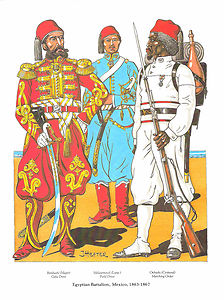
A Sudanese-Egyptian Battalion in Maximilian's Mexico

The caption on the illustration of military uniforms above, left, though it may be difficult to read, says "Egyptian Battalion in Mexico 1863-1867." This has to be one of the more curious expeditions in the history of European colonialism.

The strange French adventure in Mexico during the American Civil War, in which Louis Napoleon installed a Hapsburg Prince, Maximilian, as Emperor of Mexico, is a strange interlude, one that ended badly for Maximilian (in the firing squad sense of "badly"). Benito Juarez and Mexican Revolutionaries on the one hand, and the United States on the other (which, once the Civil War ended, decided to enforce the Monroe Doctrine and get rid of a European Emperor in Mexico) spelled the end of the strange adventure. But if a Hapsburg Emperor of Mexico installed by a Bonaparte wasn't strange enough, part of Maximilian's Army was a battalion of Egyptian troops (mostly Sudanese enlisted men with Egyptian officers), the bright idea of someone who thought Sudanese troops would be more easily acclimated to the Mexican heat than Frenchmen.

Said Pasha, Wali of Egypt 1854-1863
The Egyptian Wali Said Pasha agreed to provide an "Auxiliary Battalion" of 447 men in four companies. They sailed from Alexandria on January 9, 1863, aboard the troopship Seine. Said Pasha died nine days later, succeeded as Wali by his nephew Ismail. (The title Khedive, though in popular use, was not officially recognized by the Ottoman Sultan until 1867.)

Arrival in Veracruz
The expedition suffered severely from disease en route: a typhus outbreak aboard ship, a yellow fever outbreak after arrival in Veracruz, that killed the commanding officer, and other bouts with dysentery and pulmonary diseases. The force did see action against the Juaristas, and their French commander is said to have remarked that they fought like lions. The French used some Algerian troops as translators.

The Egyptian Battalion Arrives in Paris
In 1867, the 326 survivors of the Egyptian battalion sailed from Mexico after the fall of Maximilian. Louis Napoleon reviewed them in Paris before their return to Egypt.  Accounts of the Egyptian battalion here and here; a contemporary New York Times report here.