
I have learned from experience never to repeat stories involving certain subjects without careful checking. Rule number one: if it involves an Arab country and sex (straight or gay or anything else), check it first. Rule number two: if it involves a person identified as a sheikh (named or unnamed) issuing a fatwa (whether the reporter understands what a fatwa* is or not), check it at least twice. Rule number three: if it appeared only in The Daily Mail, check it at least three times. Rule number four: if it was an unsourced fatwa about sex by a sheikh you've never heard of and was only in The Daily Mail, go to lunch.
*In Islamic law, a fatwa is a ruling issued by a duly constituted judge with the authority to issue such rulings (a mufti). In Western journalism, as I said once before, it means "anything we can get some lunatic sheikh** to say to the press" or on an Internet website.
**Frequently self-proclaimed.
Not long ago we noted that the much-reported "Tunisian women going to Syria for 'sexual jihad'" story was mostly smoke and mirrors. (All utterly true except for the fact that no Tunisian women apparently reached Syria or engaged in "sexual jihad." Other than that, dead on.) Then there was the "Tunisian girl who posted a topless photo faces stoning to death" story, in a country where prostitution is tolerated and topless beaches exist and which hasn't executed anyone in over 20 years (and not by stoning). She spent a short time in jail, in part for desecrating a cemetery. And I spent a bit of time a year and a half ago deconstructing the Egypt "necrophilia law' hoax, in which a credulous media reported that the Egyptian Parliament was about to permit men to have sex with their deceased wives up to six hours after death. (No, it wasn't. See the post for an analysis of where this crazy idea got started.)
And I never even posted the widespread story a couple of years back that said an (unnamed) sheikh from an (equally unnamed) "European country" (Denmark? Kosovo? Andorra?) had issued a fatwa (there's that word again!) saying that women were forbidden to shop for fruits like bananas or vegetables like zucchini because, well, it might give them ideas by reminding them of something else. This was so totally improbable and unsourced I refused to mention it here, except in retrospect as an evidence of credulity and gullibility, and of course no source for the story was ever found.
(Though of course there really are crazy sheikhs who say crazy things about sex: "Egyptian Salafi: "Shi‘a Are More Dangerous Than Naked Women." (Please note for the record that while I reject this, it does not mean that I think naked women are more dangerous.)
So when over the past day or two we have seen stories with headlines like this:
"Gulf states to introduce medical testing on travellers to 'detect' gay people and stop them from entering the country," all my usual alarms went off. That particular headline was in fact in The Daily Mail, so Rules 3 and 4 above allowed me to doubt it. But a far more respectable British paper, The Independent, chimed in with "Gulf states could have clinical screenings to 'detect' homosexuals and stop them entering the country." You'll notice the disstinction between "Gulf states to introduce" and "Gulf states could have": but what kind of "clinical screening" detects gay people? (After Egypt's "virginity tests" in 2011, this is probably not something you want to dwell on.) While The Independent is not The Daily Mail, the bullshit detectors were still sounding loudly. But there were screams from people who feared that gay athletes might be barred from the upcoming World Cup in Qatar.
Now, even the original stories made certain things clear. This is not GCC policy; it is a proposal by Kuwait to be put forward at a forthcoming GCC meeting on immigration. The GCC moves at a glacial pace, and even if this were adopted it could take years. It does not at this time apply even to Kuwait, let alone Qatar.
But it isn't really about gay visitors at all. A lengthy post at an international sexual rights website (with what seems like an LGBT tilt), A Paper Bird, and a subsequent confirming follow-up post, make several things clear. First, this is not about visitors to Kuwait; it's about immigrant laborers. Second, it is not about gays: it's directed at transgendered people, especially those who have undergone sex changes. Immigrants seeking to become expatriate laborers already are required to undergo physical examinations. I personally dislike any form of discrimination, but barring transgendered persons from immigrant labor visas is not quite the same as testing every visitor to Kuwait or the whole GCC for gayness, however exactly they do that.
Unlike Iran, which former President Ahmadinejad assured us has no gays, I'm pretty sure they exist in the GCC. Perhaps even at the very highest levels. So no one should throw stones.
Showing posts with label gays in the Middle East. Show all posts
Showing posts with label gays in the Middle East. Show all posts
Thursday, October 10, 2013


Monday, May 27, 2013
Shereen El Feki's "Sex and the Citadel": a Landmark Book, and a Few Quibbles
[This post on a book about sexuality in the Arab world deals with mature themes and quotes some explicit language, so be advised. It's also a somewhat longer post than usual.]
Shereen El Feki's recent book Sex and the Citadel: Intimate Life in a Changing Arab World is getting a lot of (deserved) attention lately, and for good reason. I'm a little late in joining in because I decided to finish the book before commenting (I'm old-fashioned), and my comments here are meant as a supplement to, rather than a reiteration of, the previous reviews. It aspires to be a tour d'horizon of sexuality in the Arab world, and given the formidable obstacles to researching that subject, it largely succeeds. It does not claim scholarly credentials as sociology or anthropology, but offers raw data for those fields; as its perhaps too cute title invoking Sex and the City and its suggestive cover art (more on this below) suggest, either the author or her publisher are trying to draw a Western audience. But it deserves a Middle Eastern audience as well.
I don't usually "review" books here (lest my personal comments be confused with The Middle East Journal's proper scholarly reviews), but this one is making a lot of waves and, while I generally can just say you should read it, the pedant in me wants to raise a few quibbles about some historical and linguistic points, as well as review it in the broadest sense.
It's certainly not the first book on sexuality in the Arab world. There are general works such as Salah al-Munajjid's Al-Hayyat al-Jinsiyya ‘ind al-‘Arab [Sexual Life Among the Arabs] (Beirut 1975) (in Arabic); Abdelwahab Bouhdiba's La Sexualité en Islam (1975; English edition Sexuality in Islam, 2004); Joseph A. Massad's scholarly but contentious Desiring Arabs on homosexuality (Chicago 2007); a number of works by Samir Khalaf on prostitution, sexuality, and related issues; and numerous shorter studies by sociologists and anthropologists. But most of that material is aimed at an academic readership, or is difficult to access, in languages other than English, or burdened with social science jargon-speak (arguably, also a "language other than English"): and to her credit, she quotes al-Munajjid and Massad and interviews Bouhdiba at some length.
She has not aimed this book at a strictly academic audience. El Feki, who is half-Egyptian and half-Welsh, but was raised in Canada, holds a doctorate in immunology and has worked in HIV/AIDS education and was a Vice-Chair of the UN's Global Commission on HIV and the Law, but has also been a journalist for The Economist and Al Jazeera English, and has been a TED Global Fellow. She brings her communication skills to bear in explaining this complex subject to a non-academic, mostly Western, audience. Though her fieldwork is mostly in Egypt and Tunisia (with a bit on Israeli Arabs, the Palestinian territories, and a dash of the Gulf), her breadth is rather comprehensive: marriage, temporary or "summer" marriages, divorce, virginity, spousal abuse, female genital mutilation, sex education, birth control, abortion, prostitution, homosexuality, and so on. It's engagingly written with wit and even humor (where appropriate, and anger when required), and a keen eye for the illustrative anecdote. She uses her expertise as a health professional but mediates it to a popular audience through her background as a journalist. The book is accessible and readable, though I have a few qualms that certain features (the topic most of all, but also the cover art and some of the language), will unfortunately guarantee the book's unavailability in the countries that most need to read it.
I'm not sure I need to argue, or El Feki needs to prove, that the Middle East is hardly a sexually well-adjusted place. Young people find themselves as mature, educated adults with few job prospects and therefore little prospect for marriage or, if they do marry, any hope of affording an apartment to start a family life on their own. Hence marriage is deferred well into adulthood, but other outlets for sexual expression are taboo. Virginity for women is sacrosanct, homosexuality criminalized. Society may look the other way on male use of prostitutes, but that too is taboo. If young elites are frustrated, more traditional classes suffer from older and more disturbing practices: child marriages, "temporary" marriages, female genital mutilation justified as "female circumcision." Most of us in the field know this, but like Middle Eastern societies themselves, we don't talk about it much, leaving that to the activists. She addresses all these issues, and her role as a health educator gives her access to interview and sample real experiences not accessible to most of us.
An important sub-theme of the book is the great contrast between the candor of Arabic erotic literature in the Classical Age and the prudishness of today; the theme recurs throughout the book and is of course not all that new, as she is well aware: she herself relies on Al-Munajjid and Bouhdiba (heavily on the latter, whom she interviews). She has brought it up in many book tour interviews. It also is a major theme of Salwa Al Neimi's 2008 novel Burhan al-‘Asal (2009 English translation The Proof of the Honey), a bestseller in Europe and in Arab countries where it wasn't banned (the Francophone Maghreb and Lebanon: banned everywhere else). El Feki does not cite Al Neimi, at least in her bibliography or index, but the novel was an account of the erotic life of a female Arab librarian fascinated by the richness of Arab erotic literature of the classical age. I want to return in some detail to this question of the contrast between classical Islamic literature and today, since it's an area where I think that I may possibly have some comments to contribute as a onetime classical Islamic historian.
The book is a serious if at times subjective piece of reporting and analysis; but the tone is not heavy for the most part, except for the more depressing subjects like female genital mutilation or the grim prospects facing many prostitutes. gays, and other sexual outsiders in the Arab world. A blog post can't really do justice to the breadth of the coverage.
This is not a dour piece of social anthropology or feminist theory. This engaging accessibility of the book is one of its strengths, in a field where much of the literature is scrupulously academic and detached, and I emphasize it here lest readers be put off by a review like this one (supposedly a positive one, and [language warning] using NSFW language) by Rachel Halliburton in The Independent,
Like her reviewer above El Feki herself is not reticent about calling a spade a spade, or in this case fucking, fucking, and she also uses explicit language in quotes or when the context seems to justify it. In what follows I'm not censoring her: I'm an editor, not a censor. If such language offends you, please feel free to go put on some pleasant music (maybe madrigals: definitely not rap) and return after the post is done. My apologies to those offended, but dashes and asterisks cheat the author of the power of her word choice (for words do have power), and look silly to most everyone who reads modern literature or watches films and cable TV. Occasional NSFW language from this point on.
The strong language is used sparingly and judiciously but unapologetically. It's by no means omnipresent, but because it's sometimes used for rhetorical or shock effect it appears in some of the passages most quoted by reviewers.
I can't begin to summarize all the information and anecdotes in the book, so let me turn to the area where I actually have some kind of knowledge: her discussion of the classical era of Arab literature and its erotica. She laments the lost era of Arab erotic literature, an age when sex manuals were written by religious scholars. In this she echoes Bouhdiba, whom she interviews at length. As she notes:
This particular book is described thus in her footnote:
The assumption that nik is a "slang" version of nikah seems fairly common among many Arabic speakers. Much work still needs to be done on Arabic etymology, but these are two different words, though semantically related. The root of nikah (نكاح) is ;نكح that of nik نيك is naka ناكَ.
And the latter has its own entry in Ibn Manzur's 13th century classical lexicon Lisan al-‘Arab لسان العرب which means it certainly isn't slang. While the entry says it is equivalent to nikah, it has a full grammatical structure, even a form VI (reciprocal) verb تَنايَكَ (roughly, "fuck each other"):
نيك النَّيْكُ: معروف، والفاعل: نائِكٌ، والمفعول به مَنِيكٌ ومَنْيُوكٌ، والأَنثى مَنْيُوكة، وقد ناكَها يَنيكها نَيْكاً.
والنَّيّاك: الكثير النَّيْك؛ شدد للكثرة؛ وفي المثل قال: من يَنِكِ العَيْرَ يَنِكْ نَيّاكا وتَنَايَكَ القوْمُ: غلبهم النُّعاسُ. .وتَنايَكَتِ الأَجْفانُ: انطبق بعضها على بعض. الأَزهري في ترجمة نكح: ناكَ المطرُ الأَرضَ وناكَ النعاسُ عينه إِذا غلب عليها.
So there. I'm already using enough four-letter words here not to try to translate the whole thing, and I hope the Arabic doesn't set off blockers across the Arab world : it's from the Lisan al-‘Arab, found even in Saudi libraries! [I will note that ناكَ المطرُ الأَرضَ literally means "The rain fucked the earth" and is a nice fertility image. The second example, ناكَ النعاسُ عينه "Sleep fucked his eye," doesn't work as well, in English at least.]
Added later: I should have noted the well-known coloquial though grammatically formal common obscene proverb نيك واستنيك ولا تعلم زبك الكسل which is a X form verb and means something like "Fuck and seek after fucking and do not teach your penis laziness."
What's more, while the similarities between nik and nikah might mean they descend from different dialects of pre-Islamic Arabic, nik is probably the older root: a proto-Semitic or proto-Afro-Asiatic root something like N-[vowel]-K, with the vowel usually a or i. In Semitic languages, it seems absent in Hebrew and Aramaic, but it is found in Akkadian/Assyrian/Babylonian, with meanings relating to copulation and illicit sex. It occurs in Old South Arabian and modern South Arabian languages such as Mehri. (Not sure about Geez or Amharic: anyone?) Beyond the Semitic languages, it's found throughout the Afro-Asiatic group. N-vowel-K (probably NAK) was the standard word for copulation in Ancient Egyptian from the pyramid texts down through Demotic and is found as late as in Coptic in the sense of fornication. (The hieroglyphic includes an erect phallus, but I figure I'm in enough trouble in this post for so much strong language without reproducing it here.)
[Much later: If I got away with saying "fuck" so much I may as well show the hieroglyph. In for a penny, in for a pound (or in other words fuck it)]:

Cognates appear in Berber and, I'm told, Chadic. So one might argue that not only is nik not "slang," it has a reasonable case to be made for being the oldest "dirty word" on earth, at least that's still in use. There's a doctoral dissertation waiting to be written. I'm sure people had words for fucking long before the invention of writing (or none of us would be here), but this one looks very old. Really fucking old.
Perhaps I'm overreacting or showing off here, probably a bit of both. I'm fairly sure El Feki was mainly aiming for shock effect with translating the title as The Language of Fucking. While she doesn't use profanity excessively, she does use it for effect on occasion. Sometimes it's a play on words as (p.111): "Across the Arab world, female virginity — defined as an intact hymen — remains what could best be described as a big fucking deal." That works by playing on the double meaning of the word, in both its sexual and intensive sense, and sticks in the mind. As early as page 7, referring to Gustave Flaubert's visit to Egypt (a perhaps dubious choice, rather like using Hunter S. Thompson's Fear and Loathing in Las Vegas as a typical example of travel writing in America), she notes that "Flaubert proceeded to fuck his way up the Nile." It makes the point memorably, and Flaubert's own description of his travels fully supports the characterization. In context the language is appropriate to the theme and used for effect. (He documents his whores in some detail, and with apparent pride and explicit detail). To be blunt, in an age when "fucking" is often used by many speakers merely as a sign that a noun will follow or just as a place filler, she only uses it in its original sense, to mean, well, just plain old-fashioned fucking. (With the arguable exception of the just quoted remark about virginity still being a "big fucking deal," but that still partakes of the original meaning in a double entendre.) It's almost refreshing in a curious way. (And maybe not all that "old-fashioned," but still used in its original sexual, not multiple other meanings.) There's an ancient story about someone who was shocked to hear "bitch" used for a dog; these days some innocents may be surprised to hear "fucking" used for copulation.
While I don't think most mature adult Western readers will find the book's contents or language that objectionable (at least if they've read this far without calling the Religious Police), there are a few qualms that I should note, since they will turn some readers off without even opening the book. Like the (sometimes) strong language, the title, Sex and the Citadel, while it is a clever enough play off Sex and the City, may be off-putting for some readers, and may seem clever to some and flippant to others. The cover art will deter sales of the English edition in the Arab world. This is the American cover:
 As Brian Whitaker noted in his review for the Lebanese website Now:
 (Or are they worse?)
  Umm ... yeah. Okay. One's a woman's naked body in calligraphy (apparently of various rude words) and the other is ... (clears throat, blushes) also pseudo-calligraphy.To my perhaps dirty mind, it is perhaps the most offensive of the three.
See what I mean? They're probably more offensive than the crescents/breasts, but at least took an artist's time to create. Of course, El Feki may not have chosen the cover art, or may have preferred an in-your-face message, giving the finger (or other body parts) to the Arab patriarchy. (But I don't get that sense from her text.) If an Arabic translation ever appears (and it's needed) none of these covers is going to pass muster. But then, the explicit subject matter is also going to be an obstacle in the Middle East market. Since we're already using candid language: In an effort to draw a Western audience, and given her clear disdain for Middle Eastern prudishness, covers which essentially send a resounding "Fuck You!" message to the audience who most need to read you are not well advised.
I do hope you'll understand these quibbles as just that: quibbles, and forgive the sexual and linguistic candor I don't normally use on this blog. This is an essential book that deserves a wide readership. But this book needs an Arabic edition that (even if censored, euphemized and sanitized) makes its message acceptable to those who need it most.
Shereen El Feki's recent book Sex and the Citadel: Intimate Life in a Changing Arab World is getting a lot of (deserved) attention lately, and for good reason. I'm a little late in joining in because I decided to finish the book before commenting (I'm old-fashioned), and my comments here are meant as a supplement to, rather than a reiteration of, the previous reviews. It aspires to be a tour d'horizon of sexuality in the Arab world, and given the formidable obstacles to researching that subject, it largely succeeds. It does not claim scholarly credentials as sociology or anthropology, but offers raw data for those fields; as its perhaps too cute title invoking Sex and the City and its suggestive cover art (more on this below) suggest, either the author or her publisher are trying to draw a Western audience. But it deserves a Middle Eastern audience as well.
I don't usually "review" books here (lest my personal comments be confused with The Middle East Journal's proper scholarly reviews), but this one is making a lot of waves and, while I generally can just say you should read it, the pedant in me wants to raise a few quibbles about some historical and linguistic points, as well as review it in the broadest sense.
It's certainly not the first book on sexuality in the Arab world. There are general works such as Salah al-Munajjid's Al-Hayyat al-Jinsiyya ‘ind al-‘Arab [Sexual Life Among the Arabs] (Beirut 1975) (in Arabic); Abdelwahab Bouhdiba's La Sexualité en Islam (1975; English edition Sexuality in Islam, 2004); Joseph A. Massad's scholarly but contentious Desiring Arabs on homosexuality (Chicago 2007); a number of works by Samir Khalaf on prostitution, sexuality, and related issues; and numerous shorter studies by sociologists and anthropologists. But most of that material is aimed at an academic readership, or is difficult to access, in languages other than English, or burdened with social science jargon-speak (arguably, also a "language other than English"): and to her credit, she quotes al-Munajjid and Massad and interviews Bouhdiba at some length.
She has not aimed this book at a strictly academic audience. El Feki, who is half-Egyptian and half-Welsh, but was raised in Canada, holds a doctorate in immunology and has worked in HIV/AIDS education and was a Vice-Chair of the UN's Global Commission on HIV and the Law, but has also been a journalist for The Economist and Al Jazeera English, and has been a TED Global Fellow. She brings her communication skills to bear in explaining this complex subject to a non-academic, mostly Western, audience. Though her fieldwork is mostly in Egypt and Tunisia (with a bit on Israeli Arabs, the Palestinian territories, and a dash of the Gulf), her breadth is rather comprehensive: marriage, temporary or "summer" marriages, divorce, virginity, spousal abuse, female genital mutilation, sex education, birth control, abortion, prostitution, homosexuality, and so on. It's engagingly written with wit and even humor (where appropriate, and anger when required), and a keen eye for the illustrative anecdote. She uses her expertise as a health professional but mediates it to a popular audience through her background as a journalist. The book is accessible and readable, though I have a few qualms that certain features (the topic most of all, but also the cover art and some of the language), will unfortunately guarantee the book's unavailability in the countries that most need to read it.
I'm not sure I need to argue, or El Feki needs to prove, that the Middle East is hardly a sexually well-adjusted place. Young people find themselves as mature, educated adults with few job prospects and therefore little prospect for marriage or, if they do marry, any hope of affording an apartment to start a family life on their own. Hence marriage is deferred well into adulthood, but other outlets for sexual expression are taboo. Virginity for women is sacrosanct, homosexuality criminalized. Society may look the other way on male use of prostitutes, but that too is taboo. If young elites are frustrated, more traditional classes suffer from older and more disturbing practices: child marriages, "temporary" marriages, female genital mutilation justified as "female circumcision." Most of us in the field know this, but like Middle Eastern societies themselves, we don't talk about it much, leaving that to the activists. She addresses all these issues, and her role as a health educator gives her access to interview and sample real experiences not accessible to most of us.
An important sub-theme of the book is the great contrast between the candor of Arabic erotic literature in the Classical Age and the prudishness of today; the theme recurs throughout the book and is of course not all that new, as she is well aware: she herself relies on Al-Munajjid and Bouhdiba (heavily on the latter, whom she interviews). She has brought it up in many book tour interviews. It also is a major theme of Salwa Al Neimi's 2008 novel Burhan al-‘Asal (2009 English translation The Proof of the Honey), a bestseller in Europe and in Arab countries where it wasn't banned (the Francophone Maghreb and Lebanon: banned everywhere else). El Feki does not cite Al Neimi, at least in her bibliography or index, but the novel was an account of the erotic life of a female Arab librarian fascinated by the richness of Arab erotic literature of the classical age. I want to return in some detail to this question of the contrast between classical Islamic literature and today, since it's an area where I think that I may possibly have some comments to contribute as a onetime classical Islamic historian.
The book is a serious if at times subjective piece of reporting and analysis; but the tone is not heavy for the most part, except for the more depressing subjects like female genital mutilation or the grim prospects facing many prostitutes. gays, and other sexual outsiders in the Arab world. A blog post can't really do justice to the breadth of the coverage.
This is not a dour piece of social anthropology or feminist theory. This engaging accessibility of the book is one of its strengths, in a field where much of the literature is scrupulously academic and detached, and I emphasize it here lest readers be put off by a review like this one (supposedly a positive one, and [language warning] using NSFW language) by Rachel Halliburton in The Independent,
Sex and the Citadel is not, as El Feki – a trained scientist – warns, either peep show or encyclopedia. It owes as much of its zing to Foucault as to fucking. Taking the French philosopher's assertion that sexuality is "an especially dense transfer point for relations of power," El Feki has meticulously analysed what makes Arab society tick. The sexual climate, she declares, "looks a lot like the West on the brink of sexual revolution." Many of the same "underlying forces" are there, not least the struggle toward democracy, and a large youth population with different attitudes from their parents.She's right that it's neither peep show nor encyclopedia, but I fear the "owes as much of its zing to Foucault as to fucking" is inspired more by clever word play on the part of the reviewer than by the book itself. Foucault is only mentioned two other times in the book, other than for the quoted remark, neither time particularly substantively. Of course El Feki is not responsible for Halliburton's characterization, and I guess Halliburton was saying this is a "serious" book; but if, like me, your eyes glaze over when someone brings up Foucault, don't worry. It's much more about fucking. (Hell, it's a book about sexuality. What else would it be about?)
Like her reviewer above El Feki herself is not reticent about calling a spade a spade, or in this case fucking, fucking, and she also uses explicit language in quotes or when the context seems to justify it. In what follows I'm not censoring her: I'm an editor, not a censor. If such language offends you, please feel free to go put on some pleasant music (maybe madrigals: definitely not rap) and return after the post is done. My apologies to those offended, but dashes and asterisks cheat the author of the power of her word choice (for words do have power), and look silly to most everyone who reads modern literature or watches films and cable TV. Occasional NSFW language from this point on.
The strong language is used sparingly and judiciously but unapologetically. It's by no means omnipresent, but because it's sometimes used for rhetorical or shock effect it appears in some of the passages most quoted by reviewers.
I can't begin to summarize all the information and anecdotes in the book, so let me turn to the area where I actually have some kind of knowledge: her discussion of the classical era of Arab literature and its erotica. She laments the lost era of Arab erotic literature, an age when sex manuals were written by religious scholars. In this she echoes Bouhdiba, whom she interviews at length. As she notes:
There is a long and distinguished history of Arabic writing on sex— literature, poetry, medical treatises, self-help manuals— which has slipped out of sight in much of the Arab world. Many of these great works were by religious figures who saw nothing incompatible between faith and sex. Indeed, it behooved these men of learning to have as full a knowledge of sexual practices and problems as they did of the intricacies of Islam. There is nothing academic about their writing: with surprising frankness, and often disarming humor, these works cover almost every sexual subject, and then some. There is precious little in Playboy, Cosmopolitan, The Joy of Sex, or any other taboo-busting work of the sexual revolution and beyond that this literature didn’t touch on over a millennium ago.
Bouhdiba sees this sexual open-mindedness as part and parcel of the intellectual blossoming of the age. At their zenith in the early Abbasid period, the Arabs were a confident and creative people, and open thinking on sexuality was a reflection of this. “It was not a coincidence that at the height of Islamic culture there was a flowering of sexuality,” Bouhdiba says. “It is a synthesis of all domains. The rehabilitation of sexuality is the rehabilitation of science within the rehabilitation of Islam.” Today, however, there is a deep vein of denial that these elements are connected, and plenty of people who want to pick and choose their history, taking what is now considered the respectable face of the Arab golden age— science and technology, for example — and leaving the rest behind. But Bouhdiba believes these facets are inseparable.
But the passage on this subject which has been most quoted by far (by many of the British reviewers, by the Atlantic, and a few other American reviewers willing to print "bad" words) is the last paragraph of the following passage, which I quote in its fuller context:It’s easy to read too much into Arabic erotic literature. Did its openness really represent society at large, or just the notions of the sexually sophisticated elite? After all, many of the most famous books of Arabic erotica were written for rulers. Bouhdiba is convinced that these books say something more broadly about the spirit of the age. He invokes religion to illustrate his point: “These elites were never denounced by the masses; their societies accepted them more or less, maybe not actively but passively. It’s a little like Sufism, which represented an elite but was eventually accepted. (pp. 13-14: all page numbers are to the US edition.)
For example, new participants will use min orali (Hebrew for “oral sex”) and orgazma instead of the respective Arabic terms, jins fammii and nashwa jinsiyya. “When you say the word, to be able to say the word freely, it’s fifty percent of the work,” says one woman, a social worker from Haifa.“Why [do] I choose to speak about a dick in Hebrew not in Arabic? It must show something about my attitude toward things.”
Some participants lack even this choice, because they simply do not know the Arabic for many of the topics under discussion. Part of Muntada’s name— Jensaneya, which translates to “sexuality”— is a relatively new coinage that is not widely used, or even understood, by Arabic speakers. Even more basic terminology is problematic; until attending Muntada’s training courses, some participants were simply unaware that there are, indeed, Arabic words for female genitalia, having been taught to consider such subjects shameful beyond discussion. Even for those who do know some terms in Arabic, it is often in language so crude as to be unusable off the street.She has herself cited this in interviews as well, and while her point is absolutely correct, the pedant in me wishes she'd chosen a different book to cite. Not out of prudishness, but out of accuracy. My own discussion is going to require some scholarly discussion of Arabic words for sex. In fact, I feel an obligation to do this at some length. I'm not trying to titillate here, but if you are likely to be offended please stop reading. And bear in mind I'm doing some pedantic nit-picking here; the book still deserves the widest readership possible.
This is a far cry from the days of the Encyclopedia of Pleasure and the golden age of Arabic writing on sex. One tenth-century book, The Language of Fucking, for example, mentions more than a thousand verbs for having sex. Then there are the seemingly endless lexicons for sexual positions, responses, and organs of every size, shape, and distinguishing feature. That linguistic wealth is long gone. (p.151.)
This particular book is described thus in her footnote:
23. In Arabic, this book is known as Kitab al-Nikah fi al-Lugha, by Ibn Al Qatta’ (as detailed in Al-Munajjid, Al-Hayat al-Jinsiyya ‘ind al-’ Arab [The sexual life of the Arabs], p. 142.)First, if this book survives at all, it is unpublished. Secondly, while she has clearly chosen a translation into English that grabs the reader's attention, her own notes translate Nikah differently elsewhere. For example, in her bibliography we find:
“Kitab al-Nikah” [Book of marriage]. In Translation of Sahih Muslim. Translated by A. H. Siddiqui. Available at http://www.iium.edu.my/deed/Indeed, Nikah is the standard word in Islamic law and elsewhere referring to sexual intercourse, within or outside of marriage. She herself says elsewhere in her text:
The same word in classical Arabic, nikah, applies to both marriage and sexual intercourse; in Egyptian street slang, niik, an abbreviated form, means “to fuck.” Sex outside these regulated contexts constitute zina, that is, illicit relations— an offense that crosses the line of acceptability (hadd) in Islam. (p.32)The definitions are basically right, though nik is not "Egyptian street slang" but a classical Arabic word with cognates not only in other Semitic languages and also in Ancient Egyptian and Berber. But let me come back to that. [And strictly speaking, nik does not mean "to fuck"; it's either the imperative form of the verb or a participle, "fucking."] If she really needed to cite a work with "fucking" in its title one could suggest one by none other than the great medieval polymath Jalal al-Din al-Suyuti, author of one of the most respected commentaries on the Qur'an, who wrote (among several works on sex), one that survives, has reportedly been published in Iraq (though I haven't seen it), and that is known as Kitab al-Ik fi Ma‘rifat al-Nik, which can be translated as something like "Book of the Thicket in the Understanding of Fucking," with none of the ambiguity about nik vs. nikah. (Bear in mind: El Feki's translation of nikah as "fucking" is not wrong; it's just not the only choice. Nik would be another matter, since today at least, it implies a taboo word and is best translated as such, while nikah could as easily have been translated as "intercourse" or "sex" or the like.)
The assumption that nik is a "slang" version of nikah seems fairly common among many Arabic speakers. Much work still needs to be done on Arabic etymology, but these are two different words, though semantically related. The root of nikah (نكاح) is ;نكح that of nik نيك is naka ناكَ.
And the latter has its own entry in Ibn Manzur's 13th century classical lexicon Lisan al-‘Arab لسان العرب which means it certainly isn't slang. While the entry says it is equivalent to nikah, it has a full grammatical structure, even a form VI (reciprocal) verb تَنايَكَ (roughly, "fuck each other"):
نيك النَّيْكُ: معروف، والفاعل: نائِكٌ، والمفعول به مَنِيكٌ ومَنْيُوكٌ، والأَنثى مَنْيُوكة، وقد ناكَها يَنيكها نَيْكاً.
والنَّيّاك: الكثير النَّيْك؛ شدد للكثرة؛ وفي المثل قال: من يَنِكِ العَيْرَ يَنِكْ نَيّاكا وتَنَايَكَ القوْمُ: غلبهم النُّعاسُ. .وتَنايَكَتِ الأَجْفانُ: انطبق بعضها على بعض. الأَزهري في ترجمة نكح: ناكَ المطرُ الأَرضَ وناكَ النعاسُ عينه إِذا غلب عليها.
So there. I'm already using enough four-letter words here not to try to translate the whole thing, and I hope the Arabic doesn't set off blockers across the Arab world : it's from the Lisan al-‘Arab, found even in Saudi libraries! [I will note that ناكَ المطرُ الأَرضَ literally means "The rain fucked the earth" and is a nice fertility image. The second example, ناكَ النعاسُ عينه "Sleep fucked his eye," doesn't work as well, in English at least.]
Added later: I should have noted the well-known coloquial though grammatically formal common obscene proverb نيك واستنيك ولا تعلم زبك الكسل which is a X form verb and means something like "Fuck and seek after fucking and do not teach your penis laziness."
What's more, while the similarities between nik and nikah might mean they descend from different dialects of pre-Islamic Arabic, nik is probably the older root: a proto-Semitic or proto-Afro-Asiatic root something like N-[vowel]-K, with the vowel usually a or i. In Semitic languages, it seems absent in Hebrew and Aramaic, but it is found in Akkadian/Assyrian/Babylonian, with meanings relating to copulation and illicit sex. It occurs in Old South Arabian and modern South Arabian languages such as Mehri. (Not sure about Geez or Amharic: anyone?) Beyond the Semitic languages, it's found throughout the Afro-Asiatic group. N-vowel-K (probably NAK) was the standard word for copulation in Ancient Egyptian from the pyramid texts down through Demotic and is found as late as in Coptic in the sense of fornication. (The hieroglyphic includes an erect phallus, but I figure I'm in enough trouble in this post for so much strong language without reproducing it here.)
[Much later: If I got away with saying "fuck" so much I may as well show the hieroglyph. In for a penny, in for a pound (or in other words fuck it)]:

Cognates appear in Berber and, I'm told, Chadic. So one might argue that not only is nik not "slang," it has a reasonable case to be made for being the oldest "dirty word" on earth, at least that's still in use. There's a doctoral dissertation waiting to be written. I'm sure people had words for fucking long before the invention of writing (or none of us would be here), but this one looks very old. Really fucking old.
Perhaps I'm overreacting or showing off here, probably a bit of both. I'm fairly sure El Feki was mainly aiming for shock effect with translating the title as The Language of Fucking. While she doesn't use profanity excessively, she does use it for effect on occasion. Sometimes it's a play on words as (p.111): "Across the Arab world, female virginity — defined as an intact hymen — remains what could best be described as a big fucking deal." That works by playing on the double meaning of the word, in both its sexual and intensive sense, and sticks in the mind. As early as page 7, referring to Gustave Flaubert's visit to Egypt (a perhaps dubious choice, rather like using Hunter S. Thompson's Fear and Loathing in Las Vegas as a typical example of travel writing in America), she notes that "Flaubert proceeded to fuck his way up the Nile." It makes the point memorably, and Flaubert's own description of his travels fully supports the characterization. In context the language is appropriate to the theme and used for effect. (He documents his whores in some detail, and with apparent pride and explicit detail). To be blunt, in an age when "fucking" is often used by many speakers merely as a sign that a noun will follow or just as a place filler, she only uses it in its original sense, to mean, well, just plain old-fashioned fucking. (With the arguable exception of the just quoted remark about virginity still being a "big fucking deal," but that still partakes of the original meaning in a double entendre.) It's almost refreshing in a curious way. (And maybe not all that "old-fashioned," but still used in its original sexual, not multiple other meanings.) There's an ancient story about someone who was shocked to hear "bitch" used for a dog; these days some innocents may be surprised to hear "fucking" used for copulation.
While I don't think most mature adult Western readers will find the book's contents or language that objectionable (at least if they've read this far without calling the Religious Police), there are a few qualms that I should note, since they will turn some readers off without even opening the book. Like the (sometimes) strong language, the title, Sex and the Citadel, while it is a clever enough play off Sex and the City, may be off-putting for some readers, and may seem clever to some and flippant to others. The cover art will deter sales of the English edition in the Arab world. This is the American cover:
 As Brian Whitaker noted in his review for the Lebanese website Now:
Discussion of Arab sexuality today is often over-simplistic and when I first saw Sex and the Citadel on Amazon's website I feared the worst. Its title – a play on the popular TV series, – seemed awkwardly contrived and its cover showed a pair of Islamic crescents arranged to look like female breasts (though I'm assured that's only for the American edition).He's quite right: the stars and crescents shown as breasts only appear on the American edition, and the image just seems gratuitous, using what is usually understood as a symbol of religion to imply female breasts. (Imply? More like portray.) But I'm really not certain the other covers are much better:
 (Or are they worse?)
  Umm ... yeah. Okay. One's a woman's naked body in calligraphy (apparently of various rude words) and the other is ... (clears throat, blushes) also pseudo-calligraphy.To my perhaps dirty mind, it is perhaps the most offensive of the three.
See what I mean? They're probably more offensive than the crescents/breasts, but at least took an artist's time to create. Of course, El Feki may not have chosen the cover art, or may have preferred an in-your-face message, giving the finger (or other body parts) to the Arab patriarchy. (But I don't get that sense from her text.) If an Arabic translation ever appears (and it's needed) none of these covers is going to pass muster. But then, the explicit subject matter is also going to be an obstacle in the Middle East market. Since we're already using candid language: In an effort to draw a Western audience, and given her clear disdain for Middle Eastern prudishness, covers which essentially send a resounding "Fuck You!" message to the audience who most need to read you are not well advised.
I do hope you'll understand these quibbles as just that: quibbles, and forgive the sexual and linguistic candor I don't normally use on this blog. This is an essential book that deserves a wide readership. But this book needs an Arabic edition that (even if censored, euphemized and sanitized) makes its message acceptable to those who need it most.
Monday, June 27, 2011
I Guess it Could Get Worse; It Just Did
The whole Gay Girl in Damascus hoax should have caused enough embarrassment by now to just simply let it die. But there's more. There are allegations that a defender of the hoaxer was, in fact, yet another sockpuppet of the original hoaxer, since the postings came from his ISP address. He defends himself, but at this point the story needs to end. Pay no more attention to this, or this guy, or this site, or this site's defenders. It's distracted us all from what's really going on in Syria, and that verges on the criminal.
I, for one, will not mention this blogger again unless it is determined he (formerly she) is a conscious agent of the Syrian government. He has certainly been an unconscious one. Shame.
I have to make a presentation today at noon at the World Affairs Council of DC on the Egyptian Unfinished Revolution, so my posting today, other than this one, will be late-ish.
I, for one, will not mention this blogger again unless it is determined he (formerly she) is a conscious agent of the Syrian government. He has certainly been an unconscious one. Shame.
I have to make a presentation today at noon at the World Affairs Council of DC on the Egyptian Unfinished Revolution, so my posting today, other than this one, will be late-ish.
Monday, June 13, 2011
"Amina" Evaporates into Sockpuppetry; The Tragedy in Syria Remains Real
A week after the blogging community (and not just Middle East bloggers, including me) were horrified by word that Gay Girl in Damascus blogger Amina Arraf had been abducted by security men, the story has gradually been eroded by growing skepticism and now has apparently entirely evaporated. The author of the blog appears to be neither gay, a girl, nor in Damascus. Other than that, says the confession on the blog, "While the narrative voice may have been fictional, the facts on this blog are true and not mısleading as to the situation on the ground. I do not believe that I have harmed anyone -- I feel that I have created an important voice for issues that I feel strongly about." Other than that, other than not being gay, or a girl, or in Damascus, or abducted, it was all "true and not misleading"? HUH?
Other than that, Mrs. Lincoln, how did you like the play?
The brief confession signed by Tom MacMaster includes the lines, "This experience has sadly only confirmed my feelings regarding the often superficial coverage of the Middle East and the pervasiveness of new forms of liberal Orientalism." Whatever exactly that means, the creation of an imaginary sockpuppet blogger and then the claim that said blogger has been abducted would seem to offer little to really educate Westerners out of their ignorance (undisputed: it's the reason for this blog, which bears my real name and identity and my employer's real name and identity) or to help the plight of gays, women, or dissidents in Syria; if anything it may have focused the security forces' attention on those very communities. It also plays into the regime's hands: this particular "dissident" was apparently a man and woman living formerly in Georgia and currently in Edinburgh, Scotland but traveling in Turkey. I can see the regime claiming, if they are clever enough to capitalize on this, that the "dissident movement" is a creation of the West, just as "Amina" proved to have been.
Okay, I'll admit. I was fooled. So were nearly 15,000 followers on the Free Amina Abdalla Facebook site. Before I comment further, let me echo theirs:
It gets still stranger. A lesbian-oriented website called The LEZ Get Real which helped promote Amina has also published an apology. But The Electronic Intifada investigation has also raised questions about the existence or non-existence of the purported Executive Editor of that website, "Paula Brooks", whose real world identity seems a bit thin. Are we completely in sockpuppet (linked above, but essentially a false online identity) country here? [Later Update: "Paula Brooks" was a guy, too. Are we learning about some new Internet fetish here, or what?]
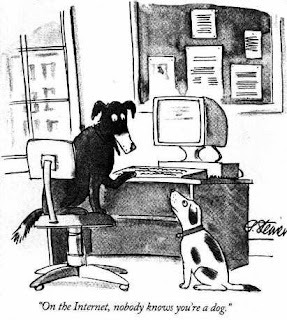 Of course like anyone moderately familiar with the culture of the Internet I realize that what you see is not, always, what you get, and that the idea of the "sockpuppet" can rarely be excluded. The famous New Yorker cartoon of some years back, at left (I hope The New Yorker copyright lawyers will see this as fair use) summarizes it perfectly.
Anonymous blogging is fine. Many of the finest bloggers in the Middle East either started out, or remain, anonymous for good, survival-related reasons; but I assume when I read them that their basic personas are real; even if I don't know their names. The guys are guys; the women are women; the young people are young. Those that have unveiled their real identities in the age of revolution have pretty much matched up with their anonymous persona. I didn't care if the "Gay Girl in Damascus" was really named Amina or not: as her story crumbled a lot of us waited, fearing she was a real person who'd used a fake name and stolen somebody else's Facebook photos, but might in fact be in a Syrian jail. As online sleuths demolished first her photos, then her not very detailed biography (searching Virginia and Georgia records for her claimed background and finding no records), it became clear that both her photos and her name were fake. A 2007 blog under the same name offered fragments of autobiography, with a birth in Staunton, Virginia, and being raised in Damascus and Virginia. That blog admitted it included fictional elements. (It does, however, show a familiarity with the real Shenandoah Valley, especially the Harrisonburg-Dayton-Bridgewater area. If I have anything to add to this overall investigation it is to say that her (fictional) childhood town of "Riverport" is almost certainly Bridgewater, a town I know well. The description, the neighboring towns, the river and the Old Order Mennonites pretty much nail it.)
But as long as there was a chance there was a real person, with another name and another photo, in a Syrian prison (or worse), I didn't want to pile on. But now that we see this as a complete invention, with no real person involved, I want to see more than a brief apology that says we meant well. Harm has been done to the communities involved and, worse, the international press has been diverted from a humanitarian horror in Syria by a blogger-driven diversion.
What makes it worse is that I contributed to it, and inadvertently committed the prestige of The Middle East Institute and Middle East Journal as well. So did a whole lot of other good folk and true, who are hoping for real change in Syria. Shame on these insensitive hoaxers who. whatever their misguided intentions, may have cost lives among the real people who live in the real Syria. There are real gay girls in Damascus and in Syria, but you cannot speak for them. We are not they. During the Tahrir days, many Westerners said "We are all Egyptians." No we aren't, and no we weren't; our butts weren't on the line and nobody was threatening us with live ammunition. Pretending you're a frontline dissident is like pretending you're a Medal of Honor Veteran: it steals from those who really are, and it demeans you. Fiction hurts those whose butts really are on the line, and all Syrians who are living a real nightmare and are really being abducted. Shame.
Be assured administrators of this site - who were friends with "Amina" online - are just as angry as everyone else over the revelation made by Tom MacMaster. This foolish and cruel hoax has distracted from the real issue in Syria - that the Syrian people are sacrificing their lives for calling for an end to a regime that silences, disappears, tortures and murders its people, a regime that has repeatedly fired directly into peaceful demonstrations. Thousands of political prisoners are being held by authorities, with many of them undergoing torture right now. The world should know about the courage and suffering of these innocent Syrians and stand with them.Someone behind that blog knew Syria pretty well, and wrote convincingly. I'd been reading "her" blog even before the "abduction" and had even linked to it. Credit must go to those who smelled something fishy early on: by last Wednesday there were already red flags, raised first (so far as I am aware) by NPR's Andy Carvin, followed soon by Robert Mackey at the NYT's the Lede (link is to an updated version.) Liz Henry was also on the case early on, and as near as I can tell she, along with The Electronic Intifada, are the people who finally ran this thing to ground. Read their posts for the evidence. Some other reactions here.
It gets still stranger. A lesbian-oriented website called The LEZ Get Real which helped promote Amina has also published an apology. But The Electronic Intifada investigation has also raised questions about the existence or non-existence of the purported Executive Editor of that website, "Paula Brooks", whose real world identity seems a bit thin. Are we completely in sockpuppet (linked above, but essentially a false online identity) country here? [Later Update: "Paula Brooks" was a guy, too. Are we learning about some new Internet fetish here, or what?]
 Of course like anyone moderately familiar with the culture of the Internet I realize that what you see is not, always, what you get, and that the idea of the "sockpuppet" can rarely be excluded. The famous New Yorker cartoon of some years back, at left (I hope The New Yorker copyright lawyers will see this as fair use) summarizes it perfectly.
Anonymous blogging is fine. Many of the finest bloggers in the Middle East either started out, or remain, anonymous for good, survival-related reasons; but I assume when I read them that their basic personas are real; even if I don't know their names. The guys are guys; the women are women; the young people are young. Those that have unveiled their real identities in the age of revolution have pretty much matched up with their anonymous persona. I didn't care if the "Gay Girl in Damascus" was really named Amina or not: as her story crumbled a lot of us waited, fearing she was a real person who'd used a fake name and stolen somebody else's Facebook photos, but might in fact be in a Syrian jail. As online sleuths demolished first her photos, then her not very detailed biography (searching Virginia and Georgia records for her claimed background and finding no records), it became clear that both her photos and her name were fake. A 2007 blog under the same name offered fragments of autobiography, with a birth in Staunton, Virginia, and being raised in Damascus and Virginia. That blog admitted it included fictional elements. (It does, however, show a familiarity with the real Shenandoah Valley, especially the Harrisonburg-Dayton-Bridgewater area. If I have anything to add to this overall investigation it is to say that her (fictional) childhood town of "Riverport" is almost certainly Bridgewater, a town I know well. The description, the neighboring towns, the river and the Old Order Mennonites pretty much nail it.)
But as long as there was a chance there was a real person, with another name and another photo, in a Syrian prison (or worse), I didn't want to pile on. But now that we see this as a complete invention, with no real person involved, I want to see more than a brief apology that says we meant well. Harm has been done to the communities involved and, worse, the international press has been diverted from a humanitarian horror in Syria by a blogger-driven diversion.
What makes it worse is that I contributed to it, and inadvertently committed the prestige of The Middle East Institute and Middle East Journal as well. So did a whole lot of other good folk and true, who are hoping for real change in Syria. Shame on these insensitive hoaxers who. whatever their misguided intentions, may have cost lives among the real people who live in the real Syria. There are real gay girls in Damascus and in Syria, but you cannot speak for them. We are not they. During the Tahrir days, many Westerners said "We are all Egyptians." No we aren't, and no we weren't; our butts weren't on the line and nobody was threatening us with live ammunition. Pretending you're a frontline dissident is like pretending you're a Medal of Honor Veteran: it steals from those who really are, and it demeans you. Fiction hurts those whose butts really are on the line, and all Syrians who are living a real nightmare and are really being abducted. Shame.
Wednesday, June 8, 2011
Could the Amina Story Be Some Sort of Hoax?
The reported abduction of "Gay Girl in Damascus" blogger Amina Abdullah Arraf has provoked concern and outrage around the world, including on this blog, but today the story took an unexpected term with some Internet speculation that Amina might not even exist. NPR's Andy Carvin lays out the evidence and cautiously comes down on the side of her really existing; Robert Mackey at the NYT's The Lede also reviews the question.
I think it goes without saying that certain of the questions, such as her use of a picture that is apparently of someone else, can be explained as self-protection; her blog certainly seemed convincing and had built up a following. Perhaps I've spent too much time in the region, but my first thought when I saw these stories was that the Syrian government would very much like us to believe that she doesn't exist, which makes me suspicious about the speculation. Perhaps she camouflaged her identity for obvious protective reasons. Of course, I could be wrong, but if her blog was a hoax it was a convincing one. I'm not convinced she's not real, but may be proven wrong of course.
I think it goes without saying that certain of the questions, such as her use of a picture that is apparently of someone else, can be explained as self-protection; her blog certainly seemed convincing and had built up a following. Perhaps I've spent too much time in the region, but my first thought when I saw these stories was that the Syrian government would very much like us to believe that she doesn't exist, which makes me suspicious about the speculation. Perhaps she camouflaged her identity for obvious protective reasons. Of course, I could be wrong, but if her blog was a hoax it was a convincing one. I'm not convinced she's not real, but may be proven wrong of course.
Monday, June 6, 2011
Syrian Blogger Amina Abdullah is Abducted
Syrian blogger Amina Abdullah Araf al-Omari, whose blog is A Gay Girl in Damascus, was reportedly abducted forcibly earlier today, presumably either by security services or Baathist militiamen. Her cousin posted a description of her abduction earlier today and there has been one further update, and of course there is a Facebook Free Amina Page already. Also a #FreeAmina hashtag on Twitter.
As both a political dissident and an openly gay woman in a closed society she has encountered problems before; I previously linked to her account of how her father defended her when security men sought to arrest her previously.
Of course with perhaps thousands dead in the Syrian uprising so far, the disappearance of one blogger can be considered a small sideshow of an enormous tragedy. But individuals sometimes become symbols (Mohammed Bouazizi in Tunis, Khalid Said in Egypt; today was the anniversary of his death), and the online community does tend to come to the defense of its own.
As both a political dissident and an openly gay woman in a closed society she has encountered problems before; I previously linked to her account of how her father defended her when security men sought to arrest her previously.
Of course with perhaps thousands dead in the Syrian uprising so far, the disappearance of one blogger can be considered a small sideshow of an enormous tragedy. But individuals sometimes become symbols (Mohammed Bouazizi in Tunis, Khalid Said in Egypt; today was the anniversary of his death), and the online community does tend to come to the defense of its own.
Thursday, March 11, 2010
Umm . . . This Probably Wasn't a Good Idea
Now, I don't judge others for their politics, religion, ethnicity, sexual orientation or much else, but rank stupidity that verges on the suicidal might be reason for passing judgment. If you live in a Kingdom that has a Commission for the Promotion of Virtue and the Prevention of Vice (the Hay'a or Commission in popular parlance), with a pervasive religious police (the mutawa‘in) , it just might not be the smartest move in the world to post a YouTube video in which you're wearing a police uniform and making gay advances.
The YouTube auteur in question is, according to that Arab News link, under arrest, charged with homosexuality, impersonating a police officer, and something called "general security," which I think is Saudi bureaucratese for "just because." Even countries without laws against the other two tend to frown on impersonating an officer.
Now a person's sexual preferences are their private business, but, uh, making a video in a Saudi police uniform and posting it to YouTube? I mean, there's self-expression, and I've defended plenty of bloggers and others who've been arrested for self-expression, but, hey, guy, have you not noticed you're living in Saudi Arabia, or what? This is Darwin Awards territory. Here's an LA Times comment on it. Of course they shouldn't arrest him for a stupid but seemingly harmless prank, but is he really that naive? (I'm assuming there's not some deeper story here than Arab News is telling us, and impersonating a police officer seems to have gilded the lily, as it were.)
The YouTube auteur in question is, according to that Arab News link, under arrest, charged with homosexuality, impersonating a police officer, and something called "general security," which I think is Saudi bureaucratese for "just because." Even countries without laws against the other two tend to frown on impersonating an officer.
Now a person's sexual preferences are their private business, but, uh, making a video in a Saudi police uniform and posting it to YouTube? I mean, there's self-expression, and I've defended plenty of bloggers and others who've been arrested for self-expression, but, hey, guy, have you not noticed you're living in Saudi Arabia, or what? This is Darwin Awards territory. Here's an LA Times comment on it. Of course they shouldn't arrest him for a stupid but seemingly harmless prank, but is he really that naive? (I'm assuming there's not some deeper story here than Arab News is telling us, and impersonating a police officer seems to have gilded the lily, as it were.)
Subscribe to:
Posts (Atom)


 Posts
Posts

