Since 2009, I have annually noted the rich Coptic traditions of the Holy Family's flight into Egypt,
which expands the couple of verses in the Gospel of Matthew, by offering a detailed story of a three-year sojourn and visits up and down the Nile. This year I've added a map and some pictures, and fixed a few errors. As always, despite the obvious apocryphal nature of these tales, I intend to respect the charm of the stories while noting some of the improbabilities. My revised and illustrated version:
Since we're in between Western Christmas and
Eastern Christmas, I thought it might be a useful time to call to your
attention the extremely detailed traditions Egypt's Copts maintain
about the Holy Family and the Flight into Egypt. There is hardly a
Christian church in Egypt — and there are some mosques, too, since
Jesus and Mary are highly venerated in Islam — that doesn't claim that
Jesus, Mary and Joseph dropped by for a while. They must have been
constantly on the move to have covered so much ground, but you can't
build up a good pilgrimage trade if you don't stop frequently.
Now,
the Flight into Egypt gets only a couple of verses in the Bible and is
only mentioned in one Gospel, Matthew, (Matthew 2, 13-14 and 19) so the extremely detailed
accounts of the Coptic stories have more to do with pious elaboration —
or pilgrimage tourism — than history, but the stories can be quite
charming. Some are based on an apocryphal Armenian infancy gospel, some
on local traditions, etc. The Coptic traditions hold that the Holy
Family spent three years in Egypt.
I am shamelessly cribbing this from Chapter XXXI of the late Otto Meinardus'
Christian Egypt Ancient and Modern,
(Cairo: AUC Press, 1965; Revised Edition 1977). Meinardus was a major
figure in Coptic studies; German-born, he wrote mostly in English or
French, taught at the American University in Cairo, and was an ordained
Lutheran pastor. (Judge for yourself what Martin Luther would have
thought of some of these stories.) He died in 2005. But I have to
condense all the details considerably; his chapter runs over 40 pages.
There's also
a detailed online site, with pictures (text approved personally by Coptic Pope Shenouda, they say), for those interested. And
tours are available;this site also offers a travelogue.
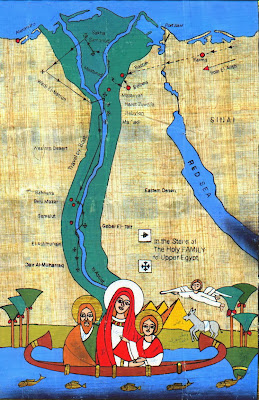
It
seems the Holy Family traveled with a midwife named Salome who isn't
mentioned in the Gospel but plays a role in the Coptic stories. Instead
of heading straight to Egypt to escape the wrath of Herod, they seem to
have zigzagged to the Plain of Jericho, then Ashkelon, then Hebron (at
least according to the various churches and monasteries situated in
those places), then proceeded to enter Egypt via the Land of Goshen, en
route to the town of Bilbays. Along the way they had an encounter with a
dragon in a cave, and were approached by wild lions, but of course
they all bowed down to the Baby Jesus. At Bilbays they rested under a
large tree, which was venerated in the Middle Ages by both Muslims and
Christians as the Virgin's Tree, which stood until 1850. Then they
headed to Samannud, where there is a church on the site of a well
blessed by Jesus. (Early Christian apocryphal infancy Gospels, as well
as the Qur'an, have Jesus talking while still in the cradle.) Then they
detoured northward to the Mediterranean coast at Burollos, stopping
there according to the monks of the place. Then, perhaps at Basus or
Sakha in Gharbiyya (Meinardus speculates on the place), Jesus left his
footprint on a stone.
Needless to say, they could not
ignore the Wadi Natrun, the Coptic version of Mount Athos, where the
four great monasteries of the Desert Fathers still stand (but of course
didn't then as Christianity hadn't been founded yet), though why they
were wandering in the desert instead of the delta in those days isn't
explained. Passing by from a distance, Jesus said to his mother, "Know O
my Mother, that in this desert there shall live many monks, ascetes
and spiritual fighters, and they shall serve God like angels."
(Apparently Mary would have known what a "monk" was, though it's hard
to know why.) Anyway, you can ask the monks if you doubt any of this.
Even
though Cairo wasn't there yet, you know Cairo isn't going to let all
these other towns have a claim and not find some of its own, don't you?
First they went to On, the ancient Heliopolis, not on the site of the
modern suburb of that name but on the site of Matariyya. There Jesus
took Joseph's staff, dug a well, and planted the staff, which grew into a
tree which became a goal of pilgrimage and was venerated by Muslims as
well as Christians. (The Qur'an has a story of Mary resting under a
palm tree, and this and the Matariyya tree became conflated in later
folklore. The Matariyya tree is a sycamore.) The present tree, still venerated, is alleged to be grown from the shoot of an older tree:
 |
| The Virgin's Tree, Matariyya |
 |
| Harat Zuwaila Church of the Virgin |
From there, the Holy Family went to a site
where, centuries later, the Harat Zuwaila quarter of Cairo would rise;
the Church of the Virgin there is one of the oldest in Cairo proper, and
the convent has a well blessed by Jesus.
(If you're
wondering why I haven't mentioned their stop in the Fortress of Babylon,
in a church many tourists visit today, it's because they stopped there
only after their tour of Upper Egypt. Trust me, it's coming.)
Next
they went to Ma‘adi, today an elite southern suburb of Cairo, and
attended a synagogue. Joseph got to know some Nile boatmen, who offered
to take them to Upper Egypt. (You're wondering how an exiled carpenter
and family fleeing from King Herod can afford all this Grand Tour?
Don't be so cynical: the legend has it covered: using the gold,
frankincense and myrrh brought by the Magi.)
I'm going
to condense a bit here since every Church of St. Mary up the Nile seems
to mark a site where the boat stopped and they visited a well or a
palm tree. But since Upper Egypt remains one of the more Christian
parts of the country, they couldn't skip such Christian centers as
Sammalout, Asyut, al-‘Ashnmunein, or the great monastery known as Deir
al-Muharraq.
One of the legendary sub-stories here
deserves telling, though. Up near al-‘Ashmunein, two brigands who had
been pursuing the Holy Family since Matariyya (must be the gold,
frankincense and myrrh again) tried to rob them. They grabbed Jesus and
Mary cried, and one of the robbers repented, and they left them. And —
as any folklorist should have figured out by now — these were the same
two thieves, including the same Good Thief, who would be crucified
alongside Jesus! How could it be otherwise?
 |
| Deir al-Muharraq Today |
The
constant travels were finally relieved when the Holy Family were taken
in by a devout Jew and lived for six months (and ten days: I told you
the stories are detailed) at the site of the Monastery of Deir al-Muharraq, south
of al-Qusiya. The monks of the monastery say it was the first monastery
in Egypt, built just after the arrival of Saint Mark as the Apostle of
Egypt. If you doubt that, take it up with the monks, not me. Or with the monks at St. Anthony's in the Eastern Desert, which is usually seen as the earliest.)
 |
| Abu Sarga Church Crypt |
Then
the angel came to Joseph and told him it was safe to go back to
Palestine. (That part actually is in the Gospel of Matthew, unlike
everything else in this post.) They stopped at pretty much every Coptic
village that would ever have a Church of the Virgin on their way back
down the Nile, and feeling they had not yet done enough for future
Cairo tourism, they stopped inside the Roman fortress known as Babylon
and, perhaps having run out of gold and frankincense, stayed in a cave
that is today the crypt of the church of Saint Sergius (Abu Sarga),
conveniently adjacent to the Coptic Museum and included on many Cairo
tours.
I hope I don't sound too cynical here: the
stories are charming and are clearly a pious attempt to elaborate on a
brief reference in the Gospel in order to make the Christian link to
Egypt more tangible to believers. On the other hand, the sense that
every Church of Saint Mary in Egypt actually sheltered the Virgin and
Child seems a bit credulous.
I hope my Coptic friends
recognize that I am helping spread knowledge of your tradition, even if
I may not accept every detail as historically attested. I'd really
like to know more about that dragon.


 Posts
Posts

