
| The Daily Show With Jon Stewart | Mon - Thurs 11p / 10c | |||
| ||||
Showing posts with label minarets. Show all posts
Showing posts with label minarets. Show all posts
Monday, December 14, 2009
If You Thought I was Hard on the Swiss . . .
In case some readers thought that my postings on the Swiss ban on minarets were too rough on the Swiss, note that this Jon Stewart Daily Show clip leaves them with more new holes than their famous cheese (Warning: Not Safe if You're Swiss, and some rather mild vulgarity, though nothing as vulgar as the anti-minaret campaign):


Thursday, December 3, 2009
A Few More Words About Minarets: Facts are Stubborn Things
Since my posting on the Swiss and the minaret ban a couple of days ago, it has come to my attention that many right-wing and anti-Islamic blogsites are reveling in what they seem to think is an aha! moment proving that minarets are indeed triumphalist. I'm not going to link: you can google for them if you wish. But they keep repeating the same point (I've now seen it several places): that Turkish Prime Minister Recep Tayyip Erdogan supposedly said:
Okay: let's look at some facts, which, as John Adams once said, are stubborn things:
Mosques are our barracks, domes our helmets, minarets our bayonets, believers our soldiers.And this, supposedly, proves that minarets are seen as a triumphalist gesture over Christianity. (Apparently this quote also was used during the Swiss campaign.)
Okay: let's look at some facts, which, as John Adams once said, are stubborn things:
- Erdogan did utter those words, and was prosecuted and imprisoned for doing so, as being a violation of Turkish secularism. He was not, of course, Prime Minister at the time.
- They are not his words. He was reciting a poem by the great Turkish nationalist Ziya Gökalp.
- Ziya Gökalp was not an Islamist. In fact he was a staunch Kemalist secularist, committed to the Westernization (though not necessarily democratization) of Turkey. He was a sociologist, poet, and ultra-nationalist, a complex man deeply influenced by Emile Durkheim. Erdogan was quoting his poem a bit out of context as I think those applauding the Swiss referendum (and those who jailed Erdogan for quoting the poem) are quoting Erdogan out of context.
- They were not written about Christianity or Western Europe: they are essentially, I think, intended to defend Turkey's cultural heritage.
Tuesday, December 1, 2009
A Few Words About Minarets
Okay, if you have an interest in the Middle East (otherwise why are you here?) you already know about the Swiss referendum banning the construction of new minarets in the country a few days ago, but if you've been in a cave all week this is as good an introduction as any. Switzerland has successfully defended its mountainous redoubt, which has avoided wars for centuries by an armed populace, democracy (women got the vote in the 1970s, long after half the Arab world), fondue, and extremely clever army knives, from an architectural feature. [Hey, if Swiss voters can stereotype Islam, I can stereotype Switzerland. Apologies to those Swiss who didn't vote yes.] An unusual coalition of anti-immigration types, xenophobes, and feminists — with differing motivations obviously — somehow coalesced to ban the minaret. What structural features should we go after next? Domes? Cupolas? Steeples?
I usually stay out of the immigration/Islamophobia/wilder shores of paranoia debates, because they produce more heat than light and too often just give publicity to the folks trying to deepen divisions that are already a problem. But this one does verge on the absurd.

In the first place, as the NYT article notes, of 150 mosques and prayer rooms in Switzerland, only four have minarets, and only two more minarets are planned. None broadcast the call to prayer; apparently the fastidious Swiss noise laws guarantee that already, so waking the neighbors up at dawn is not an issue.
There's an enormous amount of commentary out there in the blogosphere, with the right seemingly proclaiming a triumph over the imminent Islamic takeover of Switzerland (they're five percent of the population!), and the Muslim world of course reacting in shocked fury. I'm not going to echo the more anti-Muslim bloggers: you have Google if you really want to see it. Some of it's pretty bad. The notorious poster of the campaign is offensive enoughthat I won't reproduce it here, (okay: changed mind: see adjacent: I may take it down if it's too divisive), but Juan Cole has (and even now that I have, too, you should really read his post anyway), and it shows more minarets sitting on the Swiss flag than the four that actually exist in the entire country. And the NYT notes that 90% of Switzerland's Muslims come from Turkey and Kosovo, and the niqab-veiled woman in the poster would be breaking the law in Turkey, and from the pictures some friends who just spent two years in Kosovo showed me, I don't think it's typical of Kosovar garb either. Juan Cole's post evokes Cordova and the glories of Islamic Spain, and Juan's at his indignant best when he concludes:
Now kal over at The Moor Next Door also has an interesting post: I wish he hadn't lumped the Inquisition, Crusades, anti-Semitism and the Holocaust together in the first sentence (rhetorical overkill that will alienate some potentially friendly readers), since while Europe as a whole did all those things Switzerland at best only banked the profits; nonetheless I mostly agree with him on the rest.
The campaigners against minarets have used some very strange arguments that suggest the authors have either an unfamiliarity with the history of religious architecture in general or of Europe in particular: if the minaret — which is merely the means to call people to prayer in the pre-electronic age — is an attempt to declare Islam's superiority to everyone else (one of the arguments used), then what is a Gothic cathedral? What is Chartres if not a declaration that God (in Christian terms) is far superior to worldly things? I've been much more awed by Chartres and several other Gothic cathedrals than by the minaret of the mosque that's just up the road from my house. But I don't want to ban Gothic cathedrals. That would be comparable to the Taliban blowing up the Buddhas of Bamiyan.
It's also odd that the minarets in the objectionable poster look distinctively Ottoman (and thus rather missile-like: no doubt intended) and that other iconography used in the campaign seems to be derived from Hagia Sophia. It may be the "typical" mosque for many people who've never been east of Istanbul, but it wasn't built as such: It is, of course, the Emperor Justinian's grandest church in Christendom, transformed into a mosque after 1453. Who's triumphalist now?
It's an odd choice of symbols, frankly. Yes, the minaret is distinctly Muslim, but in some ways it is the architectural successor of bell towers and steeples: one of the specific restrictions on Christian churches in most Muslim countries was the banning of bells, and as Cole notes, the Swiss ban on minarets is a modern analog to that: except that none of the Swiss mosques with minarets broadcast the call to prayer.
The good news is that a mosque does not need a minaret. The earliest mosques were simply rooms set aside for prayer (and many still are). This is a slap in the face to Muslims but it neither stops them from practicing their religion or somehow reduces immigration. It just offends. I'm not Swiss and I'm not a Swiss voter so it's not mine to decide, and I suspect the far too frequent elitism of European political leaderships led to an assumption that this couldn't pass until it did; I can't imagine what it actually accomplishes.
I usually stay out of the immigration/Islamophobia/wilder shores of paranoia debates, because they produce more heat than light and too often just give publicity to the folks trying to deepen divisions that are already a problem. But this one does verge on the absurd.
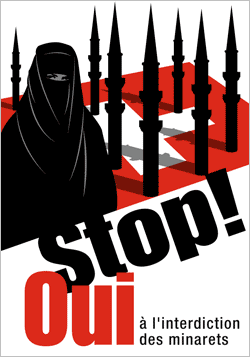
In the first place, as the NYT article notes, of 150 mosques and prayer rooms in Switzerland, only four have minarets, and only two more minarets are planned. None broadcast the call to prayer; apparently the fastidious Swiss noise laws guarantee that already, so waking the neighbors up at dawn is not an issue.
There's an enormous amount of commentary out there in the blogosphere, with the right seemingly proclaiming a triumph over the imminent Islamic takeover of Switzerland (they're five percent of the population!), and the Muslim world of course reacting in shocked fury. I'm not going to echo the more anti-Muslim bloggers: you have Google if you really want to see it. Some of it's pretty bad. The notorious poster of the campaign is offensive enough
The other Wahhabi state besides Saudi Arabia, Qatar, has allowed the building of Christian churches. But they are not allowed to have steeples or bells. This policy is a mirror image to that of the Swiss. So Switzerland, after centuries of striving for civilization and enlightenment, has just about reached the same level of tolerance as that exhibited by a small Gulf Wahhabi country, the people of which were mostly Bedouins only a hundred years ago.Actually, Juan, Qatar was mostly Bedouin when I was in grade school, and that's nowhere close to a hundred years ago (though my daughter thinks so), but I know what you mean. Also, Juan uses the word "enlightenment" with a small "e" here, but with a capital in his post heading, and at least as far as the "Enlightenment" (big "e") goes, I don't think of it as particularly Swiss. I know, Geneva has links to Rousseau (born there) and Voltaire (lived there), but also it's John Calvin's Calvinist city-state. And Geneva is the one part of Switzerland that went against the ban on minarets anyway. And I can't think of a lot of Enlightenment (big e) figures outside Geneva. (Go ahead and attack in the comments. I'm no expert here.)
Now kal over at The Moor Next Door also has an interesting post: I wish he hadn't lumped the Inquisition, Crusades, anti-Semitism and the Holocaust together in the first sentence (rhetorical overkill that will alienate some potentially friendly readers), since while Europe as a whole did all those things Switzerland at best only banked the profits; nonetheless I mostly agree with him on the rest.
The campaigners against minarets have used some very strange arguments that suggest the authors have either an unfamiliarity with the history of religious architecture in general or of Europe in particular: if the minaret — which is merely the means to call people to prayer in the pre-electronic age — is an attempt to declare Islam's superiority to everyone else (one of the arguments used), then what is a Gothic cathedral? What is Chartres if not a declaration that God (in Christian terms) is far superior to worldly things? I've been much more awed by Chartres and several other Gothic cathedrals than by the minaret of the mosque that's just up the road from my house. But I don't want to ban Gothic cathedrals. That would be comparable to the Taliban blowing up the Buddhas of Bamiyan.
It's also odd that the minarets in the objectionable poster look distinctively Ottoman (and thus rather missile-like: no doubt intended) and that other iconography used in the campaign seems to be derived from Hagia Sophia. It may be the "typical" mosque for many people who've never been east of Istanbul, but it wasn't built as such: It is, of course, the Emperor Justinian's grandest church in Christendom, transformed into a mosque after 1453. Who's triumphalist now?
It's an odd choice of symbols, frankly. Yes, the minaret is distinctly Muslim, but in some ways it is the architectural successor of bell towers and steeples: one of the specific restrictions on Christian churches in most Muslim countries was the banning of bells, and as Cole notes, the Swiss ban on minarets is a modern analog to that: except that none of the Swiss mosques with minarets broadcast the call to prayer.
The good news is that a mosque does not need a minaret. The earliest mosques were simply rooms set aside for prayer (and many still are). This is a slap in the face to Muslims but it neither stops them from practicing their religion or somehow reduces immigration. It just offends. I'm not Swiss and I'm not a Swiss voter so it's not mine to decide, and I suspect the far too frequent elitism of European political leaderships led to an assumption that this couldn't pass until it did; I can't imagine what it actually accomplishes.
Subscribe to:
Posts (Atom)


 Posts
Posts

