A Blog by the Editor of The Middle East Journal

Putting Middle Eastern Events in Cultural and Historical Context

Wednesday, July 8, 2015

Middle East Mysteries: What happened to Submarine INS Dakar in 1968?

INS Dakar before leaving Britain, 1968
History offers plenty of unsolved mysteries, thus affording titles to various poorly made series on cable TV, and this blog has occasionally tackled them, including why at least four Egyptians with shadowy intelligence links have died in London, three by falling off balconies (two of those from the same apartment tower), or who, exactly, other than the shooter himself, was behind the assassination of Vichy Admiral Darlan in Algiers in 1942.

But those are probably cold cases because intelligence services were determined to keep them that way. Today, though it's not an anniversary or anything, I thought I'd deal with a mystery of the sea.

In 1965 Israel negotiated the purchase from Great Britain of three "T" class submarines built during World War II. One of these, HMS Totem, became INS Dakar (not after the city in Senegal but from the Hebrew word for the fish, the grouper.)

On November 10, 1967, she was commissioned into the Israeli Navy. It was a difficult time for the Israeli Navy, because only three weeks before, on October 21, 1967, the ex-British destroyer INS Eilat, patrolling off Port Said  some months after the 1967 War, was sunk by two Styx anti-ship missiles by an Egyptian Komar-class missile boat.

The Dakar conducted sea and dive trials off Scotland, returned to Portsmouth in December, and on January 9, 1968, she departed Portsmouth en route to Haifa. captained by Commander Ya'akov Ra'anan with a total crew of 69. She left Gibraltar on January 15 and was originally scheduled to reach Haifa on February 2, but as she made good time across the Mediterranean, Ra'anan asked to move the arrival up and was authorized to move the arrival up to  January 29.  He requested the 28th instead but was told that would not allow time to prepare the reception ceremony.

On January 24 at 0650 hours she radioed her position as 34.16°N 26.26°E, east of Crete.  She made three more contacts that did not include her location, the last just after midnight on January 25.

That was the last she was heard from until 1999.

From the beginning there were efforts to locate Dakar, but for several reasons these did not succeed for 31 years.  On January 27, Cyprus heard one distress signal from an emergency buoy (she carried two), but nothing further. Greek, Turkish, British, and American Navies joined in the search along with the Israelis. The initial search was finally abandoned on February 4. The Israeli Navy denied she had been lost to hostile action, and suggested she might have gone down during a crash dive test.

There were many speculations. Ra'anan was considered  an experienced but somewhat adventuresome captain and there was speculation that the fact he made such a quick crossing meant he was either pushing her hard or perhaps had gone off course to spy on Arab coasts.

On February 9, 1969, over a year after her disappearance, her stern emergency beacon was found washed ashore by a fisherman at Khan Yunis in Gaza. Studies of the buoy and its mooring cable led to the conclusion that she had gone down in relatively shallow water (150 to 300 meters) and was some 50 to 70 nautical miles off her course. (These miscalculations threw future searches off for many years; when found in 1999 she lay in nearly 3000 meters and on her original course.)

There were the usual diversions; the Egyptian newspaper al-Akhbar claimed in 1970 (during the War of Attrition) that Dakar was sunk by depth charge by an Egyptian vessel; a later claim suggested she had been challenged but went into a crash dive. There is no real evidence of this and one claim
put this just off Alexandria, far from where Dakar was eventually found. After the Egyptian-Israeli peace treaty. In the 1980s an Israeli search was made off the Sinai coast with Egyptian liaison officers aboard, but nothing was found. Nor did searches near Rhodes bear fruit. Further searches were made by the US and Israeli Navies in the 1980s.

The recovered conning tower, Haifa
It was not until 1999 that Dakar was finally found by a US-Israeli expedition equipped with the remotely operated vehicle Remora II which found Dakar, on the seabed between Crete and Cyprus, at a depth of some 3000 meters. She lay on her keel, facing northwest, the front of the hull intact and flooded, the rear crushed and twisted. Her conning tower was recovered and is part of the Navy Museum in Haifa.

Though finally found, the cause of her sinking is still something of a mystery. There is clearly no sign of hostile action in the available evidence.


In 2013 the State Archives released a number of documents, but this was long after the wreck was discovered. One apparently suggests a possible sinking by the Soviets, but again, there is no sign of hostile action.

As she was a diesel submarine that needed to take in air through a snorkel when submerged,  a process known as snorting, one theory is that during or just after snorting she began to take on water in the forward hull due to some mechanical failure. The flooded forward hull would explain why that part remained intact while the stern was twisted and broken after she descended below her crush depth. In any event, she suffered a catastrophic descent.

When the new Israeli submarine INS Tanin was en route to Israel in 2014, she paused above the Dakar's final resting place to honor the dead.

If you have any interest in the strange and synchronicity, note that in 1968 four separate countries lost submarines while submerged: USS Scorpion  (possible torpedo explosion but many other theories), the Soviet K-129, lost in the Pacific in March and later partially salvaged in a famous CIA operation, the French Minerve, oddly lost off Toulon within two or three days of the loss of Dakar in the eastern Mediterranean, and never located.

For further reading:

"How Did Israel's Dakar Submarine Sink 45 years Ago?," Ha'aretz,March 10, 2013.

"The Mystery of the 'Dakar,'" Jerusalem Post Magazine, May 27, 2009.

"State Archives release documents detailing possible causes behind the 1968 sinking of Israeli submarine, that killed 69," Jerusalem Post, March 10, 2013.

"INS Dakar," Wikipedia.

"INS Dakar," at www.submarines.dotan.net.

"The Loss of the INS Dakar," Submariners' Association, Barrow-in-Furness Branch.

Tuesday, July 7, 2015

"Abou Naddara" Press Run Available Online from Heidelberg

Ya‘qub Sanu‘a
Ya‘qub Sanu‘a (also James Sanua) (1839-1912) was a pioneering Egyptian journalist, dramatist, and satirist in the 19th century who published a popular satirical paper, mostly from exile in France, with various titles but using variations on his nom de plume, "Abou Naddara," (the man who wears glasses). From an Egyptian Jewish family, he wrote variously in Arabic, French, English and Italian, and also knew Hebrew. His publication from French exile was smuggled into Egypt and became quite popular. His cartoons were the first to be captioned in Egyptian colloquial rather than Standard Arabic, and political cartoons still do this routinely.

The University of Heidelberg now has posted the complete run of newspapers from 1878 to 1910, along with other materials including unpublished manuscripts, online as "The Abou Naddara Collection."

Historians of Middle Eastern Journalism and of Egyptian politics in the late 19th and early 20th century should find this a valuable resource.

Le Monde on Cairo's Windsor Hotel

Back in 2013 I did a post on Cairo's venerable Winsdor Hotel and its famous Barrel Bar. (Unfortunately, the embedded YouTube video link no longer works.  So I thought I should link, for the record, to an article on the subject that appeared in Le Monde last month: "L’Egypte anachronique du Windsor"

Monday, July 6, 2015

Iraqi Air Force Accidentally Bombs Baghdad

An Iraqi Air Force Su-25 has unintentionally dropped one of its bombs on the neighborhood known as New Baghdad, reportedly killing several civilians.  The bomb apparently had failed to drop during the bombing mission, but reportedly worked loose and dropped as the aircraft was returning to base.

As people died, I will make no further comment.

The Ottoman Lahej Campaign against Aden, July 1915, Part 2

In Part One of this post on Friday, I generally set the scene for the fighting around Lahej in southwest Arabia in July of 1915, a century ago, when the critical British Crown Colony of Aden was threatened by Ottoman forces advancing from Yemen. If you haven't yet read Part One, I recommend you do so before reading this.

With British regulars tied down on the Western Front in France, and the Australian and New Zealand ANZACs trapped on Gallipoli, the Crown Colony of Aden, key fueling port between Suez and British India, was defended only by Indian Army troops and the Brecknockshire Territorial Battalion of South Wales Borderers, a Territorial or home defense unit sent out from Wales. By the end of June it had become clear that Ottoman forces in Yemen, having moved their command HQ to Ta‘izz   in the southern part of Yemen (later North Yemen), were preparing to move on the Sultanate of Lahjej, one of the protected states in what Britain called the Aden Protectorate, the locally-ruled hinterland of the Aden Colony. The ‘Abdali Sultan of Lahej had received British guns and advisers, but as it became clear that a superior Ottoman force was advancing on Lahej, the British commander and Political Resident in Aden prepared to advance to protect the near approaches to Aden.

Major General D.L.B. Shaw, the Resident and force commander in Aden was hesitant to send a "Moveable Column"  to Lahej due to conflicting intelligence reports but finally on July 3, 195, received a message from the Viceroy of India that 600 Turks, 400 Arabs and eight guns were threatening Lahej. The Moveable Column, assembled at Sheikh ‘Uthman north of Aden, was commanded by Lt. Col. H.F.A. Pearson of the 23rd Sikh Pioneers, and consisted of half a battalion of the Brecknockshire Territorials, a company of the 23rd Sikh Pioneers with four machine guns, half a battalion of the 109th Indian Infantry with four machine guns, two companies of the 126th Baluchistan Infantry, 6 15-pound guns of the Camel Battery and four 10-pounders of the Mountain Battery, both of the Royal Garrison Artillery, and elements of the 23rd Fortress Company, Bombay Sappers and Miners. Total infantry strength was about 350 British Territorials and 500 Indians. The Lahej Sultan, his mercenary forces already scattered in the Ottoman advance, may have had lttle more than 300 loyal troops remaining.

This "Moveable Column" finally began to move toward Lahej at 3 AM on July 4. An advanced guard of machine gunners in motor vehicles set out ahead of the largely camel-dependent column. By 10:30 AM 100 of the 109th Infantry and the Sappers and Miners reached Lahej, but as the South Arabian day heated up, much of the column straggled, the South Wales Borderers in particular suffering from dehydration and heatstroke covering the 45 kilometers/28 miles. As I said in part One, South Yemen in July is not South Wales.

By 5 PM on July 4, it is estimated that only 300 or so infantry had reached Lahej, the rest straggling and the 15-pounder battery stuck in sand to the south. More troops trickled in, but the Ottoman force advancing on Lahej forced the Anglo-Indians back through the town to camps in gardens to its south. The British column also suffered from the desertion of its camel drivers, some of whom were tribal rivals of the ‘Abdali Sultan of Lahej.

Speaking of whom, the current ruler of Lahej, Sultan Sir ‘Ali II ibn Ahmad al-‘Abdali, was watching the action from  a balcony of his residence (or in other versions fleeing town) when he was shot, reportedly by a British bullet in friendly fire, and died on July 13.  Captain F.C. Squires, Col. Pearson's Adjutant, was killed in the fighting in the town as well. The Aden Protectorate had not only failed to protect one of its "protected" sheikhs, it killed him.

The Anglo-Indians held on through the night, but their position was untenable, their logistics train gone with the desertion of the cameleers. The rest of the column was stuck four and  half miles south of Lahej trying to protect the 15-pounder artillery pieces stuck in the sand. Pearson was outnumbered and out of ammunition. Both he and Shaw saw no alternative but to fall back.

The intention was to fall back on Sheikh ‘Uthman outside Aden, a critical point as it controlled Aden's water supply. But Shaw ordered a withdrawal even from Sheikh ‘Uthman, to the boundaries of the Crown Colony, where the guns of the Royal Navy in the harbor (HMS Minto, Northbrook, Empress of Asia, and Empress of Russia) could protect the vital port.

Maj. Gen. Sir George Younghusband
With Ottoman troops now virtually on the outskirts of the vital Imperial post of Aden, the Viceroy of India, Lord Harding,  was alarmed. Shaw's vacillation had lost him the Viceroy's confidence, and he asked the War Office to reinforce Aden with a brigade under Sir George Younghusband from Egypt with his 28th Indian Brigade. Younghusband took command in Aden and received other reinforcements and replacements, and would retake Sheikh ‘Uthman and other key area north of Aden. I'll discuss that another time.

But Lahej would remain in Ottoman hands until 1918. While not a debacle on the scale of Kut or Gallipoli, it threatened a key lifeline of Empire and was a clearcut Ottoman success.

Sources for further reading online:

Abdol Rauh Yaccob, "Anglo-Ottoman Rivalries in South West Arabia Prior to and During the First World War, 1906-1919,"  SOAS PhD. thesis 1995.

The Soldier's Burden, "Military Operations in Aden, 1814-15,"

Friday, July 3, 2015

The Barren Rocks of Aden: The Ottoman Lahej Campiaign, July 1915, Part I

Last November  I posted "Landing at Sheikh Sa‘id and Turba Fort: a British Landing in Yemen on This Day in 1914," about a British landing inside the borders of Ottoman Yemen in 1914. But that was not the end of fighting in South Arabia. In July of 1915, a century ago, Ottoman forces from (North) Yemen and he Hejaz invaded the Sultanate of Lahej (today usually Lahij), also known as ‘Abdali after the ruling family, one of the inland states of what the British called the Aden Protectorate (as distinguished from the Crown Colony of Aden), and threatened the Aden colony itself.The events described here began in early July, but I don't choose to post over the Fourth of July weekend, so I'm telling the tale now, and continuing it next week.

Let's review, after the map below, the situation in southwest Arabia in 1915.
The Crown Colony of Aden was a critical way +station on the route to British India. Beginning in the 19th century, Britain had signed treaties with the tribal rulers inland, in order to secure the water supply and hinterland of Aden colony, and created a network of nine sheikhdoms under British protection, but still under nominal Ottoman suzerainty. Lahej or ‘Abdali was the closest to the port of Aden, and its fall would threaten the key British colony between Suez and India.

Prior to the Arab Revolt in 1916, the Hejaz was securely Ottoman, and North Yemen an Ottoman province ruled by its traditional Zaydi Imam. Aden (the Crown Colony at least) was a critical interest of Britain, but the British Regulars were tied down with the Western Front in France and the ANZAC colonials clinging desperately to the Gallipoli Peninsula. So Aden was being defended by Indian Army troops and a few Territorial troops (raised for home defense) from England. By July 1915, Aden Garrison Commander (and also Political Officer)  Major General D.L.B. Shaw had at his disposal the 23rd Sikh Pioneers, the 109th Infantry, and half of the 126th Baluchistan Infantry, along with the Brecknockshire Battalion (4th Battalion, South Wales Borderers), a Territorial Unit of only partially trained Welsh troops.

As memorialized in the famous pipe tune "The Barren Rocks of Aden," (see the end of the post), mean daily maximum temperatures in Aden in July run between 35°-40°C (95°-104°F) with humidity above 60%. I have never had the privilege of visiting Brecknockshire, but I suspect they were considerably less acclimated of this sort of thing than, for example, the Baluchistan Infantry. South Yemen is not South Wales.

Recognizing the threat, the British provided the ruling Sheikh of Lahej with money, rifles, four field guns and a seconded British artillery officer to teach the Sheikh's men to use he big guns.

In March of 1915, British intelligence in Aden estimated the strength of the Ottoman 7th Army (though this "Army" had the strength of a normal Ottoman Corps)  in Southwest Arabia at 15,000 men, including 6,000 from the 40th Hudayda Division, 5,000 from the 21st ‘Asir Division, and 4,000 from the 39th Division. The Hejaz Division remained in Hejaz.  Other estimates were slightly smaller, but many were garrisoned and only a third of the total strength was considered fit for offensive operations. The commander , ‘Ali Sa‘id Pasha, was considered a competent commander.

Total strength of the Ottoman force early in the war was estimated at 35 battalions, though not all available for battle Total strength of the Indian and Territorial troops in the Aden garrison may have been little more than 3,000, some of them needed to defend the coast and Perim Island. And others had been transferred to Somaliland and France.

While this was being reinforced, the numbers were still daunting, and the Ottomans had loyal allies among many local tribes. In May and June they had sent negotiators to the Sultan of Lahej.

Anglo-Indian assessments of the situation seem to have been rather slow on the uptake perhaps due to slow communications between Aden and the Indian summer capital at Simla in Kashmir. Only at the end of June did the Lahej Sultan warn that 1000 Turkish troops and 10 guns (other reports say 2,000 and six guns). While the Anglo-Indian authorities had some doubts about the Lahej Sheikh's reliability  (though he seems to have been their only real source), they finally realized something serious was going on, and a real threat to Aden was emerging.

As the saying goes, to be continued.

Thursday, July 2, 2015

Israel is Said to OK Beefing Up Egyptian Troops in Sinai

Under the 1979 Egyptian-Israeli Peace Treaty, Israel must approve of any strengthening of Egyptian troops in Sinai, but The Jerusalem Post is reporting that the IDF is prepared to approve any such requests as Egypt steps up its response to yesterday's bloody attacks near the border.

Officially, the last Army statement on yesterday's casualties spoke of 17 soldiers killed, but there are many reports suggesting the number was above 60.  Even the state-owned Ahram Online website says that "There have been discrepancies in reports about the number of those killed in the militant attacks."

Wednesday, July 1, 2015

Bloody Day in Sinai

Today's bloody clashes between jihadists and Egyptian security forces around the town of Sheikh Zuweid in northern Sinai is some of the worst violence yet in the peninsula, and marked the third straight day of bloodshed in Egypt after the assassination of the Prosecutor General on Monday and two bombings yesterday in the Cairo satellite suburb 6 October City.

Claims by the Army, the "Sinai Province of the Islamic State" (formerly Ansar Bayt al-Maqdis, now Wilayat Sina') conflict, with the Army admitting to about 17 dead on its side after multiple attacks; other estimates of government losses are higher The Army struck back with air and helicopter attacks and claims to have killed 100 of the attackers.Sinai is a closed military zone with no media access, but all reports agree there were multiple attacks against Army checkpoints and police stations and that the attackers controlled the town of Sheikh Zuweid for a while.

And we are only halfway through Ramadan.

Tuesday, June 30, 2015

ASOR Quiz: Can You Identify These Near Eastern Languages?

Somehwhere along the line the American Schools of Oriental Research (ASOR) were apparently assimilated by Buzzfeed, but their "Can You Identify These Near Eastern Languages?" is a nice challenge. Hint: Number 10 is not Near Eastern at all. At least in our world.

I got 10 out of 10. Can you?

Monday, June 29, 2015

The Battle of Badr and the Precedent for Fighting in Ramadan


 God  gave you victory at Badr when you were weak; fear God and perhaps you will be grateful.

         
  When you said to the Believers, "Is it not enough that God reinforced you with three thousand angels sent down?
           —Holy Qur'an, Sura 3 (Al ‘Imran), 123

It is proving to be another violent Ramadan, with violent jihadi attacks in Kuwait and Souuse and Grenoble, and today's assassination in Cairo. Ramadan is meant to be a month of peace and reconciliation, and warring Muslim states have sometimes held cease-fires during Ramadan, but in  fact there is no outright prohibition on fighting during Ramadan, a fact jihadists use to step up violence in what they see as a holy war against those they see as enemies, even their fellow Muslims.

The precedent lay in the very earliest years of Islam, just two years after the Prophet's hijra from Mecca to Medina. In AH 2 (AD 634), the Prophet Muhammad and his small Muslim forces fought against the more powerful Meccans in their first great battle, at Badr. It is one of the few battles mentioned by name in the Qur'an (above), which attributes the victory to Divine intervention. The traditional date of Badr is the 17th of Ramadan, AH 2.

Nor was Badr that unusual. Saladin's defeat of the Crusaders at Hattin in 1187 was also in Ramadan, and in Muslim tradition is said to have taken place the morning after the Laylat al-Qadr. (See the link for explanation.)

Less than a century later in 1260, the Mamluks finally stopped the Mongol invasion of the Middle East at another Battle in Galilee, at ‘Ain Jalut, fought in Ramadan.

On October 6, 1973, Egypt and Syria launched the 1973 Arab-Israeli War. The crossing of the Suez Canal may be remembered for taking place on Yom Kippur, but it was also the 10th of Ramadan. A code name for the Canal crossing was, in fact, Operation Badr. One of Egypt's satellite cities near Cairo is named 10th of Ramadan.

And during the Iran-Iraq War Iran even named an offensive which it launched in Ramadan the Ramadan Offensive.

Most Muslims would prefer not to fight in Ramadan, but there are numerous precedents, and in recent years jihadist terror violence has often spiked in Ramadan.

A Strike in the Heart of Cairo

The assassination of Egypt's top prosecutor, Public Prosecutor Hisham Barakat, in Heliopolis today marks the first successful assassination of a senior government official since the crackdown of 2013. Although here have been attacks on police, security forces, and judges, the killing of Barakat marks a new threat to the most senior levels of stat power, and following terror attacks over the weekend in Kuwait and Sousse in Tunisia, is the latest violence in what is emerging s a dangerous Ramadan.

Friday, June 26, 2015

This Store's Marketing Department Could Use Some Diversity Training

I'm not sure where this photo was taken, but I don't think they have the right target demographic.

Thursday, June 25, 2015

Egypt Plans Stamp for Opening of "New Suez Canal," Apparently Forgetting that Earlier Stamp

Egypt has announced plans to issue a commemorative stamp to honor the opening of the "New Suez Canal" project, expected August 6. Artists are competing for the design.

Apparently they are forgetting, or have sent down the memory hole, the fact that they already issued one, as I noted here last year:

The Suez Canal is a sea level canal. It does not have locks. The lock shown is in Panama.

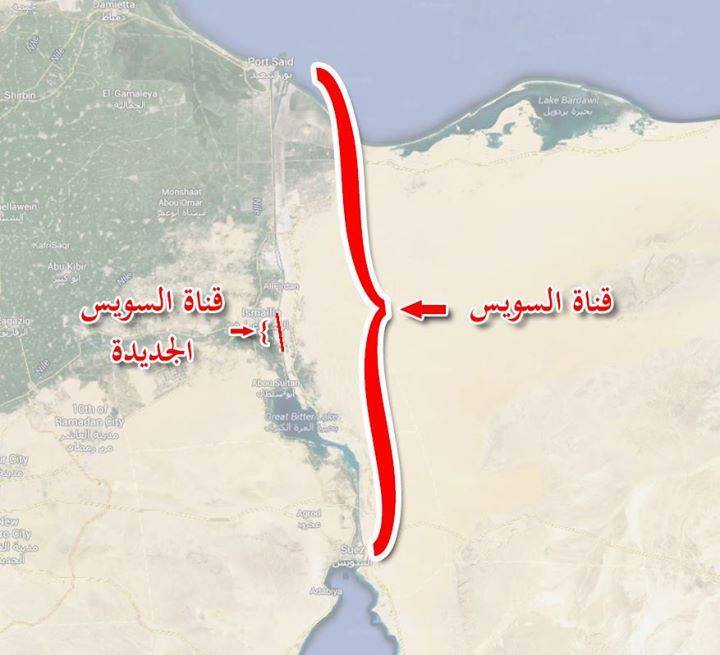
The "New Suez Canal" project, though much hyped and promised to be complete in a single year, is apparently on schedule. The catch is, it is not a new Suez Canal. It is a new shipping channel along part of the existing Canal, as well as new tunnels under the Canal and works on either side. The current canal runs 164 kilometers. The new  channel is 72 km, of which only 35 km is new dry-land digging; other areas are being deepened and widened, essentially creating a new channel mostly between Lake Timsah and Ismailia.. This graphic may help:
Large bracket on right, The Suez Canal. Small line at left, the "New Suez Canal."

The graphic is a bit unfair as it doesn't include areas being dredged and expanded or other improvements.

Bad Ideas: #SummerinSyria

You would think that in an age of instant communication and social media, old-style propagandists would realize that they need new tactics. SANA, the Syrian Arab News Agency (the Asad regime's official agency), came up with a brilliant (?) idea:
Predictably, the Internet pounced, with people posting pictures of the horrors of the Syrian war. Some examples appear in articles by The Huffington Post, The Washington Post,  and Al Jazeera.

List of Digital Resources for Middle East History

A useful list: "11 Essential Digitized Collections for Middle East Historians."


Tuesday, June 23, 2015

Syria's Embattled Druze Between al-Nusra and Asad

It isn't just the Druze of Israel and the Golan who are alarmed by the attacks by Jabhat al-Nusra on the Druze of Syria, but so far the Syrian Druze seem more intent on defending their threatened territory rather than seeking support from the Asad regime or Israel. Usually irrepressible Lebanese Druze leader Walid Jumblatt initially responded to the massacre of Druze villagers in northern Syria. Jabhat al-Nusra reportedly executed at least 20 Druze civilians in the northern governorate of Idlib, an area without a large Druze population. But the killings raised alarm in the more heavily Druze southern governorates of Sweida and Dar‘a. Sweida is heavily Druze and Dar‘a, where fighting has been heavy since the outbreak of the war, has a substantial Druze population as well. Sweida governorate is the region of the Jabal Hawran, also known as the Jabal Druze. Both Sweida and Dar‘a governorates adjoin the Jordanian border.

Irrepressible Lebanese Druze leader Walid Jumblatt initially called he massacre an isolated incident, and told a press conference, "We don’t need Assad or Israel. Both of them take a sectarian stance with the aim of perpetuating sectarianism and dividing the country.” But he also flew to Jordan to meet the King and intercede for the safety of Druze refugees in Jordan. Both Sweida and Dar‘a adjoin the Jordanian border.


Syrian Druze, like Syrian Christians and ‘Alawites, have traditionally supported he regime as a protection of minorities against Sunni jihadis. While some Druze leaders have continued to urge Druze to enlist in the regime army, others have said Druze fighters are absolved of responsibility to the regime and should defend their own home villages.

Jebel Druze State under French Mandate
Increasingly, as with the Kurdish region in the north that now calls itself Rojava, the Druze of Syria are looking to their own self-defense. During the French Mandate period, which deliberately partitioned Syria and Lebanon on sectarian lines, the Jabal Druze enjoyed a brief autonomy with its own flag, until France had to put down a Druze revolt.  The flag of the Jabal Druze 'state' in the Mandate period is the basis for variations used today as a Druze flag,

Modern Druze Flag
Whether we are returning to those days, with separate Kurdish, ‘Alawite, and Druze enclaves, or simply towards  collapse into anarchy, remains an open question.

Monday, June 22, 2015

Golan Druze Attack IDF Ambulances Carrying Syrian Soldiers

Twice today there were reports of attacks by Golan and Israeli Druze against Israel Defense Forces (IDF) carrying wounded from the Syrian civil war, The first attack occurred in the upper Galilee Druze town of Hurfeish, leaving one local Druze wounded. The second attack, near Majdal Shams in the Golan, reportedly involved a crowd of 150 and left one Syrian soldier dead and several wounded, including the Israeli driver and doctor.

The incidents come amid growing tensions among local Druze in the Galilee and Golan, concerned about attacks on their fellow Druze inside Syria by yhe jihadist Jabhat al-Nusra. Since the United Nations Disengagement Observer Force (UNDOF) was forced to withdraw last fall from the buffer zone to the Israeli forward line of control, both the IDF and the UN peacekeepers are essentially on the front line of the Syrian civil was.

Reeent background pieces in The Washington Post and the Irish Times (many of the UN peacekeepers are Irish troops) have dealt with the growing tensions as the Golan Druze demand protection for their Syrian co-religionists, many of whom have family ties across the disengagement line. Apparently the attacks on the ambulances were insire by fear that the wounded Syrians were Jabhat al-Nusra, though the Israeli reports seem to imply they were regime soldiers. Isral has regularly been treating Syrians wounded in the civil war in field hospitals in the north.

The growing danger that the fighting in Syria could spill into the Golan (or into Jordan), makes the Golan front a dangerous one.

Friday, June 19, 2015

Wikileaks Strikes the Saudi Foreign Ministry

Wikileaks claims it is posting "more than half a million cables" from the Saudi Foreign Ministry, doing to Saudi Arabia what they previously did to he US State Department. Press release here. The first 70,000 were released today, and there's a search page here.

The first few documents I've seen were OCRed, and seem to be either garbled or hard to read; they're in Arabic of course.

Light Blogging for a Bit Longer

I'm on deadline so blogging will be light for a few days longer.

Wednesday, June 17, 2015

Ramadan Karim

Ramadan will begin at sundown tonight and the fast will begin at dawn tomorrow in the US and most Middle Eastern countries that follow the Saudi determination. Ramadan Mubarak wa Ramadan Karim to my Muslim readers.

Süleyman Demirel, 1924-2015

Demirel and Bill Clinton, 1999
Süleyman Demirel, many times Prime Minister of Turkey and ultimately its President, has died at the age of 90. As head of the Justice Party and later the True Path Party, he served as Prime Minister 1965-1971 (deposed by military coup, sporadically for several terms in  1975-1980 (again deposed by military coup), mostly alternating with the Republican People's Party's Bülent Ecevit, and finally from 1991-1993. From 1993 until 2000 he served as Turkey's 9th President.

I'll let my Turkish readers judge Demirel's legacy. Coming soon after the recent death of Kenan Evren, and the recent elections, it is also a reminder underscoring how Turkey has changed since the seventies and eighties.

Tuesday, June 16, 2015

The YPG Victory at Tal Abyad

The capture of the Syrian border town of Tal Abyad from ISIS by the Syrian Kurdish People's Protection Units (YPG), combined with the previous fall of Kobane and other border areas, is a real setback to ISIS and threatens its source of international fighters reaching Syria via Turkey. The victory has also increased the flight of Sunni Arab refugees into Turkey, leading to charges by some Arab fighters that the YPG is ethnically cleansing the area; the YPG denies this and has urged the refugees to return.

Turkey is also concerned, both due to the renewed influx of refugees, and because the YPG's parent party, the Democratic Union Party (PYD) in Syria, is affiliated with the Turkish Kurdistan Workers' Party (PKK).

The Kurdish front against ISIS gets little coverage in the West, and what does get covered is mostly reported from Erbil in Iraq's Kurdistan Regional Government (KRG)-controlled areas. But the YPG is slowly capturing the Syria-Turkish border region of northeastern Syria (which Syrian Kurds call Rojava) from ISIS.

On a lighter note, I just learned Blogger's spellchecker does not include the city of Erbil in its dictionary. It suggested "gerbil" instead.

Standard Arabic, Algerian Arabic, and Kabyle

Lameen Souag at the Jabal al-Lughat linguistics blog has a piece called "The irrelevance of the standard in Algeria," citing a new study relevant to our ongoing discussion of Arabic diglossia. An excerpt:
I recently came across a nice little study of language attitudes among Kabyles in Oran, inheriting Kabyle from their parents and kin but living in an overwhelmingly Arabic-speaking context: Ait Habbouche 2013. The results will not come as a huge surprise to anyone familiar with Algeria, but they stand in stark contrast to a curiously widespread idea about Berber language endangerment: the notion that Berber is under threat from the government-imposed hegemony of Standard Arabic. What the survey answers reveal, time after time, is in fact the utter failure of government policies to create any meaningful space for Standard Arabic in daily life. It is no surprise to see that Standard Arabic is used by 0% of respondents with other Kabyles in the cafe or at home. But seeing that only 4% speak it even at work, and 0% in university, should be a shock to anyone who still imagines that Standard Arabic occupies a position analogous to, say, Standard German. The taboo on speaking Standard Arabic in any but the most formal quasi-academic conversation remains nearly absolute; 73% rated it as the language they used least. The only topics surveyed for which this option was selected by any significant number were religion and politics, and actual usage in both cases would probably reveal a mix of Standard words into a basically dialectal matrix. There are absolutely no signs that this group is shifting to Standard Arabic, or even sees this as a viable possibility. The language that has attained a large usage among these speakers, even with other Kabyles, is not Standard Arabic but Algerian Arabic - a language with no official status taught in no school, which was the least likely (2%) of any of the available languages to be rated as most beautiful or richest, and was rated by 42% as the language they liked least (nearly tied with Standard Arabic). Yet this little-loved language, dismissed as much by its speakers as by their rulers, is not only the main language they use with non-Kabyles but is extensively used even with fellow Kabyles (42% with their own siblings). 

Monday, June 15, 2015

As Ramadan Approaches, UK Muslims Discuss Fasting Hours

Ramadan starts this week, very close to the longest day of the year, and a debate that arises from time to time has cropped up again, as one British Muslim scholar suggests following Mecca times for Ramadan in northern Europe, where the days can be extremely long in summer. Something similar is practiced by Muslims north of the Arctic circle, where the sun never sets in high summer, and was also the case for the Saudi astronaut aboard the space shuttle some years back, when sunsets were about 90 minutes apart in orbit.

Wednesday, June 10, 2015

Karnak

Update: blogging will remain sparse another day or so. I'll be back. (Say in Schwarzenegger voice.)

Blogging has been sparse due to deadlines, but I should say something about the attempted suicide bombing at the Temple of Karnak. Egypt's tourist industry has been struggling to revive since the revolutionary upheavals of 2011-2013, and this presents a tempting target to radical jihadis. Just recently there was an attack on tourist police near the pyramids, and now this failed suicide bombing at Luxor's Temple of Karnak. No tourists were injured, but reports say some police and shopkeepers were wounded.

The attack on foreign tourists at the Temple of Hatshepsut at Deir al-Bahri in 1997 (just across the Nile from Luxor) killed 62 people 58 of them tourists, and remains the worst attack on tourists to date, though there have been others, especially in Sinai. I suspect this will not be an isolated case.

Monday, June 8, 2015

ErdoÄŸan Headline of the Day

I'll let others analyze the deeper meaning of the Turkish elections and the frustrations to Recep Tayyip ErdoÄŸan's dream of amending the Constitution. The anti-ErdoÄŸan Hurriyet Daily News has this telling headline:

"Water cannon producer’s stock dips after Turkey’s ruling AKP loses majority."
The largest supplier of police water cannons in Turkey has seen a steep fall in its stock prices, hours after the ruling Justice and Development Party (AKP) lost its parliamentary majority.
Shares in Katmerciler Ekipman, the company that manufactures the riot control vehicles popularly known as TOMAs, decreased 10 percent early June 8. 

Sunday, June 7, 2015

Sports Notes: Triple Crown Winner's Owner Once Ran Egypt's Stella Brewery

The main news on  Saturday was the victory of thoroughbred American Pharoah (officially so spelled on his registration, so racing fans will never spell "pharaoh" correctly again) in the Belmont Stakes, making him the first horse in 37 years to win the Triple Crown. You may already know that he is owned by Egyptian-American businessman and breeder Ahmed Zayat. I thought it worth mentioning that Zayat (besides identifying himself variously as both Muslim and an Orthodox Jew; a Yeshiva graduate and living in an Orthodox neighborhood in Teaneck, New Jersey) used to run Egypt's Al Ahram Beverages Company, which among other things brews Stella Beer, a number of other beers, and produces Gianaclis wines.

Al Ahram beverages had been nationalized under Nasser and its quality control suffered; when it was privatized in 1997 Zayat  and a group of investors bought it, expanded its product line (including a non-alcoholic beer) and improved quality control. In 2002 the company was sold to the Heineken group, though Zayat remained involved in its management until 2007.

So if you have access to a bottle of Stella, raise a glass to a record-making three year old thoroughbred with a misspelled name.

Friday, June 5, 2015

Tariq ‘Aziz, 1936-2015

Tariq ‘Aziz, who has died at the age of 79, was Saddam Hussein's longtime Foreign Minster and Deputy Prime Minister, and thus was the public face the Saddam regime showed other countries. If many found him more acceptable and less blood-soaked than his colleagues, that was certainly why he was the public face; he was still the regime's key apologist. ("He wasn't quite as monstrous as all the others" is not really an epitaph anyone wants, though.) Though sentenced to death after the fall of the regime, he was not executed. He suffered a heart attack in prison and died after being taken to a hospital.

Born Mikhail Yuhanna, he was the highest-ranking Christian in the regime, a Chaldean Catholic (though I rather suspect not a regular churchgoer). I note his passing, but will not say RIP.

June 5 + 48 Years

It's another June 5, the anniversary of the event from which so much of modern Middle Eastern history stems: the 1967 War.  As I'm rather busy, it seems best to simply link to earlier posts on that warm, of which there have been many.

Thursday, June 4, 2015

The Middle East Connections of Both NBA Championship Coaches

A very busy day so not much blogging. I'm not that big a basketball fan unless my alma mater or a local pro team is involved, but with the NBA finals underway, I should note Haaretz' piece "Middle East veterans to meet in NBA finals." 

Cleveland coach David Blatt is an Israeli dual citizen and former coach of Maccabi Tel Aviv, and Golden State coach Steve Kerr is a Beirut-born son of the late, great scholar and AUB President Malcolm Kerr, assassinated in Beirut in 1984. I met Malcolm Kerr a few times but had no idea of this connection
.