A Blog by the Editor of The Middle East Journal

Putting Middle Eastern Events in Cultural and Historical Context

Showing posts sorted by relevance for query Bulgaria. Sort by date Show all posts

Friday, October 2, 2015

Genesis of a Quagmire: The Debate Over Advancing to Baghdad, 1915: Part I

It has been some time since we looked at the British campaign in Mesopotamia (Iraq) a century ago. But in the last days of September and first days of October 1915, or a century ago right now, the British government in London, the British government of India in its summer capital in Simla, and some of the commanders on the ground (not all) made a hasty decision that, over the six months that would follow, would lead to the surrender of a British Empire army. Even as Britain was realizing its failure at Gallipoli and preparing to withdraw its Australian, New Zealand, and British troops from that particular disaster, it was creating another along the Tigris. Gallipoli wasted lives and accomplished little, but the British were able to withdraw and evacuate in late 1915 and early 1916. But in Mesopotamia, or "Mespot" as the soldiers named it, they would blunder into a months-long siege and ultimately surrender an Army at Kut. In this current series I want to look at how the fateful decision to take Baghdad was made, largely on political grounds rather than military (in fact, the plan was to take Baghdad and then withdraw). I will leave it to your own conclusions what parallels might be drawn with later foreign decision making in Mesopotamia.

First we should review some of the background so far. Even before the Ottoman Empire joined the Central Powers, Britain had determined to use Indian Army troops to protect the oilfields and refinery around Abadan in Iraq, and to do so, determined to take the port city of Basra in Ottoman territory.

For those wishing to refresh their memories, past blogposts on the beginnings of the campaign:

October 1914: Anglo-Ottoman Maneuvering in the Gulf, Part I

1914: Pre-War Maneuvering in the Gulf, Part II:Contesting the Shatt and the Dispatch of Force "D"

First Fights on the Road to Basra, November 6-12, 1914

The British Take Basra, November 21-23, 1914

The Battle of Shaiba, Iraq, April 12-14, 1915 

After each stage the British would test Ottoman defenses and move forward up the Tigris. further securing their Basra operational base. After Shaiba, the Ottoman leadership did not try to recapture Basra: the bulk of the Turkish fleet (and some German and Austrian vessels, were concentrated in the Mediterranean defending the Straits, or in the Black Sea against the Russians. British naval supremacy in the Gulf remained unchallenged. But as the British moved upriver, the big Royal Navy combatants could not follow, only riverboats. The original goal of securing Basra soon faded under the lure of Baghdad. (Remember the 1,001 Nights were widely read in 19th and early 20th century Britain.)

Dramatis Personae
Gen. Sir John Nixon, upstaged by his hat
In April of 1915, General Sir John Nixon had taken over as overall commander of the Mesopotamian campaign. An Indian Army officer and veteran of the small colonial wars of the Victorian era, Nixon was considered experienced, but not in wars against a major power.

The Ottoman commander on the Iraq front at this time was Nureddin Pasha (Nurettin Paşa). A member of the Committee on Union and Progress (the Young Turks) and a veteran of the occupation of Yemen and the Balkan Wars, he also took up his Iraq in April 1915 after his predecessor committed suicide.


Nureddin Pasha
Mesopotamia, particularly southern Mesopotamia, was not a priority for the Ottoman Minister of War, Enver Pasha. Constantinople itself was threatened by the Allied Forces at Gallipoli, and Russian troops were on Turkish soil on the Caucasus Front. Nureddin, who would later play a major role in the Turkish war of independence, was a fighter but the priority given to other fronts meant he lacked resources, particularly the farther he was from Baghdad.


Townshend
General Nixon was the overall theater commander, but the commander of the army column advancing upriver was Major General Sir Charles Vere Ferrers Townshend, Commander of the 6th Indian Division, a veteran of war in Sudan (decorated at Omdurman), in India, and in the Boer War. In June his column had reached ‘Amara. In September the advance had been resumed.
 
 On September 28 1925 at Es-Sinn near Kut al-‘Amara on the Tigris, the British Indian Army defeated an Ottoman force and occupied Kut. I won't go into the tactical details of the battle here, which Wikipedia handles fairly well; on September 29, the expedition occupied Kut, a place that will forever be linked (and not in a good way), with Townshend's name.
The fall of Kut was not an unalloyed success. Though Nureddin had lost, he was able to retreat safely upriver to the ruins of Ctesiphon. Indian Army casualties had been higher than anticipated, supply lines from Basra were now stretched thin, as was medical support. But there was another temptation before Nixon and Townshend: Kut was only 100 miles downriver from Baghdad.

The Bulgarian Factor
In the debate about advancing further to Baghdad that was to follow, British and Indian government officials had to take into account some broader geopolitical and strategic factors.

After the failure of the Suvla landings and the August offensive in Gallipoli to make any progress off the beaches, it was obvious to most that the forces would eventually have to be evacuated. A Western success, even a limited one, against the Ottomans might redeem a bit of the failure of Gallipoli. But there was a major strategic shift in the making.

Even only a year into the Great War, it was probably easy to forget that the war had begun over the assassination of Austrian Archduke Franz Ferdinand and Austria's demand for revenge against Serbia. Austria had been kept quite busy dealing with Russia in the east and, from earlier in 1815, with Italy, which had entered the war on the Allied side. But it had also fought on the Serbian front and the Serbian Army was in serious trouble.

Bulgaria had been neutral in the war. It had pan-Slavic sympathies with Russia, but had lost territory to Serbia in the Second Balkan War. But by the Fall of 1915 the Central Powers had successfully wooed Bulgaria with temptations of recovering lost territory from Serbia, Romania (which would soon enter the war on Russia's side), and Greece. Bulgaria's Tsar Ferdinand cut a deal and at the time we are discussing, was poised to enter the war and invade a weakened Serbia from the south as Austria-Hungary pushed in from the north.

1915 German or Austrian postcard
But there was a big implication for the Ottomans. A pro-Central Powers Bulgaria and a defeated Serbia could mean unimpeded rail connections between Berlin and Vienna and Constantinople. German assistance could flow directly overland, and that would be a boon to the Ottomans. The German-language "Bulgarien mit uns!" postcard, while a bit of a step down from the Hohenzollern motto "Gott mit uns," reflects this. Bulgaria's entry would eventually bring Romania and Greece unto the fight, and tie down an Allied landing force at Thessalonika.

So in the debate over the "On to Baghdad" question, the impending entry of Bulgaria on the other side was also a factor in the Anglo-Indian calculus.

In Part II, we'll look at the debate itself.

Monday, December 9, 2013

Wrapping Up the 1943 Conferences: Second Cairo


Over the past few weeks we've gone into some detail about the first two of the three World War II summits held in Cairo and Tehran 70 years ago in November and December 1943; one remains to be mentioned, the Second Cairo Conference, held in Cairo between Roosevelt, Churchil, and Turkish President İsmet İnönü on December 4-6. I'd planned to post this Friday, nearer the actual dates, but felt the Mandela posts took precedence.

Second Cairo tends to be overlooked, but of the three it was the one with the most direct connection with the affairs of the Middle East, the venue but not the subject of the others. As İnönü's presence receals, this was an effort, though an unsuccessful one, to bring Turkey into the wa on the Allied side.

Churchill, whose preoccupation with Europe and with attacking the enemy through the "soft underbelly of Europe" dateed to his championing of the Gallipoli campaign in World War I, was eager to outflank the Axis-controlled Balkans and had been urging an Allied occupation of Rhodes; bringing Turkey into the war was an element in his plans. FDR and the US Chief of Staff were never enthusiastic about these schemes, seeing them as distractions from the invasion of France.

Churchill had met secretly with İnönüearlier in the year in Adana; İnönü, who had succeeded Kemal Atatürk as President in 1938, was dubious; he feared an attack from Axis Bulgaria, and he suspected (correctly) that Stalin still harbored the ancient Russian desire for Constantinople. At Tehran, Stalin pledged to FDR and Churchill his willingness to assure İnönü that if Bulgaria dclared war on Turkey, the Soviets would declare war on Bulgaria. But Turkey was not reassured.

Churchill had also, earlier, supported a huge financial package for Turkfey, but FDR and Stalin reduced the size of the package, feeling bringing Turkey in was less critical.

İnönü's party leaderswhip did not want him flying to Cairo; Turkey proposed a meeting in Adana, or across the border in Aleppo, but in the end it was Cairo, and he flew in US Army plane from Adana to Cairo.

In the end, Turkey remained neutral. The dmaller financial package was part of it, but FDR and the American Chiefs, suspicious of what thet saw as a Churchill obsession with the Turkish Straits (and remembering Gallipoli), were not all that disappointed.

In the end. Turkey joined the Allies only in 1945, in the last weeks of the European war.

Thursday, February 12, 2015

Zeppelins in the Middle East: Part I: Military Use in Libya and the Improbable Tale of "Das Afrika-Schiff"

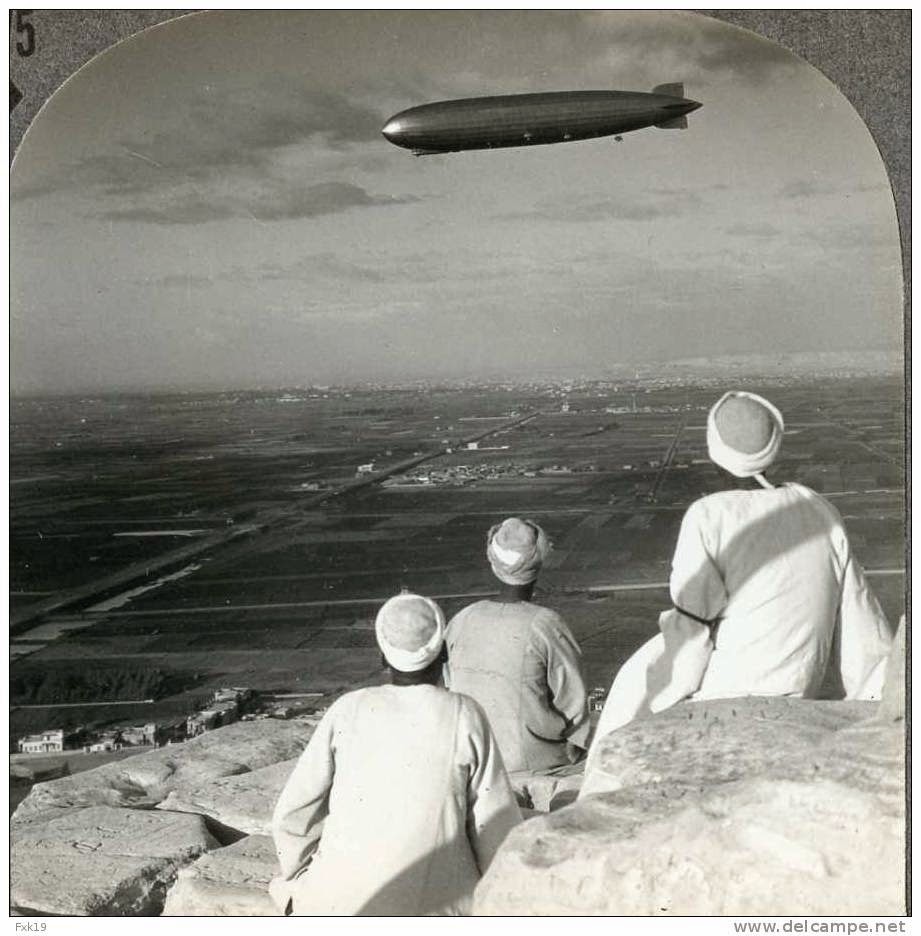
Graf Zeppelin at the Pyramids, 1931
(This replaces an earlier version of this post which was corrupted.)

The great age of luxury Zeppelin travel was a brief one in the 1920s and  1930s, memorably concluding with the Hindenburg disaster in 1937. The rigid dirigible airship, designed by Count (Graf in German) Ferdinand von Zeppelin in the 1890s, originally was used for military applications through World War I; Count von Zeppelin died in 1917,and the Zeppelin company was taken over by Dr. Hugo Eckener. Barred by the Versailles Treaty from building military Zeppelins, Eckener eventually won the right to build Zeppelins for civilian transport, and created the idea of these luxury liners of the sky for European and American elites, that could carry people across the Atlantic in comfort faster than a ship, at a time when heavier-than air aircraft were not yet ready to carry passengers so far.

Dr. Eckener's gem was the Graf Zeppelin, named for Count von Zeppelin and intended to demonstrate the Zeppelin's capabilities as the airborne version of a luxury liner. As the Weimar Republic struggled to recover from World War I, she became a major showpiece for the reputation of German aeronautical engineering. Later that year she made her first Transatlantic trip, to the US. She would make other high-profile flights, including a round-the world-flight in 1929, but here I wish to discuss her two visits to the Middle East, in 1929 and 1931.

But those trips, including photos, will appear in Part II of this post. Here in Part I, I want to discuss military Zeppelins in the Middle East.

Earlier Zeppelins in the Region

But first, a few words about military Zeppelin use in the Middle East prior to the golden age of luxury Zeppelin travel.  During the Italo-Turkish War of 1911-1912, Italy became not only the first country to drop an aerial bomb from a heavier than air airplane, but probably also the first to use dirigibles for bombing. (Some use "Zeppelin" for all rigid dirigible airships, others only for the German products).

Italian Dirigible Bombing in Libya
During the bombing of Libya in 2011 I noted this on this blog, and posted this photo of Italian dirigibles dropping bombs on Turkish positions in Libya.

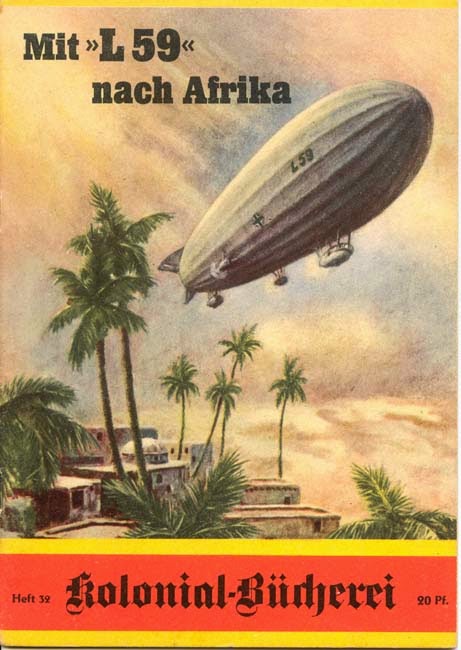
L59: "Das Afrika-Schiff"

At least as far as I am aware, the next use of a Zeppelin over the Middle East was an abortive German attempt to relieve its beleaguered forces in  German East Africa (Tanganyika, now the continental part of Tanzania) during World War I. General Paul von Lettow-Vorbeck's force in German East Africa was caught between British forces in Kenya and South African forces under General Jan Smuts. (Film buffs may note that this campaign is the context of the great, fictional, Bogart-Hepburn movie The African Queen.)

Determined to resupply their forces n East Africa, the Germans sent Zeppelin L59 to Bulgaria (a German ally) in November 1917. Its ambitious mission was to overfly British-occupied Egypt and Sudan without being detected, carrying some 25 tons of weapons and supplies to von Lettow-Vorbeck's Schutztruppe. Because hydrogen would be unavailable in East Afrika, it was intended to dismantle her there,  cannibalizing her parts to supply troops, including making her skin into tents. (The narrative which follows is based on numerous published and online accounts of the mission.)

Postwar German Brochure
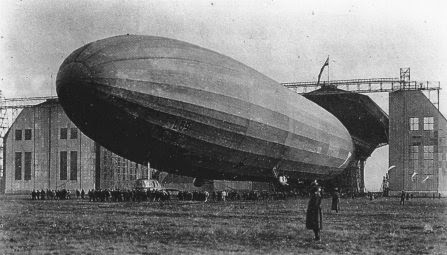
It would be a dangerous mission: her top speed would be only 50 mph, making her a sitting duck for British fighters based in Egypt, Sudan, or Kenya. The Zeppelin, whose production designation from the Zeppelin works was LZ 104, was redesignated the L59 in German Naval service. Her sister ship, L57, had originally been chosen for the Africa flight, but crashed and burned during trials.

The Zeppelin works' Dr. Eckener himself piloted her to Jamboli airfield in Bulgaria, a German ally, where  command was handed over to KapitanLeutnant (Lieutenant Commander) Ludwig Bockholt of the German Navy.

Ludwig Bockholt
Bockholt, earlier in 1917, had drawn attention when, in command of Zeppelin L23,  he had lowered a prize party from the Zeppelin to capture the Norwegian sailing ship Royal, still the only incidence in history in which a Zeppelin captured a surface ship. So he may have seemed the right man for a daring mission.

Zeppelin LZ 104/L59
After two false starts,she took off on November 21, 1917. She passed across Turkish airspace (allied with Germany) and headed out over the Mediterranean. Over Crete she encountered a thunderstorm and, as was standard practice, retracted her radio antenna to avoid lightning strikes. Meanwhile in East Africa, von Lettow-Vorbeck had suffered a defeat and was withdrawing into rough terrain where the Zeppelin could not land (he eventually crossed into Portuguese East Africa/Mozambique. The German Colonial Office tried to recall the L59 but with her antenna retracted she missed the signal.

Route of L59 in Africa and After
At 5;15 AM on November 22, L59 crossed the African coast near Mersa Matruh. As the morning sun heated the Sahara below, the airship experienced considerable turbulence; the heat of the days and bitter cold of the desert nights also affected the crew adversely, some even experiencing hallucinations.

She passed over the Farafra and Dakhla oases on course to parallel the Nile from Wadi Halfa. On that afternoon, however, her forward engine seized up. She continued to make good time on her remaining engine, but the forward engine controlled the power to her radio transmitter, so she was from that point on unable to transmit, though she could receive with some difficulty.

While the loss of the transmitter made it impossible to contact Germany, it may have had another benefit: British Intelligence knew the Germans planned to make the attempt, but were unsure of the timing; British fighters in Egypt and stations in Sudan and Kenya were ordered to watch for and intercept her, and were listening for her radio transmissions. Her inadvertent radio silence may have helped her evade detection.

Sundown on the 22nd found L59 over Sudan; she had reached the Nile and was following it southward. the sharp drop in desert temperatures at night caused her hydrogen bags to lose buoyancy and she lost altitude.

At 12:45 AM on the 23rd, L59 finally received the German recall order. There was some debate as some preferred to go on, but Holbock decided to turn back. Meanwhile, about 3 am, her loss of buoyancy due to the cold caused her to stall and nearly crash in the desert, but control was regained.

Finally, about 125 miles west of Khartoum, L59 turned around and headed for home.he had passed over Egypt and half of Sudan, and now had to pass over them again without being detected.

There has been some controversy over the recall message. British Intelligence operative Richard Meinertzhagen would claim that it was a British ruse, broadcast in German naval code and claiming von Lettow-Vorbeck had surrendered. The British may have transmitted recall messages (though days later they were still looking for Zeppelin in East Africa, so they apparently did not know where it was. The recall message was not about a surrender, but a retreat, and the message recorded in L59's log reportedly matches the one sent by the German Navy. Meinertzhagen's recent biographers have called into question his once famous diaries, which appear to be full of fabrications.

L59 successfully avoided detection and reached the Mediterranean. She was not quite home free, having another loss of altitude after night fell and nearly crashed in western Turkey, which was at least friendly ground, but recovered, and landed back at Jamboli at 7:45 am on November 25. She had flown for 95 hours and 4,200 miles without landing, a Zeppelin record that would stand until the great ocean-crossing passenger Zeppelins of the 1920s and 1930s.

Since the original plan was to dismantle L59 once in Africa, and with Lettow-Vorbeck now in Mozambique, the Germans had no immediate plans for L59, so they decided to modify it to carry bombs and keep it in the Mediterranean theater. On March 11-12, 1918, she raided Italy, bombing Naples.

Its next mission was an attempt to bomb Port Said and the Suez Canal.later in March reached a point about three miles from the target, when contrary winds forced a retreat. Unfavorable winds also forced abandoning the backup target, Suda Bay in Crete.

On April 7, 1918, L59, still commanded by Bockholt, took off from Jamboli to bomb the British base at Malta. She crossed the Straaits of Otranto and headed towards Malta. The German submarine UB-53, running on the surface, witnessed her passing low overhead; the U-Boat commander estimated her altitude at 210 meters and reported he could see the details of the Gondola.

A bit after the Zeppelin passed over, the U-Boat commander reported hearing two explosions and then witnessing a giant flame descending into the sea. She was listed as lost to an accident since neither the Italians nor the British claimed to have brought her down; none of the crew of 21, including Bockholt, survived.

Some in the German Navy's Zeppelin service reportedly suspected that UB-53 might have mistaken L59 for an Italian airship and shot her down, then realized their error. This is unproven, and UB-53 herself went down after hitting a mine in Otranto in August 1918.

That's the strange tale of Zeppelins in wartime in the Middle East. Tomorrow, the luxury liners of the sky era: Graf Zeppelin's 1929 and 1931 visits to the region.

Wednesday, December 4, 2013

Tehran Conference 1943, Part II: The Young Shah Meets the Big Three


In yesterday's post on the Tehran Conference 70 years ago, I brought the narrative down through November 28, including the young Shah's meetings with the Big Three. (On the Iranian background see the previous post.

Let's start with a contemporary British newsreel of the conference, including the only video clip I've found of the Shah (meeting Churchill: stills with all three below.) Some of the videos I posted last week on the Cairo Conference also include the Tehran Conference.
An aside about Churchill's presentation of the "Sword of Stalingrad" to Stalin, shown in the video, though it's not really about the Middle East. The specially cast sword of Sheffield steel was a gift of King George VI to the heroic people of Stalingrad, was presented by Churchill to Stalin in a solemn ceremony on November 28. You will see in the video Chuirchill giving the sword to Stalin, and then Stalin passed it to Marshal Klimint Voroshilov, the senior Soviet military man at the conference and an old Stalin crony who had survived the military purges of the 1930s.

At which point Voroshilov immediately dropped the sword.

In the video,there is a cut-away after Stalin takes the sword, then you see Voroshilov, in uniform, handing it to an aide. The memoirs of Churchill and Harriman, the published parts of Hopkins' diary, the official Presidential log of the conference and George C. Marshall's official biography all omit this, but apparently Harold Nicholson's diary and some other witnesses noted it.

Back to the Middle East. Unlike Casablanca and First Cairo, Tehran addressed, at least briefly, two Middle Eastern questions: the future of Iran and the neutrality of Turkey. On the future of Iran, the Big Three pledged to respect Iranian independence when the war was over (following the toppling of Reza Shah and the occupation of Iran by Britain and the Soviets, the US had also established bases to facilitate the flow of Lend-Lease equipment to Russia, so none were noticeably respecting it in 1943). On Turkey, they discussed the meeting FDR and Churchill were about to have with Turkish President İsmet İnönü at the Second Cairo Conference. I'll discuss that more fully in my post on that conference, but Stalin agreed that if Turkey joined the Allies and Axis Bulgaria declared war on Turkey, the Soviets would declare war on Bulgaria.
Stalin, the Shah, V. Molotov (retouched)

I previously discussed the young Shah's accession to power under British and Soviet guns two years earlier. Normally, when three foreign leaders visit a country, protocol requires them to make a courtesy call on their country's leader, their (particularly nominal in this case) host. Instead, Roosevelt and Churchill entertained the young Shah at the Soviet Legation around noon on November 30.

But Stalin, presumably thinking in postwar terms, and previously unwilling to cross town to meet Roosevelt at the American Legation, was the only one to pay a formal visit to the Shah, where he assured him of Russia's respect for Iranian independence (though international pressure only got the last Soviet troops out of Iran in 1946).
The Shah and FDR
The Shah met with Roosevelt at noon, accompanied by his Prime Minister, Foreign Minister, and Chief of the Imperial Court. He gave the President an Isfahan carpet designed by the artist Imami measuring 18 by 30 feet.

The Shah and Churchill
The Shah also met with Churchill (though Churchill's six-volume memoirs don't seem to note it), seen at right and in the video above.

I'm leaving out all the meat of the conference. There was plenty of tension between the Big Three: Churchill and FDR over Mediterranean versus Western European strategy, and Churchill and Stalin over the postwar settlement and, given Churchill's deep anti-Communism and Stalin's Bolshevik history, Just Because. Things reportedly went better that evening when Churchill hosted a festive dinner in honor of his 69th birthday. That evening ended with jokes and even teasing among the principals. An explanation may lie in the story told by a Churchill aide that when the two men first met in Moscow in 1942, every meeting was rough going except their last, private lunch, with no one present but interpreters and multiple bottles of spirits and good Georgian wide. When the aides were readmitted, they found the two leaders in a good mood and getting along quite nicely, and the bottles emptied. This may have helped smooth things at the birthday dinner as well. Both Churchill and Stalin were known to like a drink. (This is untrue. Neither man liked a drink; both liked plentiful drinks. Roosevelt was no teetotaler, but he wasn't in the same league.)

On Wednesday morning, the first of December, the President's personal physician, Admiral Ross T. McIntire, expressed concern. He had approved the President flying to Tehran provided the aircraft did not have to climb too high, but learned Wednesday morning of a cold front that might interfere with the Zagros passes on Friday, rquiring the plane to climb to altitudes too high for the Presidrnt or some other members of his party. It was agreed to cut the conference short, with Wednesday, December 1, as the last day. The Combined Chiefs proceeded on to Cairo that day, leaving the Big Three to issue their Joint Declaration (affirming among other things Iranian independence). Roosevelt sent the Shah a silver-framed pictire and gave American chocolates and cigarettes to the staff of the Russian Legation. He departed and spent the night at a US Army base called Camp Amirabad, then proceeded the next morning to the Gale Morghe airfield and headed back to Cairo. Churchill traveled the same day.

Thursday, November 10, 2011

The Other Armistice: Mudros

Ninety-three years ago today a small party of Britons landed in Constantinople, on November 10, 1918, to prepare the way for the British Fleet, which steamed into the Ottoman capital on November 12. You can find a short account by British observer G. Ward Price here.

November 10, you may be thinking. But didn't the war end with the Armistice we mark tomorrow, on November 11? That armistice, the one we mark with the Remembrance Day/Veterans' Day holiday (on which I will post tomorrow), ended the hostilities between Germany and the Allies.  The other Central Powers left the war earlier: Bulgaria collapsed in September and signed an armistice in Thessalonica Austria signed an armistice with Italy after the two sides had bled each other dry, on November 3.

The occupation of Constantinople followed  the signing of an Armistice between the Allies (actually the British, who tried to exclude the French) and the Ottoman Empire, signed aboard HMS Agamemnon, an old, pre-Dreadnought class battleship at Mudros on the Greek island of Lemnos, on October 30, by Admiral Sir Somerset Arthur Gough-Calthorpe, Commander of the Mediterranean Fleet. (Even without the knighthood, could anyone named Somerset Arthur Gough-Calthorpe be anything but British?) This is usually referred to as the Mudros Armistice.
;
The last weeks of the war in the Middle East moved quickly.Beginning with the Battle of Megiddo in mid-September, General Allenby's forces in Palestine and their Arab allies took Damascus at the beginning of October and by the armistice had reached Aleppo. In Iraq, British forces rushed to occupy the Velayat of Mosul, giving Britain control of the oil of Kirkuk. A curious little British expedition known as Dunsterforce rushed north from Iran to block an Ottoman conquest of Baku, and were besieged there. (What do Kirkuk and Baku have that interested the British, class? Three letters, starts with "o".) Though the Ottoman position in Palestine and Iraq had collapsed, and the collapse of Bulgaria cut off supplies from Germany via Austria, Enver Pasha decided to grab land from the weakened Russian front, with Russia in the midst of civil war; that's why Baku was threatened.) Some old clips appear in this documentary, which sees oil as a major factor:


 When the Ottomans wanted to open talks with the British, they used as an intermediary the highest-ranking Brit they had on hand, General Charles Townshend, who had surrendered a British and Indian Army at Kut in Iraq in 1916 (the largest British surrender ever, until Singapore 1942.) While the Indian enlisted men he surrendered at Kut died in large numbers in Ottoman POW camps, Townshend spent the rest of his war as a different sort of POW, in a sort of comfortable house arrest on an island off Constantinople/Istanbul. Townshend thought he could get easy terms or the Ottomans; in fact the terms were tough. You can read Townshend's memoirs of his negotiations online here, though I think he may inflate his own role a bit.

The whole drama of dismantling the Ottoman Empire, of the Treaty of Sèvres, the partition of the Empire, the rise of Republican Turkey, and the Treaty of Lausanne has been told many times and is in many ways the creation story of the modern Middle East. (There are many good sccounts, though the best title on the subject has to be David Fromkin's A Peace to End All Peace.) The Mudros Armistice is one of the less-remembered stages in that drama.

Thursday, October 29, 2015

October 28, 1915: Sir Charles Monro Relaces Ian Hamilton at Gallipoli

Though this post is technically a day late, or a day early perhaps (see below), it is an attempt to bring our centennial series on the Middle East in the Great War up to speed by returning to the Gallipoli Front where, from mid-October to mid-November, as decisions would be made which would lead to the decision to wind down and evacuate the Dardanelles force.

Gen, Sir Ian Hamilton
On October 16, months after the Gallipoli operation stalled following the Suvla landings in August, General Sir Ian Hamilton, the overall commander, was recalled by Lord Kitchener. Hamilton, despite being one of the more disastrous British generals in a war when Britain produced more than is share of disastrous generals, retired to write books of military memoirs and became head of the veteran's organization, the British Legion, for Scotland. He remained a pillar of the British establishment though, as a leader of the Anglo-German Association, he was an early admirer of Adolf Hitler. Having already been knighted in 1910, he was made a Knight Grand Cross of St. Michael and Saint George (GCMG) in 1919. To be fair, they say he wasn't bad in the Boer War. He lived until 1947 and died at 94.

Gen. Sir Charles Monro
Replacing Hamilton as the Commander-in Chief of the Mediterranean Expeditionary Force was General Sir Charles Monro, a veteran of the Boer War and the Western Front. He was also an advocate of the Western Front first approach, though he would end up commanding in the Salonika Front, Mesopotamia, and India before the war was over. As we'll see in the coming weeks, he would also be the advocate of withdrawal from Gallipoli. He arrived at Imbros, the staging area, on October 28, and at Gallipoli October 30, so posting today splits the difference.

He would find support from another direction: the growing demands of the Balkan Front. As I noted in discussing the Mesopotamian Campaign, Bulgaria had finally entered the war on the Central powers side, and promptly attacked Serbia, which was already partly occupied by Austria-Hungary, thus giving the Ottomans the prospect of a direct rail link with Vienna and Germany. Though a bit peripheral to the Middle East proper, the British and French sought to shore up a collapsing Serbia by landing a military force at Salonika (Greek Thessaloniki) in Greece. They did this despite opposition from a divided Greek government. In the end it was too late to save Serbia, so the rationale became defending Greece (whether it liked it or not) against the Ottomans and Bulgarians.

The French would send mostly colonial troops and the Russians and other allies would send token forces, and remnants of the Serbian Army who escaped through Montenegro and were evacuated by Italy would join them, but the obvious source of British Empire troops were the ANZAC, British, and Irish troops stuck at Gallipoli. Already on September 30 the 10th (Irish) Division left Gallipoli, landing at Salonika October 5. The troops on Gallipoli were clearly not going to take Constantinople, so Salonika, despite the crushing of Serbia, and were thus a potential source of troops.

Friday, September 26, 2014

A Century Ago: Turkey Closes the Straits, Declares Shatt al-‘Arab Inland Waters

In July and August, I posted a lengthy series of posts dealing with the seizure of Turkish dreadnoughts by the Royal Navy on the eve of the European war in 1914 (see here), the flight of the German battle cruiser and cruiser Goeben and Breslau to Constantinople and their incorporation in the Turkish fleet, and the secret German Treaty of Alliance between the Ottoman Empire and the German Reich (Part I; Part I; Part III; and Part IV). Even at the end of all that, Turkey maintained its officially neutral status, despite its Navy now being under German officers. Throughout September, as Turkey mobilized, the Western powers continued to believe that Turkey's allegiance was still undetermined. No one was eager to force the issue, since the Turkish Straits were Russia's lifeline.

Early in September, Constantinople announced that it was unilaterally terminating the system of Capitulations, under which Western consulates exercised extraterritorial rights over their own citizens in Ottoman territory. This was strongly protested by all the European powers, Germany and Austria included.

German (now Turkish) Admiral Souchon, whom we met in my earlier postings, was chafing at the bit, eager to sail against the Russian Black Sea Fleet, but the Turkish Cabinet remained divided, Grand Vizier Said Halim Pasha still trying to cut a deal with the Entente Powers, and War Minister Enver Pasha enthusiastically backing Germany. During this period, Germany reinforced its presence in Turkey by sending military men in civilian clothing by train or by boat down the Danube through still-neutral Romania and Bulgaria.

A century ago this weekend, Turkey would take another major step towards Ottoman belligerency, moving to close the Dardanelles to the shipping of the Allied (Entente) Powers, and also declaring the Shatt al-‘Arab between Ottoman Iraq and Qajar Iran as home waters closed to foreign shipping. Of these moves, (along with the closure of the waters around Smyrna/Izmir), the closure of the Dardanelles was the most provocative by far, being in direct violation of treaties and yet another violation (after the Goeben and Breslau) of Turkey's officially proclaimed neutrality.

But I misspeak. Turkey did not close the Strait. A local (German) commander did so.

Rear Admiral Carden
Late on September 26 or early on September 27 a Turkish warship armed with torpedoes, called a destroyer in some accounts and a torpedo boat in others (but with the ability to sink other ships either way), passed out of the Dardanelles into the Aegean. The British flotilla that had pursued the Goeben and Breslau remained in the Mediterranean to prevent their escape and was now under the command of Rear Admiral Sir Sackville Carden, who had replaced Admiral Milne after the escape of the Germans.

Carden's squadron intercepted the Turkish vessel and discovered German sailors on board. They were determined not to let sailors of  belligerent pass, branded it  violation of Turkish neutrality, and required the vessel to return to Turkish waters. Carden apparently had the approval of First Lord of the Admiralty Winston Churchill, but not of the British Foreign Office.


Erich Paul Weber (Weber Pasha)
The move would certainly not be well-received in Constantinople, but it didn't matter: the German commander of the fortifications on the Asian (the term at the time was "Asiatic") side of the Strait, Erich Paul Weber (1860-1933), was an Oberst (colonel) of engineers and later General, commanding the XV Pioneer Army Corps at Kum Kale. he had been in charge of the fortifications along the Asian side of the Dardanelles and, apparently entirely on his own initiative and without consulting the Ottoman Government, Weber Pasha (as he was known in Ottoman service) closed and mined the Dardanelles.

(There is an intriguing historical family connection of Weber Pasha, which I'll blog about later today.)

Already the Strait had been lined with mines and international shipping had been required to request a Turkish pilot boat to lead them through the minefields. Now the entire channel was mined, signs erected on the coasts, and the guns in the fortifications authorized to be prepared to defend the passage. Russia was cut off from warm-water access to its allies. And neither for the first nor last time in this autumn of 1914, a German officer was determining the policy of the Ottoman Empire.

The Entente protested of course, especially Britain. The Grand Vizier played it down, told the British Ambassador that he personally favored reopening the Straits, that perhaps if the British Squadron could withdraw a bit further into the Aegean, not so close to Turkish waters ...

The British were also noticing other signs of Ottoman drift towards the Central Powers. Egypt, under British de facto control since 1882, was still nominally an Ottoman territory, and the British had detected  Ottoman patrols that appeared to be probing the defenses of the Suez Canal.

As the Turks ratified Oberst Weber's closure of the Straits, only the Grand Vizier's conciliatory talk allowed the British to retain their hope that Turkey could be wooed away from its German suitors. But at the opposite end of the Ottoman Empire, similar calculations were at work.

British India was of course the "Jewel in the Crown" of the Empire, and it was no secret the Germans hoped to spark a revolt there; an alliance with the Turkish Sultan might alienate Muslims throughout the Raj. German naval vessels were known to be headed toward the Indian Ocean. And with the Royal Navy converting from coal to oil, the oil concessions of the Anglo-Persian Oil Company at Abadan were increasingly important.

The Abadan oilfields are on an island that lies between the waterway (itself formed by the juncture of the Tigris and Euphrates) known in Arabic as the Shatt al-‘Arab (roughly, coastline of the Arabs) and in Persian as the Arvand Rud, and a channel from the Karun River to the Gulf. This waterway is one of the most contentious border disputes in history, throughout Ottoman-Iranian history and including the Iran-Iraq war of the 1980s. But that's a post for another day.

In 1914 the Ottomans had an arguable claim (probably voided by a recent treaty with Persia/Iran) to Abadan island. Qajar Iran had the better claim under treaties, but both were pretty theoretical since the island was controlled by the local Sheikh of Muhammara (today Khorramshahr: this is in Iran's largely ethnically Arab Khuzistan), and he had cut a deal with the British and was under British protection.

Though the British Government was was already charting out an occupation of Basra if Turkey entered the war, it tread gingerly at first, occupying Abadan island, which was not recognized generally as Ottoman territory. West of the island in the Shatt/Arvand, it placed a warship, HMS Odin, respecting Turkish neutrality.

The day after Turkey (or Col. Weber) closed the Dardanelles, the Ottoman Vali of Basra informed the British that the Shatt was now considered Turkey's inland waters and that foreign vessels must depart.

HMS Odin left soon thereafter. A British Indian Division would land in November, but only after the Ottomans were formal belligerents.

The status of the Shatt is debatable. The Turkish Straits are the subject of international treaties. Yet despite this, Turkey would remain officially neutral for another month.

Monday, August 11, 2014

Goeben and Breslau, Part II: The Chase to Constantinople, While Turkey Bargains: "The Terrible 'If's' Accumulate"

I'm on vacation. As I have done each year, I have prepared a number of posts on historical and cultural subjects unlikely to be overtaken by events, with at least one appearing daily. This is the second of four posts on the escape across the Mediterranean of the German warships Goeben and Breslau to Constantinople in August, 1914, a century ago. Part I appeared last week and introduiced the main players and the ships. This post deals with the chase itself and the rapid negotiations between Germany and Turkey during the course of their flight. The third part will deal with the idea of transferring the ships to Turkey, and the fourth with their reception in the Turkish capital.
Wikimedia Commons (Creator Attribution: MartinD)
By 6 o’clock therefore on the morning of August 7 the Goeben, already the fastest capital unit in the Mediterranean, was steaming on an unobstructed course for the Dardanelles, carrying with her for the peoples of the East and Middle East more slaughter, more misery and more ruin than has ever before been borne within the compass of a ship.
—Winston Churchill, The World Crisis, Volume I, Chapter XI
Churchill always had a way with words, and in his discussion of the Goeben affair in the same chapter quoted above, he delivers another passage that opens with an often-quoted line:
The terrible ‘If’s’ accumulate. If my first thoughts on 27 July of sending the New Zealand to the Mediterranean had materialized; if we could have opened fire on the Goeben during the afternoon of August 4; if we had been less solicitous for Italian neutrality; if Sir Berkeley Milne had sent the Indomitable to coal at Malta instead of Biserta; if the Admiralty had sent him direct instructions when on the night of the 5th they learned where the Goeben was; if Rear-Admiral Troubridge in the small hours of the 7th had not changed his mind; if the Dublin and her two destroyers had intercepted the enemy during the night of the 6th-7th — the story of the Goeben would have ended here.
This is in part self-justification and rationalization; as Churchill acknowledges, it occurred to none of the British actors in the comedy that Admiral Souchon might be heading for Constantinople or that Turkey was on the verge of entering the war. They assumed he would either head west or into the Adriatic. The tactical failure was greatly compounded by a fundamental intelligence failure.

At the end of Part i, we left the Goeben and Breslau in Messina, with Admiral Milne and two battle cruisers 0ff the northern exit to the strait, but with only the light cruiser HMS Gloucester watching the southern exit. Despite Berlin's having rescinded an earlier order to proceed to Constantinople (because Turkey's cabinet was unready to make its treaty of alliance signed August 3 public until Ottoman mobilization was complete and Bulgaria's intentions became clear), Souchon decided to head there anyway; leaving Berlin and German Ambassador Wangenheim scrambling to cut a deal with the Turks before the ships could arrive, and the Ottoman Cabinet seeking to demand every concession possible in the same time frame. As Souchon raced to outrun his British pursuers, Berlin and Constantinople raced to cut a deal.

Souchon, in Messina, had been forced by the declaration of Italian neutrality to coal his ships from German merchant vessels in  the harbor, and had been ordered to leave within 24 hours.

Milne still expected Souchon to head west, but was also ordered to make sure he could not enter the Adriatic and join the Austrian fleet at Pola. Vice Admiral Troubridge's squadron of heavy cruisers were already on station there. Now Milne sent the light cruiser HMS Dublin and two destroyers to join him. As I noted in Part I, the Dublin's captain was John Kelly, brother of the Howard Kelly who was captain of the Gloucester, watching the southern exit.

HMS Gloucester
Souchon left Messina on the afternoon of August 6 and as soon as it exited Italian territorial waters, he was spotted by Gloucester. Gloucester and Breslau were comparable, but the much bigger Goeben outgunned and outranged the British ship and so could destroy her from outside the range of her guns. So she kept the two ships in sight but pursued them out of gunnery range.

Said Halim Pasha
Meanwhile, in Constantinople, the Grand Vizier, the Egyptian-born Prime Minister Said Halim Pasha, had held a post-midnight meeting with the German Ambassador. As I have noted before, Said Halim was not a member of the Committee or Union and Progress (CUP, the "Young Turks"),and even though he had been a signatory to the German alliance, had been reluctant about announcing it publicly until Turkey was ready.

Baron von Wangenheim
Now, at around 1 am on August 6, the day Souchon would be leaving Messina, Halim met with Wangenheim, who was being pressured by Berlin to win passage for Goeben and Breslau through the Dardanelles. Said Halim offered several conditions. Germany must agree to support an end to the system of "capitulations," under which foreign nationals had extraterritorial rights in the Ottoman realm; it must guarantee Ottoman territorial integrity; restoration of Rhodes and the Dodecanese islands, taken by Italy in 1912, to Turkey; "a rectification of the eastern frontier," presumably meaning territory from Russua; and reparations. Though some accounts imply Germany accepted these conditions, in fact Berlin seems to have rejected them for several days while Goeben and Breslau were drawing nearer. The bargaining continued.

Meanwhile, Gloucester was still pursuing Goeben and Breslau, out of gunnery range and keeping them in sight though the moonlight. Souchon had feinted a northeasterly course which the British assumed meant he was headed for the Adriatic. But he had to shift to a southeasterly course to meet his coalers in the Aegean, and Gloucester signaled the turn. Milne, finally aware that Souchon was headed east, headed for Malta, while Troubridge, at the mouth of the Adriatic, started looking for Goeben.

Troubridge ordered Dublin, en route from Malta with two destroyers, to intercept Goeben, while he ordered his own heavy cruisers to head south in pursuit.

Troubridge's actions on the night of August 6-7 have been much studied; they were the subject of a Court if Inquiry and  subsequent Court Martial, and though Troubridge was found innocent of any wrongdoing, the events ended his naval career. In Part I we noted Churchill's early order to the Mediterranean fleet, including the line, "Do not at this stage be brought to action against superior forces, except in combination with the French, as part of a general battle."

HMS Defence, Troubridge's Ship
Churchill would explain that those words were intended to refer to engaging the Austrian Navy, which had battleships, except in conjunction with the French, but Troubridge, expecting Milne to send the battle cruisers his way, interpreted it as meaning his four cruisers should not take on Goeben alone, since Goeben, though outnumbered, had greater range and could stand off and sink each of his ships in turn; hence, for Troubridge, she constituted a "superior force." When he had not found the German by 4 am, he decided that he could not risk a meeting in full daylight, and fell back. He soon sailed into port on the Greek island of Zante (Zakynthos). HMS Dublin also failed to locate the German ships.

So by daylight on August 7, only Gloucester was still in contact with Goeben and Breslau. Milne ordered Gloucesteri to fall back at 5:30 am but Kelly continued to shadow the Germans. At one point Breslau fell back to challenge him. Kelly, intent on delaying Goeben until help arrived (though no help arrived (though no help was imminent), exchanged fire with Breslau, forcing Goeben to turn and defend the smaller ship. The exchange of fire, which was inconclusive, was witnessed by an Italian passenger vessel en route to Constantinople, which happened to be carrying the daughter of US Ambassador Henry Morgenthau, so the news would soon reach Constantinople.

Milne, who had returned to Malta for fuel, ordered Gloucester not to pass Cape Matapan in Greece, and Kelly broke off pursuit. Milne left Malta only early on August 8, in a leisurely pursuit since he thought he had the Germans "bottled up" in the Aegean, still unaware that they had no intention of coming back out.

There would be one more blunder in the British comedy of errors. The Admiralty sent out an erroneous report that Austria had declared war on Britain, and so Milne and Troubridge changed course to block the Adriatic. By the time the error was discovered, Milne knew only that Souchon was somewhere in the Aegean, and felt he had neutralized the threat. Souchon, of course, was right where he wanted to be; now all he needed was permission to enter the Straits.

But that is a tale for Part III.

Wednesday, August 6, 2014

Turkey Enters the War: The Flight of Goeben and Breslau to Constantinople, Part I

Recently, we looked at how, as Europe descended into war a century ago, Winston Churchill's seizure of two Turkish dreadnoughts under construction in British shipyards inadvertently provided support for the Ottoman Minister of War, Enver Pasha, in his efforts to form a Turkish alliance with Germany. The treaty was signed on August 3, but Turkey was not yet willing to acknowledge it publicly, as Germany would have preferred. The next steps in the road to war with Turkey involved an epic naval chase across the Mediterranean an  tense moment in the Turkish Straits, but forced Turkey to tilt openly towards the Central Powers. This was the famous pursuit of the Goeben and Breslau,  and it took place a century ago this week..

The story has been frequently told. It occupies its own chapter in Barbara Tuchman's The Guns of August, in Robert K. Massie's Castles of Steel, in David Fromkin's A Peace to End All Peace, and in many general histories of the Great War in general or the war in the Middle East in particular, A leas one whole book in English, Dan Van Der Vat's The Ship That Changed the World: The Escape of the Goeben to the Dardanelles in 1914, not to mention works in Turkish and German. It produced a whole new front in the emerging war and led to a celebrated British Admiralty Court of Inquiry.

During the treaty negotiations on August 1, Enver, but not the other Turkish negotiators, ha held a private meeting at the German Embassy in Constantinople with Ambassador von Wangenheim and Geman Military Mission Chief Liman von Sanders (for all three men, see he earlier post.) The three men felt that deploying Germany's small Mediterranean fleet to the Black Sea could strengthen Turkey's (and Bulgaria's) position against Russia.

This first post introduces the ships and the Dramatis Personae. Part II later this week will deal with the chase across the Mediterranean, and Part III early next week with the aftermath in Constantinople.

Admiral Wilhelm Souchon
The secret treaty between Germany and Turkey had been signed on August 3. Germany was already at war with France and Russia and Britain's ultimatum to Germany was to expire at midnight. Early on August 4, the German Admiralty signaled to the German Mediterranean Division (consisting of only two ships) that the treaty with Turkey ha been signed, and ordering the commander, Admiral Wilhelm Souchon, to proceed to Constantinople. That was rescinded when it became clear Turkey was not about to announce the treaty and enter the war, but Souchon was about to do it anyway. Souchon had at his disposal the new, fast, well-gunned battle cruiser SMS Goeben, smaller but as well-armed and faster than a dreadnought, and the smaller cruiser SMS Breslau.
SMS Goeben

The strongest fleet in the Mediterranean was France's, with several modern battleships, since Britain's Royal Navy had pledged to protect Frances Channel and Atlantic coasts, allowing the French fleet to protect the movement of goods and troopships between North Africa and Toulon.

SMS Breslau
Austria-Hungary had a strong fleet on paper, but it spent the war in port in Pola at the head of the Adriatic (today Pula in Croatia). Italy had declared armed neutrality, so its fleet was not in play. With the French fleet protecting the lines of communication with North Africa, that left the British and Germans.


Admiral Sir Berkeley Milne
Souchon's ships have been mentioned. The British Mediterranean Fleet, based in Malta, had no battleships (those were in home waters) but three battle cruisers, HMS Inflexible, Indomitable, and Indefatigable. any one of which was a more or less even match for Goeben, as well as four armored cruisers, four light cruisers, and 14 destroyers. This force was commanded by Admiral Sir Archibald Berkeley Milne, son and grandson of admirals and well connected at Court, but not highly respected in naval circles.

Vice Admiral Sir Ernest Troubridge
Milne was to stay with the three battle cruisers during the campaign as his first squadron,  keeping his flag on Inflexible, while the second squadron, consisting of battle cruisers, light cruisers, and destroyers, was under the command of Rear Admiral Sir Ernest Troubridge. Troubridge had had a great-grandfather who served under Nelson at Cape St. Vincent and he Nile, so he too had a naval heritage; he has also been naval attache in Japan at the time of Tsushima and had seen what modern warships could do.

Neither Milne nor Troubridge was exactly a Nelson, but the First Lord of the Admiralty, Winston Churchill, had muddled thingss further on the eve of war; our earlier post noted how he was well out ahead of the Cabinet in preparing the Navy for war. On July 30, aware that war was likely, sent this order to Milne:
Your first task should be to aid the French in the transportation of their African Army by covering, and if possible, bringing to action individual fast German ships, particularly Goeben, who may interfere in that action. You will be notified by telegraph when you may consult with the French Admiral. Do not at this stage be brought to action against superior forces, except in combination with the French, as part of a general battle. The speed of your squadrons is sufficient to enable you to choose your moment. We shall hope to reinforce the Mediterranean, and you must husband your forces at the outset.
"Do not at this stage be brought to action against superior forces, except in combination with the French, as part of a general battle." What those words meant would be debated later by a Court of Inquiry and a Court Martial.

 Churchill kept sending Milne orders. On August 2, "Goeben is to be shadowed by two battle cruisers." On August 3:
Watch on mouth of Adriatic should be maintained, but Goeben is your objective. Follow her and shadow her wherever she goes, and be ready to act on declaration of war which appears probable and imminent.
Milne assumed, and London probably assumed, that the German ships had three likely destinations: 1) to interfere with the French troop transports in the western basin of the Mediterranean; 2) to escape via the Straits of Gibraltar into the Atlantic; and 3) to enter the Adriatic and join he Austrian fleet at Pola. The idea of  flight to the Turkish Straits does not seem to have been considered a likely scenario by the British side.

On August 1, as Milne prepared to leave Malta,he ordered Troubridge's cruisers to watch the mouth of the Adriatic, a light cruiser, HMS Chatham, to watch the Strait of Messina, and two of his battle cruisers, Indomitable and Indefatigable, to head west toward Gibraltar. Britain, remember, was still at that point three days from entering the war.

One of the German ships (note flag) with pursuing British
Souchon had indeed been at Messina, but left before Chatham arrived. On August 3, learning that Germany was at war with France, Souchon steamed towards Algeria.to try to intercept the French. But at 2 am on August 4 he received the previously-mentioned order to "proceed at once to Constantinople." Rather than wait for the French transports, he contented himself with shelling the Algerian coast; Goeben shelling Philippeville (now Skikda) while Breslau shelled Bone (now Annaba). The two ships headed back to Messina. They were spotted by Indomitable and Indefatigable, but Britain was not yet in the war. The ultimatum was to expire at midnight, but the German ships escaped to Messina, where they planned to coal from German ships due to Italian neutrality. Aware that Britain could enter the war at any time, Souchon laid on steam to outrun his pursuers, in the end shadowed by the light cruiser HMS Dublin.


Meanwhile, Milne had been ordered to strictly respect Italian neutrality to the point of remaining at least six miles from the Italian coast. Since at its narrowest point the Strait of Messina was less than two miles wide, that barred him from the Strait.

Milne decided to guard both exits from the Strait, since by morning Britain and Germany were at war. But Milne assumed Souchon would head west; Troubridge's cruisers were guarding the Adriatic and no one suspected Goeben was aiming for Constantinople.

HMS Dublin
So he kept the battle cruisers at the northern exit into the western Mediterranean, he stationed Inflexible and Indefatigable there, and sent Indomitable to fuel at Bizerte in Tunisia.

HMS Gloucester
To patrol the southeastern exit, he assigned the light cruiser HMS Gloucester as the only guard. Its Captain, Howard Kelly, was ironically the brother of the Captain of HMS Dublin, John Kelly, who had earlier been part of the pursuit and would be again..

Throughout August 4 and 5, the British maintained the watch on the exits. Meanwhile, though Enver had asked for German ships, Berlin learned that the Grand Vizier and the rest of the Turkish Cabinet were balking, and rescinded the "Proceed to Constantinople" order. But Souchon was given the option to decide on his destination, and he did not want to end up in Pola under Austrian command. He chose to head for Constantinople anyway.

In Part Two: the Chase.

Monday, July 28, 2014

July 28, 1914: As Europe Descends into War, Winston Churchill and Enver Pasha Separately Push Turkey Towards a German Alliance

One hundred years ago today, Austria declared war on Serbia, lighting the fuse that within a week would transform what Bismarck had called the Balkan powder keg into a Europe-wide explosion. It was one month exactly since the assassination of Archduke Franz Ferdinand in Sarajevo.

On the same day, July 28, two men on opposite sides of Europe would take actions that would lead to the Ottoman Empire joining the German side. In London, First Lord of the Admiralty Winston Churchill initiated the idea of confiscating two Turkish battleships being built in  British shipyards, one already complete and the other nearing completion, and adding them to the Royal Navy. Meanwhile on the same day in Constantinople, the most pro-German member of the Ottoman Cabinet, War Minister Enver Pasha, was proposing an alliance to the German Ambassador. Over the coming days Churchill's move inadvertently would provoke  popular outrage in Turkey, helping push reluctant members of the Cabinet into Enver's pro-German camp.

As most other media are focusing on the centennial of the opening moves of the Great War, this blog will concentrate on the series of events that brought Turkey into the war on the side of the Central Powers, setting in motion the events from which the modern Middle East emerged.

At the moment Austria declared war on Serbia, Britain was still trying to avoid a war; in fact the British Cabinet, preoccupied with events in Ireland, had not even discussed the European crisis until July 27.

Churchill, with responsibility for the Royal Navy, was astute enough to realize that the tangle of European alliances was dragging Britain towards war,  and he was determined to make sure the Royal Navy was prepared to meet its only serious challenger, the German High Seas Fleet.

Churchill in 1914
He had taken his first precaution a week before. The fleet had had a regular mobilization maneuver in early July, ending with a Grand Review. Normally after that, the elements of the fleet would disperse to their home ports to allow heir crews shore leave. The First Fleet at Portland was scheduled to disperse on Monday, July 27, and on July 26 Churchill approved the recommendation of the First Sea Lord (senior uniformed commander in the Navy), Prince Louis of Battenberg, to keep the fleet together. Commander of the Home Fleet Admiral Sir George Callaghan was accordingly ordered not to disperse the fleet. (Within a few weeks of the war breaking out, Churchill replaced Battenberg as First Sea Lord with Admiral Sir John Fisher and the aging Callaghan as Fleet Commander with Admiral John Jellicoe). (During the war the German name Battenberg name was Anglicized as Mountbatten, and Prince Louis' son Louis would become famous in the next war as Lord Mountbatten of Burma.)

The decision not to disperse had been made in response to the Austrian ultimatum to Serbia. Now, on Tuesday, July 28, Churchill still moving ahead of a reluctant Cabinet (whose reluctance helped convince Germany that Britain would not go to war), unilaterally another huge step: he ordered the Fleet to move from its home ports to its War Station at Scapa Flow in the Orkneys north of Scotland, where it would be in position to intercept the High Seas Fleet in the North Sea if it came out.

These moves were widely praised at the time and since by naval historians who recognize Churchill's prescience about the impending war. But July 28 seems to have also marked the genesis of another idea whose impact Churchill had not entirely foreseen: the seizure of the Turkish battleships.

Under the long reign of Sultan Abdul Hamid II the Ottoman Empire more than earned its reputation as the "Sick Man of Europe." Both the Army and the Navy had been neglected, to the point that the navy had no modern warships. But with the Young Turk Revolution of 1908, Turkey had embarked on a major military modernization program. For advice and training of its Army, it turned to Germany, and the famous military mission of Liman von Sanders. For the Navy, it turned to Britain, even proposing an alliance to Britain in 1911. (It was declined. Even Churchill, considered more pro-Turkish than most in the British government, was opposed. Disdain for Turkish military capabilities would persist in Britain, at least until Gallipoli and Kut.) (To balance things further, the French were training the police.)

Ex-Reshadiyeh (as HMS Erin)
As part of the buildup of its Navy, Turkey ordered the first of a new class of battleship based on the British Dreadnought, the lead ship to be named Reshadiyeh (Reşadiye in Modern Turkish). She was laid down by Vickers in 1911, launched in September 1913, and was ready for delivery by August 1914. She remained in Britain to await completion of a second battleship and preparation of proper docking facilities back home..

Meanwhile, in the interim, an even larger warship became available. Brazil, engaged in a naval arms race in 1911, had ordered a Dreadnought-class battleship named Rio de Janeiro from the Armstrong-Whitworth shipyard at Newcastle upon Tyne, designed with heavier gunnery than previous ships. When rubber prices declined and relations with Argentina improved, Brazil decided it could no longer afford payments on the ship. In December 1913,  she was sold to Turkey, and the Rio de Janeiro became the Sultan Osman I. (Perhaps setting some sort of record, within less than a year she would become HMS Agincourt.)

Ex-Sultan Osman I (as HMS Agincourt) in 1915
The cost of these two ships for an Ottoman economy struggling to pay its bills was enormous. At least in popular Turkish tradition schoolchildren had contributed their small-change paras and kuruş to fundraising efforts at schools, women reportedly selling their hair, and, of course, both higher taxes and popular subscription efforts. The ships had become symbols of national pride.

On July 7, the head of the British Naval Mission in Constantinople had embarked for Britain for the handover of the ships, as had the Sultan Osman's captain; preparations were under way to welcome the ships in the Dardanelles. On July 28, Churchill asked Prince Louis and his Third Sea Lord, who was in charge of procurement, if the ships could be seized. Churchill may have thought of the idea previously, but the paper trail starts on the 28th. Turkey was a friendly power with a valid contract, and Churchill was advised that there was no legal ground for seizing the ships since Britain was not at war; the contract allowed Britain to purchase the ships in case of necessity, but not to seize them without compensation.

On the 29th, there were reports that Sultan Osman (which had its Turkish crew for training) was fueling, despite not being completed. Churchill ordered security aboard the ship to prevent it from sailing or from raising the Turkish flag. On the 30th the Attorney General advised the move would be illegal but might be justified under the exigencies of ear, while the Foreign Office decided to let the Admiralty deal with Navy issues. I don't see much evidence in the histories of the event that anyone was discussing what the Turkish reaction might be. It just wasn't part of the equation. On July 31 the Cabinet approved the decision, and on August 1 the two shipyards, Vickers and Armstrong-Whitworth, were informed that the ships were to be detained.

It was not until August 3 (the day Britain issued its ultimatum to Germany in response to the violation of Belgian neutrality, and the day before Britain declared war) that the British Government officially notified the Ottoman Government that the ships would not be delivered, and that the British were prepared to give "all due consideration" to the financial loss to Turkey: not exactly a promise of full compensation.

August 3 is often given as the date of the decision, but clearly it had been under active discussion for a week. In fact, the fueling of the Osman on July 29 shows the Turks suspected what was happening, and certainly the Turkish crews in Britain knew they were barred from leaving; David Fromkin in A Peace to End All Peace notes that evidence discovered long after the war shows Enver discussed it with the other Young Turk leadership on August 1, suggesting the Government knew before the official notification on August 3. And that beings us to what was going on on the other side of Europe.

Meanwhile, in Constantinople . . .

Said Halim Pasha
The official head of the Ottoman Government in August 1914 was Said Halim Pasha, the Grand Vizier or Prime Minister. He was, ironically, a grandson of Muhammad ‘Ali Pasha of Egypt, born in Cairo and collateral kinsman of the Khedive; his villa in central Cairo still stands, though decaying; but he and his wife, also a collateral of the Khedivial family, preferred their villa on the Bosporus.

Said Halim Pasha, however, was not a member of the Committee of Union and Progress (CUP, the "Young Turks"), who had led the Revolution of 1908 and taken effective control of the Cabinet in 1913. Despite being the nominal head of the government, the Cabinet was dominated by the CUP "triumvirate" consisting of the  by the War Minister, Enver Pasha, the CUP Secretary-General and Interior Minister, Talaat (Talat) Pasha (who would succeed Said Halim as Grand Vizier), and the Minister of Marine and later commander of the Fourth Army against Britain, Djemal (Jemal, Cemal) Pasha.

Enver Pasha
Of the three, Enver had long been pro-German, and wore a turned-up mustache not unlike the Kaiser's. Talaat had started by favoring an alliance with the Entente powers, but became disillusioned. Djemal Pasha also was a reluctant convert and in fact was excluded by Enver and Talat from negotiations on the German treaty. By July 1914 the triumvirate were leaning towards a German alliance. Unfortunately, Germany wasn't buying.

Germany spent parts of 1913 and 1914 trying to push Germany into an alliance with Greece (even today you may guess how that was received) or Bulgaria (its recent Balkan War adversary. These went nowhere.

Talaat Pasha
Enver had sought to sound out Germany about an alliance for some time. Turkey's main concern was Russia, whose navy dominated the Black Sea and whose armies bordered Turkey in the Caucasus, not to mention the historic Russian desire to control the Straits.

Djemal Pasha
The only powers that could help clearly did not include Greece and Bulgaria, and France and Britain, though friendly, were allies with Russia in the Triple Entente. Austria-Hungary was militarily weak, and a historic enemy of the Ottomans, though Constantinople was pursuing overtures with Vienna as well. Germany was the only obvious candidate.

But neither the German Government nor General Staff initially saw much value in a Turkish alliance. The presence of Liman von Sanders' military mission meant that they knew that the Turkish Army would take some time to prepare for war, and the assumption in Beflin that July was still that Britain would stay out, France would be quickly defeated, then the Army would turn to Russia,nd be home before winter. (The Chief of the German General Staff, Helmuth von Moltke the younger, apparently forgot his uncle and much more famous namesake Moltke the elder's maxim that "war plans never survive contact with the enemy." Moltke the Elder got to Paris in 1870-71; his nephew never did.)

Baron von Wangenheim
Among the nay-sayers was the German Ambassador to the Sublime Porte (the Ottoman Government), Hans Freiherr (Baron) von Wangenheim. Ambassador since 1912, Wangenheim considered that an alliance would be more of a burden than a boon. He called it a "liability," but all
German parties agreed that Turkey must be kept from an alliance with the Entente (unlikely since Russia was seen as the major threat). Nevertheless, Enver strongly hinted that an alliance with Russia and France was favored by some in the Cabinet, and on July 22 explicitly said the Grand Vizier, he, and Talaat were unwilling to become "vassals of Russia." (Quoted from Luigi Albertini, The Origins of the War of 1914, Volume III, as is much else about the treaty negotiations in this section.)

But as the July crisis deepened, Berlin began to feel need for allies as war with Russia loomed, and on July 24, the day after Austria's ultimatum to Serbia, the Kaiser himself overruled Wangenheim and ordered his envoy to reopen discussions with Enver. On the 27th, Wangenheim signaled willingness to discuss the alliance.

Generalleutnant Otto Liman von Sanders
And that brings us to July 28, the day of Austria's declaration of war and of Churchill's first move against the Turkish battleships. Early in the morning the grand Vizier (presumably as a mouthpiece for Enver and Talaat) dispatched Turkey's proposal of an alliance. Turkey only sought protection against Russia. In return it would offer supreme direction of the Turkish Army and even direct command of a quarter of that Army to the German Military mission under Liman von Sanders. later the same day, German Chancellor Theobald von Bethmann-Hollweg replied in the Kaiser's name that Germany accepted the proposal with four specifications: 1) for the moment, both parties would remain neutral in the Austria-Serbia dispute; 2) if Russia intervened against Serbia, Germany would respond and that would be a casus foederis (legal cause for invoking the alliance) for Germany to bring in Turkey; 3) the German Military Mission will remain in Turkey and exercise supreme command; it will guarantee Turkey's territorial integrity against Russia; 4) the treaty to be valid for the present crisis and the conflicts emerging from it.

The Ottomans preferred that the treaty run at least to 1918, when the Liman von Sanders mission was due to conclude. By July 31, the day Russia mobilized, both Wangenheim and Sanders were expressing doubts to Berlin that Turkey was going to sign. Later that day, after Germany had declared a Kriegsgefahrstand or probability of imminent war, Chancellor Bethman-Hollweg agreed to the condition and urged Wangenheim to pursue imminent conclusion of the tresty, but with a caveat (again from Albertini):
. . . it must, however, first be ascertained whether in the present war turkey can and will undertake some action worthy of mention against Russia. In negative case alliance would obviously be useless and not to be signed.
At 4 pm on August 2, the treaty was signed. The negotiators were th Grand Vizier, Enver and Talaat on the Turkish side and Wangenheim and Liman von Sanders on the German. What exactly transpired in the negotiations on August 1 is still unclear a century later. David Fromkin, cited earlier, notes a report discovered much later that indicates that Enver already knew the British were seizing the Turkish battleships in English shipyards, and another indicating that he offered the Germans those two battleships. if both statements are true, he was offering something he already knew or suspected was not his to give. But perhaps, Fromkin suggests, that is what met Bethmann-Hollweg's condition.

That may never be known for certain. Talaat and the grand Vizier were assassinated by Armenians soon after the war and Enver died in an improbable cavalry charge in Russian Central Asia during the Russian Civil War.

Germany hoped (and Enver claimed to agree) that Turkey would declare war on Russia immediately on August 3 and announce the alliance. But in fact the treaty had been negotiated without consulting the rest of the Cabinet, and Bulgaria's continuing neutrality was an awkward geographic obstacle to the alliance.. And Turkey was nowhere near ready for war. Instead, on August 3 Turkey ordered mobilization, and declared its armed neutrality (siding with neither alliance but prepared to defend itself against either). on August 3, the day Germany declared war on France and violated Belgian neutrality, and Britain issued its ultimatum to Germany. It was also the day Britain officially informed Turkey it had seized the battleships.

Though Turkey had already committed itself to Germany, this was not known to the allies or to the Ottoman citizenry, so the parallel events leading to Churchill's seizures of the ships handed Enver a fine propaganda lever for turning the Turkish populace against the Entente. Churchill, unintentionally to be sure, had helped Enver push the Ottoman Empire to Germany's side.

Epilogue and Teaser

On that same August 1, in the midst of the treaty negotiations, Enver held a private meeting with Wangenheim and Liman von Sanders at the German Embassy.  Having on the same day offered Germany the warships being built in England (which he knew were being seized, but Germany did not), he asked for German naval support against Russia in the Black Sea. On August 3, Germany ordered the commander of its Mediterranean Division, Admiral Wilhelm Souchon, who was attacking French transports carrying troops from Algeria to metropolitan France, to proceed to Constantinople. Turkey was still publicly neutral and the following day Britain, with a dominant force in the Mediterranean, entered the war. Souchon's force was to lead the British Navy on an epic chase, push Turkey more openly towards war (and ultimately ignite it), and at the same time redress the loss of the two battleships.

But Souchon had only two ships: the battle cruiser SMS Goeben and the cruiser SMS Breslau. The Goeben and Breslau were about to become two of the most famous vessels in all of naval history.

But that is a tale for the first week of August.