
After 19 years as Editor of The Middle East Journal, I am retiring as of the end of January, that is, today.
I have now also spent nine years writing this blog, and have offered to continue posting here though we might have to change the "Editor's Blog" name, but I don't know if MEI will agree to that, in which case I may end up blogging somewhere else. In the meantime I thank all my readers and I will try to let you know the fate of the blog.
UPDATE: Until and unless MEI decides to continue this blogin some form, I will post occasional observations at michaelcollinsdunn.blogspot.com.
Wednesday, January 31, 2018


Tuesday, January 30, 2018
Egypt: Round Up All the Usual Candidates
Even in the days of Husni Mubarak, there were opposition Presidential candidates. They never won, of course, or stood a chance, but the pretense of a competitive system was at least honored.
It would appear that President Sisi, about to run for a second term, is not eager for any such competition. When former Air Force Commander and 2013 Presidential candidate Ahmad Shafiq returned from exile in the UAE to run for President, he soon announced he had been away too long and wasn't running.
Then Anwar El Sadat, nephew and namesake of the late President, who had planned to run, announced he was pulling out.
Then former Chief of Staff Sami Anan announced he was running. Not only is he a senior military man, but he made his announcement a few hours after Sisi's own, and named as his Vice Presidential candidate Hisham Geneina, formerly head of the Administrative Control Authority, who had been fired for pointing out corruption.
Anan was promptly arrested for "forgery" and "violating Army regulations."
Next human rights lawyer Khaled Ali announced he would not run as there was no hope of a competitive vote.
Then on Saturday, Geneina, Anan's designated Vice President, was attacked by three men and beaten, though official statements referred to an automobile accident.
Finally, yesterday, a little-known political figure named Moussa Mustafa Moussa of the Al-Ghad (tomorrow) Party, which has no seats in Parliament, announced he was running, though no one knows much about him. He has not, as of this writing, quit the race.
It's looking like Sisi will win without any real competition.
It would appear that President Sisi, about to run for a second term, is not eager for any such competition. When former Air Force Commander and 2013 Presidential candidate Ahmad Shafiq returned from exile in the UAE to run for President, he soon announced he had been away too long and wasn't running.
Then Anwar El Sadat, nephew and namesake of the late President, who had planned to run, announced he was pulling out.
Then former Chief of Staff Sami Anan announced he was running. Not only is he a senior military man, but he made his announcement a few hours after Sisi's own, and named as his Vice Presidential candidate Hisham Geneina, formerly head of the Administrative Control Authority, who had been fired for pointing out corruption.
Anan was promptly arrested for "forgery" and "violating Army regulations."
Next human rights lawyer Khaled Ali announced he would not run as there was no hope of a competitive vote.
Then on Saturday, Geneina, Anan's designated Vice President, was attacked by three men and beaten, though official statements referred to an automobile accident.
Finally, yesterday, a little-known political figure named Moussa Mustafa Moussa of the Al-Ghad (tomorrow) Party, which has no seats in Parliament, announced he was running, though no one knows much about him. He has not, as of this writing, quit the race.
It's looking like Sisi will win without any real competition.
Monday, January 1, 2018
My Annual Post on the Coptic Traditions of the Flight Into Egypt
A Happy New Year, but also a reminder that a great many Middle Eastern Christians of the eastern tradition have not yet celebrated Christmas, which theey celebrate according to the Julian calendar. This year's
rerun of my post on the Coptic folklore traditions of the itinerary of
the Holy Family during the Flight Into Egypt comes at a time when the Egyptian government is trying to promote the idea of Christian pilgrimage as a way to bolster tourism, and
Coptic Pope Tawadros II helped launch the program with the line, "Jesus
was the first tourist to Egypt." [Herodotus might disagree.]
Since 2009, I have annually noted the rich Coptic traditions of the Holy Family's flight into Egypt, which expands the couple of verses in the Gospel of Matthew, by offering a detailed story of a three-year sojourn and visits up and down the Nile. More recently I've added a map and some pictures, and fixed a few errors. As always, despite the obvious apocryphal nature of these tales, I intend to respect the charm of the stories while noting some of the improbabilities. My revised and illustrated version:
Since we're in between Western Christmas and Eastern Christmas, I thought it might be a useful time to call to your attention the extremely detailed traditions Egypt's Copts maintain about the Holy Family and the Flight into Egypt. There is hardly a Christian church in Egypt — and there are some mosques, too, since Jesus and Mary are highly venerated in Islam — that doesn't claim that Jesus, Mary and Joseph dropped by for a while. They must have been constantly on the move to have covered so much ground, but you can't build up a good pilgrimage trade if you don't stop frequently.
Now, the Flight into Egypt gets only a couple of verses in the Bible and is only mentioned in one Gospel, Matthew, (Matthew 2, 13-14 and 19) so the extremely detailed accounts of the Coptic stories have more to do with pious elaboration — or pilgrimage tourism — than history, but the stories can be quite charming. Some are based on an apocryphal Armenian infancy gospel, some on local traditions, etc. The Coptic traditions hold that the Holy Family spent three years in Egypt.
I am shamelessly cribbing this from Chapter XXXI of the late Otto Meinardus' Christian Egypt Ancient and Modern, (Cairo: AUC Press, 1965; Revised Edition 1977). Meinardus was a major figure in Coptic studies; German-born, he wrote mostly in English or French, taught at the American University in Cairo, and was an ordained Lutheran pastor. (Judge for yourself what Martin Luther would have thought of some of these stories.) He died in 2005. But I have to condense all the details considerably; his chapter runs over 40 pages. There's also a detailed online site, with pictures (text approved personally by Coptic Pope Shenouda, they say), for those interested. And tours are available;this site also offers a travelogue.
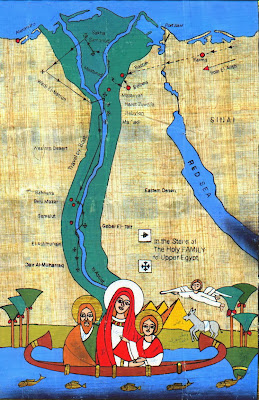 It
seems the Holy Family traveled with a midwife named Salome who isn't
mentioned in the Gospel but plays a role in the Coptic stories. Instead
of heading straight to Egypt to escape the wrath of Herod, they seem to
have zigzagged to the Plain of Jericho, then Ashkelon, then Hebron (at
least according to the various churches and monasteries situated in
those places), then proceeded to enter Egypt via the Land of Goshen, en
route to the town of Bilbays. Along the way they had an encounter with a
dragon in a cave, and were approached by wild lions, but of course
they all bowed down to the Baby Jesus. At Bilbays they rested under a
large tree, which was venerated in the Middle Ages by both Muslims and
Christians as the Virgin's Tree, which stood until 1850. Then they
headed to Samannud, where there is a church on the site of a well
blessed by Jesus. (Early Christian apocryphal infancy Gospels, as well
as the Qur'an, have Jesus talking while still in the cradle.) Then they
detoured northward to the Mediterranean coast at Burollos, stopping
there according to the monks of the place. Then, perhaps at Basus or
Sakha in Gharbiyya (Meinardus speculates on the place), Jesus left his
footprint on a stone.
It
seems the Holy Family traveled with a midwife named Salome who isn't
mentioned in the Gospel but plays a role in the Coptic stories. Instead
of heading straight to Egypt to escape the wrath of Herod, they seem to
have zigzagged to the Plain of Jericho, then Ashkelon, then Hebron (at
least according to the various churches and monasteries situated in
those places), then proceeded to enter Egypt via the Land of Goshen, en
route to the town of Bilbays. Along the way they had an encounter with a
dragon in a cave, and were approached by wild lions, but of course
they all bowed down to the Baby Jesus. At Bilbays they rested under a
large tree, which was venerated in the Middle Ages by both Muslims and
Christians as the Virgin's Tree, which stood until 1850. Then they
headed to Samannud, where there is a church on the site of a well
blessed by Jesus. (Early Christian apocryphal infancy Gospels, as well
as the Qur'an, have Jesus talking while still in the cradle.) Then they
detoured northward to the Mediterranean coast at Burollos, stopping
there according to the monks of the place. Then, perhaps at Basus or
Sakha in Gharbiyya (Meinardus speculates on the place), Jesus left his
footprint on a stone.
Needless to say, they could not ignore the Wadi Natrun, the Coptic version of Mount Athos, where the four great monasteries of the Desert Fathers still stand (but of course didn't then as Christianity hadn't been founded yet), though why they were wandering in the desert instead of the delta in those days isn't explained. Passing by from a distance, Jesus said to his mother, "Know O my Mother, that in this desert there shall live many monks, ascetes and spiritual fighters, and they shall serve God like angels." (Apparently Mary would have known what a "monk" was, though it's hard to know why.) Anyway, you can ask the monks if you doubt any of this.
Even though Cairo wasn't there yet, you know Cairo isn't going to let all these other towns have a claim and not find some of its own, don't you? First they went to On, the ancient Heliopolis, not on the site of the modern suburb of that name but on the site of Matariyya. There Jesus took Joseph's staff, dug a well, and planted the staff, which grew into a tree which became a goal of pilgrimage and was venerated by Muslims as well as Christians. (The Qur'an has a story of Mary resting under a palm tree, and this and the Matariyya tree became conflated in later folklore. The Matariyya tree is a sycamore.) The present tree, still venerated, is alleged to be grown from the shoot of an older tree:
From there, the Holy Family went to a site
where, centuries later, the Harat Zuwaila quarter of Cairo would rise;
the Church of the Virgin there is one of the oldest in Cairo proper, and
the convent has a well blessed by Jesus.
(If you're wondering why I haven't mentioned their stop in the Fortress of Babylon, in a church many tourists visit today, it's because they stopped there only after their tour of Upper Egypt. Trust me, it's coming.)
Next they went to Ma‘adi, today an elite southern suburb of Cairo, and attended a synagogue. Joseph got to know some Nile boatmen, who offered to take them to Upper Egypt. (You're wondering how an exiled carpenter and family fleeing from King Herod can afford all this Grand Tour? Don't be so cynical: the legend has it covered: using the gold, frankincense and myrrh brought by the Magi.)
I'm going to condense a bit here since every Church of St. Mary up the Nile seems to mark a site where the boat stopped and they visited a well or a palm tree. But since Upper Egypt remains one of the more Christian parts of the country, they couldn't skip such Christian centers as Sammalout, Asyut, al-‘Ashnmunein, or the great monastery known as Deir al-Muharraq.
One of the legendary sub-stories here deserves telling, though. Up near al-‘Ashmunein, two brigands who had been pursuing the Holy Family since Matariyya (must be the gold, frankincense and myrrh again) tried to rob them. They grabbed Jesus and Mary cried, and one of the robbers repented, and they left them. And — as any folklorist should have figured out by now — these were the same two thieves, including the same Good Thief, who would be crucified alongside Jesus! How could it be otherwise?
The
constant travels were finally relieved when the Holy Family were taken
in by a devout Jew and lived for six months (and ten days: I told you
the stories are detailed) at the site of the Monastery of Deir
al-Muharraq, south
of al-Qusiya. The monks of the monastery say it was the first monastery
in Egypt, built just after the arrival of Saint Mark as the Apostle of
Egypt. If you doubt that, take it up with the monks, not me. Or with
the monks at St. Anthony's in the Eastern Desert, which is usually seen
as the earliest.)
Then
the angel came to Joseph and told him it was safe to go back to
Palestine. (That part actually is in the Gospel of Matthew, unlike
everything else in this post.) They stopped at pretty much every Coptic
village that would ever have a Church of the Virgin on their way back
down the Nile, and feeling they had not yet done enough for future
Cairo tourism, they stopped inside the Roman fortress known as Babylon
and, perhaps having run out of gold and frankincense, stayed in a cave
that is today the crypt of the church of Saint Sergius (Abu Sarga),
conveniently adjacent to the Coptic Museum and included on many Cairo
tours.
I hope I don't sound too cynical here: the stories are charming and are clearly a pious attempt to elaborate on a brief reference in the Gospel in order to make the Christian link to Egypt more tangible to believers. On the other hand, the sense that every Church of Saint Mary in Egypt actually sheltered the Virgin and Child seems a bit credulous.
I hope my Coptic friends recognize that I am helping spread knowledge of your tradition, even if I may not accept every detail as historically attested. I'd really like to know more about that dragon.

Since 2009, I have annually noted the rich Coptic traditions of the Holy Family's flight into Egypt, which expands the couple of verses in the Gospel of Matthew, by offering a detailed story of a three-year sojourn and visits up and down the Nile. More recently I've added a map and some pictures, and fixed a few errors. As always, despite the obvious apocryphal nature of these tales, I intend to respect the charm of the stories while noting some of the improbabilities. My revised and illustrated version:
Since we're in between Western Christmas and Eastern Christmas, I thought it might be a useful time to call to your attention the extremely detailed traditions Egypt's Copts maintain about the Holy Family and the Flight into Egypt. There is hardly a Christian church in Egypt — and there are some mosques, too, since Jesus and Mary are highly venerated in Islam — that doesn't claim that Jesus, Mary and Joseph dropped by for a while. They must have been constantly on the move to have covered so much ground, but you can't build up a good pilgrimage trade if you don't stop frequently.
Now, the Flight into Egypt gets only a couple of verses in the Bible and is only mentioned in one Gospel, Matthew, (Matthew 2, 13-14 and 19) so the extremely detailed accounts of the Coptic stories have more to do with pious elaboration — or pilgrimage tourism — than history, but the stories can be quite charming. Some are based on an apocryphal Armenian infancy gospel, some on local traditions, etc. The Coptic traditions hold that the Holy Family spent three years in Egypt.
I am shamelessly cribbing this from Chapter XXXI of the late Otto Meinardus' Christian Egypt Ancient and Modern, (Cairo: AUC Press, 1965; Revised Edition 1977). Meinardus was a major figure in Coptic studies; German-born, he wrote mostly in English or French, taught at the American University in Cairo, and was an ordained Lutheran pastor. (Judge for yourself what Martin Luther would have thought of some of these stories.) He died in 2005. But I have to condense all the details considerably; his chapter runs over 40 pages. There's also a detailed online site, with pictures (text approved personally by Coptic Pope Shenouda, they say), for those interested. And tours are available;this site also offers a travelogue.
 It
seems the Holy Family traveled with a midwife named Salome who isn't
mentioned in the Gospel but plays a role in the Coptic stories. Instead
of heading straight to Egypt to escape the wrath of Herod, they seem to
have zigzagged to the Plain of Jericho, then Ashkelon, then Hebron (at
least according to the various churches and monasteries situated in
those places), then proceeded to enter Egypt via the Land of Goshen, en
route to the town of Bilbays. Along the way they had an encounter with a
dragon in a cave, and were approached by wild lions, but of course
they all bowed down to the Baby Jesus. At Bilbays they rested under a
large tree, which was venerated in the Middle Ages by both Muslims and
Christians as the Virgin's Tree, which stood until 1850. Then they
headed to Samannud, where there is a church on the site of a well
blessed by Jesus. (Early Christian apocryphal infancy Gospels, as well
as the Qur'an, have Jesus talking while still in the cradle.) Then they
detoured northward to the Mediterranean coast at Burollos, stopping
there according to the monks of the place. Then, perhaps at Basus or
Sakha in Gharbiyya (Meinardus speculates on the place), Jesus left his
footprint on a stone.
It
seems the Holy Family traveled with a midwife named Salome who isn't
mentioned in the Gospel but plays a role in the Coptic stories. Instead
of heading straight to Egypt to escape the wrath of Herod, they seem to
have zigzagged to the Plain of Jericho, then Ashkelon, then Hebron (at
least according to the various churches and monasteries situated in
those places), then proceeded to enter Egypt via the Land of Goshen, en
route to the town of Bilbays. Along the way they had an encounter with a
dragon in a cave, and were approached by wild lions, but of course
they all bowed down to the Baby Jesus. At Bilbays they rested under a
large tree, which was venerated in the Middle Ages by both Muslims and
Christians as the Virgin's Tree, which stood until 1850. Then they
headed to Samannud, where there is a church on the site of a well
blessed by Jesus. (Early Christian apocryphal infancy Gospels, as well
as the Qur'an, have Jesus talking while still in the cradle.) Then they
detoured northward to the Mediterranean coast at Burollos, stopping
there according to the monks of the place. Then, perhaps at Basus or
Sakha in Gharbiyya (Meinardus speculates on the place), Jesus left his
footprint on a stone.Needless to say, they could not ignore the Wadi Natrun, the Coptic version of Mount Athos, where the four great monasteries of the Desert Fathers still stand (but of course didn't then as Christianity hadn't been founded yet), though why they were wandering in the desert instead of the delta in those days isn't explained. Passing by from a distance, Jesus said to his mother, "Know O my Mother, that in this desert there shall live many monks, ascetes and spiritual fighters, and they shall serve God like angels." (Apparently Mary would have known what a "monk" was, though it's hard to know why.) Anyway, you can ask the monks if you doubt any of this.
Even though Cairo wasn't there yet, you know Cairo isn't going to let all these other towns have a claim and not find some of its own, don't you? First they went to On, the ancient Heliopolis, not on the site of the modern suburb of that name but on the site of Matariyya. There Jesus took Joseph's staff, dug a well, and planted the staff, which grew into a tree which became a goal of pilgrimage and was venerated by Muslims as well as Christians. (The Qur'an has a story of Mary resting under a palm tree, and this and the Matariyya tree became conflated in later folklore. The Matariyya tree is a sycamore.) The present tree, still venerated, is alleged to be grown from the shoot of an older tree:
 |
| The Virgin's Tree, Matariyya |
 |
| Harat Zuwaila Church of the Virgin |
(If you're wondering why I haven't mentioned their stop in the Fortress of Babylon, in a church many tourists visit today, it's because they stopped there only after their tour of Upper Egypt. Trust me, it's coming.)
Next they went to Ma‘adi, today an elite southern suburb of Cairo, and attended a synagogue. Joseph got to know some Nile boatmen, who offered to take them to Upper Egypt. (You're wondering how an exiled carpenter and family fleeing from King Herod can afford all this Grand Tour? Don't be so cynical: the legend has it covered: using the gold, frankincense and myrrh brought by the Magi.)
I'm going to condense a bit here since every Church of St. Mary up the Nile seems to mark a site where the boat stopped and they visited a well or a palm tree. But since Upper Egypt remains one of the more Christian parts of the country, they couldn't skip such Christian centers as Sammalout, Asyut, al-‘Ashnmunein, or the great monastery known as Deir al-Muharraq.
One of the legendary sub-stories here deserves telling, though. Up near al-‘Ashmunein, two brigands who had been pursuing the Holy Family since Matariyya (must be the gold, frankincense and myrrh again) tried to rob them. They grabbed Jesus and Mary cried, and one of the robbers repented, and they left them. And — as any folklorist should have figured out by now — these were the same two thieves, including the same Good Thief, who would be crucified alongside Jesus! How could it be otherwise?
 |
| Deir al-Muharraq Today |
 |
| Abu Sarga Church Crypt |
I hope I don't sound too cynical here: the stories are charming and are clearly a pious attempt to elaborate on a brief reference in the Gospel in order to make the Christian link to Egypt more tangible to believers. On the other hand, the sense that every Church of Saint Mary in Egypt actually sheltered the Virgin and Child seems a bit credulous.
I hope my Coptic friends recognize that I am helping spread knowledge of your tradition, even if I may not accept every detail as historically attested. I'd really like to know more about that dragon.

Monday, December 25, 2017
Christmas Greetings
I want to wish those readers who celebrate Christmas on the Western date today my wishes for the season. Since many Middle Eastern Christians celebrate on the Eastern date instead, there will be further Christmas posts between the two Christmases.
Thursday, December 21, 2017
Belated Yalda Greetings
 I was busy last night with a holiday party and so failed to note an actual holiday. Last night was the Winter solstice, and thus the ancient Iranian feast of Yalda, originally Zoroastrian in origin. As I've posted about Yalda in previous years, I'll refer you to my earlier posts for now.
 Tuesday, December 12, 2017
Monday, December 11, 2017
December 11, 1917: Allenby Enters Jeusalem
 |
| Allenby enters the Jaffa Gate |
Allenby did not take Jerusalem by a direct assault. He sent several columns of British and Empire troops to advance to the north of Jerusalem, to cut the road to Nablus and cut the Turkish line of retreat; another column advanced from Hebron toward Bethlehem from the south. On ditionNovember 24 the 75th Division took Nabi Samwil, the traditional tomb of the Prophet Samuel which dominated the Jerusalem northern horizon.
There was a pause in the advance, but on December 8 the southern column reached the outskirts of Bethlehem. That night the last Ottoman troops left the city. On the morning of the ninth, the Mayor of Jerusalem, Hussein Salim al-Husseini of the well-known Husseini family, set out under a white flag with a letter from the Ottoman commander, planning to surrender the city.
 |
| Mayor Husseini and the Surrender Delegarion |
He encountered two sergeants of the London Regiment, James Sedgewick and Frederick Hurcomb. Essentially feeling this was above their pay grade, the sergeants declined the surrender, but Husseini was eventually passed up the chain of command until finding an officer to accept the surrender.
Allenby was instructed to keep the surrender a secret until Parliament could be notified, and though he wrote his wife on both the ninth and tenth, he did not mention the surrender until the 11th, the day he entered the city.
Jerusalem, as noted in an earlier post, was not a military objective (the Ottoman Seventh Army had moved to Nablus), but it was a powerful religious symbol to the three religions that consider it holy. The Ottomans did try a counterattack later in December, but by the new year the front had stabilized with both Jerusalem and Jaffa securely in British hands.
Some video (Hebrew captions but the first is an Imperial War Museum video) of the entry:
Wednesday, December 6, 2017
The Jerusalem Decision
President Trump has said that recognizing Jerusalem a the capital of Israel will advance the peace process. Using the same logic, the fires now threatening Los Angeles might best be fought by dropping gasoline on them instead of water, in order to advance the firefighting process.
While the issue of Jerusalem is largely symbolic, Jerusalem is a powerful symbol.
And the symbol was bizarrely timed. Why now? What possible benefit can be gained that outweighs the damage done by the US acting unilaterally? Despite claims to the contrary, the move gives the impression that the most difficult of the 'final status' issues has been settled, by awarding it to Israel.
This may pass, but I cannot see how it "advances the peace process."
While the issue of Jerusalem is largely symbolic, Jerusalem is a powerful symbol.
And the symbol was bizarrely timed. Why now? What possible benefit can be gained that outweighs the damage done by the US acting unilaterally? Despite claims to the contrary, the move gives the impression that the most difficult of the 'final status' issues has been settled, by awarding it to Israel.
This may pass, but I cannot see how it "advances the peace process."
Monday, December 4, 2017
The Long Career and Ironic Death of ‘Ali ‘Abdullah Salih
‘Ali ‘Abdullah Salih became President of what was then North Yemen in 1978. Though he stepped aide as President of united Yemen in 2012, he remained a key player in the chaotic conflict in that country. In the course of nearly 40 years on center stage, he had survived assassination attempts, coups, and plots by his neighbors. Yesterday, after one last change of sides, his luck ran out.
Salih's longevity in a country with a history of short-lived leaders was unusual; he came from a relatively small tribe but always seemed to land on his feet. When he was being challenged by the Houthi movement, he originated the charge that the Houthis were Iranian-backed, though more recently he was allied with the Houthis, while Saudi Arabia has embraced the charge. This weekend Salih gambled: starting open battles with his Houthi allies while making overtures to Saudi Arabia. It was a daring maneuver, but this time Salih lost his gamble.
Salih's longevity in a country with a history of short-lived leaders was unusual; he came from a relatively small tribe but always seemed to land on his feet. When he was being challenged by the Houthi movement, he originated the charge that the Houthis were Iranian-backed, though more recently he was allied with the Houthis, while Saudi Arabia has embraced the charge. This weekend Salih gambled: starting open battles with his Houthi allies while making overtures to Saudi Arabia. It was a daring maneuver, but this time Salih lost his gamble.
Wednesday, November 29, 2017
November 1917: Allenby Moves North, Part I
After General Allenby's forces took Beersheba on October 31, 1917, the early days of November were spent occupying Ottoman lines between Beersheba and the coast at Gaza. It took only about another month for Allenby to take Jerusalem.
That was no easy task. Before the construction of the modern road from Tel Aviv to Jerusalem and other major routes in the modern Israeli road system, the roads approaching Jerusalem were poor, mostly unpaved, and winding through the rough Judaean hill country. As the Ottoman Seventh and Eighth Armies withdrew from the desert around Gaza and Beersheba into the coastal plain and adjacent hill country, it became increasingly difficult to maintain communications between them, leaving the Eight Army in the coastal plain and the Seventh in the hill country unable to cooordinate operations.
Things were no easier for Allenby. The rail line and water pipeline from Egypt ran to Deir al-Balah south of Gaza; from the railhead (nicknamed "Dear Old Bella" by the troops) Allenby had to arrange transport for food and water and other supplies to the advancing troops, and these included the Desert Mounted Corps, this had to include supplies for their mounts as well. Given the lack of deepwater ports, despite the Royal Navy's control of the sea, supplies had to be landed by small boats.
There is an old military axiom that "amateurs talk about strategy; professionals talk about logistics." Though Allenby was a master of tactics, his organizational logistical work in the Palestine campaign was crucial.
Allenby's aide and first biographer General Archibald Wavell (later Field Marshal Lord Wavell), who was a skilled military historian as well as a field commander, noted that Allenby relied on two books during the Palestine Campaign: the Bible and Sir George Adam Smith's Historical Geography of the Holy Land. Smith's book, first published in 1894 and still valuable to anyone interested in the impact of geography on Israel/Palestine/Jordan (I'll do a separate post about the book soon), places great (though not exaggerated) emphasis on the natural defenses of the Judaean hill country, while recognizing it has frequently been conquered. If he read Smith carefully, Allenby would have understood the challenges ahead of him.
Once embarked on the Palestine campaign, there was really only one realistic objective: Jerusalem. It was not a major military objective: the Ottoman Seventh Army was already moving its headquarters to Nablus. But while Allenby may have carried a Bible, the Prime Minister for the past year, David Lloyd George, fancied himself something of a Bible scholar. And clearly everyone in Europe (and America, now in the war, though not with Turkey) would pay attention if the British took the Holy City. (Baghdad was a more important military objective than Jerusalem, in terms of importance ro rhe Ottomans but how often do you see photos of Gen. Maude's entry into Baghdad compared to those of Allenby entering Jerusalem?)
On the left, Allenby's forces fought a battle at Ayun Kara (also known as Mughar Ridge) on November 14, forcing the withdrawal of the Ottoman Eighth Army from Jaffa. The British occupied Jaffa November 6, but this did not free up Jaffa for use as a port by the British. The Turkish Eighth Army had only withdrawn behind the al-‘Auja River (today usually known by the Hebrew name, ha-Yarkon), which left the port of Jaffa within range of the Ottoman artillery behind the ‘Auja. (Today, Jaffa, the Yarkon, and everything in between are part of the modern Municipality of Tel Aviv-Yafo; Tel Aviv, founded in 1909, was still tiny in 1917.)
In Part 2, which will appear in early December, we will look at Allenby's advance into the hill country.
That was no easy task. Before the construction of the modern road from Tel Aviv to Jerusalem and other major routes in the modern Israeli road system, the roads approaching Jerusalem were poor, mostly unpaved, and winding through the rough Judaean hill country. As the Ottoman Seventh and Eighth Armies withdrew from the desert around Gaza and Beersheba into the coastal plain and adjacent hill country, it became increasingly difficult to maintain communications between them, leaving the Eight Army in the coastal plain and the Seventh in the hill country unable to cooordinate operations.
Things were no easier for Allenby. The rail line and water pipeline from Egypt ran to Deir al-Balah south of Gaza; from the railhead (nicknamed "Dear Old Bella" by the troops) Allenby had to arrange transport for food and water and other supplies to the advancing troops, and these included the Desert Mounted Corps, this had to include supplies for their mounts as well. Given the lack of deepwater ports, despite the Royal Navy's control of the sea, supplies had to be landed by small boats.
There is an old military axiom that "amateurs talk about strategy; professionals talk about logistics." Though Allenby was a master of tactics, his organizational logistical work in the Palestine campaign was crucial.
Allenby's aide and first biographer General Archibald Wavell (later Field Marshal Lord Wavell), who was a skilled military historian as well as a field commander, noted that Allenby relied on two books during the Palestine Campaign: the Bible and Sir George Adam Smith's Historical Geography of the Holy Land. Smith's book, first published in 1894 and still valuable to anyone interested in the impact of geography on Israel/Palestine/Jordan (I'll do a separate post about the book soon), places great (though not exaggerated) emphasis on the natural defenses of the Judaean hill country, while recognizing it has frequently been conquered. If he read Smith carefully, Allenby would have understood the challenges ahead of him.
Once embarked on the Palestine campaign, there was really only one realistic objective: Jerusalem. It was not a major military objective: the Ottoman Seventh Army was already moving its headquarters to Nablus. But while Allenby may have carried a Bible, the Prime Minister for the past year, David Lloyd George, fancied himself something of a Bible scholar. And clearly everyone in Europe (and America, now in the war, though not with Turkey) would pay attention if the British took the Holy City. (Baghdad was a more important military objective than Jerusalem, in terms of importance ro rhe Ottomans but how often do you see photos of Gen. Maude's entry into Baghdad compared to those of Allenby entering Jerusalem?)
On the left, Allenby's forces fought a battle at Ayun Kara (also known as Mughar Ridge) on November 14, forcing the withdrawal of the Ottoman Eighth Army from Jaffa. The British occupied Jaffa November 6, but this did not free up Jaffa for use as a port by the British. The Turkish Eighth Army had only withdrawn behind the al-‘Auja River (today usually known by the Hebrew name, ha-Yarkon), which left the port of Jaffa within range of the Ottoman artillery behind the ‘Auja. (Today, Jaffa, the Yarkon, and everything in between are part of the modern Municipality of Tel Aviv-Yafo; Tel Aviv, founded in 1909, was still tiny in 1917.)
In Part 2, which will appear in early December, we will look at Allenby's advance into the hill country.
Tuesday, November 28, 2017
What Happens When You Fall Behind
I was slowly catching up on blogging when the Middle East went haywire, or even more haywire than usual. The Saudi Crown Prince removed most of his remaining rivals, including attacking the sacrosanct independence of the National Guard, then seemed to order the Lebanese Prime Minister to resign, then kept him in Riyadh until international pressure grew, and then, when he returned to Beirut, he un-resigned, maybe. Meanwhile Saudi Arabia and Israel have been engaging in public flirtation, Egypt is facing major terrorism challenges, the Yemen War remains a bloody mess, and everything I ever knew about Saudi Arabia isn't true anymore.
Almost every day I've started to blog about this, something else has happened and I've decided to wait. It seems at this point the best thing I can do is say things are very precarious at the moment. The combination of an inexperienced Saudi Crown Prince with a penchant for risky action and an inexperienced American President reluctant to learn does not bode well.
That said, I'm going to resume blogging, and not even bother to try to catch up.
Almost every day I've started to blog about this, something else has happened and I've decided to wait. It seems at this point the best thing I can do is say things are very precarious at the moment. The combination of an inexperienced Saudi Crown Prince with a penchant for risky action and an inexperienced American President reluctant to learn does not bode well.
That said, I'm going to resume blogging, and not even bother to try to catch up.
Tuesday, November 14, 2017
Back Tomorrow, I Hope
Work has kept me busy but mostly the whole Saudi Palace Coup/Hariri "Resignation" fracas has been moving faster than I could comment. I expect to have one or more posts tomorrow.
Thursday, November 2, 2017
Balfour After a Century
A century ago:

Many commentators have already analyzed the Balfour Declaration before its centennial, and there is little point in repeating their observations here. Let me make just a few points:
As I noted just two days ago, the occupation of Beersheba by Allenby on October 31,1917, was the first real British foothold inside Ottoman Palestine (unless we count the occupation of Aqaba by the Arab Revolt). Beersheba was seen as the Biblical southern boundary of Ancient Israel (from Dan to Beersheba), and two days after Britain acquired a tenuous hold there, the British Foreign Secretary made a commitment, ambiguous and hedged with conditions as it is, to the future of Palestine, then still under Ottoman control.
Now, under the Sykes-Picot agreement France and Britain had envisioned an international regime for part of Palestine including Jerusalem. But Sykes-Picot was a secret agreement, unknown to Lord Rothschild or Chaim Weizmann on November 2. (But not for long: on November 23, the new Bolshevik regime in Russia published the text in Pravda and Izvestia.) And then of course there was the Hussein-McMahon correspondence which promised Sharif Hussein territories argued about ever since.
Generations have noted that the "Promised Land" was promised to several different parties, even though Britain did not even control the territory in question. But 1917 was still an age of imperialism, and the idea that Great Powers could decide the fate of "lesser" countries. (Bonus question: Has this really changed that much?)
Israelis today are more likely to point to the League of Nations Palestine Mandate and/or the 1947 UN Partition Resolution as the legal basis for the state, since these had international legitimacy, and were not simply the diktat of a single Great Power.
To save space, I will avoid the question of what a "national home" meant or how it could be created without prejudicing the rights of "the non-Jewish communties of Palestine."
Arthur James Balfour had served as Prime Minister and First Lord of the Admiralty before becoming Foreign Secretary. But despite his long political career, his name will forever be attached to a single, run-on 67-word sentence sent a century ago today.

Many commentators have already analyzed the Balfour Declaration before its centennial, and there is little point in repeating their observations here. Let me make just a few points:
As I noted just two days ago, the occupation of Beersheba by Allenby on October 31,1917, was the first real British foothold inside Ottoman Palestine (unless we count the occupation of Aqaba by the Arab Revolt). Beersheba was seen as the Biblical southern boundary of Ancient Israel (from Dan to Beersheba), and two days after Britain acquired a tenuous hold there, the British Foreign Secretary made a commitment, ambiguous and hedged with conditions as it is, to the future of Palestine, then still under Ottoman control.
Now, under the Sykes-Picot agreement France and Britain had envisioned an international regime for part of Palestine including Jerusalem. But Sykes-Picot was a secret agreement, unknown to Lord Rothschild or Chaim Weizmann on November 2. (But not for long: on November 23, the new Bolshevik regime in Russia published the text in Pravda and Izvestia.) And then of course there was the Hussein-McMahon correspondence which promised Sharif Hussein territories argued about ever since.
Generations have noted that the "Promised Land" was promised to several different parties, even though Britain did not even control the territory in question. But 1917 was still an age of imperialism, and the idea that Great Powers could decide the fate of "lesser" countries. (Bonus question: Has this really changed that much?)
Israelis today are more likely to point to the League of Nations Palestine Mandate and/or the 1947 UN Partition Resolution as the legal basis for the state, since these had international legitimacy, and were not simply the diktat of a single Great Power.
To save space, I will avoid the question of what a "national home" meant or how it could be created without prejudicing the rights of "the non-Jewish communties of Palestine."
Arthur James Balfour had served as Prime Minister and First Lord of the Admiralty before becoming Foreign Secretary. But despite his long political career, his name will forever be attached to a single, run-on 67-word sentence sent a century ago today.
Wednesday, November 1, 2017
November 1, 1954: Toussaint Rouge, The Algerian War Begins
Sixty-three years ago today, a day remembered as Toussaint Rouge, "Red All Saints' Day," the Algerian National Liberation Front (FLN) staged 30 or more raids against French military and police posts throughout Algeria. It heralded the beginning of the eight year war for Algerian independence, a war which would bring down the Fourth French Republic and inaugurate the Fifth with the return of Charles de Gaulle, finally leading to Algerian independence in 1962.
The war, which saw hundreds of thousands of casualties, remains an enormous event in Algerian national consciousness. Though ailing and rarely appearing in public, President Abdelaziz Bouteflika is a living reminder of those days when most of the other historic leaders have passed on. Today the median age in Algeria is in the 20s; few Algerians today witnessed the War of Independence.
The war, which saw hundreds of thousands of casualties, remains an enormous event in Algerian national consciousness. Though ailing and rarely appearing in public, President Abdelaziz Bouteflika is a living reminder of those days when most of the other historic leaders have passed on. Today the median age in Algeria is in the 20s; few Algerians today witnessed the War of Independence.
Tuesday, October 31, 2017
October 31, 1917: The Light Horse Charge at Beersheba
 |
| George Lambert, The Charge of the Australian Light Horse at Beersheba, 1917 |
Over the summer, Allenby moved his headquarters from Cairo to the front, received only limited reinforcement, but was ordered to advance with the forces he had.
The Ottomans had reinforced their defenses, but Minister of War Enver Pasha wanted to move to retake Baghdad from the British, and so assembled a joint Turkish-German force near Aleppo intended to move into Mesopotamia under German command, known as the Yıldırım Force. Enver's generals objected, both to being put under German command and to leaving the Palestine defenses undermanned in order to concentrate on retaking Baghdad when there were threats on other fronts.
The British operated best along the coast, where they could depend on the guns of the Royal Navy, but Murray having twice failed to break the line at Gaza, Allenby resolved to try something different. As I've noted in earlier posts, the British had slowly extended the railroad and a pipeline carrying fresh water across Sinai to the borders of Palestine. But to operate inland beyond the end of the pipeline required a source of water for the troops, and for the horses of the Desert Mounted Corps.
Allenby's first biographer, Archibald Wavell (who would himself command in Egypt in a later war), wrote that Allenby carried with him two books, the Bible and Sir George Adam Smith's Historical Geography of the Holy Land, a wonderful Victorian description of the historical landscape of Palestine. He would, then, understand the importance of finding water once he abandoned the coast road.
 |
| Gaza to Beersheba |
Every effort was made to persuade the Turks that the main attack would be along the coast. Beginning october 27, field artillery and naval guns bombarded the Turkish lines at Gaza, and the main force of British and Empire forces, centered on XXI Corps, remained in front of Gaza. Meanwhile the British XX Corps and the largely Australian Desert Mounted Corps were moved quietly and by night far to the right. Allenby's center was weak and potentially vulnerable to Turkish attack, but Allenby gambled that the Turks would remain secure in their defenses.
 |
| Beersheba in 1917 |
 |
| Sir Harry Chauvel |
After a long day of fighting, Allenby urged Sir Harry Chauvel, commander of the Desert Mounted Corps, to take Beersheba by nightfall. This produced one of history's famous cavalry charges, by the 4th and 12th Light Horse. It was the 12th that actually occupied the center of Beersheba, but the 4th got most of the credit.
 |
| The Charge |
Harry Chauvel had one knighthood already; he won another (Knight Commander of the Bath) for Beersheba. At a moment when the Western Front was being bled dry at Passchendaele, Allenby had struck the first blow in a campaign that would have him in Jerusalem before Christmas.
A Busy Week for Historical Anniversaries
I'll be doing a lot of historical posts this week. Today is the 100th anniverary of the Battle of Beersheba, one of the great cavalry charges of the 20th Century and a coming-of -age moment for Australian pride, and I'll be posting on that later today. From November 1-7 the British rolled up the Ottoman line from Beersheba to Gaza and advanced into Palestine; and by December 11 General Allenby entered Jerusalem.
Meanwhile, on November 2, British Foreign Secretary Arthur James Balfour sent a short note to Lord Rothschild. We call it the Balfour Declaration.
The last week of October and the first week of November in years ending in -17 include other events that didn't directly impact the Middle East. Half a Millennium ago today, on October 31, 1517, an obscure German monk named Martin Luther nailed 95 theses to the church door in Wittenburg, and Europe was shaken to the root.
And a century ago on November 7, Lenin launched the Bolshevik October Revolution, so named as Russia was still on the Julian calendar, which considered it October 25. That did eventually affect the Middle East by driving Russia out of the war and ending Russian advances in the Caucasus.
I won't be dealing with Luther or Lenin, but I'll continue to post on the centenary of the Great War in the Middle East and much besides.
Meanwhile, on November 2, British Foreign Secretary Arthur James Balfour sent a short note to Lord Rothschild. We call it the Balfour Declaration.
The last week of October and the first week of November in years ending in -17 include other events that didn't directly impact the Middle East. Half a Millennium ago today, on October 31, 1517, an obscure German monk named Martin Luther nailed 95 theses to the church door in Wittenburg, and Europe was shaken to the root.
And a century ago on November 7, Lenin launched the Bolshevik October Revolution, so named as Russia was still on the Julian calendar, which considered it October 25. That did eventually affect the Middle East by driving Russia out of the war and ending Russian advances in the Caucasus.
I won't be dealing with Luther or Lenin, but I'll continue to post on the centenary of the Great War in the Middle East and much besides.
Monday, October 30, 2017
Mas‘oud Barzani Steps Down
Mas‘oud Barzani's decision not to seek another term as President of the Kurdistan Regional Government (KRG) (despite his current term's having technically expired in 2015) is a rare case of a Middle Eastern leader stepping down as a consequence of his own mistakes. Barzani's insistence on forging ahead with the September independence referendum proved to be a serious miscalculation, and has led to the KRG's increasing isolation, with international air connections cut and neighboring coutries supporting Baghdad against Erbil. At this point, it will take considerable diplomatic skill to prevent civil war.
Barzani, who like his farher before him has strong tribal and family ties in northwestern Kurdistan and is likely to remain a force in the Kurdistan Democratic Party, where many of his clansmen hold important positions. A nephew, Nechirvan Idris Barzani, remains the KRG Prime Minister. The influence of the Barzani clan has dominated Kurdish politics since the days of the Mahabad Republic, and I suspect we have not seen the last of Mas‘oud Barzani.
Barzani, who like his farher before him has strong tribal and family ties in northwestern Kurdistan and is likely to remain a force in the Kurdistan Democratic Party, where many of his clansmen hold important positions. A nephew, Nechirvan Idris Barzani, remains the KRG Prime Minister. The influence of the Barzani clan has dominated Kurdish politics since the days of the Mahabad Republic, and I suspect we have not seen the last of Mas‘oud Barzani.
Tuesday, October 17, 2017
When Raqqa was the Capital of a Real Caliph: Harun al-Rashid
The glories of Baghdad during the reign of the ‘Abbasid Caliph Harun al-Rashid have been much celebrated and elaborated upon in the tales of the 1001 Nights, so his reign is generally identified with the great period of Baghdad's glories. Yet of the 23 solar years, 786-809 AD, of Harun's Caliphate, for 13 of those he reigned not from Baghdad, but from Raqqa on the Euphrates. Long before Raqqa served as the capital of ISIS' self-declared "Caliphate," it was the capital of the ‘Abbasids when they ruled most of the Islamic world (except Umayyad Spain).
With the announcement today that Raqqa has fallen to the Syrian Democratic Forces (mainly the Kurdish YPG), it may be worth remembering Raqqa's previous glories. The Islamic State most likely chose Raqqa as its capital because it was one of the few cities it controlled, but it was surely aware of its role as a onetime Caliphal capital.
Raqqa was an ancient foundation, known in classical times as Kallinikos. Harun was the fifth ‘Abbasid Caliph. His grandfather the second ‘Abbasid Caliph al-Mansur (Harun's father and brother had reigned between the two), who was the real founder of Baghdad, noticed the attractive elements of Raqqa and founded a suburb he named al-Rafiqa ("the companion"). Though proud of his great new Round City of Baghdad, al-Mansur adopted Rafiqa as the ‘Abbasid summer capital. (For the nitpickers: I know Mansur did not found "Baghdad," the Persian name for the village on the Tigris which preceded Mansur's city, which was officially named Madinat al-Salam, the City of Peace. But everyone called it by the older name. Al-Mansur's Round City, until destroyed by the Mongols in 1258, lay where the al-Mansur neighborhood of modern Baghdad is today.)
In 796 AD, ten solar years into his Caliphate, Harun moved his administrative capital to Raqqa, though the state bureaucracy mostly remained in Baghdad. Many of the descriptions (mostly anachronistic) of the glories of Harun's Baghdad refer to Raqqa, where outside the view of the religious establishment and the Baghdad populace, Harun was more free to indulge his penchants for horse-racing, wine, and other pleasures. Some of the songs/poems in the Kitab al-Aghani refer to the pleasures of Harun's place at Raqqa.
 Not much remains of ‘Abbasid-era Raqqa, even before ISIS and the fight to retake the city. Some ancient walls and the Baghdad Gate at left, less whatever damage ISIS and the air and artillery assaults on the city may have destroyed.
With the announcement today that Raqqa has fallen to the Syrian Democratic Forces (mainly the Kurdish YPG), it may be worth remembering Raqqa's previous glories. The Islamic State most likely chose Raqqa as its capital because it was one of the few cities it controlled, but it was surely aware of its role as a onetime Caliphal capital.
Raqqa was an ancient foundation, known in classical times as Kallinikos. Harun was the fifth ‘Abbasid Caliph. His grandfather the second ‘Abbasid Caliph al-Mansur (Harun's father and brother had reigned between the two), who was the real founder of Baghdad, noticed the attractive elements of Raqqa and founded a suburb he named al-Rafiqa ("the companion"). Though proud of his great new Round City of Baghdad, al-Mansur adopted Rafiqa as the ‘Abbasid summer capital. (For the nitpickers: I know Mansur did not found "Baghdad," the Persian name for the village on the Tigris which preceded Mansur's city, which was officially named Madinat al-Salam, the City of Peace. But everyone called it by the older name. Al-Mansur's Round City, until destroyed by the Mongols in 1258, lay where the al-Mansur neighborhood of modern Baghdad is today.)
In 796 AD, ten solar years into his Caliphate, Harun moved his administrative capital to Raqqa, though the state bureaucracy mostly remained in Baghdad. Many of the descriptions (mostly anachronistic) of the glories of Harun's Baghdad refer to Raqqa, where outside the view of the religious establishment and the Baghdad populace, Harun was more free to indulge his penchants for horse-racing, wine, and other pleasures. Some of the songs/poems in the Kitab al-Aghani refer to the pleasures of Harun's place at Raqqa.
 Not much remains of ‘Abbasid-era Raqqa, even before ISIS and the fight to retake the city. Some ancient walls and the Baghdad Gate at left, less whatever damage ISIS and the air and artillery assaults on the city may have destroyed.
Monday, October 16, 2017
Iraqi Forces Enter Kirkuk
Iraqi Armed Forces entered Kirkuk today, pushing back Kurdish Peshmerga and lowering the Kurdish flag. Following a period of threats and symbolic gestures after the Kurdish independence referendum, the Iraqi government and the Kurdistan Regional Government are now teetering on the brink of war, especially in Kirkuk, where ethnic Arabs, Kurds, and Turkmen dispute control of the city at the heart of Iraq's northern oilfields.
The US, which in many ways has encouraged autonomous Kurdistan since the early 1990s and has supported the Peshmerga as a counterweight to ISIS, now finds two of its allies, the governments in Baghdad and Erbil, at daggers drawn. The Iraqi Army and its allies, the Shi‘ite militia the Popular Mobilization Forces (PMF, al-Hashd al-Sha‘bi) seem determined to take all of Kirkuk, though some Yezidi units in the PMF are said to have refused to fight the Peshmerga, since most Yezidis are ethnic Kurds.
As a sign of the dangers posed by the Iraqi-KRG clashes, ISIS reportedly took two villages north of Kirkuk from the Peshmerga.
The US, which in many ways has encouraged autonomous Kurdistan since the early 1990s and has supported the Peshmerga as a counterweight to ISIS, now finds two of its allies, the governments in Baghdad and Erbil, at daggers drawn. The Iraqi Army and its allies, the Shi‘ite militia the Popular Mobilization Forces (PMF, al-Hashd al-Sha‘bi) seem determined to take all of Kirkuk, though some Yezidi units in the PMF are said to have refused to fight the Peshmerga, since most Yezidis are ethnic Kurds.
As a sign of the dangers posed by the Iraqi-KRG clashes, ISIS reportedly took two villages north of Kirkuk from the Peshmerga.
Dumbarton Oaks Makes Irfan Shahid's Mastetpiece Available for Free Download
After Irfan Shahid died in 2016, I lamented the fact that his multi-volume life's work, Byzantium and the Arabs, and its "Prolegomenon," Rome and the Arabs, were in several cases out of print (and not inexpensive when available).
Well, there's great news for anyone interested in the Arabs in Late Antiquity or the pre-Islamic context of the rise of Islam (especially the Ghassanids): Dumbarton Oaks has made all seven of the volumes available for free download.
If you have any interest in the subject, download them all now.
Well, there's great news for anyone interested in the Arabs in Late Antiquity or the pre-Islamic context of the rise of Islam (especially the Ghassanids): Dumbarton Oaks has made all seven of the volumes available for free download.
If you have any interest in the subject, download them all now.
Subscribe to:
Posts (Atom)


 Posts
Posts

