A Blog by the Editor of The Middle East Journal

Putting Middle Eastern Events in Cultural and Historical Context

Showing posts with label Cairo History Series. Show all posts

Monday, September 18, 2017

"A Pub Crawl in Ottoman Cairo"

In an attempt to resume my past efforts to highlight the occasionally offbeat, here's a link to "A Pub Crawl in Ottoman Cairo," which uses a 1904 ultra-detailed insurance map of Cairo to highlight the numerous drinking establishments in and around the Ezbekiyya Gardens.

 While the choice of "Ottoman Cairo" is arguable (though technically correct) since 1904 was the later years of Lord Cromer's ascendancy and Ottoman suzerainty was merely theoretical, I won't quibble. The formal Ezbekiyya gardens had emerged in the 19th century around an earlier lake, and had become a center for elite European hotels (including the original Shepheard's and the Grand Continental) and polite society. (Ironically, Cairo's most notorious red light district lay just a few blocks to the north, where the modern European quarters blended with and abutted the more "traditional" quarters.)

As the detailed map, which can be found online via the Harvard library, shows, there was no shortage of places to drink. (At least a small number of these survived into the 1970s, when highway flyovers and a tunnel pretty thoroughly transformed the neighborhood.)

If you like Cairo, or old maps, or bars,or if, like me, all three, take a look.

Wednesday, April 27, 2016

A 1930s Travelogue of Cairo that Touches Just about Every British Colonial/Orientalist Stereotype

Hat tip to Sarah Carr for this: a 1930s travelogue of Cairo that touches all the bases of Orientalist and British colonial stereotypes, starting with Shepheard's and ending with the pyramids. Not to mention the music.

Thursday, November 19, 2015

Four Years Since the "Battle" of Mohamed Mahmoud

Daily News Egypt marks the fourth anniversary of the "Battle of Mohamed Mahmoud" in November of 2011, one of the more violent confrontations between young revolutionaries and the military in Cairo in the months after the fall of Mubarak. As I noted at the time, it had special resonance for me since, decades earlier, I had lived at the corner of Mohamed Mahmoud and Yusuf al-Gindi Streets, right at the center of the "battle."

Mohamed Mahmoud became one of the symbols of that era (along with "blue-bra woman" and other outrages) and later became the site of the Revolution's most famous graffiti walls along the American University in Cairo's Downtown Campus.

Mohamed Mahmoud Street runs from Tahrir Square, the Revolutionaries' iconic headquarters, past the Interior Ministry. The several days of fighting were sparked by the demonstrators' attempts to march on the Interior Ministry, headquarters of State Security. Several died in he attempt and others were beaten or blinded when hit by tear gas canisters. The beating of well-known commentator Mona El Tahawy drew considerable attention.

Though the street became famous, for the Battle and the graffiti, I don't seem to have ever explained how it got its name. Mohamed Mahmoud Pasha (1878-1941)(link is in Arabic), an early Wafdist who had been imprisoned by the British along with Saad Zaghloul during the 1919 Revolution, but later split with the Wafd and joined he Liberal Constitutional Party. He served stints as Prime Minister in 1928-29 and again in 1937-1939.

Monday, November 2, 2015

Apparently Cairo's Famous Cafe Riche Has Reopened

Photo: https://www.facebook.com/Cafe-Richeeg-175557732650867/?fref=ts
I've posted about Cairo's famous Cafe Riche more than once, last spring when the owner's death led to its closure, perhaps permanently, and a discussion back in 2011 as to whether today's Riche was living off its historical reputation as opposed to the genuinely authentic place I frequented in the 70s and 80s.

It's now reported that the Riche has reopened, under the late owner's brother. That's good news for Cairo nostalgia fans, and the mandatory interview with Felfel, a waiter now said to be in his 80s; the article calls him Aam Felfel, so I'm pleased to learn he's now acquired the venerable appellation of "Uncle" in the 30 years or so since I saw him almost daily; I hope a raise or two came with it.

My earlier postings on the Riche dealt with its legendary past, and when I lived in downtown Cairo in 1977-1978  I was a patron almost daily, and again on periodic visits throughout the 1980s. The 1992 earthquake severely damaged the cafe and it was closed for several years.

One passage in the  Al-Monitor article did give me pause:
Café Riche’s vibrant political history led to its closure during the rule of Anwar al-Sadat. Although the late president was himself a patron of the café, he had it closed after he witnessed heated discussion and debates over his rule and the peace treaty with Israel taking place within its walls.
I question the accuracy here because  I know it was open in 1977-1978 and that it was also open when I returned to Cairo only two weeks after the Sadat assassination in October 1981. (And Anwar Sadat, a most imperially aloof President, would not have "witnessed" those discussions; his mukhabarat would have.) After some sanity checks, I believe if Sadat ever closed the Riche entirely it must have been in 1979 and fairly brief, but that government pressure may have already led to the Riche closing on Fridays, which was already standard practice in 1977 even before Sadat went to Jerusalem.(Naguib Mahfouz' translator/biographer Raymond Stock suggests to me this was to shut down Mahfouz' regular Friday nadwa or salon, which then moved elsewhere.)

Even if the Riche is still dining out on its onetime reputation, it's good to hear that it has reopened.
Photo: https://www.facebook.com/Cafe-Richeeg-175557732650867/?fref=ts

Tuesday, August 4, 2015

The Khedive throws a Party: As Egypt Prepares for Grand Opening of Enlarged Suez Canal, Let's Remember 1869


As I've noted in a couple of recent posts this is the week Egypt is celebrating the dedication of the "New Suez Canal,"consisting of a newly dredged channel and a widening and deepening of the existing Canal, to permit increased traffic and two-way traffic in sections. It looks to be a much-hyped celebration, but it will be hard pressed to match the extravagant party staged by Khedive Isma‘il on the opening of the original Canal in 1869.

Cairo Opera in 1869
In the 1860s, Isma‘il had embarked on a spending spree, partly funded by European loans. As the French were working (with local laborers of course) to build the Canal, Isma‘il embarked on an ambitious plan to rebuild Cairo, or more precisely to build a European-style city in the reclaimed floodplains to the West of the traditional city. He also was granted the right by the Ottoman Sultan to use the title of Khedive rather than Wali. The new Isma‘iliyya quarter, what we think of today as downtown Cairo, consisted of grand, Parisian-style avenues and boulevards scattered with parks and squares, European hotels, an Opera House, several palaces, and more. The architecture was mostly French or Italianate. The Opera House was opened on November 1, 1869, just before the Canal dedication. (Most people think the first performance was the debut of Verdi's Aida, which was indeed commissioned for the occasion, but was not yet ready, so Rigoletto was performed instead. Aida had its debut in 1871.) This original Cairo Opera on what was called Opera Square next to the Ezbekiyya Gardens burned in 1971, The present Opera House on Gezira was built in 1988.


In addition to a European city and a European Opera, Isma‘il invited the Crowned heads of Europe. The French under De Lesseps were building the Canal, so France had pride of place. Napoleon III was busy (the Franco-Prussian War would break out the following year), so he sent his Empress, Eugénie, to preside. These distinguished guests would need places to stay. (The Khedive did not invite Muslim sovereigns such as the Shah of Persia or the Sultan of Morocco, however.) Other guests included painters, scholars, musician, and novelists.

Gezireh Palace after becoming a Hotel
The New Hotel (later the Continental Savoy) opposite Ezbekiyya was taken over for many of the guests, but it would not do for Royalty, so the Khedive had built a palace especially for them, just across the Nile in the Zamalek area of Gezira. This, the Gezira Palace, was where Eugénie and others were quartered. It later became a grand hotel, first called the Gezira Palace and Later the Omar Khayyam. Today the original palace forms the central core of the much-expanded Cairo Marriott Hotel and Omar Khayyam Casino. The video shows the interior in its later incarnation as a grand hotel.


Pavilion at Ismailia (Illustrated London News)
But the celebrations would not be confined to Cairo. The guests of honor were given a boat tour up the Nile and then transported to the city of Ismailia for the Canal opening. On November 17,  after a Muslim cleric and a French priest blessed the Canal at Port Said, a parade of ships sailed and steamed through the Canal to formally open it. The Empress declared it open and the guests banqueted in the desert.

The Empress on Camelback
The ceremonies brought Egypt much world attention, but there was a downside. The Khedive had borrowed heavily from Europe, and the debts were to accumulate. Ironically, though the French built the Canal, the first toll-paying ship through it was British, and the Canal would become a lifeline to British India. By 1875, with Egypt indebted and France weakened in the Franco-Prussian War, Britain acquired the shares of the Suez Canal Company. In 1879 Isma‘il was deposed in favor of his son, and in 1882 the British occupied Egypt. Isma‘il's big party was over.


Wednesday, June 3, 2015

Egypt Demolishes Fire-Gutted NDP HQ, One of the Last Visible Reminders of the Revolution

NDP HQ Burning, January 28, 2011 (Egyptian Museum to the Left)
This week, Cairo began demolishing one of the most familiar buildings along the Nile Corniche, the former headquarters of Husni Mubarak's ruling National Democratic Party (NDP).

The building, which had stood since 1959 between the Egyptian Museum and the original Nile Hilton (now the Nile Ritz-Carlton) was set afire on January 28, 2011, the critical "Friday of Rage" early in the 2011 Revolution. The burned-out hulk has stood there ever since as its future was debated; lately the facade had been covered with a hanging touting Egypt's new development efforts.

This week it finally came down. As Zeinobia notes, some had hoped to keep it as a visible reminder of the Revolution, but that didn't happen. Ahram Online has a photo gallery of the demolition, from which the two photos below are taken.

Originally built in 1959, it was, like the Nile Hilton and the Arab League, built on the site of the old British Qasr al-Nil Barracks; the new buildings represented Egypt's liberation from colonial rule. Originally intended to be the Cairo Municipality, Nasser instead made it the headquarters of his single party, the Arab Socialist Union. The ASU (which was not very Arab and only nominally socialist) morphed in the Sadat era into the National Democratic Party (which was somewhat National but never Democratic).

A website appropriately called Failed Architecture has an aptly-titled piece, "Erasing the Remnants of a Revolution."

I believe officially the land is supposed to go to the Egyptian Museum for expansion. Knowing the rapacity of Cairo developers and the prime location fronting the Nile, I hope it does but plan to wait and see.

Tuesday, May 26, 2015

Khaled Diab for Al Jazeera Notes Closing of Cafe Riche

I recently noted the closing, perhaps permanent, of Cairo's famous Cafe Riche. Now Khaled Diab has a lengthy piece for Al Jazeera: "A cultural shift as iconic Cairo cafe closes."


Friday, May 15, 2015

Good News and Bad News on the Cairo Bar Scene: El-Horriya Still Going Strong, but Cafe Riche is Closed for Now, Perhaps for Good

This blog has occasionally commented on the bar scene in Cairo, especially the baladi or local hangouts as opposed to those in five-star hotels. I bear both good news and bad news: El-Horriya is  apparently going strong after 70 years, but the Cafe Riche, which goes back a century, is closed and unlikely to reopen.

I imagine most people who know downtown Cairo will be familiar with both. CairoScene has a piece, "El-Horreya Cafe: 70 Years Strong," dealing with the enduring coffeehouse/bar off Midan Falaky in the Bab al-Luq neighborhood. Always a sort of cross between a classic qahwa with men playing chess or backgammoin over tea or coffee, and a bar inside,Though the story throws in words like "infamous" and "notorious," those aren't really deserved unless you're a temperance campaigner. Centrally located not far from Tahrir Square and the old downtown campus of AUC, it has long been a place that cut across divides of class. They interview a barman who has worked there since the 1960s.

According to a 2010 story in Egypt Independent, the bar closed for several months that year for renovation, including a new paint job, but it doesn't sound like it spoiled the place.

But the news is not so good about an even older and more famous venue. After the death of its owner, the Cafe Riche has closed, and may never reopen.

The legendary cafe and bar, which in recent years has been selling its legend, is a few doors south of Midan Tal‘at Harb on the street of the same name, deep in the beating heart of downtown Cairo.

In 2011 I posted about the Riche: "Cairo's Cafe Riche: a Classic or Living Off its Reputation?" 

When I first lived in Egypt under Sadat in the 1970s, it was more or less a daily hangout. On multiple visits in the 1980s, I stopped by whenever possible. It suffered serious damage in the devastating 1992 Cairo earthquake and was, I believe, closed for much of the 1990s.

The Riche I knew was an egalitarian, welcoming place. Literary types and intellectuals rubbed elbows with students and workers, as well as backpacking tourists. I haven't seen the reopened post-earthquake version, which reviews say capitalizes on its historical reputation (the Free Officers, .Naguib Mahfouz, etc.) and was selective in its clientele.  My 2011 post linked above, a great piece in The Economist the same year (unsigned but probably by Max Rodenbeck) and the Ahram Online piece linked above all allude to the changes that have occurred. My Riche from the 70s and 80s had put on airs.

The Ahram article holds out some hope that developers will acquire and reopen the Riche, but in the wake of its owner's death and uncertainty about its ownership, it's closed for now. Even if it is resurrected, it will probably resemble the post-earthquake version rather than the glory days.

Wednesday, April 8, 2015

Manial Palace: A Cairo Gem

Prince Muhammad ‘Ali Tawfiq
Prince Muhammad ‘Ali Tawfiq (1875-1995) was a son of Khedive Tawfiq of Egypt, a brother of Khedive ‘Abbas Hilmi II, and was more than once regent or heir presumptive to the Khediviate/Sultanate/Kingship of Egypt, though he never reached the throne. Even as late as 1952 he was heir presumptive to his cousin King Farouq until the birth of Egypt's last King, Ahmad Fuad II.

Egyptian Streets  reminds us that he also left a gem to Cairo: the Manial Palace on Roda Island, built between 1899 and 1929: "The Palace of Gold in the Heart of Cairo."

The link contains stunning photography of the palace, recently reopened after a 10-year restoration,  by photographer Mohamed Nour, and while recognizing copyright (©FORMA|Photos) I hope I can show one to persuade you to go see the website:
And of course, if you're visiting Cairo, to the Palace and Museum itself.

Thursday, April 2, 2015

Today is the 100th Anniversary of the "Battle of the Wasa‘a," When ANZACs Trashed Cairo's Red Light District

Today marks the 100th anniversary  of the event known, to those who've ever heard of it, as the Battle of the Wasa‘a or Wazza, or, Down Under, the Wozzer. Not an official battle of World War I, it's nevertheless a memorable story I first told back in 2011. Today's version is updated, corrected, enhanced with new photos and maps, and some broken links have been fixed.

Though it took place in Cairo, few Egyptians know about it; unless you're an Aussie or a Kiwi you probably don't know it, and even then only if grandpa was unusually candid. Hence, one of my wanderings down the forgotten (and somewhat censored) side alleys of Middle Eastern history. And side alleys are definitely involved.

Brace yourselves. This one requires a lot of historical background.

If you are, or have ever been friends with or worked with, an Australian or a New Zealander (I've worked with both), you will know ANZAC Day, April 25, the shared national day/remembrance day of the two great nations Down Under, memorializing the day the ANZACs (the Australia and New Zealand Army Corps in World War I) were thrown ashore under Turkish guns at ANZAC Cove on Gallipoli on April 25, 1915. April 25 is, in both countries, the analog not only of Armistice Day/Remembrance Day but also a bit of the Fourth of July, for it was out of the crucible of World War I that both the Aussies and the Kiwis found their modern national identities. Though it marked a signal defeat, that was not the fault of the soldiers but of their utterly incompetent commanders, who were from neither of the countries involved. I will not at the moment comment on the degree to which the incompetence of the bloody Pommy Bastards British High Command led to unspoken disdain for the motherland and their growing independence of their colonial patrons. Except to say that the occasional ANZAC Day parties to which I was invited rarely mentioned the Turks at all, but rather Mother England. (Though the Turkish Republic itself has its genesis in the same events.)

April 25 will never be overshadowed, at least not soon, in the national mythology of either nation. But many of the veterans of the ANZAC Corps,  remembered another "battle" in that same month: on April 2, 1915, a mere 23 days before the debacle of Gallipoli, the ANZACs fought another battle in the Middle East, this one in Egypt. No Turks were involved. It was remembered by those who ever spoke of it as the "Battle of the Wasa‘a" to be scholarly about it, or in the speech of our Australian cousins, the "Battle of the Wazza." Or, even more colloquially, "the Wozzer."

Like all Great War veterans all the ANZACs are gone now. The last Australian Gallipoli vet, a Tasmanian named Alec Campbell, died in 2002. Though a Gallipoli vet, he didn't land there till November 1915. The last Aussie and the last Kiwi to land on April 25 died in 1997, and Australian Jack Ross, who enlisted in 1918 but never left Australia but still served in the Great War, died in 2009 at age 110. Good on them all. And their opponents too who died for their country. Brave men, stupid war.

Neither as glorious nor as bloody as Gallipoli, the "Battle" of the Wozzer may, however, have been almost as stupid, and even more pointless in its objective, and it certainly was something only a few veterans spoke of very much. For on the eve of their great sacrifice at Gallipoli, the Australian and New Zealand troops violently trashed the Red Light district of Cairo. On Good Friday. And their own troops, along with British military police, were called out to stop their destruction of the neighborhood.

The ANZAC units, Australians and New Zealanders, a great many of whom had never been far from their own hometowns before, found themselves in Cairo. Because Britain's own troops were tied down on the Western Front, and the Indian Army in "Mespot," (Mesopotamia, Iraq), the "colonial" troops were sent to the Middle East, where they would play major roles in both the Gallipoli and Palestine campaigns. Australian films like Gallipoli and The Lighthorsemen have helped make them known in the Northern Hemisphere.
The ANZACs were trained in camps near the Pyramids (photo) and other areas, the Australians mainly at Mena near the Great Pyramid and the New Zealanders at Zeitoun northeast of Cairo. So, not unnaturally, they spent their free time in Cairo which could be reached by tramway. Below right is a photo of a tram overflowing with Australians, including on the roof.
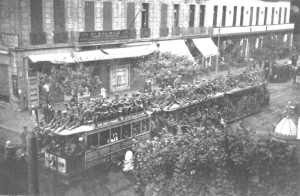
It would be nice to say they spent their time sightseeing, but they spent their time the way many soldiers have in many wars, drinking and seeking women, especially of the sort whose virtue was negotiable.

Lest you approach this tale with a "boys will be boys" snigger, let me deliver the downside up front: though tolerated houses of prostitution were supposedly subject to medical checks, the rate of venereal disease during the war was enough to create major problems for the British and colonial forces. ANZAC units reported an average incidence of VD across the Corps as 12%, or one man in eight; one unit is said to have had a rate of 25%. And penicillin hadn't yet been discovered.

Camp at Pyramids, Kangaroo Mascot
Cairo in 1915 was rather different from the Cairo of today. Many of its residents, whether foreign born or Egyptians of foreign ancestry, claimed the protection of foreign consulates under the system of "capitulations," under which they were subject to the laws of their protective country, not of Egypt. Disputes with Egyptian nationals were settled in a system known as the "Mixed Courts." This naturally created complex jurisdictional issues for law enforcement.

Sir Thomas Russell (Russell Pasha), was the British Deputy Chief of Police for Cairo, later becoming the Chief. (Egypt, until the war nominally Ottoman but under de facto British rule, was declared a British Protectorate when Turkey joined the Central Powers.) Russell's memoir, Egyptian Service, 1902-1946 is a very readable view of the British era from the inside. (His wife, Lady Dorothea Russell, wrote a readable guide to the Islamic monuments, a predecessor of later works by Richard Parker and Caroline Williams). As a police officer, his memoir deals a lot with the seedier side of things, including prostitution and the hashish trade.

Egypt had developed a licensed brothel quarter in the late 19th century, where the houses were nominally subject to medical inspection. Beyond the licensed quarters, there were areas where prostitution was semi-tolerated. Even when, in 1916 (the year after the events described here), a crackdown was introduced, the capitulations got in the way. Russell Pasha:
One particular house of some size and popularity defied Bimbashi Quartier, our chief detective officer, and myself for months by ringing changes on the nationality of the padrona [the Madam]. Police could not enter a foreigner's house without the consent and presence of the Consul or his representative. When we arrived with the French consular cavass to demand admission from the French padrona, the spy-hole in the front door would be opened and a husky voice announce that Madame Yvonne had sold the business to Madame Gentili, an Italian subject, without whose Consular representative we could not enter. Next week we would arrive with the Italian cavass to be met by another change of nationality by the padrona. Picqued beyond the ordinary, Quartier one night assembled seven Consular cavasses at the fast-closed door, and one by one the fictitious landladies were defeated, entry gained, and the law enforced.
A linguistic note: "Bimbashi" is not detective Quartier's first name. It's a rank which in the Egyptian Army and Police was equivalent to lieutenant colonel. (Though binbashi today in the Turkish Army is a major.)

Now, to further set the scene for the Battle of the Wozzer, we need to introduce the Red Light District of the Day (or the Red Blind Quarter as it was known). The area may come as a surprise to those who know Cairo today, since it included the once-elegant colonnaded street of Clot Bey (named, ironically given those VD rates above, for the French doctor who introduced European medicine to Egypt in the age of Muhammad ‘Ali), and other streets to the north of the Ezbekiyya Gardens.

Back in Ottoman times, Ezbekiyya had been a lake, and the area to its west was mostly flood plain; Bulaq was an island. Under the Khedives Isma‘il and Tawfiq in the late 19th century the area to the west was filled in and became the Ismailia Quarter, what today we think of as downtown Cairo. (Midan al-Tahrir was originally Midan Ismailiyya.) The Ezbekiyya Lake became the Ezbekiyya Gardens, formal gardens with promenades, surrounded by the foreign consular quarters and the big foreign hotels, including the famous original Shepheards, burned in 1952, opposite its northwest corner. (The later Shepheards was placed on the Nile instead.)

The area to the north of Ezbekiyya was known as Wagh al-Birka, "fronting the lake," because it was once the site of palaces and villas on the lake. The name itself actually needs a little note as well. Literally, the original name was named وجه البركة (Wajh al-Birkat in Arabic) which normally would be pronounced, in Cairene dialect where the jim is pronounced as a hard 'g', as Wagh al-Birkat. But in this case, the jim acquired an sh sound, so that the usual pronunciation was Wish al-Birkat. In fact, the engineer and planner of much of modern Cairo, ‘Ali Pasha Mubarak, in his street-by-street masterwork on Cairo, Al-Khitat al-Tawfiqiyya al-Jadida, actually spelled it that way: وش البركة.

Ezbekiyya remained fashionable, with Shepheards being the HQ of the ANZAC command (who may or may not have known that in 1798 Napoleon had his headquarters just to the west)

The general area of the Wajh al-Birkat and the streets to its north, though once fashionable, were also in the area where the new city of Cairo and the elegant foreign hotels rubbed up against the older quarters of town. It led to unusual juxtapositions: one reason the military command could respond so quickly to the riot we're about to describe is that they were in Shepheards only a couple of blocks away; just north of the area under discussion sat the main Coptic Cathedral for Cairo (the church is still there, but it was replaced as seat of the Coptic Pope by the new Cathedral in ‘Abbasiyya in the Nasser era). It was also an area where the tolerated brothel quarters around Clot Bey and the Wajh al-Birkat merged into a more unregulated area known as the Wasa‘a, literally the "wide area" which apparently once referred to the old fish markets when the Nile came much farther east. The actual "battle" in question started in a street called the Darb al-Muballat, but most of the troops knew the whole area as the Wasa‘a. Or, since the ‘ayn would defeat them, as the Wazza or the Wozzer. As Russell Pasha put it, the Wajh al-Birkat
. . . was populated at the time with European women of all breeds and races other than British, who were not allowed by their Consular authority to practice this licensed trade in Egypt. Most of the women were of the third-class category for whom Marseilles had no further use, and who eventually would be passed on to the Bombay and Far East markets, but they were still European and not yet fallen so low as to live in the one-room shacks of the Wasa'a which had always been the quarter for purely native prostitution of the lowest class.
He tells us the area was "ruled" by a "king," "a huge, fat Nubian named Ibrahim al-Gharbi," who dressed in women's clothes and wore a white veil.

Now, we come to April 2, 1915. The ANZACs were getting ready to ship off to the Greek islands of Lemnos and Mudros to prepare for the Gallipoli landings. According to some of the accounts I will be quoting below, there had been some incidents leading up to the "battle," but since April 2 was Good Friday, there was no training that day and large numbers of men had leave for the Easter weekend. So all the resentments came to a head.

Depending on the version, and there are many, the immediate provocation was one or more of the following:
  • Anger over the extremely high rates of VD, already mentioned;
  • An Englishman was trying to rescue his sister from one of the houses;
  • Claims the beer was watered or even stretched with urine;
  • A New Zealand unit was outraged because one of its Maori soldiers was rejected by a girl as too dark-skinned;
  • Arguments over price.
Perhaps it was some combination of all these, or just the imminent deployment.The fight began with an attack on a house at Number 8, Darb al-Muballat, for whatever reason. Soon sofas were burning in the street, a piano came crashing out a window, and as many as 2000 ANZACs were torching brothels and fighting with natives and each other. Both mounted British military police and Australian units eventually put the riot down; the whole thing started between four and five in the afternoon (remember, the men had the day off and doubtless started drinking early) and ended by eight. What may be the nearest thing to a photo of the scene: From the Australian War Memorial collection. Caption: "Cairo, burnt buildings and carts possibly the aftermath of the riot later known as the Battle of the "Wozzer", which took place in the street known as the Haret El Wasser near Shepheard's Hotel, Cairo 2 April Good Friday 1915."

The lady (well, woman anyway) in the foreground in what might be a nightgown invites speculation. I'm pretty certain she's not a man in a galabiyya.

Now, some accounts, including eyewitness ones, from those who were there. Oddly enough, more of those on guard duty who put down the riot seem to have written about it than the participants.

Another view of the post-riot damage is at right.

An account from a website dedicated to the Australian Light Horse:
First Wassa (also Wozzer or Wazzir), the appellation given to the first of two unheroic riots in the Haret el Wassa (the brothel quarter of Cairo, Egypt) involving troops from Australia and New Zealand. The initial incident occurred on 2 April 1915 (Good Friday), after units of the Australian & New Zealand Army Corps (ANZAC) received news that their period of training was at an end and that orders had been received for them to embark for long-awaited action. Causes of this disturbance reportedly lay in a desire to exact revenge for past grievances arising from dealings with the district's denizens-such as diluted liquor, exorbitant prices, and high rates of venereal infection-although wild rumours of stabbings of Anzac men by locals also appear to have played a part.

Trouble began soon after 5 p.m. when soldiers began evicting whores and their pimps into the street, and tossing their possessions out after them. Bedding, furniture and clothing-even pianos-were thrown from windows of buildings several storeys high. These materials were piled in the road and set alight. The town picket, drawn from the Australian 9th Light Horse Regiment, came on the scene and tried to clear the men out of the houses being attacked. Five arrests were made, although the crowd-growing larger by the minute refused to let these men be taken away, snatched rifles from some of the troopers and threw the weapons onto the fires, and succeed in freeing four of the prisoners.

British military police (MPs) were summoned, about 30 arriving on horseback to choruses of abuse and a shower of stones and bottles. An ill-advised effort by the MPs to gain control by firing their pistols, supposedly over the rioters' heads, resulted in the wounding of four men in the throng estimated at 2,000-3,000. This only served to further inflame matters, and forced the police to hastily withdraw. Efforts by the Egyptian fire brigade to douse the bonfires were also frustrated, its hose-lines being cut, its members manhandled (especially after they turned a hose onto the crowd), and the engine itself finally pushed into the flames.

Left to themselves, the more unruly elements began to loot some shops and put the torch to a Greek tavern. Shortly after 7 p.m. a second fire engine arrived, this time under cavalry escort which exercised extreme tact, and the various fires were tackled while a still sizeable crowd looked on. Since the `Wassa' was close by Shepheard's Hotel, where the Anzac commander had his headquarters, armed troops had also been called out. After the  Lancashire Territorials (non-regular British troops who were popular with the colonials) were drawn across the road, the rioters wisely began to disperse and order was eventually restored by 10 p.m.

A formal inquiry was convened the following day under Colonel Frederic Hughes, commander of the AIF's 3rd Light Horse Brigade, to investigate the causes of the riot and establish responsibility for its outbreak. Many New Zealand officers attempted to disclaim that their men had played any part, although the evidence of their presence was quite conclusive - the officer leading the Australian picket was adamant that `New Zealanders predominated'. In any event, nine-tenths of those present had been merely spectators. Apportioning blame was next to impossible, however, with few of the 50 witnesses able (or willing) to provide precise information. As the number of men injured by the MPs' bullets (three Australians and one New Zealander) was roughly in proportion to the size of the respective contingents, it could be said that the ‘honours' were about equally shared. So too was the damages bill of £1,700.
The Lancashire troops were the 42nd East Lancashire Territorials.

From a letter by Jack Jensen, from Wasley in South Australia, written in England recovering from wounds in Gallipoli:
The last few days we had in Egypt I shall never forget as three nights running there were riots in & about Cairo. On good friday there was a big row in one of the main streets in Cairo. I think I told you once before that Cairo is a very immoral place in fact they say that it is the worst town in the world. Some streets there are nothing but brothels & houses of infamy where every possible vice under the sun exists. Of course some of our men had been going to these places & had got diseases of different kinds & as a (what?) our chaps had a grievance against these places. Finally to finish up with one of the Manchester soldiers who were also stationed in Egypt found his sister in one of them. She had left England as a servant to some lady who had taken her to Egypt & left her there. I dare say you have heard of that sort of thing it is called the white slave traffic here in England. Anyway this girl went from bad to worse until finally she way found dancing in what they call a Can-Can hall that is a dozen or so women dancing perfectly naked in a big hall & exposing their person to every kind of indignity both by themselves & also the onlookers. It is just as well that I cannot tell you everything that goes on here as it would only grieve you. This Manchester chap managed to have a talk with his sister & tried to get her away. She was only too willing to go but the people she was with would not let her & they threw the brother out of a window as a result he was in hospital for nearly a week. When he got right he came in the camp & told our chaps & asked them to help him. At first they could not find the girl again but at last she was found in a particularly vile house. This was a day or two before Good Friday & that day being a holiday about 500 of our chaps & some New Zealanders & English troops went in to raid these houses. When they got in there a good many got drunk & they were joined by a great many more also drunk so the affair ended in a riot. They got the girl out first & then set fire to the houses. The affair started about four oclock in the afternoon & was kept up until nearly midnight Shops were raided & windows broken everywhere. I was on guard that day & we were called out to go & stop it but only twenty of us could do nothing against nearly two thousand. They had a fire in the street & were throwing the furniture out of windows two & three storeys high on to it. Some of us went in & tried to put it out & a chair came out of a window three storeys high & hit one chap & nearly killed him. We carried him away & a few minutes after piano came out of the same window & fell with an awful crash on the pavement. All the strings seemed to break at once & it went off like a cannon. After that the Military Police charged the crowd on horseback firing their revolvers into them but the crowd threw broken bottles & stones at them. One policeman got badly hit & one eye cut out with a broken bottle & two of our chaps were hit by the revolver shots.

About eight oclock five hundred Manchester troops came with fixed bayonets & were told to charge. They charged alright but they wouldn’t go for our men so they gave them rifles & our chaps threw them on the fire. Then they turned & ran & our fellows followed them up with sticks A while after the South Australian Light Horse came but the horses wouldn’t face the fire & smoke A little after eleven oclock the Westminster Dragoons came. They looked all right as they were coming down the street with all their swords drawn & their horses going straight through the fire & smoke. This very soon cleared the street & then we went for the houses & took everybody prisoner that we found. We got about fifty Australians & some New Zealanders.

The girl who was the cause of all the trouble was sent to England. She was taken charge of by the Y.M.C.A. The men in camp collected over forty pounds to pay her passage & expenses back to England Of course the money was handed over to the Y.M.C.A.

Next night a riot started in the canteen of the Abbasieh camp. Somebody caught an Arab who was employed at the canteen making water in a tub of beer. The Arab was at once pulled & half killed. All the beer casks & tubs were broken & spilt & all the groceries & goods stolen & the place burned down.

The guard was called out again but by the time we got there everything was over & the camp was quiet except for the fire still burning.

On Sunday evening the New Zealanders burned down a picture show. The man had advertised a boxing match & doubled the admission & then showed just the same pictures as he usually did. So they burned his place down.
The "Manchester" troops Jensen refers to are presumably the Lancashire Territorials mentioned in the earlier quote as being more popular with the ANZACs than British regulars; before the British government started messing with the historical counties, Manchester was in Lancashire.

You can also find the original contemporary diary of Australian War historian C.E.W. Bean on the Australian War Memorial site; Diary Number 3, including the Wozzer (which at one point he calls the Wozzy), is here.This has gone on too long and transcribing a PDF manuscript would take me all night, but it's there if you want more detail. His account of April 2 begins on page 25 of the PDF link.

At right, troops in evidence in the Wasa‘a after the riot, via Australian Light Horse Studies Centre.

Now, for the sake of completeness, I should note that there was a second Battle of the Wozzer fought on July 31. This was a much smaller affair, and took place after most of the ANZACs were ashore at Gallipoli.It also has its own website, The 2nd Battle of the Wozzer, complete with some of the testimony, so I'll just refer you there. The medallions at the top of this post are from his site.

Source here
Now, a discursus on the area in more recent times, in case any of my readers want to visit the scene.

When I first went to Cairo back in the 1970s, Ezbrekiyya still had traces of its former glory, though once the Opera house burned down it was less of a draw. Nearby Cafes and bookstalls surrounded the gardens.

When the new Azhar Flyover was built, I think sometime in the 80s, the south side of Ezbekiyya was dominated by its on-ramps and nearby Midan al-Ataba dwarfed by the highway. But the area to the north, site of our story, has changed less (though of course Shepheards has been gone since 1952, two revolutions ago). I've scanned in a section of a Survey of Egypt map from the late 1960s. It's in Arabic, but so for non-Arabists who nevertheless know Cairo, here's a brief guide:

The large street with a tramway down the middle at the right is Clot Bey. The street running westward and intersecting Clot Bey at the lower right corner, today the extension of Naguib al-Rihani Street east of Gumhuriyya St. was the old Wajh al-Birkat street. Gumhurriya (then Sh. Kamel) and Clot Bey reach the northwest and northeast corners of Ezbekiyya a couple of blocks south of the lower edge of the map. The big building complex in the right center of the map is the Coptic church of Saint Mark, formerly Cairo's main cathedral, now replaced by the big one in ‘Abbasiyya. The north-south street through the middle of the picture, running from Naguib al-Rihani to Clot Bey, is Al-Kanisa al-Marqusiyya, named for the church which is on it. If you'll look between Naguib al-Rihani (Wajh al-Birkat then) and Qabila street to its north, you'll see a small back street, the third to the right counting from Al-Kanisa al-Marqusiyya. The print here is too small to read, but it is Darb al-Muballat. The original brothel attacked and burned in 1915 was at number 8, Darb al-Muballat. I don't know if the street numbers have changed; today's number 8 is on the west side of the street. It's a pretty staid neighborhood today, or was the last time I saw it. Illegal brothels were cleaned up in 1916 and prostitution made illegal in 1924. (Therefore there was no prostitution in Egypt during World War II when Cairo again filled up with foreign troops. After all, it was illegal.)

The overall area from Google Earth  (copyright Google):
And Darb al-Muballat today (again, street numbers may have been changed so Number 8 may not be in the same spot, and the copyright is Google's):

Friday, March 13, 2015

Egypt Unveils Plan for "New Capital City" East of Cairo

Locator map from the website
To accompany the launch of a much awaited economic development conference in Sharm al-Sheikh, Egypt unveiled plans for a "new capital city" and administrative center to be located to the east of the existing metropolis. The website is here.

The idea to create a new government center outside the center city has been discussed for some time, but this is the first time details have been released. The new capital city would continue the expansion of the metropolitan area further eastward into the eastern desert, at a point midway between the core city and the Suez Canal. As the map shows, it would lie to the east of New Cairo, a satellite city developed since the early 2000s and home to AUC and other universities, sporting clubs, etc.

Many urbanologists have criticized the growth of satellite cities since the 1980s as encouraging the segregation and isolation of political and economic elites in gated communities far from the urban core, which is bypassed by a growing number of ring roads and bypasses.

A Dubai in the desert?
The publicity claims that the new capital will be a city of five million with a diversity of land use and employment. This post at CairoScene and this one at Egyptian Streets take fairly positive approaches, largely repeating the official publicity.

But not everybody is on board. At the always interesting CairObserver, AUC historian Khaled Fahmy's sharp critique is unsparing:
The website also links to Capital City Partners, a private real estate investment fund led by Emirati Mohamed Alabbar. Alabbar is one of the main advisors of Muhammad bin Rashed al Maktoum, the governor of Dubai. He is also CEO of Emaar, a leading construction firm which built the iconic Burj Khalifa in Dubai and which already has extensive business in Egypt.
I won’t dwell on the fascination with Dubai as a model for urban development and how unsuitable this model is for Egypt whose GDP per capita is 8% of that of the UAE. Nor will I dwell on the deep political and social inequalities that lie beneath the glittering veneer of Dubai, and the serious political implications that this model bodes for the new proposed capital of Egypt. I also won’t dwell on the meaning and significance of announcing such a momentous decision not in front of parliament (for we have no such institution due to a legal fracas that delayed the elections to an unspecified future date) and not to the local media (despite the fact that whatever independence this media might have once enjoyed has evaporated in thin air), but to a group of word leaders and foreign investors who claim to be  “focus[ing] on efforts to promote shared prosperity in Egypt and the region” (in the words of US Secretary of State John Kerry).
I just wonder what will happen to Cairo, Egypt’s capital for more than a thousand years? What will happen to the metropolis that is home to close to 20 million inhabitants? Where do they fit in the government’s plans for the new capital? The website says that it is hoped that the new city will attract 5 million inhabitants when it is finished. Assuming that the aim of building a new administrative capital is to alleviate the pressure from downtown Cairo where the majority of government offices are located, and assuming, for argument’s sake, that the 5 million inhabitants will actually be moved from overcrowded city, what will happen to the rest of us?
But do read the whole piece, "Chasing Mirages in the Desert."

I will also look forward to seeing how David Sims, whose new book, Egypt's Desert Dreams: Development or Disaster? was recently published by AUC Press, reacts to these plans. I haven't read the new book, but he summarized it in this interview last month.

(For my appreciation of Sims' earlier book, Understanding Cairo: The Logic of a City Out of Control, see my 2011 post on essential readings on Cairo.) 

I imagine I and others will have more to say about this in coming days.

Friday, February 13, 2015

Zeppelins in the Middle East, Part II: The Graf Zeppelin's Visits in 1929 and 1931 to Paletine and Egypt

1933 Egyptian Stamp Marking 1931 Visit
In yesterday's first part of this two-part post,we dealt with the use of Zeppelins in the Italo-Turkish War in Libya and the bizarre 1917 adventure of German Zeppelin L59 attempting to cross British-occupied Egypt and Sudan to resupply troops in German East Africa.

Dr. Hugo Eckener
As mentioned in yesterday's post, after the death of Count von Zeppelin in 1917, the Zeppelin enterprise was headed by Dr. Hugo Eckener, When the Versailles Treaty force Germany to give up all military Zeppelins, Eckener began to seek permissions for civilian passenger Zeppelin airships, and by the late 1920s there began the age of luxury airship travel, when these luxury liners in the sky offered elites a way to cross the oceans faster than ships, at a time when heavier-than-air crossings were still he realm of adventurers like Charles Lindbergh and passenger aircraft with such range were still in the future (though the first passenger flying boats were beginning to challenge them).

Eckener's crown jewel was the Graf Zeppelin, named for the founder Count von Zeppelin. It remains one of the best-known Zeppelins, its memory eclipsed only by the ill-fated Hindenburg, whose end was so memorably captured in newsreels in 1937. (The Hindenburg was not one of Eckener's. He hated the Nazis and the feeling was mutual, and he was removed from his position after Hitler came to power and the Zeppelin works nationalized by the Nazis. Hindenburg, with its bright swastikas on its tail, was Hitler's attempt to impress the world. Well, it's certainly remembered.)

Returning, though, to Graf Zeppelin. Designated LZ 137, she was built at the Zeppelin works at Friedrichshaven am Bodensee between 1926 and 1928, she was 776 feet long (the largest airship built to that time) and could reach a top airspeed of 80 mph, though it normally did not reach that speed. During its lifetime (1928-1937)  it would make 590 flights and cover a million miles, including one round-the-world trip (Weltfahrt). She was Weimar Germany's pride and joy, and she was meant as a demonstration of German aviation prowess.

As a result its trips were often intended to impress, and therein lies the theme of this posts: its Middle East visits, to Palestine in 1929 and to both Palestine and Egypt in 1931. It would also visit Tangier during one of its Mediterranean voyages, as well as I believe on its trips to Latin America.

The  1929 Visit to Palestine

For a good summary of both the 1929 and 1931 visits, let me refer you to zan  article by Alan McGregor in a 1994n issue of Saudi ARAMCO World: "Contrary Winds: Zeppelins Over the Middle East." 

Originally, the 1929 trip was supposed to include both Palestine and Egypt, but as the article notes, while Britain approved overflying the Palestine Mandate, it vetoed the visit to Egypt, worried about Egyptian nationalism and determined that the first dirigible to visit Egypt should be the British R-101, and intending that it make a visit in 1930 to India, making a stop in Cairo. Nevertheless, an Al-Ahram reporter, Mahmud Abul-Fath, was going to make the voyage. The ARAMCO World article quotes dispatch he publish on March 24, 1929, the day before the flight:
"The Egyptian people, through no fault of their own, are being prevented from witnessing a magnificent spectacle. This is due to [British] envy of the thoughtful, hard- working German nation, which is developing so quickly and outclassing most other countries, particularly in aviation. As a result, the people cannot see the [Graf Zeppelin], and it will not see the Suez Canal."
Below is a German map of the 1929 route (in which rhe Zeppelin did not land):
Route of the 1929 Visit
Leaving Fridrichshafen on March 25, 1929, tthe Graf passed over Italy, Crete and Cyprus before reaching Palestine in the evening.

The ARAMCO World article is a little confusing in its sequencing:
By early evening they were over Palestine, dropping a bundle of 5000 letters to the large German colony at Jaffa. They found Mount Carmel bedecked with German flags and the word "Willkommen " spelled out in 8-meter-height letters; then they flew along the coast to Tel Aviv, where a passenger showered confetti on the crowds below.
Since Jaffa and Tel Aviv adjoin each other, while Mount Carmel towers above Haifa, this is confusing. Mail drops were in fact made at both Haifa and Jaffa, and in fact franked postcards from both are collectors' items, frequently seen on E-Bay and philatelic sites. Both Haifa and Jaffa had large German colonies (actually Jaffa's was at Sarona, now a part of Tel Aviv), but oher accounts and the map make clear that after the mail drop at Haifa, he Zeppelin proceeded down the coast to Tel Aviv-Jaffa, I'm unsure if this photo of the Zeppelin over Sarona is from the 1929 or the 1931 visit (most photos are from 1931, since most of the 1919 flight was after dark):
Over Sarona
The ship then sailed east to Jerusalem, stopping its engines to hover over the Old City, then proceeding eastward to Jericho and the Dead Sea. Over the sea, the captain  descended to close to the surface before rising and proceeding back over Jerusalem, now visible in bright moonlight.

Proceeding out over the Mediterranean, the Zeppelin proceeded along the Egyptian coast, where Dr. Eckener, off Rashid, sent birthday greetings to King Fuad I, regretting that "contrary winds" prevented him from visiting Egypt. Graf Zeppelin then passed over Greece, circled the  Acropolis, and proceeded via Vienna to Friedrichshafen and home. The first Middle East visit had lasted four days, May 25-28. Her next Middle East visit would be in 1931.

Meanwhile,  the British completed their challenger to he Graf Zeppelin, the R-101. On October 5, 1930, on its first trip outside Britain, R-101 crashed and burned in France, killing 48 of the 54 people aboard including Britain's Air Minister. That marked the end of British dirigible building. It also brought Dr. Eckener to the funeral of those killed. At that point, the British Air Ministry invited Eckener to visit Egypt with the Graf.

On April 9, 1931, Graf Zeppelin left Friedrichshafen at 6:10 AM and proceeded south over Corsica, Sardinia, and Sicily, and reached the Libyan coast at 5:15 AM the next day and proceeded eastward over Benghazi, crossing into Egypt at Sollum and continuing to Alexandria at 12:55 PM. The Zeppelin spent 40 minutes circling over Alexandria while much of the population watched.
Over Alexandria
From Alexandria, the ship followed the Nile to Cairo, arriving around 3:30 PM. Eckener brought it over the  Qubba Palace, where King Fuad I and Queen Nazli were watching from a balcony. He dipped the great Zepplin's bow three times to the monarch.

So much of the 1929 trip had been in the dark that there were few photo opportunities, But the 1931 trip offered plenty of the sort of publicity photos Eckener and Germany had been hoping for.
Over the Cairo Citadel and Muhammad ‘Ali Mosque
After cruising over Cairo, Graf Zeppelin then proceeded to the Pyramids at Giza, providing multiple photo ops and descending to only a short distance above the Great Pyramid of Khufu. These were to become some of the most iconic pictures of the visit:


The Zeppelin proceeded south to the Step Pyramid at Saqqara and then cruised northward over the cities of the Delta overnight, while the passengers slept. At the coast it turned back towards Cairo and its first landing in the Middle East.

At 5:15 AM,the ship reached Cairo and the old Almaza airfield, which was Cairo's original civil airport and is today an Air Force Base some distance south of Cairo International Airport which replaced it. There, at 6:10 AM, British troops stationed in the area manned the mooring cable and also formed  a cordon around he airship to hold back surging crowds, estimated at 30,000, who had flocked to Almaza to see it Firehoses were reportedly used to hold back the crowds when it took off later. An account of that visit can be read here.
Troops Guarding the Zeppelin
Eckener and some of the crew disembarked in Cairo, as did others wishing to see Cairo. Eckener had lunch with dignitaries and an audience with King Fuad. Meanwhile,  the Zeppelin took off for a voyage over Palestine, passing over the Suez Canal, gaza, ajd Tel Aviv-Jaffa, then turning east toward Jerudalem.

Arriving this time in clear daylight at 11 am, the Zeppelin took several circuits over the city, stopping her engines 100 meters over the Church ofthe Holy Sepulchere, and also unfurling the German flag over the (German-run) Augusta Victoria Hospital on the ridge east of the Old City. And, of course, again providing great photo opportunities:
Over the Old City of Jerusalem

Over the Old City of Jerusalem
Over David's Tower and the Jerusalem Citadel


The Graf Zeppelin then returned to Cairo, landing at Almaza at 5 PM. After picking up Eckener and the other, and departed over the desert, passing over Siwa and exiting over Libya. The second Middle East visit of the Graf Zeppelin was over. She returned to Friedrichshafen after 97 hours (four days plus an hour).

The ARAMCO World article cited earlier claims that for years Egyptians used the phrase "zayy al-zeppelin" (like the Zeppelin) to refer to something very large.


Monday, January 26, 2015

63 Years: Black Saturday, January 26, 1952

It is a curious fact that, 63 years after the Cairo Fire of January 26, 1952, there is still debate about who instigated it. Some 750 buildings in the heart of Cairo were burned and dozens died, yet no one has ever been held accountable. Depending on the prevailing ideological winds at the time, regime narratives since 1952 have tended to blame the Muslim Brotherhood, the King, the Wafd, or the British, even though the last were the main targets. Most historians assume that more than one of the above elements played a role, either of commission or omission.

The previous day, Friday, January 25, in a major clash in the Suez Canal Zone, the British Army had killed 50 Egyptian policemen in Ismailia after besieging the police post following hit-and-run attacks on British troops. (For details, including a video, see this post.)  The Wafd Government of Prime Minister Mustafa Nahas had previously abrogated the Anglo-Egyptian Treaty of 1936, and Interior Minister Fuad Serag al-Din ordered the police to hold out at all costs.

Rage was naturally running high on Saturday. Some organized political groups, including the Muslim Brotherhood and the Misr al-Fatat Movement, were likely both among the instigators, though Serag al-Din and the Wafd may have welcomed demonstrations until they got out of hand.

When demonstrators saw a police officer dining with a woman on the terrace of Casino Opera, the famed nightclub founded by Badia Masabni on Opera Square, they attacked him for not joining his colleagues in Ismailia, and proceeded to sack and burn the club, Cairo's most famous belly-dancing venue. (Badia Masabni had sold the club in 1950 but most still called it Madame Badia's.) That is usually considered the first of the fires, and may have been the Brotherhood, which opposed nightclubs, bars, and  cinemas, all of which were soon being targeted.

As the afternoon wore on, mobs (some apparently organized, some not) attacked British institutions (most famously Shepheard's Hotel, but also Barclay's Bank, the Turf Club, etc.); institutions owned by Greeks, Italians, Jews and others were also targeted.

Shepheard's in Ruins
Shepheard's was destroyed; the grandest of the colonial era hotels was a prime target and some guests died in the fire.

Cinema Rivoli on fire
Many cinema theaters were also attacked, though the demonstrators reportedly struck only after the matinees had ended when there were no patrons, This suggests come careful planning.

Cicurel Department Store
As the fires were spreading throughout downtown, there was little being done to stop them. King Farouq, lunching with senior police officials. took no immediate action. Nor did Serag al-Din, the Wafd Interior Minister. Though the Wafd and the King were sworn enemies at this point, the inaction of both has fueled conspiracy theories ever since.

Cinema Metro
Finally, in the evening, the Army was called in to restore order. What had begun as an anti-British protest had turned into a destructive event that further weakened the King and the Wafd, and destroyed much of central Cairo's best-known institutions, many of them Egyptian-owned. Less than six months later, on July 23, the Free Officers would stage their coup.

A newsreel of the aftermath: