
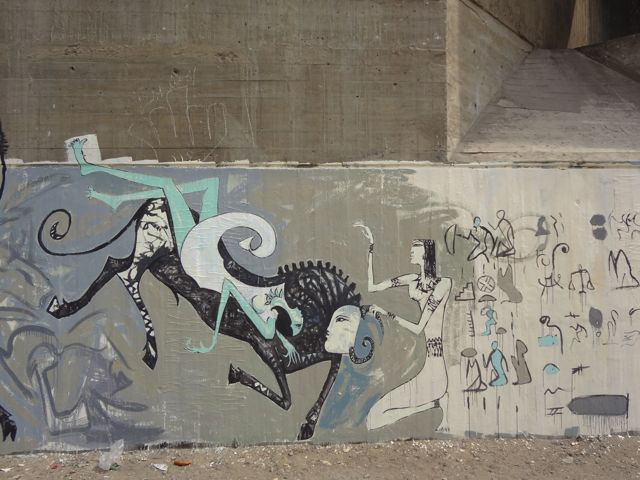
Back during the turmoil of the Egyptian Revolution in 2011 I posted several posts about revolutionary street graffiti in Cairo, especially the much-decorated walls of the American University's downtown campus along Mohamed Mahmoud Street. Now they're the subject of anew controversy. A group known as the Women on Walls Project, founded by Swedish journalist and photographer Mia Grondahl, author of a book on Cairo graffiti, aims to celebrate women and the struggle against harassment through street art. It's a worthy idea, but many revolutionary artists charge that in some cases revolutionary graffiti dedicated to those ho died in Mohamed Mahmoud Street in November 2011, and other memorials to the dead, are being painted over. They are also painting on adjacent Yusuf al-Gindy Street, where I once lived. Grondahl denies that intact graffiti are being painted over and defends the project to both Ahram Online and Daily News Egypt; both are illustrated.
Since I'm reliant on media and social media reports I can't claim to judge the facts from far away. I'd urge you to read the linked articles and judge for yourselves and will welcome comments from those on the ground.
Whatever the merits of the two sides, I'm sorry to see supporters of street art quarreling among themselves, when there are plenty of state institutions who'd paint it all over in a minute if AUC didn't provide a welcoming wall.
Showing posts with label graffiti. Show all posts
Showing posts with label graffiti. Show all posts
Thursday, April 9, 2015


Wednesday, November 6, 2013
Egypt Drafting Bill to Ban Graffiti
 Egypt's Minister of Local Development, ‘Adel Labib, says his Ministry is drafting a law to ban "abusive" graffiti. (Also see this article.) While this is most immediately likely aimed at attacks on the Army by Morsi supporters, it needs to be remembered, as this blog has recorded many times, that graffiti was the artistic lifeblood of the 2011 Revolution.
Coming just days after satirist Bassem Youssef's popular show was "suspended" by its host network after its brief return to the air for the first time since the coup (a move nearly half of all Egyptians are said to support!), this, like so many other recent indicators, does not augur well for freedom of expression. Graffiti is by definition an underground, transgressive medium, and perhaps it is possible to ban only the obscene or libelous stuff, but censorship is a slippery slope indeed, especially if military men are writing the ground rules.
I would expect a new wave of creative graffiti. The suzeeinthecity blog has done an excellent job of documenting it to date.
Thursday, August 15, 2013
It's Come to This: Cairo Graffiti "Down With the Whole World"
Via Sarah Carr, Egyptian graffiti artist "Sad Panda's" latest work:
 "Yusqut al-‘Alam Kulluh": "Down with the whole world."

Wednesday, January 9, 2013
"A Tribute to the Women of Egypt" in Graffiti by "suzee"
 |
| suzeeinthecity |
Like her earlier posts, it's an important document.
Thursday, September 20, 2012
Egyptian PM Calls for Graffiti to Return
I don't know whether it's just typical bureaucratic miscommunication in a country which invented bureaucracy and has over 5,000 years of practice, or whether the Egyptian authorities were taken by surprise by the outcry over the removal of the Mohamed Mahmoud graffiti, but now a Cabinet statement is saying that the removal "is contrary to [the Cabinet's] will to commemorate the revolution" and noting:
Prime Minister Hesham Qandil calls on artists and painters and others to turn Tahrir Square into a space worthy of the martyrs of the revolution in order to become a symbol of the Egyptian revolution. He called for it to become a platform for freedom of opinion through wall paintings and graffiti, which reflect the spirit of the 25 January revolution, and the principles and aspirations of the Egyptian people.As I noted earlier today, they're already being repainted.
"The Walls Will Not Be Silent"
Wednesday, September 19, 2012
Whitewashing a Revolution

This is a loss for Egyptian culture, and a triumph for the bureaucratic mind,
Tuesday, June 12, 2012
suzeeinthecity: Cairo Graffiti for the Elections
The blogger suzeeinthecity has been documenting graffiti in Cairo ever since the revolution, and I've linked to her a number of times. Now she has a new post on the graffiti relating to the presidential elections. As usual, it's worth a perusal.
Since, as I've done before, I'm going to reproduce some of her graffiti, let me also note her notice/complaint to those who have taken without attribution. I've always attributed her as the source and linked to her post, but apparently others have not been so scrupulous. She says bloggers may use her work in exchange for linkbacks, duly provided here, and credit, but print publications need to pay for rights to her photos. I'm both giving credit and adding her copyright here, and urge others to respect her rights as well. A selection follows, but by all means go to her site.
A mural:
Right to left below: Mubarak, Tantawi, Amr Moussa, Ahmad Shafiq. Caption: He who names a successor never dies."
Her comment on the below: "My favourite stencil: Justice has been made into a belly dancer, wearing a military beret and a moustache."
The military as puppeteer manipulating the Presidential candidates:
After the above was painted over, repainted with the two runoff candidates:
Nationalist icon and hero Saad Zaghloul's last words in 1927 were "Ma fish fayda," "it's no use. Here Saad Pasha is repeating them and giving the finger, which has been painted over:
Since, as I've done before, I'm going to reproduce some of her graffiti, let me also note her notice/complaint to those who have taken without attribution. I've always attributed her as the source and linked to her post, but apparently others have not been so scrupulous. She says bloggers may use her work in exchange for linkbacks, duly provided here, and credit, but print publications need to pay for rights to her photos. I'm both giving credit and adding her copyright here, and urge others to respect her rights as well. A selection follows, but by all means go to her site.
A mural:
 | ||||
"Forget What is Past ..."
|

 |
| ©suzeeinthecity |
 |
| ©suzeeinthecity |
 |
| ©suzeeinthecity |
 |
| ©suzeeinthecity |
 |
| ©suzeeinthecity |
Friday, April 20, 2012
Yet More Pics of the Cairo Graffiti
I keep posting the Internet's many sites celebrating the graffiti on Muhammad Mahmoud Street in Cairo; click on graffiti for the earlier ones. This one is a slideshow from Zeinobia.
Thursday, April 19, 2012
Still More on the Cairo Graffiti Walls
I've posted a lot about the graffiti walls around AUC in Cairo; you may recall that AUC was organizing a panel on it earlier this month. Ebony Coletu, one of the organizers, has a well-illustrated piece at Jadaliya under the title "Visualizing Revolution: the Politics of Paint in Tahrir." The pharaonic themes are emphasized, among others.
Read it of course, but most importantly, look at the pictures.

Read it of course, but most importantly, look at the pictures.
Thursday, March 29, 2012
Cairo Graffiti Gets More Attention, its Own Panel
 I've noted multiple times how the graffiti walls on Muhammad Mahmoud Street in Cairo have become a major artistic phenomenon. Now the American University in Cairo (on whose walls much of the art is painted) is holding a panel of the artists themselves, on Monday at the downtown AUC campus, to discuss the art,as part of its "In Translation" series. More on the panel here, and flyer at left if you're in Cairo.
 |
| suzeeinthecity.com |
Meanwhile the suzeeinthecity blog has yet another of her collections of the graffiti, focusing largely on the Pharaonic themes. Even CBS News has gotten on the bandwagon. And recently, murals went up on the concrete block walls used by the authorities to block off the key streets between Tahrir and the Interior Ministry.
Thursday, March 22, 2012
Still More on Revolutionary Graffiti in Cairo, Well-Illustrated
Another piece at Jadaliyya, this one by Soraya Morayef and called "The Seven Wonders of the Revolution," adds to the growing wave of posts devoted to the revolutionary art and graffiti that have sprung up around Tahrir Square, in Muhammad Mahmoud Street, Kasr El Aini and others. Three of my earlier posts on the theme can be found under my graffiti tag. Note that the newest article is one of the most lavishly illustrated yet.
Thursday, March 15, 2012
Jadaliyya Celebrates M. Mahmoud Street Graffiti/Murals
Mona Abaza at Jadaliyya has a well-illustrated piece about the increasingly famous murals on the AUC walls along Muhammad (Mohamed, Mohammad) Mahmoud street just off Tahrir Square. The increasing fame certainly helps efforts to preserve the folk art murals. Earlier posts by me on the artwork are here and here.
Tuesday, March 6, 2012
AUC Professor on Keeping the Graffiti Walls
I've posted previously on the extreaornarily creative wall paintings (really too sophisticated to keep calling "graffiti" along the walls of the American University in Cairo's downtown campus, paintings which went up after the Port Said football massacre. Blogger "suzeeinthecity" had already issued a plea to preserve them. Now it appears that the university is indeed moving "to preserve the current images, life-size, in another medium so that they might be later displayed."
While the exact method of preserving them isn't spelled out in the linked article, this is clearly a Good Thing. Congratulations to AUC.
While the exact method of preserving them isn't spelled out in the linked article, this is clearly a Good Thing. Congratulations to AUC.
Tuesday, February 28, 2012
Muhammad Mahmoud Street Becomes Graffiti Central
|
| This and other stills below from suzeeinthecity.com |
A lot of attention has been paid to graffiti in all the Arab revolutions, and especially in Egypt. (Not njust in countries in open revolt either: here's a site on Saudi street art.) I've posted the occasional photo or link, but haven't talked about it in detail. Perhaps the Muhammad Mahmoud development is a good reason to do so. Besides the pharaonic themes I'm reproducing here, the walls also contain portraits of the dead supporters of the Ahly football team who died at Port Said, often depicted with wings.
Blogger suzeeinthecity, whose blog regularly posts collections of graffiti and who occasionally interviews the artists, has an appeal to AUC to leave the current art up on its wall. The photo at top, much of the Al Jazeera video, and the pharaonic themed paintings below are all on the AUC walls. As she puts it:
Dear AUC,
You will probably not listen to me – why should you? I’m clearly no art expert with any weight to throw around – but please don’t paint over this wall. These artists have worked tirelessly for two weeks to commemorate the deaths of 75 young men, including a student of yours, working days and nights through tear gas and riots to pay tribute to the dead.
This, in my humble opinion, is a masterpiece. And you clearly have bigger things to worry about, such as the fact that every single side street down Mohamed Mahmoud has been blocked by concrete slab walls, or that the military has turned your area into a war zone and has no problem shooting students, doctors or journalists. Or the fact that your Greek Campus SS Building has had a fire on its upper floor, and probably several other properties have been harmed in the past months of clashes. And who knows what more violence the future will bring?
As an institution that teaches art and publishes books on Egyptian art, including one on graffiti soon, please take pride in this mural on your walls, and instead of removing it, protect it. Show it off as a symbol of how your campus was in a pivotal location in so many historical events that have shaped our country for the past year.
But clearly this will fall on deaf ears and you will paint over it all. NB: painting a wall gives a new canvas to a graffiti artist. They will keep coming back. Just so you know. You might as well save the paint. Your effort is futile.
Sincerely,
me
I don't know her identity, but I'm sure AUC knows Al Jazeera English's identity, and while I have no particular clout there either, I see no reason not to note that preserving this work of street art seems worth doing. She has a much fuller collection of the Muhammad Mahmoud photos here.
One of the interesting things about the Egyptian graffiti is that a number of graffiti artists with distinctive styles have emerged, often signing their work and gaining a following, such as Ganzeer. Someone could write a book on the subject and if AUC press is up to their usual quality, I imagine they'll publish it.
The pharaonic themes are recurrent: this by Alaa Awad:

Another pharaonic theme:

And this by Muhammad Alaa:

There are good views of these in the AJE clip above, as well. I find the pharaonic theme intriguing, since the vast majority of the graffiti I've seen has been standard revolutionary street art: some of it stenciled, some painted, but mostly contemporary, political, and often aimed at either demonizing or insulting authority. That's worth preserving too, and some of it is clever. But this seems to transcend that. It evokes the deep past and the Egyptian identity.
The walls along Muhammad Mahmoud saw plenty of graffiti in November and December, most of it quickly painted over (hence the above plea to leave the current art in place). Here's an interesting palmpsest of graffiti along the stret from late last year, also from suzeeinthecity. It's more the typical mix of slogans and scrawled graffiti, with one quite clever item (and one crude one). Although I mainly want to talk about the Arabic, it needs a language warning due to an English expletive on the same wall, which English readers will naturally gravitate to first:

The most interesting part is not the profanity, though I'll address that too, but the part on the right, painted to resemble one of the plaques used to give street names. It reads "Street of the Field Marshal's Massacre (Formerly Muhammad Mahmoud)." No doubt long since painted over,the mimicking of the street sign struck me as notable (and others, as I've seen other photos of it from differing angles).
The painting to its left, in the colors of the flag, with the manacled hands, reads "Freedom Must Come." On the left, under the obvious "Fuck SCAF," (sorry: there's little point in my using asterisks here, as it's right there in the picture), is something about the Field Marshal in Arabic, possibly (?) Tiz ya Mushir, which would be rude, but not as rude as the English,and hard to translate exactly (possibly in the "Up yours" range of offensiveness).
This brings up a delicate subject I've noted, at least from my long distance perch, though discussing it may offend some readers. I can't really talk about it without giving examples, so first, strong language warning in both English and Arabic. Nor do I wish to suggest that most of the graffiti is vulgar: from what I've seen, it's not, and I hope mentioning it here doesn't offend too many readers (if the photo above upsets you, stop reading) nor do I want to imply that profanity is common. But I think it's an interesting linguistic observation, even if I have to cite offensive language to make it: at least in terms of the graffiti photographed by bloggers, English profanity (mostly "Fuck SCAF," and before that, Mubarak) has seemed much more common than Arabic, at least as graffiti if not in speech, despite Arabic's rich wealth of vocabulary for cursing and obscenity. I've seen the same "Fuck SCAF" phrase in photos of a tent in Tahrir, and on lots of walls (and #FuckSCAF became a common Twitter hashtag). On the other hand, strong language in Arabic, while heard on plenty of YouTube videos and angry Twitter posts in Arabic, doesn't appear as much on walls, at least in the graffiti photos I've seen (exception below). Once again, I'm not there, and perhaps those taking the photos are self-censoring in Arabic, or the authorities are painting over Arabic profanity before it can be photographed. Or perhaps it's the revolutionaries themselves, more willing to curse in English than in Arabic (what if grandma found out?). I suspect in all seriousness it's an attempt not to alienate and offend the less-educated populace (who are conservative and would object) but who would be unable to read the English, combined with the cachet among many young elite Egyptians of English, especially transgressive English.
But they definitely don't appear to be as quick to use profanity in Arabic on walls (again: they seem to use it in their chants, though). Also from one of suzeeinthecity's earlier collections, I found one graffiti use of very strong Arabic — but it uses the equivalent of asterisks:

In small script at the top: "Connect the dots:" then "*** umm al-Maglis al-‘Askari." Anyone knowing Arabic (probably even the hypothetical grandma mentioned above), will know that the missing three letters are kuss (the u is not written), the most vulgar Arabic term for the vagina, followed by "of the mother of SCAF" (profanity rarely makes sense in any language). It's easily the functional equivalent of "Fuck SCAF," and arguably even more taboo, given recent trends in English. Yet it's censored with the dots instead of the word. It's the equivalent of "**** SCAF." Readers know what is meant, but unlike the English above, it's not actually written. Standard for newspapers, perhaps, but on a graffiti wall?
Apologies for the brief diversion into revolutionary cursing. There's a scholarly article in there somewhere, perhaps for comparative linguists. I hope I haven't detracted from the genuine art above.
Subscribe to:
Posts (Atom)


 Posts

