A Blog by the Editor of The Middle East Journal

Putting Middle Eastern Events in Cultural and Historical Context

Showing posts with label Bahrain. Show all posts

Monday, March 21, 2016

The Forgotten, Silenced Uprising: Bahrain Five Years Later

Five years ago last week, Gulf Cooperation Council troops from Saudi Arabia and the UAE poured across the causeway into Bahrain, the only GCC state to experience a large-scale outbreak of protest during "Arab Spring." Within a week, demonstrators had been cleared from the Pearl Roundabout, center of the protests. Although protests have never completely disappeared, the Bahraini Spring was over. The GCC had made clear that if one of their member states is threatened internally, the others were prepared to intervene in favor of the status quo.

The Pearl Monument in 2011
The intervention was, at the time, a rare case of GCC military assertiveness except in the liberation of Kuwait in 1991. Today, with GCC forces (except for Oman) engaged deeply in Yemen and having flown missions in Libya,the Bahrain intervention seems, in retrospect, to have been something of a turning point.

On March 18, 2011, the Pearl Monument in the roundabout, which had become the rallying point of the protests, was torn down by government forces. Soon after, the roundabout itself was replaced with a junction with trafic lights.

Wednesday, September 9, 2015

As the World Freaks Out About Russian Troops in Syria, Has Anybody Noticed Qatar and Morocco are Sending Ground Trrops to Yemen to Join the GCC Forces Already There?

The Russian buildup in Syria has produced a lot of media attention and expressions of concern, but Syria isn't the only war attracting foreign military intervention. Within days of the death in Yemen of 45 UAE troops  (along with 10 Saudi and five Bahraini troops), Qatar announced that it was deploying 1,000 ground troops to Yemen to join the Saudi-led coalition there, its first dispatch of ground troops there, and Bahrain's King Hamad announced that two of his sons would go to Yemen as part of their national service.

All of the GCC states except for Oman are now participating in the Yemen coalition, and with the Qatari deployment all will have ground troops in Yemen except Kuwait, which is contributing aircraft. Egypt, Jordan, and Sudan are also participating militarily in various ways, and now there are reports that Moroccan ground troops will also be joining the coalition. Reports suggest that up to 6,000 Sudanese troops may be coming as well.

At a time when it is still not clear whether the Russian buildup in Syria is intended to participate in combat or is merely there for force protection and regime protection, it is interesting that there is much less attention (at least in the US media) to the growing ground force commitment in Yemen.

Wednesday, August 26, 2015

Ottomans Expelled from Qatar, August 1915, Part III

Just a reminder: Postings will be sparse during my current two week vacation.

In Part I of this post, I explained the background of the fact that at the outbreak of World War I, the Ottomans still retained a small garrison at Doha, Qatar, and at the neighboring al-Bida‘ Fort. Part II described the dramatis personae on the British and Qatari sides, and the orders given to the key players, Major T.H. Keyes, British Political Agent in Bahrain, and Commander Viscount Kelburn of the HMS Pyramus. For the actual events at Doha, the best approach seems to be to quote extensively from Major Keyes' account of the affair sent to Percy Cox:
From Major T.H. Keyes, I.A. [Indian Army], Political Agent, BAHRAIN To the Hon'ble Lieut-Colonel Sir Percy Cox, K.C.I.E., C.S.I., Political Resident in the Persian Gulf, BASRAH
Bushire 23rd August 1915
I have the honour to report that H.M.'s Ships "Pyramus: and "Dalhousie" arrived at Bahrain on the 18th instant, when your 1633-B of the 16th instant was delivered to me by the Commander of the "Pyramus" [Commander the Viscount Kelburn].
2. As there were no Tangsiri [= Tangistani] boats in Bahrain, I left the same afternoon in "Pyramus", arriving off Doha early on the 19th. Large numbers of boats were leaving Doha that morning, as the second fishing was just commencing. While "Pyramus" was negotiating the difficult entrance to Doha bay, I went away in an armed cutter and examined all boats that were under sail, but found no Tangsiri boats among them.
3. "Pyramus" having anchored within 2,000 yards of Doha Fort while "Dalhousie anchored out of range of the Turkish guns, I sent my interpreter ashore to fetch Shaikh Abdullah [‘Abdullah bin Jasim Al Thani, Ruler of Qatar].
The terminology of British Imperial officers at the height of the Empire is telling. Qatar still had an Ottoman garrison and would not be a British protectorate until 1916, yet Keyes sent to "fetch" the ruler. I am reasonably sure that when a foreign warship pus into Doha today, no once sends to "fetch" Sheikh ‘Abdullah's great-great-grandson, Sheikh Tamim. Keyes continues:
The shaikh arrived on board in the early afternoon, and assured us there were no Tangsiri boats in his port, and that none had been there for some time,  but said that he believed that some Turkish deserters had joined the Tangsiris with several rifles and large quantities of ammunition. He vehemently denies having sent Rais Ali any ammunition [See Part Two] and said that he only sent him 8 cloaks in exchange for the ten hawks Rais Ali had sent him. From independent enquiries which I instituted in Doha and Al Bida I am inclined to believe his version of the affair.
Doha about 1904 (Lorimer's Gazeteer)

Doha Fort Today
As we saw in Part Two, Cox had added an additional task (afterthought or perhaps the main motive all along?) to looking for Tangistani dhows: offering the Ruler an incentive if he could get the Ottoman garrison out of Doha and turn over its guns. He was authorized to pay 2,500 rupees per gun or, since there turned out to be two guns, 5000 rupees. (As near as I can tell, in 1915 the rupee under the raj was pegged at 480 silver rupees to one gold sovereign, but I may have this wrong.)


Keyes' report continues:
4. We then proceeded to discuss the question of the Turkish fort.  Shaikh Abdulla [sic, Abdullah elsewhere in the report] informed me that there were two officers and forty men with two guns and one mountain gun at the Fort.  Entrenchments could be sen around the Fort, the emplacement of the mountain gun could be easily distinguished, and also two objects which we took to be the emplacements for the field guns. All of these in the entrenched line.
I requested Shaikh Abdullah to place the following alternative before the Turkish Commandant:
(a) That he should surrender, when the officers would be allowed o retain their swords and be treated in the manner indicated in your letter sent by Abdul Jabbar Effendi.
(b) That he should vacate the fort leaving the guns intact in which case I would hand the Fort [inconsistent capitalization in original] over to Sheikh Abdullah, on the latter;s agreeing to look after the Turks, I insisted on an answer by 7 a.m. the next morning and Shaikh Abdullah agreed to settle the matter during the night, though he was very anxious to have ten days for the negotiations.
I promised him 5,000/- [Rupees] if he arranged the surrender of the Fort without a hitch and gave him to understand that if he failed the Fort could be taken by H.M.'s ships. I may add that the Shaikh was under the impression that "Dalhousie" was a trandport.
As noted in Part II, HMS Dalhousie had been a transport in the Indian Marine Service, but four guns had been added to her.
On the morning of the 20th I landed with Commander Viscount Kelburn. On learning from Shaikh Abdullah that the Turks had fled in the night, we proceeded to the Fort which was first occupied by a landing party and searched, and then formally handed over to Shaikh Abdullah.
Besides the three guns in the trenches there were 14 rifles, about 8,000 rounds of ammunition, 500 projectiles, some casks of black powder, tents, great coats, and odds and ends of stores in the Fort. Three old muzzle loaders had also been used for revetments. The cordite charges for the guns and the breech blocks had been removed At Shaikh Abdullah's request I gave him the rifles and unfortunately promised all the rifle ammunition. Shortly after this a blue-jacked discovered 105 cases of mauser ammunition in a magazine about 100 yards way. I handed this over to the Shaikh subject to your approval.
"Dalhousie" sailed for Charbar that afternoon and "Pyramus" for Bahrain ...
The remainder of the report deals with the question of the location of the Tangistani dhows. In subsequent correspondence, Cox asked for clarification as to whether the full 5,000 Rupees had been paid and whether it was possible to get the Sheikh to hand over the 105 boxes of Mauser ammunition. Keyes noted he had paid 3,000 Rupees and promised to send the other 2,000 from Bahrain, which was done along with a request for the 105 boxes, which seem to have been delivered.

Thus the Ottoman presence in Qatar came to an end.The following year Sheikh ‘Abdullah signed a Protectorate agreement with the British, handing over responsibility for foreign affairs and defense. The Protectorate lasted until independence in 1971.

Sheikh ‘Abdullah bin Jasim
As for Sheikh ‘Abdullah, he ruled until 1940, when he abdicated in favor of his son. When the son died unexpectedly in 1948 he resumed the throne for a year and then abdicated again in 1949 in favor of another son. He witnessed the discovery of oil and lived until 1959.

Sir Terence Humphrey Keyes
As for Major Keyes, Terence Humphrey Keyes went on to serve in the  Western intervention in the Russian Civil War, serving in southern Russia. receiving British, Romanian, and (White) Russian decorations. Returning to Indian service in Baluchistan, served in Nepal and in various Indian administrative posts until retirement in 1932 with the honorary rank of Brigadier General He was knighted (Knight Commander of the Order of the Indian Empire) in the New Year's Honours List of 1933. He died in 1939

Commander Viscount Kelburn
As for Viscount Kelburn, Commander of HMS Pyramus, as previously noted, he was the eldest son of the 7th Earl of Glasgow. Just a few months after the affair at Doha, in December 1915, he succeeded his father to become the 8th Earl. He too served in the intervention in the Russian Civil War, as a Naval officer at Vladivostok, and this made him a lifelong anti-Communist. In the 1920s and 1930s he became an open British Fascist supporting the British Union of Fascists. He died in 1963.

Friday, August 21, 2015

Ottomans Expelled from Qatar, August 1915, Part II

 Just a reminder: Postings will be sparse during my current two week vacation.

In Part I of this post, I explained the background of the fact that at the outbreak of World War I, the Ottomans still retained a small garrison at Doha, Qatar, and at the neighboring al-Bida‘ Fort. If you have not yet read Part I, it provides the necessary context for this second part.

The Men and the Ships

In conjunction with the British intervention at Bushire (Bushehr) and the punitive expedition against Dilwar in 1915 (Part I and Part II of the Dilwar posts), the British decided to clear any Tangistani dhows trading with Bahrain or Qatar from the Arab side of the Gulf and, at the same time, resolve the question of the Ottomans in Qatar. In the Anglo-Ottoman Convention of 1913, discussed in Part I, Turkey had agreed to remove them, but the Convention had not been ratified when the war broke out.

Sir Percy Cox
The India Office Records show that the British political agents in Basra (Sir Percy Cox, Agent for the entire Gulf) and his agents in Bahrain (Major T.H. Keyes), Bushire (A.P. Trevor), and Kuwait (W.G. Gray) had been receiving reports of major desertions from the Ottoman garrison in Qatar, including reports that some had crossed to the Iranian side and were providing arms and assistance to the Tangistani rebels.

Let me note that I am basing this account almost entirely on the India Office Records in the British Library, but helpfully available online at the Qatar Digital Library. Most of the documents cited here appear in the "File No. E.7: Qatar & Anglo-Turkish Convention of 1913." The documents appear in roughly chronological order and are all in the same file, so I have not given separate links for each document, as I would if this were a scholarly article rather than a blogpost.

By July 30 the Political Agent in Bahrain, the closest British post to Qatar, Keyes, reported to Cox that "there are now only 34 soldiers in the Fort and ten in the villages, and that that [sic] all but about ten men and three officers are preparing to desert. The Commandant has told them they may go."

Terence Humphrey Keyes (1877-1939) in 1915 was a 38-year old officer in the British Indian Army, son of a General and younger brother of a later Admiral. In 1914 he was made Political Agent in Bahrain and had been newly promoted Major when these events occurred.

Terence Humphrey Keyes in later years
At least from my vacation perch I have not found a portrait of young Major Keyes in 1915, so I must ask you to retro-imagine a younger version of his later self. At left is the elderly Brigadier General Sir Terence Humphrey Keyes later in his career.

On August 16, the Political Agent in Bushire, Major A.P. Trevor, notified Keyes that the Senior Naval Officer for the Gulf (Captain Drury St. Aubyn Wake) was dispatching HMS Pyramus to Bahrain to hunt for Tangistani dhows there and in neighboring regions. He added:
I expect a number of Tangistani dhows may be at Doha and I have also heard that Shaikh Abdullah [‘Abdullah bin Jasim Al Thani, Ruler of Qatar] has sent a present (a most useful one) of 50,000 cartridges to Rais Ali [Ra'is ‘Ali Delvari, leader of the Dilwar opposition to the British occupation of Bushire] just before the affair at Dilwar began. I think it would be worth while to follow this up. I think it would be worth while [repetition in original] for "Pyramus" to go over there (perhaps the Commander would take you over) and take away the Tangistani dhows which might be taken somewhere to be destroyed unless you think it advisable to destroy them there.
In a telegram to Sir Percy Cox in Basra, Trevor in Bushire added the detail that the Ruler had sent the cartridges to Ra'is ‘Ali "in return for a present of hawks last year." (As will be seen later, the Ruler insisted that he only sent cloaks to Ra'is ‘Ali in return for the hawks. Hawking and falconry have long been the sport of Gulf sheikhs, of course.)

On the 18th of August, Cox telegraphed approval of the plan including the sending of Keyes, but expressed uncertainty hat Pyramus could enter Doha under the guns of the Turkish fort. Cox added a new twist, though:
Object of Keyes' visit would be seizure of hostile dhows. If shaikh fears to cooperate he can look on and plead force majeure. Incidentally Keyes should ascertain exact state of affairs regarding Turkish detachment and guns. If shaikh agrees to hand the guns over intact and clear out remainder of Turks, Keyes can offer him two thousand five hundred rupees per gun complete same as our price here or a bit more if necessary.
So, "Incidentally,"(!)  Cox has added to the search for Tangistani dhows an inducement for the Ruler to expel he Turks and hand over the guns of the Fort. One wonders if this had been a goal all along, especially since no hostile dhows were found in either Bahrain or Doha. (This is my own speculation not supported by the documentation.)

HMS Pyramus in 1914
HMS Pyramus, the main ship designated for the mission, was a Protected Cruiser 3rd Class, launched in 1897, an older ship by the standards of the time, and nearing the end of her useful life in the age of Dreadnoughts. She spent most of her life in colonial service, and when the war broke out in 1914 she was in the Pacific and took part with a New Zealand force that occupied German Samoa at the outbreak of the war. In fact, though a Royal Navy ship, she had more New Zealanders serving in her during the war than the Royal New Zealand Navy's  first ship of its own, HMNZS Philomel,  which would also serve in the Middle East during the war. She had served at Basra and in the landing at Bushire and Dilwar.

Commander Viscount Kelburn
Commanding the Pyramus on its mission to Qatar was an aristocrat, Patrick James Boyle, the Viscount Kelburn. Kelburn was the eldest son of the 7th Earl of Glasgow (and four months later in December  would become the 8th Earl on his father's death). (Kelburn, as the Earl of Glasgow, would have a certain notoriety in the 1920s and 1930s as a supporter of the Union of British Fascists.)

HMS Dalhousie
The Pyramus was accompanied by another vessel on the Doha mission, HMS Dalhousie. Before the war she had been a troopship in the Indian Marine Service, but had been brought into Royal Navy Service for the Mesopotamian campaign (replacing HMIMS with HMS) and also adding four six-inch guns. Her exact designation is unclear but she may have been classed as an armed merchant cruiser.

Sheikh ‘Abdullah bin Jasim
Those are the men and the ships on the British side. One other key player needs an introduction, the previously mentioned Sheikh ‘Abdullah bin Jasim (or Qasim, pronounced Jasim in the Gulf and often spelled with a jim in modern Qatari sources) bin Muhammad Al Thani, Ruler of Qatar (lived 1880-1959, ruler 1913 or 1914-1940 and again 1948-1949, when he abdicated in favor of his son). As in the case of Major Keyes above, the only available public domain photo I can find on vacation shows Sheikh ‘Abdullah bin Jasim, not as the man of 35 he would have been in 1915, but as a man of advanced age. He is the great-great-grandfather of the current Ruler, Sheikh Tamim; the great-grandfather of his father, Sheikh Hamad, who abdicated in 2013, and the grandfather of his father, Sheikh Khalifa, deposed in 1995. All three of the latter are still living at this writing.

This post will conclude with the action in Doha in Part III, on Monday with any luck.

Wednesday, August 19, 2015

More Gunboat Diplomacy: Ottomans Expelled from Qatar, August 19-20, 1915: Part I

 Just a reminder: Postings will be sparse during my current two week vacation.

Early last week we dealt with the British intervention at Bushire (Bushehr) and the punitive expedition against Dilwar in 1915 (Part I and Part II). Yesterday and today mark a century since the British used an aftermath of that campaign to do a little Imperial mopping up of a leftover of Anglo-Ottoman rivalry in the Gulf: ousting a residual Ottoman garrison from Doha, Qatar.

The Background

This requires a bit of historical scene-setting. (This is the Reader's Digest Condensed Version; there are many potential future blogposts here.) During the 19th Century, Britain, concerned with protecting its control of the sealanes with India, had been forming allegiances with the local rulers on both the Arab and Iranian sides of the Gulf, turning the Gulf into a virtual British lake, though without actual colonizing. The rapid decline of central authority in Qajar Iran posed little threat to this pattern, but the Ottoman Empire still saw these territories as Ottoman. In 1871, the Ottoman Empire, not quite yet the "Sick Man of Europe," began reasserting (or in some cases arguably asserting for the first time in years) Ottoman authority in the Arabian Peninsula. This included an expedition in Yemen and Ottoman efforts to establish sovereignty in what are today Saudi Arabia, Kuwait, and Qatar. (The ruling Al Khalifa of Bahrain had established a protectorate agreement with Britain as early as 1820, and the "Trucial" Emirates of the future UAE made their deals with Britain between 1820 and 1853. Oman was never under Ottoman control other than a brief interlude in the 1500s.)

In or soon after 1871, along with the expedition to Yemen, the Ottomans sent envoys to the various emirates of Arabia and to Kuwait and Qatar and persuaded the local rulers to hoist the Ottoman flag and to acknowledge a least a vague Ottoman suzerainty. This was the case in Qatar.

Now Qatar's history is a complex one. The Al Khalifa we associate today with Bahrain had an ancestral base at Zubara on the west coast of Qatar, but as the Al Khalifa became increasingly identified with Bahrain, other forces emerged elsewhere in the Qatar peninsula, notably the Al Thani around al-Bida‘ (BIdda or Bedaa in Western sources) and its adjacent port of Doha on the eastern side. (Al-Bida‘ is now a neighborhood of Doha.) Both the British and the Ottomans sought to cultivate the Al Thani rulers, who however raised the Ottoman flag and allowed the dispatch of 100 or so Ottoman soldiers to Qatar.

Since Bahrain was under British protection and the Al Khalifa still had a foothold at Zubara in Qatar, this added to Anglo-Ottoman rivalry in the Gulf. In 1893 an Ottoman effort to enforce tax collection by force was resisted by the Ruler and, in the end, the Ottomans were beaten and had to settle for a token presence at Al-Bida‘ and a very loose nominal suzerainty.

In 1913 Great Britain and the Ottomans negotiated a rather comprehensive agreement delineating their respective spheres in the Gulf and elsewhere. This Anglo-Ottoman Convention of 1913 recognized British influence in both Kuwait and Qatar and was signed July 29, 1913,

However, competing Russian, French, German and other claims made ratification difficult. Eleven months minus one day later, Archduke Franz Ferdinand was assassinated at Sarajevo, and a few months later Britain and the Ottoman Empire were at war. Though the Ottomans had agreed to evacuate Qatar, the agreement was never ratified, and the residual Ottoman garrison remained at Al-Bida‘ Fort.

In passing, I should mention that as an unratified agreement, the Anglo-Ottoman Convention of 1913 has had a remarkable impact in both international law and politics in subsequent years. Both Kuwait's claim to independence and Iraq's claim to rule Kuwait relate to the status of the 1913 accord,  and the longstanding dispute between Bahrain and Qatar over the Hawar Islands, fought in the International Court of Justice between 1991 and 2001 and decided in the latter year, also saw both sides resorting to citing the unratified agreement.

August 1915

The campaign against the Tangistanis provided an opportunity for the British to do something about the residual Ottoman garrison in  to do something about the residual Ottoman garrison in Qatar. The British believe that some of the garrison at Doha had slipped across to the Iranian side and were aiding the Tangistanis. They also reported a rumor that the Ruler of Qatar had provided ammunition to the Tangistani leader Ra'is ‘Ali in exchange for a gift of hawks (for falconry). And they were determined to search for any Tangistani dhows in Qatari waters. That set the stage for the naval operation to be described in Part II.

Wednesday, March 5, 2014

The GCC Fracture Lines Deepen

I've been busy most of today but I do feel the latest escalation in the feud between Qatar and its neighbors, in which Saudi Arabia, the UAE, and Bahrain have withdrawn their ambassadors from Doha over alleged Qatari "interference" in their internal affairs, underscores the growing splits within the GCC over a range of issues involving Iran, the Muslim Brotherhood, the Egyptian situation, and more. The KSA/UAE/Bahrain bloc also want a greater political union, which Qatar (and for somewhat different reasons, Oman) oppose, while Kuwait is somewhere in the middle.

This is part of the far deeper polarization we are seeing throughout the region, of course.

Tuesday, December 4, 2012

When Tabloid Stars Meet the Arab Uprisings

I realize I have been remiss to those of my readers for those who rely on this blog for the latest gossip about US tabloid figures and reality TV stars; I know this is a Middle East blog, but even so I completely failed to post anything at all last month about the opening of Paris Hilton's store in Mecca, which drew some criticism from the Saudi clerical establishment.

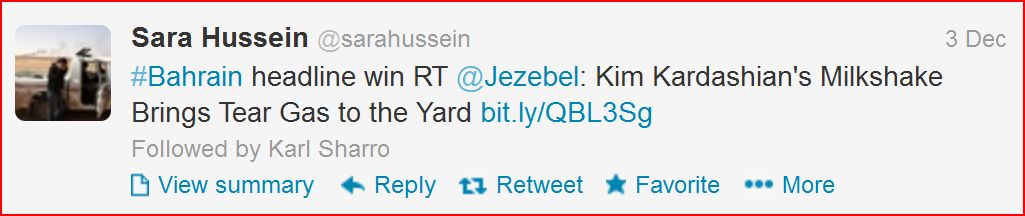
This time, however the demonstrations and controversy over Kim Kardashian's opening a milkshake shop in Bahrain, and her tweeted comments praising the place, demand some comment.

Now I must confess that I am far from clear exactly why Kim Kardashian is famous, or why she obviously makes more money than I do, or possibly more than the whole Middle East studies community put together do. But I must say I do agree with these comments from Juan Cole:
The real scandal of the Kim Kardashian visit to Bahrain is that it is what it took for Western media to mention the word “Bahrain” on the evening news. I did a search at Lexis Nexis Broadcast Transcripts under “CBS and Bahrain” for the past 3 months and got … 10 hits. Now, this methodology is inexact. I am not singling out CBS but it is useful because it can’t be confused with anything else (ABC could be Australian Broadcasting Company) and it does not have a cable news sister, so we really are looking at evening news and Face the Nation. Even so, I got several non-CBS items among the hits. Conclusion: Bahrain has been almost invisible as an issue in most US television news reporting . . .
But did Kim Kardashian show up in Manama? Why that they put on t.v.
ABC news reports on the controversies surrounding the reality-show star’s visit to Manama promoting her milkshake shops.
Marc Lynch also picks up on the theme:
Kim Kardashian's December 1 trip to Bahrain to promote milkshakes brought all the Middle East tweeps to the yard.  Her visit attracted both delerious young fans and a raucous protest (reportedly cleared away by the time she arrived), with conflicting accounts as to whether she actually ended up mixing a tear gas flavored milkshake.  The Middle East twitterati had a field day of outrage and humor over the news, with pretty much my entire Twitter feed (and Bahrain's Foreign Minister) retweeting her now deleted "OMG can I move here please?" tweet.   It's easy to poke fun at Kardashian.  But did Kanye's girlfriend really do anything different than those foreign policy wonks willing to participate in Friday's 2012 Manama Dialogue?
Kardashian went to Bahrain and Kuwait to promote "Millions of Milkshakes."  She evidently had a great time, declaring at the end: "Thanks Sheikh Khalifa for your amazing hospitality. I'm in love with The Kingdom of Bahrain." For this, she was roundly mocked by Bahraini opposition and Middle East commentators. Bahraini activist Maryam al-Khawaja posted an open letter to Kardashian inviting her to meet with human rights activists during her trip.   The one bright note, such as it was, came from @Therwees: "Kim Kardashian tweeting about Bahrain makes more news than actual Bahrain."
Part of this dismay and the attention paid to it comes from the star's tweets during her visit to Bahrain, which, of course, continues to endure major protests which are firmly put down, and which has been widely criticized by human rights groups.  She seemed pretty oblivious to that:
But she drew plenty of criticism on Twitter as well:


One last thing: milkshakes??

Monday, November 5, 2012

New Saudi Interior Minister

 Saudi Arabia has announced that King ‘Abdullah has relieved Interior Minister Prince Ahmad bin ‘Abd al-‘Aziz "at his own request" and replaced him with Prince Muhammad bin Nayef, his nephew and the Deputy Interior Minister for Counterterrorism. Prince Ahmad had succeeded his brother Prince Nayef when the latter died a few months ago.

Muhammad bin Nayef has been the Kingdom's main counterterrorist chief for some years and was the target in 2009 of an assassination attempt by Al-Qa‘ida in the Arabian Peninsula.

While keeping the Interior Ministry in the same branch of the family, Muhammad moves up at a time of growing challenges both inside the Kingdom and nearby; he is considered a hard-liner not only on terrorism but also on internal dissent and Shi‘ite activism, at a time when tensions are once again rising between the government and opposition on Bahrain.


Friday, June 29, 2012

Mark Katz in The Moscow Times: "Your Syria is My Bahrain"

Mark Katz of George Mason University is one of the best known specialists in this country on Russian-Middle East relations. At this timely moment in Russian-US discussions on Syria, he happens to be visiting Moscow, and he has a very timely piece in The Moscow Times: "Your Syria is My Bahrain." While the title clearly underscores his main point, it's worth a read.

Monday, May 14, 2012

A Reminder of Britain's Security Legacy in Bahrain

During Bahrain's current troubles,there has been little talk about the legacy of British rule, and the post-independence role of British security advisers, in the island Kingdom. This post from Adam Curtis at the BBC, complete with lots of old BBC video clips, reminds us of the legacy of Charles Belgrave and more notoriously, Ian Henderson. I'm not the sort to blame colonialism for every single flaw in modern Middle Eastern states, but it's certainly not entirely innocent. And a note: though Ian Henderson, the British policeman who ran security fot decades in Bahrain after establishing his credentials suppressing the Mau Mau in Kenya, only retired in 1998,the last I heard he is still alive and living in Bahrain.

Though there are a lot of old video clips of historical interest, I'm not going to label this one "nostalgia," since I doubt if very many are all that nostalgic for this aspect of the past.

Tuesday, May 8, 2012

Malinowski: Hard Truths on Bahrain

Tom Malinowski's "Prison Island," as its title implies, is not terribly encouraging on the situation in Bahrain, which he characterizes thus:
Since [the Bassiouni Commission], the momentum has dissipated. There has been no real resumption of dialogue between the government and opposition to pursue what moderates on both sides agree is the only viable solution to Bahrain's crisis -- a constitutional monarchy in which government ministers are chosen by an elected parliament rather than appointed by the king. This course of action would necessarily give Bahrain's Shiite majority more say in running the country, a prospect that is anathema to portions of the island's ruling family as well as its regional backers.
The government has also not ended human rights abuses against protesters. As we would see during our visit, police torture and abuse have simply moved from police stations to the alleyways and back lots of Shiite villages. The courts have agreed to retry key opposition leaders, but the government still refuses to release them, though their convictions were based on nothing more than the content of their speeches and participation in meetings and rallies challenging the monarchy. Also, for the first time in months, there is no approaching milestone -- no committee to be appointed, or report to be issued, or deadline to be met -- that might give moderate leaders reason to ask their people to be patient. The absence of hope is radicalizing both sides.
But he still sees some room for avoiding the worst:
Bahrain is almost broken, but not entirely so. The government is persecuting its critics, but not killing them on a large scale as in Syria. As everyone we met told us, Bahrain is a small country: The protagonists on both sides know each other, and there still seems to be room for compromise. But the window is rapidly closing, and once it shuts -- as in Syria -- it will be hard to turn back. Preventing this outcome by holding Bahrain to the commitments it made to the Bassiouni Commission, and encouraging political compromise, is America's paramount interest in Bahrain.
 It's worth your time.

Thursday, May 3, 2012

David Roberts on Gulf Unity Talk

Of late there has been talk of greater unity within the Gulf Cooperation Council, with serious discussion of some sort of Saudi-Bahraini unity as a starting point. The idea is Saudi, and would institutionalize the Saudi intervention last year in Bahrain (justified by portraying the Bahtraini opposition as Iranian stooges). David Roberts (of The Gulf Blog) explores some of the implications at Foreign Policy's Mideast Channel.

It's particularly interesting that there are apparently some within the Bahraini ruling family who are considering this idea, though it would seem to surrender Bahrain's sovereignty to Big Brother next door. That tells you something right there.

Friday, April 20, 2012

Formula Wrong: Is Bahrain's F1 Grand Prix Race Backfiring?

The decision to go ahead with Bahrain's Formula 1 Grand Prix race this weekend may have seemed like a good idea at one time: try to show that the country is back to normal after last year's disturbances; give Bahrain some positive PR instead of the negative ones engendered by clashes with the opposition, and so on. It isn't quite working out that way. Major protests have erupted demanding cancellation of the race, and of course the media eye is focused on Bahrain precisely because of the race, so the protests are getting coverage. Jane Kinninmont at Foreign Policy recently went into some detail about the complexities of the situation (it's not just a government vs. opposition thing as some in the opposition supported the race), but whatever happens in the race itself, today's demonstrations have made sure that the world is reminded of the situation in Bahrain.

The Crown Prince says the race will go on, but now the race itself has become a lightning rod, and the PR strategy may have backfired.

Wednesday, March 14, 2012

Reporters Without Borders "Enemies of the Internet" List

Reporters Without Borders has issued their annual "Enemies of the Internet" list, and once again it is heavily weighted toward the Middle East and Central Asia. This year Bahrain has been added as an enemy, and Libya has been dropped from the "under surveillance" category. Read the report at the link.

Wednesday, February 29, 2012

A Key Figure in Bahrain's Colonial Era is Gone

An interesting historical footnote here about Jassim Buheiji, a key figure in nationalist agitation in Bahrain in the 1950s, who has recently passed away. He was active in the movement for independence from Britain and influenced by Arab nationalism. Also the piece notes Miriam Joyce's 2000 article in MEJ on the subject. (Though I'm checking to see if the link to the article online has a copyright release from us.) I recently saw Professor Joyce and she was surprised I still remembered her article, but there's so little on pre-independence politics in Bahrain.

Tuesday, February 14, 2012

Bahrain: The Anniversary

Lest we forget more serious matters amid all the Valentine's Day cheer, today is not all red hearts and cupids: it's also the first anniversary of Bahrain's protests, Protesters tried to march to the former Pearl Roundabout, symbol of the protest movement, but were blocked by massive police presence. Both clashes and peaceful protests were reported. Updates and videos here. Al Jazeera English report here. And BBC's take here.

Monday, January 23, 2012

Is a New Explosion Coming in Bahrain?

I haven't talked about Bahrain lately, since the tensions there have remained persistent but somewhat under most people's radar. Yet over the past few weeks tensions have continued to rise, and February 14 will mark the anniversary of the outbreak of the protests. Since the regime narrative is also to blame everything on Iran, the overall escalation of tensions across the Gulf may also add to the pressures. But February (and March, the anniversary of the Saudi/GCC intervention) could be tense.

Tuesday, January 3, 2012

"Bahrain's Revolutionaries" at FP

An important piece I think, by Toby C. Jones and Ala'a Shehabi at Foreign Policy on "Bahrain's Revolutionaries."

Monday, August 8, 2011

The Saudis Bail on Asad

 UPDATE: A roundup at Syria Comment.

Saudi Arabia has recalled its Ambassador to Syria, saying Syrian actions are unacceptable to the Kingdom. Kuwait and Bahrain have since followed the Saudi lead. This is fairly important I think, since the Kingdom supported Ben Ali and Mubarak to the bitter ends. (Libya was another story, but there is personal bad blood between Qadhafi and the King, so there was a getting-even element there.) King ‘Abdullah has personal ties with Syria, so his move is a sign the Saudis are very uncomfortable with the course of events there and possibly cutting their losses.

It may not deter Asad, of course, but it's a pretty interesting signal.

Thursday, August 4, 2011

And Now, Baluchi Mercenaries in Bahrain

Bruce Riedel in The National Interest  discusses how the Bahraini government is hiring Baluchi "mercenaries" in Pakistan — retired soldiers and police — to serve in the police and Bahrain Defense Force. So, following the earlier Saudi/UAE intervention, Bahrain is importing still more Sunnis, these not even Arab, to control its restive Shi‘a majority. Not a good sign.