A Blog by the Editor of The Middle East Journal

Putting Middle Eastern Events in Cultural and Historical Context

Showing posts with label "Islamic State". Show all posts

Tuesday, October 17, 2017

When Raqqa was the Capital of a Real Caliph: Harun al-Rashid

The glories of Baghdad during the reign of the ‘Abbasid Caliph Harun al-Rashid have been much celebrated and elaborated upon in the tales of the 1001 Nights, so his reign is generally identified with the great period of Baghdad's glories. Yet of the 23 solar years, 786-809 AD, of Harun's Caliphate, for 13 of those he reigned not from Baghdad, but from Raqqa on the Euphrates. Long before Raqqa served as the capital of ISIS' self-declared "Caliphate," it was the capital of the ‘Abbasids when they ruled most of the Islamic world (except Umayyad Spain).

With the announcement today that Raqqa has fallen to the Syrian Democratic Forces (mainly the Kurdish YPG), it may be worth remembering Raqqa's previous glories. The Islamic State most likely chose Raqqa as its capital because it was one of the few cities it controlled, but it was surely aware of its role as a onetime Caliphal capital.

Raqqa was an ancient foundation, known in classical times as Kallinikos. Harun was the fifth ‘Abbasid Caliph. His grandfather the second ‘Abbasid Caliph al-Mansur (Harun's father and brother had reigned between the two), who was the real founder of Baghdad, noticed the attractive elements of Raqqa and founded a suburb he named al-Rafiqa ("the companion"). Though proud of his great new Round City of Baghdad, al-Mansur adopted Rafiqa as the ‘Abbasid summer capital. (For the nitpickers: I know Mansur did not found "Baghdad," the Persian name for the village on the Tigris which preceded Mansur's city, which was officially named Madinat al-Salam, the City of Peace. But everyone called it by the older name. Al-Mansur's Round City, until destroyed by the Mongols in 1258, lay where the al-Mansur neighborhood of modern Baghdad is today.)

In 796 AD, ten solar years into his Caliphate, Harun moved his administrative capital to Raqqa, though the state bureaucracy mostly remained in Baghdad. Many of the descriptions (mostly anachronistic) of the glories of Harun's Baghdad refer to Raqqa, where outside the view of the religious establishment and the Baghdad populace, Harun was more free to indulge his penchants for horse-racing, wine, and other pleasures. Some of the songs/poems in the Kitab al-Aghani refer to the pleasures of Harun's place at Raqqa.

Not much remains of ‘Abbasid-era Raqqa, even before ISIS and the fight to retake the city. Some ancient walls and the Baghdad Gate at left, less whatever damage ISIS and the air and artillery assaults on the city may have destroyed.


Wednesday, March 8, 2017

Conquest of Western Mosul Gathers Speed

In the past two days, Iraqi Security Forces and their allies have made significant advances against Islamic State forces in western Mosul. Reports suggest senior IS leaders have already left Mosul for Raqqa. Although there is a sense of collapsing resistance, the narrow streets of the old city could still provide ample opportunity for hard fighting.

As the two maps below indicate, after crossing the Tigris and seizing the airport, Iraqi forces have steadily advanced northward, and have now taken the government center. Though the advance may slow in the old city, a key symbolic target will likely be the Great Mosque, where IS "Caliph" Abu Bakr al-Baghdadi was proclaimed. Baghdadi is believed to have fled, perhaps to Raqqa, where allied forces are already maneuvering for the final assault.
Institute for the Study of War
Iraqi Joint Operations Command

Monday, August 1, 2016

İncirlik Under Pressure Again: Will US Keep its Nukes There?

Yesterday, more than two weeks after Turkey's failed coup, Turkish troops and demonstrators again surrounded the joint NATO base at İncirlik. After the July 15 coup attempt, Turkey had surrounded the base and cut power. After nearly a week since the coup with external power cut off, the US confirmed that power had been restored to the base on July 22. The power had been cut at the time of the coup, after at least one Turkish KC-135 was used to refuel Air Force aircraft used to attack Ankara. The Turkish commander at İncirlik was arrested (photo at left).

As the purges (no other word quite works) have deepened, Turkish rancor towards the United States has deepened, as demands for extradition of Fethullah Gülen and vague accusations of US responsibility for the coup have accelerated, and President Erdoğan has been saying NATO and the US are not Turkey's friends. But İncirlik is a NATO base, and is home to a store of nuclear weapons, the only US nukes permanently deployed in the Middle East. The weapons are part of a nuclear sharing program under which NATO deployed weapons in allied countries, under full US control in peacetime, but which would be available to the allied power in a nuclear war. of some 200 weapons still stored with NATO allies in Europe, the largest number, estimated somewhere between 50 and 90, are at İncirlik.

The weapons are stored in storage bunkers under the control of the US Air Force and are equipped with Permissive Action Links (PALs), which prevent their use without express authorization by US National Command Authority. How secure are the PALs in an age of cyberhacking of secure computer networks? The US Air force assures that they are foolproof, but if a hostile power came into possession of the weapons, some observers are not sure how unbreakable the codes may be?

When the Turkish Army sealed off the base and cut off electrical power, USAF raised the Force Protection Condition to FPCON Delta, the highest possible. But with continuing threatening gestures from Turkey, like yesterday's on the eve of a visit by the Chairman of the Joint Chiefs of Staff, Marine General Joseph Dunford, a certain jitters about the security of the nuclear arsenal seems appropriate.

The weapons are B61 thermonuclear gravity bombs with a variable adjustable yield with an upper limit of an estimated 340 kilotons, two to three times the yield of the Hiroshima or Nagasaki bombs, which means they are now classed as tactical rather than strategic weapons, though it has long been assumed that the use of tactical nukes would inevitably escalate to the use of multi-megaton strategic weapons.

The B61s are aging and only tactical, but they could still destroy a city. The number at İncirlik is estimated at 50 to 90, increasingly outdated or even obsolete. That's between 50 and 90 goddamn fucking H-bombs.

If Turkey were to leave NATO the US would presumably withdraw these weapons, but what if the coup had succeeded and a hostile force gained control of the weapons. Or if Erdoğan quit NATO and seized the base? How confident are we the PALs cannot be compromised. Many voices are warning the nukes are in some jeopardy, They are unlikely to be used for their original purpose, to defend Turkey. Is it time to get them out?

Bear in mind where İncirlik is located. It is just outside Adana in southeastern Turkey.

The larger map below emphasizes the importance of this. The base is perhaps 100 miles from the Syrian border, In the map below, Adana is the conurbation in southeastern Turkey at the upper left; the city in the lower right is Aleppo. Of all the places in Turkey to store nuclear weapons, we store ours as close to the ISIS front lines as possible. I suspect the US is having second thoughts about this deployment.


Tuesday, April 26, 2016

France24 English Documentary on YPG Victory in Shaddadi

The Kurdish YPG and its allies in the Syrian Democratic Forces recovered the northeastern city of al-Shaddadi from ISIS at the end of February. France24 English has broadcast this week a documentary by its journalists accompanying the YPG. There are clearly Western special forces accompanying the Kurds.

Tuesday, March 29, 2016

After Palmyra: What Next?

Now that Syrian forces have recovered Palmyra, where do they go from here? The campaign to retake Palmyra benefited from the inactivity on other fronts as a result of the ongoing cessation of hostilities (which excludes operations against the Islamic State and Jabhat al-Nusra), and certainly the Syrian government and Russia are claiming a significant victory. The Institute for the Study of War has an analysis of the Palmyra campaign as well as a useful map:
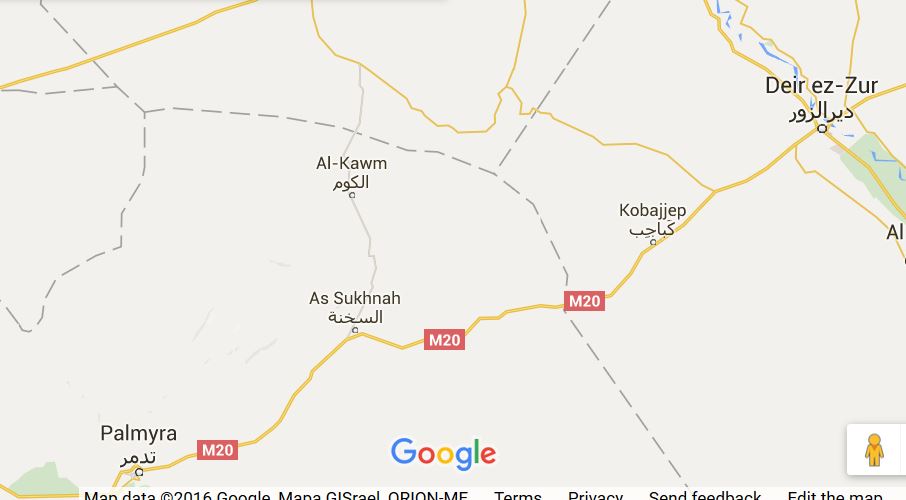
But once control of Palmyra is consolidated, where does the war against ISIS go from here? Syrian pro-government media are pointing in two directions from Palmyra: toward Qaryatayn to the southwest, and toward reopening the road to Deir al-Zor to the northeast in an effort to lift the ISIS siege of the Syrian Army garrison there.

Syrian forces were already pushing toward Qaryatayn from the west; a column from Palmyra could provide additional pressure.


But Syrian reports also say that forces from Palmyra are advancing in the direction of Sukhna, which would suggest an effort to clear the road to Deir al-Zor. It is also claimed that the besieged forces in Deir al-Zor are pushing westward.
If Syrian forces could clear the motorway to Deir al-Zor, they would end the siege, and open a route to the Euphrates, and also find themselves 140 kilometers downriver from the IS capital at Raqqa. Raqqa would then be vulnerable from the expanding area of regime control around eastern Aleppo, the YPG forces already threatening Raqqa from the northeast, and a potential column advancing upriver from Deir al-Zor.

That will not be accomplished overnight. The distances are substantial, though mostly across open desert. The Palmyra campaign relied heavily on elite Syrian Army forces, Hizbullah allies, and Russian air cover. (As part of the Palmyra campaign, Syria has recovered the Tadmur Air Force base, giving Syrian and Russian aircraft a forward operating base.)

As an aside they have presumably also recovered the notorious Tadmur Prison, once the regime's most notorious.

Monday, March 28, 2016

Palmyra Destruction is Not Complete, But Bad Enough

Now that the Islamic State has been driven out of Palmyra, there have been some reports suggesting that the damage to the ancient site is not as bad as had been feared.

Insofar as it proves to be true, that's good news, of course, but let's not sound too optimistic. We know the once beautifully well-preserved Temple of Bel was razed:
Temple of Bel (my photo, 1972)
And we know little was left:
 

Triumphal Arch (My photo, 1972)
We also know that the Temple of Baalshamin and the Great Triumphal Arch (above) were also turned to rubble.  ISIS also destroyed several tower tombs which, like the temples, they considered idolatrous. But the amphitheater received little damage, though it reportedly was used for executions, and while some exhibits in the museum were smashed, others are said to be intact.

Russia has released drone footage showing the site from the air. The first version, from RT, is in English without commentary; the second has fuller commentary in Russian, which I don't speak but some readers will.

Finally, I add an ASOR aerial shot of the site before ISIS for comparison.


Thursday, December 10, 2015

Juan Cole on the Ramadi Campaign

Juan Cole asks a useful question: "If Defeating ISIL/Daesh is so important, why isn’t Ramadi Campaign all we’re talking about?"

He notes:
The end of Daesh militarily can be envisioned. But unless the Iraqi government becomes more inclusive and politics successfully with Iraqi Sunnis (and spends some of its billions in oil income to rebuild their cities), then radicalization will remain a threat.
Meanwhile, critics of President Obama’s plan, set out 18 months ago– which involved training of Iraqi troops and rebuilding the Iraqi army. and the offer of close air support to them– may have to eat some crow. That is, they may have to if US cable news bothers to notice that out there in the real world, Daesh is facing another major setback, after its losses of Tikrit, the refinery town of Beiji, and the Kurdish area of Sinjar.
I suspect part of it is thatmost US journalists are based in Erbil and find it easier to report Kurdish advance, and some of it may be that the Iraqi Army''s Shi‘ite militia allies and IRGC advisers don't fit the preferred narrative. (No one is paying much attention to the Asad regime's successes in Homs, either, though not against ISIS.) But it's a valid point.

Thursday, November 19, 2015

Let's Not Give ISIS What it Wants

I've been quiet about the debate over ISIS since Paris. I was going to do a links dump of some of the saner essays out there, but Donald Trump's suggestion today that he might consider a special ID for American Muslims sent me over the edge. (Yes, and Jews could wear yellow Stars of David. Oh, wait, that's been done.)

The US has an unfortunate record of waves of xenophobic nativism, odd for a country that once prided itself as a haven for refugees (Give me,your tired, your poor your weak, your huddled masses yearning to breathe free...) But more than in most cases, this is precisely the reaction the Islamic State hopes to provoke. It considers Muslims living in the West as a danger, and seeks to provoke anti-Islamic sentiment in the West to increase the number of potentially alienated young recruits.

Remember ISIS' preoccupation with Dabiq, an apocalyptic end-times battle mentioned in a hadith attributed to the Prophet. They actually want to provoke Armageddon. Let's not help them along.

Demagoguing the refugee crisis for political gain is not just sleazy; it's dangerous. Creating suspicions about your neighbors can lead to the worst kinds of fear, fear of an enemy that may barely exist. The internment of Japanese-Americans in World War II (most of them citizens) has actually been cited by some of the worst sort of politicians as a model.

What is the purpose of terror? By definition, it's to terrorize, to incite fear. Within days of the carnage in Paris all it took was a warning to evacuate the stadium in Hannover. Of course one should take precautions, but if all it takes is a phone call to evacuate a stadium, why should ISIS spend money making bombs. They've created terror with little effort.

An ISIS video that shows a man with an explosive device interspersed with stock footage of New York is getting a lot of attention, but it could have been made anywhere and the NYC scenes spliced in. Of course New York should ramp up security, and it can never forget 9/11, but it shouldn't cower in fear. A better response might be Rick's dialogue with the Nazis in Casablanca:
Major Strasser: Are you one of those people who cannot imagine the Germans in their beloved Paris?
Rick: It's not particularly my beloved Paris.
Heinz: Can you imagine us in London?
Rick: When you get there, ask me!
Captain Renault: Hmmh! Diplomatist!
Major Strasser: How about New York?
Rick: Well there are certain sections of New York, Major, that I wouldn't advise you to try to invade.
Don't give them what they want.The best way to combat them on the ground  is something that can be debated, but action should not be undertaken without clearly defined objectives and the realistic means to achieve them. That's basic Clausewitz.


Monday, November 16, 2015

Remember Paris, But Also Beirut, Ankara, Baghdad, Sinai...

Amid the mourning over the Paris attacks, I think it is particularly important to remember that the overwhelming majority of victims of the Islamic State have been in the Middle East. The 40+ dead in Beirut the day before the Paris attacks were innocent civilians as well. Sunnis and Shi‘a, Kurds and Assyrians and Yazidis, have died in the thousands, without everyone changing their Facebook profile pictures to the colors of the Lebanese or Syrian or Iraqi flag. Mourn for Paris to be sure,  but also for all victims.

Thursday, November 12, 2015

The Burj al-Barajineh Bombings

Today's bombings in Beirut's Burj al-Burajineh neighborhood,which killed at least 41 and wounded 200 or more, is the worst bombing attack in terms of its human toll since the Lebanese Civil War.And the Islamic State is reportedly claiming credit. This appears to be the worst blowback yet in Beirut from Syria's civil war and an ill omen for Lebanon.

Several headlines I've seen in Western media refer to the attacks as being in a "Hizbullah stronghold." I think that's an unfortunate choice of words, as it suggests Hizbullah was the target. One bomb went off near a a Shi‘ite mosque and the other at a bakery: civilians were the target, in one of the most densely populated areas of the city. The civilians may have been targeted because they are Shi‘ites, but referring to it as a "Hizbullah stronghold" distracts from the reality that the victims are civilians, not Hizbullah fighters.

Wednesday, September 30, 2015

Russia Strikes in Syria: First Thoughts

Blogging has been light lately due to deadlines but I'm starting to emerge from that.

Russia's airstrikes in Syria are already a bone of contention, with Russia saying it flew about 20 sorties against at least eight Islamic State targets, but the West and the Free Syrian Army claiming that they struck civilians and areas controlled by the Free Syrian Army or other non-Islamic State groups.

Assuming Russia's primary goal is to defend the Asad regime, reports that its targets were in the Homs and Hama regions could confirm this because the regime forces are mainly facing the FSA, Jabhat al-Nusra, and other forces there rather than IS. While the US can hardly object to  attacks on Nusra, an al-Qa‘ida affiliate attacks on the FSA could be another matter. And several FSA geoups and allies have claimed they were hit. The map below, from the Institute for the Study of War, shows all the attacks as being well to the west of area controlled by the Islamic State, as do the analysis at ISW's website and an early assessment by Fabrice Balanche at The Washington Institute. If these readings are correct (and with so many competing factions in Syria, the Fog of War is even foggier than usual), then it would seem regime defense is the real motivator in target selections.

I will save editorializing until the facts are a bit clearer, but it seems at first glance that Russia's initial strikes are aimed at preventing the further collapse of the regime-controlled zone, which suggests Russia knows exactly what it seeks to accomplish. What is clear is that the situation is transformed and the Russian Bear is in the game.

But FSA and other anti-Asad sources are reporting numerous civilian casualties, and one aviation site is suggesting that videos (see below) released by the Russians suggest that the initial strikes may have been with non-guided munitions and may have missed their targets. It would be interesting to know the Russians' own bomb damage assessment (BDA) of the results of day one.

The third video below purportedly shows Russian aircraft over a Tajammu‘ al-‘Izza (Gathering of Honor) (FSA-aligned) position. I think the aircraft are Su-24s?


Friday, January 9, 2015

"Nous sommes tous Français": La Marseillaise from Casablanca

Immediately after September 11, 2001, Le Monde, one of the world's great newspapers but rarely one with a pro-American tilt, ran the front page sidebar "Nous sommes tous Américains."  I know the fashion now is to write Je suis Charlie, and of course the attack on Charlie-Hebdo was barbarous and appalling, but rather than endorse their often openly racist humor it seems to me the better response is to echo Le Monde and say, "Nous sommes tous Français." And of course, as an editor, I defend complete freedom of the press, no matter how offensive.

Or as an earlier generation of Americans once put it, "Lafayette, we are here."

Or as Casablanca put it back in 1942:

Wednesday, August 6, 2014

The Yazidis' Last Stand in Jabal Sinjar?

 There is an old Kurdish proverb, "The Kurds have no friends,except the mountains." But for Kurdish-speaking Yazidis, the mountains may not be a refuge: The Washington Post: "Iraqi Yazidis stranded on isolated mountaintop begin to die of thirst." Estimates are said to be between 10,000 and 40,000, numbers which certainly verge on the genocidal. Surrounded and isolated, having retreated to a barren mountaintop, these people need rescue.

At least when the Christians were driven from Mosul by the "Caliphate," Western Christians took note (even if they did little else). But outside of some Yazidi Diaspora groups in Europe and, to my surprise, Lincoln, Nebraska, where my wife went to college, the Yazidis get even less than the grudging concern accorded the Christians.

A Yazidi member of the Iraqi Parliament collapses in tears after pleading for her people (English subtitles):
Because I try to keep a certain objectivity even while expressing my opinion, I didn't post that much about Gaza, since the whole human rights community was loud and clear. But here we have a clear case of outright ethnic cleansing or even full scale genocide. IS considers Yazidis "devil-worshipers" and worthy of extermination (No collective group is, though I'm starting to wonder if IS is an exception.)

Unlike Gaza, my tax dollars have not gone to buy the ammunition killing the Yazidis (though maybe they have, since some was captured from the Iraqi Army). But US policy broke Iraq, and out of that breakage came the horror that is ISIS/IS/the Caliphate.


Regardless of how we got here, we're here, and an entire distinct ethnographic/religious group is in imminent jeopardy of destruction. If you ignore Kristallncht, you will have the death camps.


Sad to say, that's also true. I'm not urging US re-intervention in Iraq. But the international community has, I believe, the ability to supply the dying Yazidis on the mountain, and even to evacuate them from the damned mountaintop. And if that's not feasible, mount airstrikes against the IS forces down the mountain to save the Yazidis.

Gaza was and may soon be again, a horror. But that is no excuse to shrug off other horrors.