A Blog by the Editor of The Middle East Journal

Putting Middle Eastern Events in Cultural and Historical Context

Showing posts with label sex and sexuality. Show all posts

Tuesday, July 26, 2016

AUB's Art Exhibition on "The Arab Nude: The Artist as Awakener"

Beirut has always been a city that has seemed more cosmopolitan than much of the Arab World, and the American University of Beirut (AUB) has often been in the forefront. As part of AUB's 150th anniversary celebrations, AUB has been hosting an art exhibition called The Arab Nude: The Artist as Awakener. It closes this week, so I'm a bit late in writing about it. There was a conference held on the subject as well. At a time when puritanical censorship is growing in many Arab countries, the willingness to address artistic nudity, both male and female (though from the photos mostly the latter) is what still makes Beirut distinct.

From the reviews (a few: here and here and here and here) it's clear this is not about the Orientalist fantasy nudes, erotic harem girls who existed only in European sexual imaginings of the exotic East, so prominent in 19th century art (a subject for another post), but nudes in the work of Arab artists, and an attempt to situate their appreciation of the nude in the context of the broader Arabic cultural awakening, the nahda. The reviews emphasize that the exhibit did not minimize the obvious masculine viewpoint of the artists. A summary from the exhibition's Facebook page:
The Arab Nude: The Artist as Awakener examines the way in which artists and intellectuals of the Mandate era engaging in a double struggle against imperialism, Ottoman and European, resorted to an ideal form or pictorial device to concretize their visions of Arab modernity. For them, to be “Arab” was as much a matter of ambiguity and ambition as was the quest to be an artist. In fact, both labels required leaps of imagination over local conditions and imperial plans. What claims for identity, community, and political society were invested in the divesting of Arab bodies of their clothes? Our exhibition documents the debates that met the genre of the Nude in exhibition halls and newspapers. It situates artistic practices in relation to ongoing, urgent discussions about the meaning of citizenship, urbanity, and internationalism carried out amid movements for women’s rights, pan-Arabism, and various nationalisms, as well as educational reform, militarization, the scouting movement and nudist colonies. Without espousing the role of awakener for artists, our subtitle foregrounds the social, political or cultural motivations for these artists to embrace and adopt the genre of the Nude in their artistic careers.
Or as the last of the reviews linked above says:
More importantly, perhaps, it addresses the idea that these artists used their work to express liberation from Ottoman and European colonisation. As the title suggests, the exhibition, curated by Octavian Esanu and Kirsten Scheid, seeks to establish to what extent these artists used their artistic explorations of the nude as a means of promoting social change in line with the spirit of the nahda – a period of modernisation known in Arabic as the “awakening.” In the context of discussions about the meaning of identity, community, citizenship and internationalism, and of what it meant to be “an Arab,” what was the significance of the Arab form laid bare?

Thursday, June 2, 2016

Erdoğan's Anti-Birth Control Campaign

Turkish President Recep Tayyip Erdoğan a few days ago delivered a speech, or perhaps I should say a sermon, on birth control. He's against it.

Saying that no Muslim family can accept birth control, Erdoğan urged Turkish women to have many children in order to increase Turkey's population, a topic he has addressed before.

If his argument is that Turks should reproduce to increase population, that is one thing, but if he means that Islam forbids contraception, he is well outside the religious consensus. While there are conservative scholars who oppose all contraception, most Islamic legal schools  accept artificial contraception as long as it is reversible (not vasectomy or tubal ligation), and all oppose abortion. This is not a modernist issue: several hadith indicate that the Prophet Muhammad himself was aware of, and did not express disapproval of, the withdrawal method (‘azl in Arabic, coitus interruptus), the main form available in his day, unless it was done without the wife's permission. Other reversible methods are also generally accepted, and many governments actively promote family planning. Even the most theocratic regime, Iran's, actively promotes family planning and has seen a plunge in birthrates. Iran's program was directly authorized in a fatwa by Imam Khomeini himself, which in the eyes of the regime gives it the highest authority.

So Erdoğan, however much he may believe "no Muslim family" may practice contraception, is well outside the pale of mainstream Islamic jurisprudence.

Monday, February 22, 2016

The Ahmad Naji Case: The Offending Text

Amid the many unpleasant things happening to the arts in Egypt, a recent one is the decision a few days ago by the Bulaq criminal court in Cairo to sentence novelist Ahmad Naji to two years in prison for "publishing obscene sexual content" in the publication Akhbar al-Adab.

Now, in a country attempting to sentence  a four-year-old child to life in prison (though they now say that was a mistake), this may seem mild, but the article in question was an excerpt from a previously published novel, by an "experimental" modem novelist. The novel itself was neither banned nor prosecuted. But the state censors seem to feel that novels have more leeway since no one reads them; a periodical available on newsstands might actually be read by someone. The publisher was also fined.

As a publisher, I despise censorship, and this sort of hypocrisy (the words are fine in a book but deserve a jail term in a literary paper) is even more senseless than most.

The best way to deal with censored material is to publish it. Last month the Arabic Literature (in English) blog published the excerpt translated by Ben Koerber, and I link it here so you can read it yourself.

The article notes that
Specifically, the original accuser complained that his “heartbeat fluctuated and blood pressure dropped” while reading the chapter.
The excerpt won't seem strange to anyone familiar with modern literature: the alienated youth of every novel for the last 60 years since Catcher in the Rye, a Sartrean ennui and world weariness, and the sex and drugs of 60s lit. But in today's Cairo.

Again, the book was published; the excerpt produced the problem. Is this so offensive in a
modern novel?:
In this city, you’ll be lucky if you can get over your sexual tension, and appreciate sex as just one of the many facets of a friendship.  Otherwise, your horniness will make you a testy bitch.  Kiko rubs my back, and I feel a heat between my legs.
This is admittedly much more explicit (potentially NSFW):
I gave her knee a parting kiss, and continued my tongue’s journey up her thigh.  I planted a kiss, soft as a butterfly, on her thinly lined underwear and pulled it away with my hands.  I plunged my tongue into her pussy.  I drank a lot that night.  I drank until I felt thirsty.  I gave her a full ride with my tongue before she took me into her room, where we had slow and leisurely sex.  She turned over, and I put my fingers in her mouth.  Wet with her saliva, I stuck them in her pussy.  Slipping and sliding.  I stuck them in from behind.  I grabbed her short hair and pulled it towards me.  I humped her violently and then lay on top of her for a few seconds.  I got out of bed and threw the condom into the trash.  As I gave her a smile, the phone rang.
OK, strong stuff for a Muslim country, but then why was it OK in a book? If you don't like this sort of thing, don't read it, don't buy it, or even ban the book, but why jail the author?

It seems to me the proper response to censorship is to make the censors work harder: so go read the excerpt and oh yes, Fuck Censorship.

Wednesday, February 3, 2016

Culture Wars and Cultural Appropriation: Israeli Designer Eroticizes Palestinian Keffiyeh

Cultural  appropriation of indigenous cultures by the mainstream culture is a worldwide complaint, from Native Americans complaining about fashion designers using sacred eagle feathers (or everything about the Washington Redskins) to affluent young whites adopting African American culture: those doing the appropriating usually assert that they mean it as a compliment and an honor to the appropriated culture, but far too often the appropriated culture fails to see the compliment.

I am virtually certain that will be the case here: As the article notes, Israeli high-fashion designer Dodo Bar Or has designed a line of women's clothing drawing its inspiration from the iconic Palestinian (male) headdress, the keffiyyeh or kuffiyah. The keffiyeh is an icon of Palestinian nationalism:  Yasser Arafat wore his draped in the shape of the map of Palestine, and I'm sure I'm not the only foreigner who learned the trick of keeping one visible in your car in the West Bank so it wouldn't be attacked if it had Israeli plates.

I don't want to be a prisoner of gender stereotyping. If a female Palestinian designer derided to feminize and even sexualize the keffiyeh, that might be a suitable protest to the dominant patriarchy. But this is not a Palestinian or Israeli Arab designer.

But when an Israeli designer takes a well-known symbol of the Palestinian national movement (and a distinctly masculine one) and both feminizes and eroticizes it, one has to wonder if the intentions were generally benign but the realization disastrous, or something else. The collection can be seen on Bar Or's website; the two photos reproduced here (one topless but from the rear, the other with some "sideboob") are probably the ones most likely to raise hackles. Neither is overtly offensive as fashion poses go; but each seems deliberately provocative given the cultural context..

Wednesday, December 16, 2015

Four Years Since the "Blue Bra Woman" Brutality

Last month I noted the fourth anniversary of the "Battle" of Mohamed Mahmoud Street in Cairo in November 2011, a street I once lived on. But if there was any "Battle" between protesters and SCAF in the last months of 2011 that was truly iconic it was the battle of Qasr al-‘Aini Street on November 16-17, 2011. The main reason is the photo above, the notorious "blue bra woman" photo.

As the video below makes clear the woman, and I'm not certain she has ever been conclusively identified, was wearing a hijab and a black abaya. After beating her with sticks,
the soldiers (Military Police) strip back her conservative religious garb to expose her torso except for what became her iconic blue bra.

The still above shows a soldier's boot only inches from her chest. It's bad enough. The video below, for which I feel obliged to issue a "you're going to want to kill these [insert favorite expletive here]-ing bastards" warning, clearly shows him kicking her directly and forcibly twice, striking both exposed breasts. She appears to be unconscious, but one soldier at least reaches down to cover her exposure before leaving.

The fact she was in religious garb exacerbated the outrage, though there is no justification for stripping and stomping any woman. Or man, for that matter.

There was immediate outrage, but global outage has a short shelf life. US Secretary of State Hillary Clinton denounced the "systematic degradation of women." Mona ElTahawy, herself sexually abused and her arms broken at Mohamed Mahnoud, argued for calling the victim "Tahrir woman," but "blue bra woman" stuck. Even the usually demure and cautious Egyptian blogger who calls herself Zeinobia used a rare obscenity for this obscenity (NSFW): We are Fucked!

It was a huge issue at the time but it was Arab Spring (well, it was December, but you know what I mean).

This went the rounds:
For a while, "blue bra woman" was both a feminist and a sexual abuse icon. Four years later she appears forgotten. So do the "virginity tests" of 2011 when the Army decided intact hymens were a matter of national security and fingers were the means of checking.These were human and sexual atrocities (including explicit rape and other violations) that should not be forgotten, but were flushed down the memory hole.

If you are prepared to see sexual brutality, here is a video.What sort of so-called "man" strips a conservatively dressed religious woman after rendering her unconscious with sticks, and then deliberately stomps on each of her breasts? (Obscene responses in the comments will not be censored, and let me know if others are remembering this atrocity. And if anyone knows what became of her, if she even survived.)

.

Tuesday, October 20, 2015

Egypt's Latest "Inciting Debauchery" Case is About Words, Not Videos

Amid widespread reports of low turnouts in the first two days of the current Parliamentary elections, pro-government columnist Dendarawy al-Hawary, writing in Youm 7, lamented:
It is the bitter truth that Egyptian society, across all its sectors, was more concerned with discussing pornographic films... and everyone forgot the most important parliamentary election in Egypt,
That is almost certainly an exaggeration, and there may be far deeper reasons for the lack of turnout,  but it's true that the latest instance of someone being hauled into court on charges of "incitement to debauchery" (التحريض على الفسق) is not, as previously, a case of belly-dancers being charged for YouTube videos, but a talk-show host being charged with expressing an opinion. That opinion was to express concern about the poor (nonexistent) state of sex education in Egypt, and perhaps less wisely, to suggest that watching pornography might be a good way to educate oneself before marriage. Now she must appear in court.

Now, I've posted studies of the lack of sex education in Egypt, even among medical students,and there's little room to debate that there is little opportunity to learn factual, as opposed to fantasy, information about sex. I rather doubt that most pornography offers a realistic depiction of real human sexuality, but I don't think you should face jail for expressing an opinion contrary to mine.

An Egyptian TV personality and actress who goes by the single name Intisar and two fellow talk show colleagues started the fuss. Ahram Online's English language account:
Egypt's prosecutor ordered Tuesday the investigation of TV host and actress Entsar after complaints were submitted accusing her of lewdness, debauchery, and blasphemy in the way she discussed porn on her show, which aired on Al-Qahira Wa El-Nas channel.
The prosecutor also ordered investigations into Entsar's co-host, actress Heidi Karam, along with businessman and owner of Al-Qahira Wa El-Nas channel, Tarek Nour.
In the three police reports filed, complaints said Entsar, who is known for her daring TV roles as an actress, "called on her audience to watch pornography as it is very beneficial to educate youth before marriage."
During the nightly show, Nafsana (roughly meaning rancour) that focuses on women and social issues that aired last week, Entsar said that she herself watches pornography, a statement that many criticised and ridiculed on social media.
Entsar also said that sex education should be introduced in schools.
A third host in the show, Hoda, opposed the opinions of Entsar and Karam, saying that porn should be banned.
While there was no rush to support pornography, many commentators did support the idea of sex education in schools.  Social media also jumped into the controversy (link partly in Arabic.) As one blogger put it, as part of a post titled "Audacious? Yes, But High  Time":
The program “Nafsana” i.e. “Venting,” though an exact synonym may not exist in English, has three women stormily contradicting one another’s views on air. It has Intisar, Heidi, and ٍShaima bouncing ideas off one another about various Egyptians attitudes and issues. Intisar, the most outspoken, has ventured where no Egyptian woman, or man for that matter, has in the history of Egyptian television. She approves of porn as a way to calm young men, makes fun of the hijab and the many layers women choose to add on their heads, and allows herself to speak as she would privately amongst friends in the cosiness of her own living room, hardly ever an option on public TV.
This program may have gone too far since the reviews on social media are mostly condemning. We will have to wait and see how much heat can Tarek Nour, the owner of the TV channel, Al Kahera Wal Nas, take. It does sound as though Nour gave the presenters of Nafsana free reign to tackle any topic and its presenters have taken the bull by the horn on this one.
A clip in Arabic will be found at the end of this post.

Not only were complaints filed; Intisar will face the court on November 10, unusually quickly for Egypt's sometimes sluggish court system.  The Arab Network for Human Rights Information (ANHRI) issued a statement that said:
The Arabic Network for Human Rights Information (ANHRI) has condemned the frequent complaints filed against artists for allegedly inciting debauchery, as well as the rapid referral of these complaints to courts.
Nasr City Misdemeanor Court has fixed November 10 for considering the first trial of Intisar, an actress, over an accusation of inciting debauchery, in a rapid response to the complaint filed against her on October 8, on account of her statements on Kahera we Nas (Cairo & People) satellite channel in connection with watching pornographic movies.
In that way, the name of singer “Haifa Wehbe” appeared again in the prosecution of artists. Al-Agouza prosecution, yesterday Monday, ordered the urgent probe of Decencies Investigation Department regarding Haifa Wehbe, owing to accusing her of inciting debauchery through the videos she is posting on the social networking websites and the TV channels,; according to the complaint filed against her last May. Also, a complaint was filed against two belly-dancers “Pardice” and “Shakira”, and accordingly, they were sentenced, last September, to 6 months in prisons, after convicting both of them of the same charge.
The Arabic Network has expressed its surprise over the rapid referral of the complaint brought against the actress “Intisar” to the court, while the referral of several cases and complaints to the competent courts are delayed, particularly the cases related to prisoners of opinion.
“The continual attack on actors and actresses for allegedly breaking with customs and traditions, and spreading immorality etc entrenches an anti-creativity freedom climate, and return us to the Inquisition era,” ANHRI said. “We should not separate this incident from that incident of upholding the verdict against Islam Al-Behairi, a researcher, due to his views contrary to the state’s official view of Islam. All these cases of crackdown waste the citizens’ right to freedom of expression and opinion- the right that is mainly established to protect the differing views prevailing in the society from predominance of the majority,” ANHRI added.
ANHRI calls on Egypt’s public prosecution not to give attention to those complaints, whose complainants are only seeking fame and media appearance; it rather urges the prosecution to do its main role in defending the citizens’ interests over cases need much attention than those.
Also, ANHRI calls upon the Egyptian authorities to review Article 269 bis of Egyptian Penal Code, since this vague article is used in most charges concerning inciting debauchery and spreading immorality.
ANHRI's English is a bit awkward; if you prefer, you can find the statement in Arabic here.

And finally, for those who can follow colloquial Egyptian dialect spoken very rapidly, judge for yourselves from the clip below:


Friday, July 24, 2015

A Bad Year for Belly Dancers as Egypt Charges Two More for "Inciting Debauchery"

 It's proving to be a difficult year for belly-dancers in Egypt,  two years after the Muslim Brotherhood lost power.. Late this week two more were charged with "incitement to debauchery" (التحريض على الفسق) (link is in Arabic; for English accounts see here), based on videos they had posted. Just a short time ago (though I didn't mention it here) another dancer and her manager were charged with the same crime, and earlier, the dancer Safinaz (also known as Safinar) was sentenced to six months in prison for "insulting the Egyptian flag"; that sentence was recently upheld by a court.

Safinaz' Flag Outfit
I had posted about the Safinaz case in March; be sure to read the two comments by commenter "anonymous," on the political context.) Insulting the flag is a crime in Egypt, and I guess incitement to debauchery must be, too, though I don't know what the legal definition may be. (American courts would call it "unconstitutionally vague," but in Egypt vagueness may be the intention.)

Earlier this month, dancer Reda El-Fouly was charged with incitement to debauchery, along with her partner Wael Elsedeki (who some reports say has fled the country), posted a YouTube video  that soon went viral; she's facing a year in prison. The video, Sib Eddi (Hands Off) is suggestive but pretty mild by Western music video standards; yes, she shakes her assets in a low-cut dress and teases the viewer, including closeups of bouncing cleavage, but nothing that couldn't play even on puritanical US broadcast TV:


OK, it's suggestive (and the still is focused right down her cleavage), and the cleavage closeups  are meant to titillate (pun intended), but there's no nudity. It's a tease. Mild by Western standards, but is this really a belly dance, or a shake-your boobs-at-the camera-dance? The true Eastern Dance or raqs sharqi is about controlled movement of the whole body, by all means including but not limited to the breasts.The video is not a crime punishable by law in my view (though Egyptian prosecutors disagree) but it may be a crime against a longstanding tradition of genuine artistry and control.

Now, before I discuss the two latest arrests, let me pause to note that to call this "belly dancing" in the land of Badia Masabni and Tahia Carioca suggests the debasement of the art in modern times. I've touched on the classical age of belly dancing before, and posted videos showing the classic works by great artists of the 1940s and 1950s such as Tahia Carioca and Samia Gamal (or even better, Tahia Carioca and Samia Gamal together) not to mention the masters of the 1960s through the 1980s such as Nagwa Fuad and Fifi Abdou, dancers who really put the belly in belly dancing with amazing muscular control, rather than dancing around bouncing halfway out of a low-cut dress. Reda El-Fouly is weak tea indeed, by those standards. Incitement of debauchery? Nah, not really. (If this is illegal, why is superdiva Haifa Wehbe, who regularly shakes her generous assets, not doing hard time?) El-Fouly is relying on a single (well, obviously double) asset rather than the coordinated skill of her whole body. Compare this video to the Fifi Abdou clips above. There may be a belly dancing Gresham's Law at work here. I don't think either the classics or El-Fouly clips "incite debauchery," but the former are erotic and the latter just suggestive unless you're a horny 17-year-old male, in which case you consider everything, including moss on a north-facing rock, somehow sexy and masturbate to it.

End of rant. The two arrests this week were of two dancers who go by the names of Bardis and "the Egyptian Shakira" (obviously to distinguish her from the international singing star). They were arrested at a club, or two separate clubs depending on the report, in the Giza neighborhood of Mohandeseen, but again for videos posted online. Here's a news clip of them being loaded into a paddy-wagon

They were initially ordered held for four days, but may be sentenced to much longer. It isn't clear what videos produced the objections in these two cases. Some of their dance videos can be found on YouTube, though I don't know if they're the offending ones. You can search for them if you like, but if you;re in it for the art search for Samia Gamal or the others mentioned earlier instead or check out the links above. I may not consider their dancing up to snuff, but I don't really think jailing young women for dancing what was once a respected (if now declining and somewhat debased) art form is really Egypt's biggest problem right now.

Wednesday, May 27, 2015

Linguistic Notes I: Skolnik on "Hebrew Slang"

Language warning: this post on Arabic slang in Hebrew includes strong NSFW language some readers will find offensive. Please proceed only if very strong language (though in a scholarly context) does not offend.

During my slow blogging while recovering from surgery I've let a lot of bloggable material go by. Tonight I'll comment on a couple of linguistic topics.

The first is a piece by Fred Skolnik, Editor of the Encyclopedia Judaica, at the Ilanot Review, entitled simply "Hebrew Slang." It deals with the multiple origins of slang in Modern Israeli Hebrew (Hebrew itself, Yiddish, Arabic, English, Russian, etc.). My own knowledge of Hebrew is far too rudimentary to comment linguistically (though others have done so, particularly on  the role of Russian slang in Israeli Hebrew). I am, however, going to cite his comments on Arabic slang in  Hebrew, a subject of interest to me. Any Arabist spending time among Hebrew speakers (at least outside  a synagogue, and most especially in an Army camp) will have noted many Arabic cusswords in Hebrew.

It's impossible to discuss the subject without quoting Skolnik and discussing his comments, which requires one of my rare Not Safe for Work language warnings. The easily offended should proceed at their own risk. I am not kidding here. It does, however, allow me to comment in a normally taboo area.

Skolnik writes:
Chronologically, it may be said that the early settlers brought the Yiddish with them from Eastern Europe, picked up the Arabic from the Arabs here, and got the English first from the British during the Mandate period and then from the Americans through their films (which furnished the ubiquitous “happy end” – “heppy end” – of Hebrew speech, the -ing getting lost somewhere between Hollywood and Tel Aviv) and other cultural imports. Sometimes, too, Israelis were too provincial, or ignorant, to recognize the force of the foreign words they adopted. Kus (rhymes with puss) for cunt, adopted from the Arabic, is not only used in the street but heard regularly in the sitcoms and soap operas, not to mention the less dignified talk shows, and now we have kus’-eet too, referring to a woman as such, even affectionately, as has occurred with the word nigger (or “nigga”) among American blacks. In actual fact, despite the Arabic origin of the Hebrew word, it is precisely the English “cunt” or “pussy” that is the real inspiration, as Arabs do not habitually talk about women the way Westerners do. Also “fuck,” which becomes fack (rhymes with sock), is regularly exclaimed without any real sense of what is being said, though focking is perceived as somewhat strong even if one does not grasp the full force or resonance of the word. At the same time, a word like manyak with its independent Arabic (cocksucker) and English (maniac) origins became totally confused in Hebrew speech and has been used in both senses, sometimes with the (inexplicable) force that the British “bloody” had fifty years ago and therefore not heard in polite society, and sometimes with far less sting for someone acting in a crazy or outrageous way. I would guess that the word was first used in the Arabic sense by Oriental Jews and then picked up by Ashkenazi Jews in the mistaken belief that it derived from the English word.
The supposed conflation in Hebrew between relatively mild English "maniac" and obscene Arabic manyak is intriguing, though I can't testify  to the Hebrew usage. Translating manyak as "cocksucker" is at best arguable,  Manyak (منيك) is a dialectal variant of the more standard manyuk, (منيوك), which literally translates as "fucked," and is indeed used to refer to a homosexual taking the passive role, while the feminine form manyuka is one of Arabic's several words for "whore," also giving rise to ibn manyuka (son of a whore) addressed to males. Though Skolnik's article doesn't seem to accept comment, the linguistics blog Language Hat linked to the post and has a vigorous comments thread now up to 34, many dealing with the manyak/maniac conflation.

I also have to take exception, despite it involving even more offensive language, to Skolnik's comment:
In actual fact, despite the Arabic origin of the Hebrew word, it is precisely the English “cunt” or “pussy” that is the real inspiration, as Arabs do not habitually talk about women the way Westerners do.
This royally misses the point. The fact that "Arabs do not habitually talk that way" means that when they do, watch out. Kuss ummak, or in Palestinian and Hebrew pronunciation, Kuss immak (كس أمك) and its variants are the strongest Arabic obscenity, at least in general use. (I warned you the language was strong.)  If "your mother's cunt" is  coarse and offensive in English, it is vastly more so in Arabic, intentionally so, and makes "fuck you" sound tame and limp, though it fills a similar semantic role. But it is a native Arabic usage of long standing, and intended to be as obscene a possible. (Hebrew has other equivalents to "fuck you," including the purely [or impurely?] Hebrew lech li-hizdayen, also noted by Skolnik, which is literally "go fuck yourself.") (Hizdayen and its cognates are another story, and produced a wondrously funny Menachem Begin anecdote from Amos Oz, but that's a tale for another day.)

The taboo doesn't originate in English, as Skolnik suggests, and while it certainly is equivalent  to "cunt" and stronger than "pussy," (speaking in American terms; Brits use the "c-word" more liberally and apply it to males), it's a Classical Arabic (and I think is used in the 1001 Nights though I can't find it just now, though I think etymologically Persian in origin) word. Skolnik is way off base here. Patriarchal societies consider attacking one's mother far more offensive than attacking the individual. Both Spanish (Iberian and American, though using multiple different verbs) and Chinese consider "Fuck your Mother" the standard insult, as Arabic does with the Kuss insults. (It has even gotten to the point where some Arabs simply use Kuss umm as equivalent to English "fuck," leading to phrases like Kuss umm al-hukuma, essentially "Fuck the Government," though the government presumably lacks a vagina.) If that isn't intense enough, other female relatives starting with your sister, grandmother, etc. can be used for escalation. But at least given the weakening of taboos and ubiquity of "fuck" in English media, kuss ummak is far more offensive. Hebrew has, if anything, defined the term down from its Arabic offensiveness. (The American "motherfucker," originally black, has also become common if  taboo, and is somewhere in the same semantic register.)

Actress Natalie Portman once used Kuss immak  on US TV, calling it "a curse word that is also humorous. That is priceless." Israelis may find it humorous. (And "vagina" is a euphemism, but it was TV.) Arabs will find it fighting words.

Thursday, May 21, 2015

Egyptian Court Bans Internet Pornography. Yet Again. This Time Due to Alleged Friskiness at the Pyramids

Egypt's Administrative Court has moved to ban pornographic sites on the Internet this week, (link is in Arabic; English summary here).

This latest move should probably not be confused with a May 2009 ban on pornographic websites, nor with the state prosecutor's ban on such websites in 2012, nor with a separate case in the Morsi era that was adjourned, not to mention the fact that Egypt-based sites have long been illegal anyway.

The latest rebanning of something already banned seems to be a feelgood response to public outrage at two reported cases of pornographic films being surreptitiously made at the pyramids. The first case erupted in March when a Russian couple apparently filmed a partially explicit video at the pyramids.

Then at the beginning of May reports said that the Ministry of Antiquities had opened an investigation of reports that a porn star known as Carmen de Luz had posed for "indecent' pictures at the pyramids. She denied it, saying she visited the pyramids and posted modest pictures to Facebook, and a reading of the link suggests the Ministry is partly concerned that she was at the site after hours. Given the earlier Russian incident, the mere visit of a known porn star to the pyramids may trigger suspicion.

Need I note that even the first incident and its resulting video were not posted on an Egyptian website and presumably were already banned under existing law?

It's a good thing Egypt has solved all its problems of poverty, human rights, social violence, terrorism etc., and can now concentrate on the important stuff like pyramid porn, real or imagined.  Meanwhile, tourists, please remember, if you feel like getting promiscuous at the pyramids or sexy at the Sphinx, don't film it or post it to the Internet.

Thursday, April 2, 2015

Today is the 100th Anniversary of the "Battle of the Wasa‘a," When ANZACs Trashed Cairo's Red Light District

Today marks the 100th anniversary  of the event known, to those who've ever heard of it, as the Battle of the Wasa‘a or Wazza, or, Down Under, the Wozzer. Not an official battle of World War I, it's nevertheless a memorable story I first told back in 2011. Today's version is updated, corrected, enhanced with new photos and maps, and some broken links have been fixed.

Though it took place in Cairo, few Egyptians know about it; unless you're an Aussie or a Kiwi you probably don't know it, and even then only if grandpa was unusually candid. Hence, one of my wanderings down the forgotten (and somewhat censored) side alleys of Middle Eastern history. And side alleys are definitely involved.

Brace yourselves. This one requires a lot of historical background.

If you are, or have ever been friends with or worked with, an Australian or a New Zealander (I've worked with both), you will know ANZAC Day, April 25, the shared national day/remembrance day of the two great nations Down Under, memorializing the day the ANZACs (the Australia and New Zealand Army Corps in World War I) were thrown ashore under Turkish guns at ANZAC Cove on Gallipoli on April 25, 1915. April 25 is, in both countries, the analog not only of Armistice Day/Remembrance Day but also a bit of the Fourth of July, for it was out of the crucible of World War I that both the Aussies and the Kiwis found their modern national identities. Though it marked a signal defeat, that was not the fault of the soldiers but of their utterly incompetent commanders, who were from neither of the countries involved. I will not at the moment comment on the degree to which the incompetence of the bloody Pommy Bastards British High Command led to unspoken disdain for the motherland and their growing independence of their colonial patrons. Except to say that the occasional ANZAC Day parties to which I was invited rarely mentioned the Turks at all, but rather Mother England. (Though the Turkish Republic itself has its genesis in the same events.)

April 25 will never be overshadowed, at least not soon, in the national mythology of either nation. But many of the veterans of the ANZAC Corps,  remembered another "battle" in that same month: on April 2, 1915, a mere 23 days before the debacle of Gallipoli, the ANZACs fought another battle in the Middle East, this one in Egypt. No Turks were involved. It was remembered by those who ever spoke of it as the "Battle of the Wasa‘a" to be scholarly about it, or in the speech of our Australian cousins, the "Battle of the Wazza." Or, even more colloquially, "the Wozzer."

Like all Great War veterans all the ANZACs are gone now. The last Australian Gallipoli vet, a Tasmanian named Alec Campbell, died in 2002. Though a Gallipoli vet, he didn't land there till November 1915. The last Aussie and the last Kiwi to land on April 25 died in 1997, and Australian Jack Ross, who enlisted in 1918 but never left Australia but still served in the Great War, died in 2009 at age 110. Good on them all. And their opponents too who died for their country. Brave men, stupid war.

Neither as glorious nor as bloody as Gallipoli, the "Battle" of the Wozzer may, however, have been almost as stupid, and even more pointless in its objective, and it certainly was something only a few veterans spoke of very much. For on the eve of their great sacrifice at Gallipoli, the Australian and New Zealand troops violently trashed the Red Light district of Cairo. On Good Friday. And their own troops, along with British military police, were called out to stop their destruction of the neighborhood.

The ANZAC units, Australians and New Zealanders, a great many of whom had never been far from their own hometowns before, found themselves in Cairo. Because Britain's own troops were tied down on the Western Front, and the Indian Army in "Mespot," (Mesopotamia, Iraq), the "colonial" troops were sent to the Middle East, where they would play major roles in both the Gallipoli and Palestine campaigns. Australian films like Gallipoli and The Lighthorsemen have helped make them known in the Northern Hemisphere.
The ANZACs were trained in camps near the Pyramids (photo) and other areas, the Australians mainly at Mena near the Great Pyramid and the New Zealanders at Zeitoun northeast of Cairo. So, not unnaturally, they spent their free time in Cairo which could be reached by tramway. Below right is a photo of a tram overflowing with Australians, including on the roof.
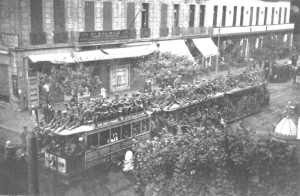
It would be nice to say they spent their time sightseeing, but they spent their time the way many soldiers have in many wars, drinking and seeking women, especially of the sort whose virtue was negotiable.

Lest you approach this tale with a "boys will be boys" snigger, let me deliver the downside up front: though tolerated houses of prostitution were supposedly subject to medical checks, the rate of venereal disease during the war was enough to create major problems for the British and colonial forces. ANZAC units reported an average incidence of VD across the Corps as 12%, or one man in eight; one unit is said to have had a rate of 25%. And penicillin hadn't yet been discovered.

Camp at Pyramids, Kangaroo Mascot
Cairo in 1915 was rather different from the Cairo of today. Many of its residents, whether foreign born or Egyptians of foreign ancestry, claimed the protection of foreign consulates under the system of "capitulations," under which they were subject to the laws of their protective country, not of Egypt. Disputes with Egyptian nationals were settled in a system known as the "Mixed Courts." This naturally created complex jurisdictional issues for law enforcement.

Sir Thomas Russell (Russell Pasha), was the British Deputy Chief of Police for Cairo, later becoming the Chief. (Egypt, until the war nominally Ottoman but under de facto British rule, was declared a British Protectorate when Turkey joined the Central Powers.) Russell's memoir, Egyptian Service, 1902-1946 is a very readable view of the British era from the inside. (His wife, Lady Dorothea Russell, wrote a readable guide to the Islamic monuments, a predecessor of later works by Richard Parker and Caroline Williams). As a police officer, his memoir deals a lot with the seedier side of things, including prostitution and the hashish trade.

Egypt had developed a licensed brothel quarter in the late 19th century, where the houses were nominally subject to medical inspection. Beyond the licensed quarters, there were areas where prostitution was semi-tolerated. Even when, in 1916 (the year after the events described here), a crackdown was introduced, the capitulations got in the way. Russell Pasha:
One particular house of some size and popularity defied Bimbashi Quartier, our chief detective officer, and myself for months by ringing changes on the nationality of the padrona [the Madam]. Police could not enter a foreigner's house without the consent and presence of the Consul or his representative. When we arrived with the French consular cavass to demand admission from the French padrona, the spy-hole in the front door would be opened and a husky voice announce that Madame Yvonne had sold the business to Madame Gentili, an Italian subject, without whose Consular representative we could not enter. Next week we would arrive with the Italian cavass to be met by another change of nationality by the padrona. Picqued beyond the ordinary, Quartier one night assembled seven Consular cavasses at the fast-closed door, and one by one the fictitious landladies were defeated, entry gained, and the law enforced.
A linguistic note: "Bimbashi" is not detective Quartier's first name. It's a rank which in the Egyptian Army and Police was equivalent to lieutenant colonel. (Though binbashi today in the Turkish Army is a major.)

Now, to further set the scene for the Battle of the Wozzer, we need to introduce the Red Light District of the Day (or the Red Blind Quarter as it was known). The area may come as a surprise to those who know Cairo today, since it included the once-elegant colonnaded street of Clot Bey (named, ironically given those VD rates above, for the French doctor who introduced European medicine to Egypt in the age of Muhammad ‘Ali), and other streets to the north of the Ezbekiyya Gardens.

Back in Ottoman times, Ezbekiyya had been a lake, and the area to its west was mostly flood plain; Bulaq was an island. Under the Khedives Isma‘il and Tawfiq in the late 19th century the area to the west was filled in and became the Ismailia Quarter, what today we think of as downtown Cairo. (Midan al-Tahrir was originally Midan Ismailiyya.) The Ezbekiyya Lake became the Ezbekiyya Gardens, formal gardens with promenades, surrounded by the foreign consular quarters and the big foreign hotels, including the famous original Shepheards, burned in 1952, opposite its northwest corner. (The later Shepheards was placed on the Nile instead.)

The area to the north of Ezbekiyya was known as Wagh al-Birka, "fronting the lake," because it was once the site of palaces and villas on the lake. The name itself actually needs a little note as well. Literally, the original name was named وجه البركة (Wajh al-Birkat in Arabic) which normally would be pronounced, in Cairene dialect where the jim is pronounced as a hard 'g', as Wagh al-Birkat. But in this case, the jim acquired an sh sound, so that the usual pronunciation was Wish al-Birkat. In fact, the engineer and planner of much of modern Cairo, ‘Ali Pasha Mubarak, in his street-by-street masterwork on Cairo, Al-Khitat al-Tawfiqiyya al-Jadida, actually spelled it that way: وش البركة.

Ezbekiyya remained fashionable, with Shepheards being the HQ of the ANZAC command (who may or may not have known that in 1798 Napoleon had his headquarters just to the west)

The general area of the Wajh al-Birkat and the streets to its north, though once fashionable, were also in the area where the new city of Cairo and the elegant foreign hotels rubbed up against the older quarters of town. It led to unusual juxtapositions: one reason the military command could respond so quickly to the riot we're about to describe is that they were in Shepheards only a couple of blocks away; just north of the area under discussion sat the main Coptic Cathedral for Cairo (the church is still there, but it was replaced as seat of the Coptic Pope by the new Cathedral in ‘Abbasiyya in the Nasser era). It was also an area where the tolerated brothel quarters around Clot Bey and the Wajh al-Birkat merged into a more unregulated area known as the Wasa‘a, literally the "wide area" which apparently once referred to the old fish markets when the Nile came much farther east. The actual "battle" in question started in a street called the Darb al-Muballat, but most of the troops knew the whole area as the Wasa‘a. Or, since the ‘ayn would defeat them, as the Wazza or the Wozzer. As Russell Pasha put it, the Wajh al-Birkat
. . . was populated at the time with European women of all breeds and races other than British, who were not allowed by their Consular authority to practice this licensed trade in Egypt. Most of the women were of the third-class category for whom Marseilles had no further use, and who eventually would be passed on to the Bombay and Far East markets, but they were still European and not yet fallen so low as to live in the one-room shacks of the Wasa'a which had always been the quarter for purely native prostitution of the lowest class.
He tells us the area was "ruled" by a "king," "a huge, fat Nubian named Ibrahim al-Gharbi," who dressed in women's clothes and wore a white veil.

Now, we come to April 2, 1915. The ANZACs were getting ready to ship off to the Greek islands of Lemnos and Mudros to prepare for the Gallipoli landings. According to some of the accounts I will be quoting below, there had been some incidents leading up to the "battle," but since April 2 was Good Friday, there was no training that day and large numbers of men had leave for the Easter weekend. So all the resentments came to a head.

Depending on the version, and there are many, the immediate provocation was one or more of the following:
  • Anger over the extremely high rates of VD, already mentioned;
  • An Englishman was trying to rescue his sister from one of the houses;
  • Claims the beer was watered or even stretched with urine;
  • A New Zealand unit was outraged because one of its Maori soldiers was rejected by a girl as too dark-skinned;
  • Arguments over price.
Perhaps it was some combination of all these, or just the imminent deployment.The fight began with an attack on a house at Number 8, Darb al-Muballat, for whatever reason. Soon sofas were burning in the street, a piano came crashing out a window, and as many as 2000 ANZACs were torching brothels and fighting with natives and each other. Both mounted British military police and Australian units eventually put the riot down; the whole thing started between four and five in the afternoon (remember, the men had the day off and doubtless started drinking early) and ended by eight. What may be the nearest thing to a photo of the scene: From the Australian War Memorial collection. Caption: "Cairo, burnt buildings and carts possibly the aftermath of the riot later known as the Battle of the "Wozzer", which took place in the street known as the Haret El Wasser near Shepheard's Hotel, Cairo 2 April Good Friday 1915."

The lady (well, woman anyway) in the foreground in what might be a nightgown invites speculation. I'm pretty certain she's not a man in a galabiyya.

Now, some accounts, including eyewitness ones, from those who were there. Oddly enough, more of those on guard duty who put down the riot seem to have written about it than the participants.

Another view of the post-riot damage is at right.

An account from a website dedicated to the Australian Light Horse:
First Wassa (also Wozzer or Wazzir), the appellation given to the first of two unheroic riots in the Haret el Wassa (the brothel quarter of Cairo, Egypt) involving troops from Australia and New Zealand. The initial incident occurred on 2 April 1915 (Good Friday), after units of the Australian & New Zealand Army Corps (ANZAC) received news that their period of training was at an end and that orders had been received for them to embark for long-awaited action. Causes of this disturbance reportedly lay in a desire to exact revenge for past grievances arising from dealings with the district's denizens-such as diluted liquor, exorbitant prices, and high rates of venereal infection-although wild rumours of stabbings of Anzac men by locals also appear to have played a part.

Trouble began soon after 5 p.m. when soldiers began evicting whores and their pimps into the street, and tossing their possessions out after them. Bedding, furniture and clothing-even pianos-were thrown from windows of buildings several storeys high. These materials were piled in the road and set alight. The town picket, drawn from the Australian 9th Light Horse Regiment, came on the scene and tried to clear the men out of the houses being attacked. Five arrests were made, although the crowd-growing larger by the minute refused to let these men be taken away, snatched rifles from some of the troopers and threw the weapons onto the fires, and succeed in freeing four of the prisoners.

British military police (MPs) were summoned, about 30 arriving on horseback to choruses of abuse and a shower of stones and bottles. An ill-advised effort by the MPs to gain control by firing their pistols, supposedly over the rioters' heads, resulted in the wounding of four men in the throng estimated at 2,000-3,000. This only served to further inflame matters, and forced the police to hastily withdraw. Efforts by the Egyptian fire brigade to douse the bonfires were also frustrated, its hose-lines being cut, its members manhandled (especially after they turned a hose onto the crowd), and the engine itself finally pushed into the flames.

Left to themselves, the more unruly elements began to loot some shops and put the torch to a Greek tavern. Shortly after 7 p.m. a second fire engine arrived, this time under cavalry escort which exercised extreme tact, and the various fires were tackled while a still sizeable crowd looked on. Since the `Wassa' was close by Shepheard's Hotel, where the Anzac commander had his headquarters, armed troops had also been called out. After the  Lancashire Territorials (non-regular British troops who were popular with the colonials) were drawn across the road, the rioters wisely began to disperse and order was eventually restored by 10 p.m.

A formal inquiry was convened the following day under Colonel Frederic Hughes, commander of the AIF's 3rd Light Horse Brigade, to investigate the causes of the riot and establish responsibility for its outbreak. Many New Zealand officers attempted to disclaim that their men had played any part, although the evidence of their presence was quite conclusive - the officer leading the Australian picket was adamant that `New Zealanders predominated'. In any event, nine-tenths of those present had been merely spectators. Apportioning blame was next to impossible, however, with few of the 50 witnesses able (or willing) to provide precise information. As the number of men injured by the MPs' bullets (three Australians and one New Zealander) was roughly in proportion to the size of the respective contingents, it could be said that the ‘honours' were about equally shared. So too was the damages bill of £1,700.
The Lancashire troops were the 42nd East Lancashire Territorials.

From a letter by Jack Jensen, from Wasley in South Australia, written in England recovering from wounds in Gallipoli:
The last few days we had in Egypt I shall never forget as three nights running there were riots in & about Cairo. On good friday there was a big row in one of the main streets in Cairo. I think I told you once before that Cairo is a very immoral place in fact they say that it is the worst town in the world. Some streets there are nothing but brothels & houses of infamy where every possible vice under the sun exists. Of course some of our men had been going to these places & had got diseases of different kinds & as a (what?) our chaps had a grievance against these places. Finally to finish up with one of the Manchester soldiers who were also stationed in Egypt found his sister in one of them. She had left England as a servant to some lady who had taken her to Egypt & left her there. I dare say you have heard of that sort of thing it is called the white slave traffic here in England. Anyway this girl went from bad to worse until finally she way found dancing in what they call a Can-Can hall that is a dozen or so women dancing perfectly naked in a big hall & exposing their person to every kind of indignity both by themselves & also the onlookers. It is just as well that I cannot tell you everything that goes on here as it would only grieve you. This Manchester chap managed to have a talk with his sister & tried to get her away. She was only too willing to go but the people she was with would not let her & they threw the brother out of a window as a result he was in hospital for nearly a week. When he got right he came in the camp & told our chaps & asked them to help him. At first they could not find the girl again but at last she was found in a particularly vile house. This was a day or two before Good Friday & that day being a holiday about 500 of our chaps & some New Zealanders & English troops went in to raid these houses. When they got in there a good many got drunk & they were joined by a great many more also drunk so the affair ended in a riot. They got the girl out first & then set fire to the houses. The affair started about four oclock in the afternoon & was kept up until nearly midnight Shops were raided & windows broken everywhere. I was on guard that day & we were called out to go & stop it but only twenty of us could do nothing against nearly two thousand. They had a fire in the street & were throwing the furniture out of windows two & three storeys high on to it. Some of us went in & tried to put it out & a chair came out of a window three storeys high & hit one chap & nearly killed him. We carried him away & a few minutes after piano came out of the same window & fell with an awful crash on the pavement. All the strings seemed to break at once & it went off like a cannon. After that the Military Police charged the crowd on horseback firing their revolvers into them but the crowd threw broken bottles & stones at them. One policeman got badly hit & one eye cut out with a broken bottle & two of our chaps were hit by the revolver shots.

About eight oclock five hundred Manchester troops came with fixed bayonets & were told to charge. They charged alright but they wouldn’t go for our men so they gave them rifles & our chaps threw them on the fire. Then they turned & ran & our fellows followed them up with sticks A while after the South Australian Light Horse came but the horses wouldn’t face the fire & smoke A little after eleven oclock the Westminster Dragoons came. They looked all right as they were coming down the street with all their swords drawn & their horses going straight through the fire & smoke. This very soon cleared the street & then we went for the houses & took everybody prisoner that we found. We got about fifty Australians & some New Zealanders.

The girl who was the cause of all the trouble was sent to England. She was taken charge of by the Y.M.C.A. The men in camp collected over forty pounds to pay her passage & expenses back to England Of course the money was handed over to the Y.M.C.A.

Next night a riot started in the canteen of the Abbasieh camp. Somebody caught an Arab who was employed at the canteen making water in a tub of beer. The Arab was at once pulled & half killed. All the beer casks & tubs were broken & spilt & all the groceries & goods stolen & the place burned down.

The guard was called out again but by the time we got there everything was over & the camp was quiet except for the fire still burning.

On Sunday evening the New Zealanders burned down a picture show. The man had advertised a boxing match & doubled the admission & then showed just the same pictures as he usually did. So they burned his place down.
The "Manchester" troops Jensen refers to are presumably the Lancashire Territorials mentioned in the earlier quote as being more popular with the ANZACs than British regulars; before the British government started messing with the historical counties, Manchester was in Lancashire.

You can also find the original contemporary diary of Australian War historian C.E.W. Bean on the Australian War Memorial site; Diary Number 3, including the Wozzer (which at one point he calls the Wozzy), is here.This has gone on too long and transcribing a PDF manuscript would take me all night, but it's there if you want more detail. His account of April 2 begins on page 25 of the PDF link.

At right, troops in evidence in the Wasa‘a after the riot, via Australian Light Horse Studies Centre.

Now, for the sake of completeness, I should note that there was a second Battle of the Wozzer fought on July 31. This was a much smaller affair, and took place after most of the ANZACs were ashore at Gallipoli.It also has its own website, The 2nd Battle of the Wozzer, complete with some of the testimony, so I'll just refer you there. The medallions at the top of this post are from his site.

Source here
Now, a discursus on the area in more recent times, in case any of my readers want to visit the scene.

When I first went to Cairo back in the 1970s, Ezbrekiyya still had traces of its former glory, though once the Opera house burned down it was less of a draw. Nearby Cafes and bookstalls surrounded the gardens.

When the new Azhar Flyover was built, I think sometime in the 80s, the south side of Ezbekiyya was dominated by its on-ramps and nearby Midan al-Ataba dwarfed by the highway. But the area to the north, site of our story, has changed less (though of course Shepheards has been gone since 1952, two revolutions ago). I've scanned in a section of a Survey of Egypt map from the late 1960s. It's in Arabic, but so for non-Arabists who nevertheless know Cairo, here's a brief guide:

The large street with a tramway down the middle at the right is Clot Bey. The street running westward and intersecting Clot Bey at the lower right corner, today the extension of Naguib al-Rihani Street east of Gumhuriyya St. was the old Wajh al-Birkat street. Gumhurriya (then Sh. Kamel) and Clot Bey reach the northwest and northeast corners of Ezbekiyya a couple of blocks south of the lower edge of the map. The big building complex in the right center of the map is the Coptic church of Saint Mark, formerly Cairo's main cathedral, now replaced by the big one in ‘Abbasiyya. The north-south street through the middle of the picture, running from Naguib al-Rihani to Clot Bey, is Al-Kanisa al-Marqusiyya, named for the church which is on it. If you'll look between Naguib al-Rihani (Wajh al-Birkat then) and Qabila street to its north, you'll see a small back street, the third to the right counting from Al-Kanisa al-Marqusiyya. The print here is too small to read, but it is Darb al-Muballat. The original brothel attacked and burned in 1915 was at number 8, Darb al-Muballat. I don't know if the street numbers have changed; today's number 8 is on the west side of the street. It's a pretty staid neighborhood today, or was the last time I saw it. Illegal brothels were cleaned up in 1916 and prostitution made illegal in 1924. (Therefore there was no prostitution in Egypt during World War II when Cairo again filled up with foreign troops. After all, it was illegal.)

The overall area from Google Earth  (copyright Google):
And Darb al-Muballat today (again, street numbers may have been changed so Number 8 may not be in the same spot, and the copyright is Google's):

Monday, February 2, 2015

Hmm. Did Old Kingdom Egypt Have Movie Dates?

Amid so much carnage in the Middle East, and my ongoing postings about the centenary of World War I, I thought it might be worth lightening things up a bit, even if it means employing somewhat adolescent humor.

The Fourth Dynasty of Egypt was the age of the Great Pyramids. The full details are below the picture, but as the caption says "This statue evokes the intimacy of Memi and his companion, Sabu, although she is set somewhat apart by her oblique gaze." In my youth (which despite what my daughter thinks was not really the Bronze Age), we'd have called it copping a feel, or getting to second base, but the Pyramid Age didn't have baseball. I'm far too mature and adult to pursue this theme further.

Full original caption:

The Royal Acquaintances Memi and Sabu.
This statue evokes the intimacy of Memi and his companion, Sabu, although she is set somewhat apart by her oblique gaze.
Until recently, the flowering of nonroyal statuary was believed to have occurred only in the Fifth and Sixth Dynasties. Recent studies indicate, however, that many of these nonroyal statues, including Memi and Sabu, are better dated to the Fourth Dynasty, contemporary with the great royal statuary programs. The early date for Memi and Sabu is based both on her coiffure and on the reciprocated embrace.


Thursday, January 15, 2015

Recycling Old News: Middle East Watches Porn

It seems about once a year someone studies online search traffic and "discovers" that searches for online pornography are extremely high in the Islamic world. It's happening again in this Salon article, "Why Porn is Exploding in the Middle East."

I'm not sure "exploding" is the right term. Yes, "According to data released by Google, six of the top eight porn-searching countries are Muslim states." But in December of 2013, I blogged about a similar study, more limited to the Arab world, and it was old news then. I think writers enjoy the contradictions and seeming hypocrisy implicit in discovering that some of the most repressive and censored parts of the world are watching online pornography; periodically we also read that Utah, the most conservative US state, consumes the most porn per capita.

The Salon article also notes the recent furor in Lebanon, which I hadn't blogged about, over a Lebanese American called Mia Khalifa, who was voted the most popular actress in US porn by some website. I didn't blog about it because she isn't making films in Lebanon, but in the US. I am unfamiliar with Ms. Khalifa's, um, body of work, but I didn't consider it a Middle East story. If she were making films in Lebanon, that would qualify as news.

So, it's old news. The countries in the region routinely condemn it, try to block it, and insist it's a Western plot, but it continues to be popular in a part of the world where there are few socially accepted outlets for sexual curiosity. This is not news; it's human nature.

Wednesday, November 26, 2014

In Other Lebanese Diva News, Haifa Wehbe Has Had a Busy Week

Having started the day with the news of the death of Sabah at age 87, it seems only appropriate to check in with the current generation of celebrity superstar Lebanese divas. Haifa Wehbe has been in the news at least three different ways in the past week or so.


  • Haifa also came under fire for wearing a revealing dress on the competition show Arab Star Academy. Parts of the dress appeared see-through under the bright studio lights. In fact, her strategic areas were opaque and she has worn far more revealing outfits in her concerts and movies, but this program is broadcast across the Arab World and so the dress seemed shocking in countries more socially conservative than Lebanon. (American actresses and entertainers routinely appear on television in more revealing outfits, of course.)
But in true diva style, Haifa Wehbe managed to appear in headlines for three different reasons in under two weeks' time. A clip of the Arab Star Academy broadcast is below.

Wednesday, May 28, 2014

Headline of the Week? "Nude Wife of Saudi Football Coach Sparks Anger."

From Al-Arabiya: "Nude Wife of Saudi Football Coach Sparks Anger."

A grabber of a headline. Did a Saudi coach's wife attend the game stark naked instead of in full abaya? Well, no. The coach isn't himself Saudi, and the wife isn't always nude (I assume) and may not be coming to the KSA. Still, female nudity and Saudi Arabia being the matter and antimatter of the Middle East, an explosion was predictable.

Here's the story. The most prominent and popular Saudi football (soccer to us Yanks) club, Al-Hilal just hired Romanian Laurenţiu Reghecampf as its new coach. His contract is reportedly worth $2.5 million. But it has been learned that his wife (and reportedly his agent), Ana Maria (or Anamaria) Prodan, has a profile not typical of Saudi women. As Al-Arabiya puts it:
Prodan is reportedly the first female FIFA-licensed agent in Romania. A Las Vegas resident, she supplements her income through gambling and modeling. Her latter work includes a photo-shoot for Playboy.
Professional woman who gambles, models, and poses for Playboy? Pretty much a trifecta for the Hay'a, the Saudi Committee for the Promotion of Virtue and the Prevention of Vice, also known as the Religious Police. There is no confirmation she is even planning to relocate, with her husband, to the Kingdom (she lives in Las Vegas, a place somewhat different from Riyadh), but that hasn't prevented an uproar that may jeopardize Reghecampf's brand-new contract. (The fact that many Saudis resent the replacement of the previous Arab coach is also a factor.)

Among other things, tattoos are taboo
As far as I can tell through extensive research (aka looking on Google), she has only appeared in the Romanian edition of Playboy, which I assume does not circulate widely outside Romania and maybe Moldova, and quite certainly is not readily available in Saudi Arabia. The PG-13 photo at right seems to be from this shoot, and the (concealed) nudity is compounded by another no-no to strict Muslims: tattoos.

Whatever the Saudis do, my image of sports agents is changed forever.

Wednesday, February 26, 2014

EIPR Issues New Study on Reproductive Health and Rights in MENA

The Egyptian Initiative on Personal Rights (EIPR), marking the 20th anniversary of the International Conference on Population and Development (ICPD), has released a major new report, “Reclaiming and Redefining Rights: ICPD+20 Status of Sexual and Reproductive Health and Rights in Middle East and North Africa”. You can read the press release here and read or download the full report (PDF) here.

The press release notes:
The report evaluates the progress made by a select number of countries in the region (six) towards fulfilling their commitments under the International Conference for Population and Development (1994)Programme of Action.  The six countries are: Egypt, Kuwait, Yemen, Palestine, Turkey and Tunisia. The report relies on data from different United Nations bodies and the Demographic and Health Surveys (DHS) for the countries researched. The report also relies on a wide range of qualitative studies and human rights reports to support the quantitative statistics and data, as well as several interviews with activists and NGOs in the six countries mentioned.

Using several indicators to measure this progress, the report is divided into three main sections: the first covers the status of women’s rights in the examined countries as well as the health expenditure. The second part uses reproductive health indicators to measure the status of maternal care, abortion, fertility and family planning and reproductive cancers. The third part examines the states’ protection of sexual rights by monitoring sexuality education, sexually transmitted infections, HIV, early marriage, human trafficking and gender based violence in the six countries.

Launched on the occasion of the 20 year review of the Programme of Action, the reports concludes with policy recommendations for countries in the region on reproductive and sexual rights. The report highlights the importance of the commitment of the countries to ensuring and guaranteeing for its citizens and residents access to affordable and of good quality comprehensive sexual and reproductive health services. It also recommends to the countries that they review laws that limit the access to the above services for groups who need them, including women and youth.