A Blog by the Editor of The Middle East Journal

Putting Middle Eastern Events in Cultural and Historical Context

Tuesday, December 11, 2012

A Few Words on the Mahalla Declaration of Autonomy

Last Friday, as most attention was focused on the demonstrations in Cairo, workers in the big Egyptian textile city of al-Mahallat al-Kubra (Mahalla for short) took over the City Council offices, ousted the council, declared themselves a Revolutionary Committee, and declared that Mahalla was announcing its autonomy from the "Ikhwani (Brotherhood) State."

There were predictable jokes on Twitter about Mahalla joining the United Nations and laments that it was just one more item making Egypt look ridiculous in foreign eyes.

Of course Mahalla is not about to become an independent republic, but I suspect this incident deserves more attention, and I suspect less giggling, than it has received. If you haven't heard about it, that's because all the Western reporters are in Tahrir Square in Cairo.

Most Westerners have probably never heard of Mahalla, or al-Mahallat al-Kubra, but it's of the most important industrial cities in Egypt, the center of the country's huge textile industry. You probably own some shirts or sheets or bathrobes made in Egypt; odds are,they were made in Mahalla.

It's a big place. (In fact, that's pretty much what "al-Mahallat al-Kubra" means: the Big Place. That may contribute to its anonymity.) Perhaps half a million people today. And for all those people who are arguing over whether the Egyptian Revolution is a revolution of Islamists led by the Muslim Brotherhood or a Revolution of liberal intellectuals led by a bunch of young folk with Facebook and Twitter accounts, the workers in the textile mills of Mahalla are convinced it's a revolution of an oppressed proletariat. And what's more, they think it started in 2006. And they sure don't think it's over.

Indeed from 2006 onward, and really picking up momentum in 2008, Mahalla has been wracked by labor activism, general strikes, and worker-management and worker-security forces clashes, and some of the inspiration for the later Egyptian Revolution took spark from the Mahalla strikes, most notably the April 6 movement.

Throughout the post-fall-of-Mubarak era, Islamists and liberals have fought constantly over politics and religion, while the economy has drifted steadily downward. Many political forces give lip service to the plight of Egyptian industrial workers, but no one has done anything effective. The real revolution may be yet to come, and the powers in office whether Muslim Brothers or liberals, will be held responsible,

Not wanting to sound like a Marxist here, but the day may yet come when last Friday's odd little declaration of an autonomous workers' soviet in Mahalla may not seem quite so humorous,
Mahalla's Big Textile Plant

Has the US Unwittingly Helped Out Jabhat al-Nusra?

The US decision to list the Syrian rebel movement Jabhat al-Nusra as a supporter of terrorism, on the grounds that it is an offshoot of Al-Qa‘ida in Iraq,appears to have backfired; in response 29 militias and coordinating committees announced a new pro-Jabhat al-Nusra front, which presumably was not rhe result the US was seeking. If they were seeking to marginalize the group, they instead won it new allies. One mystery is why, exactly, the US chose to take this action now at a time when generally the US has been expressing support (mostly verbal) for the rebels), and the rebel advances have been getting generally positive coverage in the West.

Perhaps they would have done better to follow the lead of blogger Karl ReMarks, who offers this "Secular Idiot's Giude to Syria's Jihadist Groups."  It's funny, if irreverent, and a reminder that ridicule can sometimes be effective where "terrorism" labels are not.


A Dialogue with the General?

Egyptian Defense Minister General Abd al-Fattah al-Sisi has called on all elements of Egyptian life, including President Morsi, to join in a "dialogue" about the problems facing Egypt, tomorrow afternoon under the Defense Ministry's aegis. Although various spokesmen are saying they will not be discussing "politics" or the Constitutional referendum, one cannot help but wonder if some sort of pressure is intended. But what sort? (And how can you have a dialogue about Egypt today and not mention politics or the referendum?)

For much of the day there have been confusing reports and denials of what, exactly, General Sisi has called for. But the fact that the Army, which has been silent since the Morsi reshuffles in August, has suddenly been heard from (however ambiguously) seems to be the real news here. Sort lf a "Don't forget we're still here" reminder?


Monday, December 10, 2012

Naguib Mahfouz' 101st Birthday

Today is the celebration of the 101st birthday of the great Egyptian novelist (and winner of the Nobel Prize for Literature), Naguib Mahfouz (1911-2006). Last year, for the centenary, I published a lengthy interview with Dr. Raymond Stock, who has translated many of Mahfouz' works and is working on a definitive biography. He told many stories of the great man, and if you didn't read it then I commend it to you now, (If you did read it then, go read it again, then go read some Mahfouz).

As Dr. Stock noted in that interview, his birthday has always been celebrated on December 11, the date the birth was registered, but his research discovered the actual record of the birth showed he was born December 10.

And let me also mention that Stock's latest translation of one of Mahfouz' works was published this year, Before the Throne, in which Egyptian rulers from the earliest times to Anwar Sadat seek to defend their rule before the Ancient Egyptian gods.
Stock Visiting Mahfouz after his 1994 Stabbing

Egypt as the Referendum Approaches

The polarization in Egypt continues. Though over the weekend President Morsi did rescind his Constitutional Declaration, he did so while insisting on going ahead with the December 15 referendum on the Constitution, and at the same time giving the Army the authority to maintain security between now and the referendum.

In the present political impasse I find the secular/liberal camps refusal to negotiate with Morsi over the weekend somewhat questionable: it's true Morsi showed no signs of being willing to yield on the critical question of the referendum, but the refusal to sit down with him sounds as if the liberals are in fact doing what Morsi accuses them of doing: refusing to accept that Morsi won the election, if only narrowly. The fact that the liberal opposition are planning to boycott the referendum also strikes me as self-defeating: te referendum was likely to pass anyway, but this will guarantee fewer "no" votes. What does that achieve? I feel Morsi has been far too imperious in his attempt to ram the Constitution through, but by refusing to negotiate the liberals may be handing him an inevitable victory.

A few key commentaries worthy of your attention:
  • Ellis Goldberg at Foreign Policy: "Egypt's Political Crisis"; Goldberg emphasizes the dispute is primarily political, and stems from major miscalculations;
  • Nathan Brown at Foreign Affairs: "Egypt's Constitutional Conundrum." Our best expert on constitutionalism in the Middle East reminds us that constitutions always need to be judged by the political environment at the time of operation.

Friday, December 7, 2012

Hanukkah Greetings

Since Hanukkah will begin this weekend, let me wish my Jewish readers a rewarding holiday.

The "Government of the Guide"

The slogan painted on the APC (apparently tolerated by the Republican Guard on board) reads "Down with the Governement of the Guide," referring to Muhannad Badie, the General Guide or  Supreme Guide of the Muslim Brotherhood. Many people in Egypt seem to feel (with some justification I think) that the Muslim Brotherhood leadership is calling the shots, not President Morsi (especially now that his non-Brotherhood advisers have quit).

Since we've never gone much into the Btotherhood's Organization here, I thought it was worth making one point at least. The leadership of the Guide does not, whatever else you may think of the institution, constitute an Iranian-style "Governance by the Faqih," both because Sunni clerics lack the power of Shi‘ite clerics, but  because the Guide of the Muslim Brotherhood is not in fact a trained cleric. Badie is a veterinatian, and in fact of the eight Guides so far none have been clerics; they have been laymen active in Islamist politcics and political organization. For example:

Hasan al-Banna':: schoolteacher (1928-1949)
Hasan al-Hudaybi: lawyer, judge (1951-1972)
Umar al-Tilmisani (1972-1986) wealthy landowner
Muhammad Hamid Abu'l-Nasr (1986-1996)  not clear: apparently only a secondary education?
Mustafa Mashhur (1996-2002), wealthy landowner
Ma'mun al-Hudaybi, (2002-2004), lawyer, judge, son of Hasan al-Hudaybi
Muhammad Mahdi Akef schoolteacher organuzer international activist (2004-2010)
Muhammad Badie: (2010- )Veterinarian

Two judges, two wealthy landowners, two schoolteachers, and a veterinarian, plus one who apparently had few major secular jobs but also was not a cleric? This is fairly typical not just of the Brotherhood Guides but of its senior leadership, who tend to businessmen, doctors, and such.

That doesn't justfy the current grab for power in any way, but it seemed like a point worth noting,

Thursday, December 6, 2012

Nefertiti at 100 (or 3357) and Still Looking Great

The old rule that one should never comment on the age of a beautiful woman is hopefully outmoded as a sexist one; so I thought I'd be gauche and discuss the age of the well known lady at left. One hundred years ago today, December 6, 1912, the German Archaeologist Ludwig Borchardt dug up what is perhaps the most famous single depiction of a woman from antiquity: the bust of Queen Nefertiti. Made about 1345 BC (so she's closer to 3357), her sculptor somehow captured both a cold beauty and a regal sense of command. Nefertiti was the Great Wife of Pharaoh Akhenaten.

The bust is in Berlin; Egypt of course would love to get it back, but won't.

I am also tossing in a photo of a much less well-known statue of Nefertiti, purely because I'm annoyed with the Muslim Brotherhood and she's naked in this one. If you want to make bad puns on "the bust of Nefertiti" you'll have to do it yourselves. We should all look so good when we're 3357.

Sorry to Be Late on the Really Important News

You know, I'm just one blogger. When Egypt is plunging again into political violence, when Bashar al-Asad is mixing his Sarin precursor chemicals, as Damascus is burning, when Israel is opening up settlement in the E-1 corridor and so much else is happening, it's little wonder I miss some of the major stories. I know I was late on such really important stories as Kim Kardashian's Excellent Bahrain Adventure, but I feel particularly remiss that I dealt with an American tabloid star famous for, well, being famous, and have failed to comment for a month about the major news of the Arab world's reigning tabloid queen; Lebanese singing diva Haifa Wehbe. A month ago she announced that she and her most recent husband, an Egyptian, had divorced. We've mentioned Haifa here before, and of course regret the end of any marriage. Nor do we believe the story that her husband has political ambitions and found her the wrong sort of wife for the Muslim Brotherhood era. I mean, Haifa reportedly recently became a grandmother for the first time. How could even the Muslim Brotherhood object to a Lebanese grandmother?

OK, it's true she's not everybody's Lebanese grandmother.

Nor will we give any credence to gossip about semi-nude videos or curious behavior with the King of Bahrain,  since scurrilous rumors should not be spread about Lebanese grannies.

Tomorrow.we will return to the world of revolutions, oppression, Sarin gas warheads and the imminent expiration of the Mayan Calendar.

Springborg on What the Officer Corps is Thinking

The fact that Army units from Egypt's Republican Guard ultimately separated the combatantsat the Presidential Palace last night marked the first involvement of the Armed Forces as opposed to the Central Security Forces from the Interior Ministry) marks the first h8gh-visibility military presence since Morsi's move to retire the high command in August, and it raises a question I raised at the end of my post last night. It also maikes even more timely a question  I raised at the end of my post last nght: can Morsi count on the Army's loyalty in the current crisis

My old friend Bob Springborg, who has been watchiing Egypt's kmilitary in politics as long as I have and is currently at the US Naval Postgraduate School, had a piece in the Egypt Independent last week that is even more timely now: "The View From the Officers' Club.:" Though written before the latest round of violence, it is particularly timely now. An excerpt:
The key question now is: Might the military act a third time? Might key officers now perceive Morsy’s and the Muslim Brotherhood’s aggrandizement of power as threatening the stability and even viability of the state, and possibly the interests of the military as well?
The short answer is “maybe.”
Morsy is obviously preoccupied with this question, as indicated by his handling of the military before and after turning the tables on the SCAF in August. Sensing the military’s dissatisfaction with Tantawi and former Armed Forces Chief of Staff Sami Anan, he reached out to officers he thought would support his intended purge.
Key among them was General Abdel Fattah al-Sisi, whose suitability rested upon his background in military intelligence, his comparative youth and his sympathy for Islamism.
He had his fingers on the political pulse of the officer corps. As a 57-year-old, he was a full generation younger than Tantawi, but also sufficiently senior so as not to require the hasty retirements of hundreds of older officers.
Finally, and possibly most importantly, Sisi openly professed Islamist orientations, as suggested by some media accounts accusing him of being a Brotherhood mole inside the SCAF. Whether this allegation is true or not is unknown, but his open support for Islamist conceptions of government is a matter of public record.
Do read the whole th8ng. In brief, he's not sure the whole officer corps is fully on board along with Sisi. I don't think anyone knows for sure what they're thinking, but I respect Bob's comments here,

Wednesday, December 5, 2012

Blood in the Streets of Heliopolis: Is the Brotherhood Making its Move?

What happened today around the Presidential Palace in Cairo? It may be a long while before its implications become clear. As I write the casualty count is still confused: at least three dead according to Ministry of Health; four according to press reports, and hundreds wounded. The dead reportedly include both protesters and Muslim Brotherhood/Morsi defenders.

What seems different about today is that whatever else it proves to mean, the Muslim Brotherhood seems to be jettisoning its alliances and seeking to claim power for itself. Remember that Morsi won only 24% of the vote in round one; Morsi's 51% victory margin included plenty of people who thought he was the lesser of two evils. But today it seems to be shedding allies. Morsi's non-Brotherhood advisors are quitting right and left: the newly-appointed head of the committee overseeing the constitutional referendum has quit, refusing to preside over a referendum that has shed Egyptian blood;as have two other key aides.

There are reports that  up to 26 Egyptian diplomats abroad have refused to administer referendum voting in their embassies. And even the Muslim Brotherhood's usual Salafi allies were not out today:


And some reports say he has no non-Muslim Brotherhood aides remaining at the Presidency.

One of the best online/scholarly observers of the Muslim Brotherhood, Khalil Anani, has offered some interesting preliminary assessments:
Even before today's violence, Farid Zahran was asking "Is the Muslim Brotherhood Sowing the Seeds of its Own Destruction?" He even outright calls the MB "faacist" and makes an extended argument to defend the term.

Fascist or no, no one has burned the Reichstag quite yet, but the Brotherhood seems to be portraying what had been a peaceful demonstration outside the Presidential Palace yesterday as a violent provocation, though the only thing that changed today was the arrival of the Brotherhood demonstrators, whose restraint I had prematurely praised because they stayed away yesterday. It almost looks as if a decision was made within the past 24 hours to throw down the gauntlet and take the streets. And the protesters are claiming the Brotherhood supporters — NOT the police, Central Security Forces or State Security —were themselves using teargas, and pellet guns and/or birdshot, as well as the Molotov cocktails used by both sides. I can't confirm this, but where would Brotherhood supporters get teargas? Alarming if true. I'm not endorsing the "fascist" label but it does remind me of something rather 1930ish

There is talk of a Presidential speech tomorrow with "good news," though I'm dubious; the resigning aides said Morsi would not listen to any of his non-Brotherhood advisers, and Anani, who is a sober analyst, feels the Brotherhood leadership, not Morsi, is calling the shots. The seal of the Presidency at right has had scrawled on it, "Down with the Government of the Guide," meaning not Morsi but Brotherhood Supreme Guide Muhammad Badie.

The conflict has been in the area around the Presidential Palace in Heliopolis, and along Ahram Street and the area known as Roxy Square and Roxy (after an old Moorish art deco theater from a century ago when the suburb was built) (Palace lower center; Roxy to the North running SW-NE):
Many of the videos are disturbing and should be viewed with caution.


Now, because much of the rest of ths post is going to consist of English-language Twitter posts about Muslim Brotherhood thugs attacking peaceful demonstrators, let me let the other side have their say first (though they don't seem to recognize there are two sides, just Brothers and "thugs") (baltagiyya), a word also applied to them by their opponents:

Okay. Now let's hear from the other side. For speed I've only selected English-language tweets, but the Arabic is telling the same basic story. As is often the case when I post Twitter posts, a strong language warning is in order for a handful of these unedited tweets.
Some are complaining the US media (mostly CNN I think) is interviewing onlly Muslim Brotherhood supporrers; they did have an interview with Essam El Haddad, Morsi's Foreign Policy advisor, who's in Washington and thus available,
One TV host did apologize for any role he may have had in electing Morsi:


Well there's that, too. Unless they pull off what appears to be a power grab. It's pretty stupid (or since I already posted a language warning, pretty fucking stupid as he/she says) indeed to stage a coup when you're already holding most of the cards. Unless you're absolutely sure of the Army. Are they? I'm not. But that's an entirely separate post,

OK, I Spoke too Soon . . .

. . . yesterday when I praised the lack of violence in the confrontations in Cairo. Today the Muslim Brotherhood has taken on the demonstrators and the two sides have been clashing violently with some deaths reported. Meanhile most of Morsi's non-Brotherhood advisers have resigned and the polarization is deepening. I'll have more to say later.as the situation clarifies.

Ignatius IV, Greek Orthodox Patriarch of Antioch, Dies at 92

Ignatius IV Hazim, Greek Orthodox Patriarch of Antioch and All the East (also sometimes translated "and the Levant"), died today in Beirut at the age of 92 after suffering a stroke yesterday. The Syrian-born patriarch held the patriarchal throne for 33 years.

The Greek Orthodox Patriarch of Anrioch has his seat in Damascus in the ancient Street Called Straight. (None of the five patriarchs of Antioch of the various Christian denominations still have their seat in the ancient city of Antioch, today's Antakya, Turkey.) In the Greek Orthodox churches the Patriarch of Antioch traditionally ranks third in ceremonial order after the Ecumenical Patriarch of Constantinople and the Greek Orthodox Patriarch of Alexandria. Jerusalem ranks fourth. The Antiochian Patriarch heads the Orthodox communities of the Middle East except for those in Egypt (Alexandria Patriarchate) and Israel, Palestine, and Jordan (Jerusalem Patriarchate).[Update: Before one of my very picky readers brings this up, Saint Catherine's at Mount Sinai is sometimes considered an autocephalous Orthodox church, but its archbishop is consecrated by the Patriarch of Jerusalem.]

The Orthodox Patriarchate of Antioch is believed to be the second-largest Christian denomination in the Middle East after Egypt's Copts, with perhaps two million adherents. Over a million are in Syria, where they represent the largest Christian denomination; in Lebanon they are second to the Maronites. The Maronites worldwide, including Western diasporas, may outnumber the Antiochian Orthodox, but no longer do so in the Middle East.

Known for his work among Orthodox youth, Ignatius IV Hazim was a popular leader. He will be buried in Syria.

Kuwait Election Results

To no one's particular surprise, the Kuwaiti Prime Minister has been reappointed to a new term in the wake of the December 1 elections. The elections, which drew widespread protests and an opposition boycott, were the second parliamentary election in this calendar year and the fifth in six years.

Readers should remember that in Kuwait the government is named by the Amir, while Parliament is often dominated by the opposition, unlike in a Westminster style system. Due to the opposition boycott, the new Parliament is dominated by the pro-government elements. Sunni Islamists are much reduced in numbers. So are representatives chosen by rhe powerful tribes, due to the new single vote system intrroduced in a controversial electoral reform. A major result of the electoral reform was a strengthening of rhe Shi‘ite representation, now 17 of the 50 elected seats. That is a reflection of the actual population balance (about one third Shi‘ite), though in Kuwait the Shi‘ites are not politically or socially unified.

Analyses of rhe results here, here, and here; a breakdown of the results by constituency here.

Tuesday, December 4, 2012

When Tabloid Stars Meet the Arab Uprisings

I realize I have been remiss to those of my readers for those who rely on this blog for the latest gossip about US tabloid figures and reality TV stars; I know this is a Middle East blog, but even so I completely failed to post anything at all last month about the opening of Paris Hilton's store in Mecca, which drew some criticism from the Saudi clerical establishment.

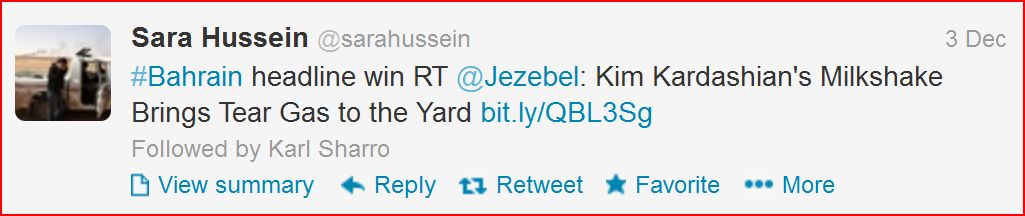
This time, however the demonstrations and controversy over Kim Kardashian's opening a milkshake shop in Bahrain, and her tweeted comments praising the place, demand some comment.

Now I must confess that I am far from clear exactly why Kim Kardashian is famous, or why she obviously makes more money than I do, or possibly more than the whole Middle East studies community put together do. But I must say I do agree with these comments from Juan Cole:
The real scandal of the Kim Kardashian visit to Bahrain is that it is what it took for Western media to mention the word “Bahrain” on the evening news. I did a search at Lexis Nexis Broadcast Transcripts under “CBS and Bahrain” for the past 3 months and got … 10 hits. Now, this methodology is inexact. I am not singling out CBS but it is useful because it can’t be confused with anything else (ABC could be Australian Broadcasting Company) and it does not have a cable news sister, so we really are looking at evening news and Face the Nation. Even so, I got several non-CBS items among the hits. Conclusion: Bahrain has been almost invisible as an issue in most US television news reporting . . .
But did Kim Kardashian show up in Manama? Why that they put on t.v.
ABC news reports on the controversies surrounding the reality-show star’s visit to Manama promoting her milkshake shops.
Marc Lynch also picks up on the theme:
Kim Kardashian's December 1 trip to Bahrain to promote milkshakes brought all the Middle East tweeps to the yard.  Her visit attracted both delerious young fans and a raucous protest (reportedly cleared away by the time she arrived), with conflicting accounts as to whether she actually ended up mixing a tear gas flavored milkshake.  The Middle East twitterati had a field day of outrage and humor over the news, with pretty much my entire Twitter feed (and Bahrain's Foreign Minister) retweeting her now deleted "OMG can I move here please?" tweet.   It's easy to poke fun at Kardashian.  But did Kanye's girlfriend really do anything different than those foreign policy wonks willing to participate in Friday's 2012 Manama Dialogue?
Kardashian went to Bahrain and Kuwait to promote "Millions of Milkshakes."  She evidently had a great time, declaring at the end: "Thanks Sheikh Khalifa for your amazing hospitality. I'm in love with The Kingdom of Bahrain." For this, she was roundly mocked by Bahraini opposition and Middle East commentators. Bahraini activist Maryam al-Khawaja posted an open letter to Kardashian inviting her to meet with human rights activists during her trip.   The one bright note, such as it was, came from @Therwees: "Kim Kardashian tweeting about Bahrain makes more news than actual Bahrain."
Part of this dismay and the attention paid to it comes from the star's tweets during her visit to Bahrain, which, of course, continues to endure major protests which are firmly put down, and which has been widely criticized by human rights groups.  She seemed pretty oblivious to that:
But she drew plenty of criticism on Twitter as well:


One last thing: milkshakes??

Escalation and Mass Protest in Cairo but Less Bloodshed

Today's mass protest at the Presidential Palace in Cairo were mostly peaceful despite the use of teargas when demonstrators broke through a police line, but they did indicate that there is widespread anger against Morsi's Constitutional Declaration and the proposed Constitution. Protests were also reported across Egypt, but there is no sign that Morsi is prepared to back down prior to the referendum on the Constitution on December 15. And given the Muslim Brotherhood's strong electoral showing in rural Egypt and the general social conservatism of the country outside the major urban areas, it would be naive to predict the referendum will reject the proposed Constitution. (And even if that were to happen

In a related protest,  12 independent newspapers and five privately-owned television networks were "on strike" today with the newspapers not publishing and the channels dark. Five of the papers ran variants of the same image on their front page,  shown here from Tahrir, showing a human figure made of newspaper in a jail cell, all bearing the  slogan in red "no to dictatorship." The Tahrir caption shown adds "Al-Tahrir and the Free Media will disappear tomorrow."

While the liberal and secularist protesters showed their strength today, the sort of serious violence that occurred during the protests of last November and December, when the stripping and beating of "blue bra woman" became an international scandal. The decision last weekend by the Muslim Brotherhood to hold its pro-Morsi rally at Cairo University rather than in Tahrir Square showed a recognition of the risks of bloodshed and police and security forces refrained from firing rubber bullets or live ammunition today, using only teargas. The polarization of society is real and exacerbated by Morsi's actions, but the bloodshed of a year ago, with a handful of exceptions last week, is not yet in evidence.

Those Syrian Sarin Reports

All the reports suggesting that the Syrian government may be preparing Sarin for use against its own people are alarming, The fact that the US and the UN appear to deem the reports credible means the danger should be taken seriously. I am generally cautious about reports coming out of Syria; there are too many competing factions, producing propaganda of their own, and too many videos of uncertain provenance being posted to social media with little ability to verify the source. The recent AP "Iranian nuclear plan" fiasco is a reminder that false information (in that case, leaking a graph that did not show scientifically what it claimed to) can easily be reported around the without proper verification.

What the US has said so far is that there is evidence Syria is bringing together the chemicals needed to manufacture Sarin, which is a binary weapon. There is no doubt that Syria possesses a sophisticated binary chemical weapons capability; this is not a  case of an alleged capability like WMD in Iraq in 2003. The fact that the US has been so adverse to open intervention up to now suggests the alarm has some justification, though that does not mean that some caution is not in order.

Despite stern warnings from the international community, it is far from clear that this would deter the beleaguered regime once it decides it has no alternative but to use Sarin against its own people. That would mean the regime is prepared to bring the building crashing down on its own head: that the Alawite community is prepared to go down fighting even if it carves a space for itself in the annals of genocide.

But if the threat is real. one hopes some thought is being given to how (other than verbal warnings) to deter the actual use of such weapons in this already horrific war.

Monday, December 3, 2012

Vanished States: the Hashemite Kingdom of Hejaz

On a couple of earlier occasions I've posted about vanished states,not historical items like the Abbasid Caliphate or the Crusader States, but evanescent states that had a brief existence in the past century. Earlier posts have dealt with the Republic of Hatay and the Syrian Arab Kingdom.

Hejaz Flag, 1921-25
Hejaz Flag 1916-1920
Kingdom of Hejaz (Wikipedia)
The Syrian Kingdom was a short-lived Hashemite Kingdom following World War I; it was closely linked to the Kingdom of the Hejaz, the product of the Arab Revolt. Sharif Hussein of Mecca, whose revolt against the Turks had won British backing, had proclaimed Arab independence in 1916, and added the title of King of Hejaz to that of Sharif of Mecca. His son Faisal tried to become king of Syria (originally of a greater Syria embracing most of the Levant), though when driven from the throne by France, Faisal received the throne of Iraq from the British as a consolation prize; the monarchy ruled in Iraq until 1958. Faisal's brother ‘Abdullah became Amir of Transjordan, where ‘Abdallah's great-grandson and namesake still rules.

King Hussein
Though Britain had supported Hussein against the Turks and the Hashemites proved reliable British allies,  his ambitions and that of another former British client, the rising Saudi Kingdom in the Najd, came into conflict. In addition to calling himself King of the Hejaz, he called himself King of the Arabs. Raising the ante yet again, when the Turkish Republic abolished the institution of the Islamic Caliphate (claimed by the Ottomans since 1517), Hussein proclaimed himself Caliph in 1924. Later that year, after a military defeat by the Saudis, Hussein Abdicated in favor of his son ‘Ali. He fled first to Cyprus and then to Transjordan, where he lived with his son ‘Abdullah. Hussein died in 1931 and was buried in Jerusalem.

King ‘Ali ibn al-Hussein
King  ‘Ali ruled what the Hashemites still controlled of the Hejaz from October 1924 until the fall of Mecca to the Saudis in December 1925. ‘Ali fled to Iraq to join his brother Faisal; ‘Ali's son ‘Abd al-Ilah later served as Regent for King Faisal II of Iraq.

Lawrence-designed stamps

The Hejaz soon became a province in the new Kingdom of Saudi Arabia. Like other short-lived nation-states, the Kingdom of Hejaz is not forgotten by at least two constituencies (besides the Hashemite family): philatelists and numismatists.

Its stamps, which bear the mark Makka al-Mukarima, Mecca the Blessed, are not only colorful: the earliest ones are said to have been personally designed by T. E. Lawrence
(Lawrence of Arabia).

Gold Dinar, front and rear
As for its coinage and paper money, we are informed that "Hijaz banknotes are among the most sought after and rarest known to collectors. A complete SPECIMEN set is housed in the Jordan Central Bank Museum and just a few other pieces are reported in private collections. King Farouk had  four pieces in his collection, three of which are now believed to be in North America."


Ottoman Sultans for Monday

To get your week off to a different sort of start:  a family tree of the Ottoman Sultans:


Morsi Watch: Some Links

The speed of developments in Egypt is produing a lot of commentary. Here are a few useful links:
  •  An Arabist Podcast on recent events with Issander El Amrani and Ursula Lindsey joined by Heba Morayef of Human Rights Watch and Max Rodenbeck of The Economist

Sunday, December 2, 2012

Video of Morsi's Mosque Confrontation

 On Friday I posted about the various accounts of President Morsi's encounter during Friday prayers. A YouTube video definitely appears to show congregants saying "Batil! Batil!  (False! or Error!) after the Imam reportedly compared Morsi to the Prophet:

Friday, November 30, 2012

Two Versions of Morsi's Friday Prayer

 President Morsi had a curious experience at Friday Prayer today, though there are varying accounts of what precisely occurred. The state-run Ahram Online says only this:
The president had to intervene to contain the anger of some worshippers during Friday prayers in an upscale district of Cairo, when the mosque’s preacher dedicated his sermon to defending Morsi’s latest decisions. "My dear brother, the one who is angry, please come and explain to me why you are angry. It’s your right and it’s my duty [to explain]," Morsi said in the mosque, drawing applause from worshippers. "After prayers, we will talk for a few minutes," the president said. "I hope you will all listen."
So the President conciliated some dissidents gathered for Friday prayer. The story the Egypt Independent tells is much more confrontational:
Worshippers at Hassan al-Sharbatly Mosque in New Cairo protested against President Mohamed Morsy while he was attending prayers there Friday, when the imam of the mosque tried to justify the president’s recent decisions.
“Prophet Mohamed and the Caliphs used to dismiss and appoint judges, and there is no problem with Morsy doing that,” the imam said, according to an eyewitness. The imam was referring to Morsy’s dismissal of the prosecutor general, which was deemed a staggering interference of the president in judicial matters.  
But worshippers stopped the imam and protested his likening Morsy to the Prophet.
The atmosphere was charged following the prayers, with some worshippers chanting, “Down with the rule of the supreme guide,” referring to the leader of the Muslim Brotherhood, from which Morsy hails.
Meanwhile, Morsy supporters in the crowd chanted the president’s name.
“The imam made a mistake and the president is to be blamed,” retired professor Hassan Abdel Kader, who was praying close to the president, told Egypt Independent. “What the imam said angered the people and created a hubbub,” he added. “His sermon was immediately interrupted by angry worshippers.”
The ensuing chaos remained for a few minutes following the prayer. The imam asked people to calm down, saying, “No voice should be louder than the chant of ‘There is no God but Allah.’”
To end the chaos, some people called for prayer. As soon as the prayer ended, “the hubbub returned again, even more strongly,” said Hassan Awad, a retired army general, who attended the prayer.
After the end of the prayer, Morsy took the microphone and talked to the worshippers, assuring them of the independence of the judiciary.
“Morsy contained the protesters smartly, and acknowledged the judges’ rights, but at the same time his decisions are not in line with what he said in the mosque,” said Awad. Abdel Kader said Morsy asked to talk with some of the protesters, and four young men went to talk with him for about 15 minutes.

Adel Ibrahim, a journalist at Al-Ahram state daily, who attended the prayer, said four buses carrying pro-Morsy people came to attend the prayer. A security guard confirmed that. Ibrahim added that worshippers were annoyed before the start of the prayer because of the tight security measures.   
That would seem to tell a rather different story.  I wasn't there, but have seen versions where Presidential security had to protect Morsi, at least initially. Strictly speaking, the two accounts are not directly in conflict,  but they certainly paint different pictures.

Another Constitution, Another Demonstration

This photo is of a student demonstration protesting a constitution in Egypt. Unlike today's protests of the new, hastily written draft constitution, this took place nearly 80 years ago.
The protesters are demanding the retraction of the Constitution of 1930 and the restoration of the Constitution of 1923. The caption says that the photo dates from 1935, which would date it after the King's abrogation of the 1930 Constitution on November 30, 1934, though the 1923 Constitution as not restored until December 12, 1935, after a little over a year with neither constitution officially in force.

Constituent Assembly of 1923 (Al-Ahram)
In my earlier post on the 1923-24 Egyptian elections, I mentioned the Constitution of 1923, which followed formal Egyptian independence and the return of Sa‘ad Zaghloul. That Constitution was liberal for its era, though the franchise was limited to males. It was drawn up by a committee of 30.

The 1923 Constitution (and virtually the whole period down to the 1952 Revolution) was characterized by a power struggle between the populist Wafd Party and the King, with the British forming a third power center, despite nominal Egyptian independence. After the British Governor General of the Sudan and head of the Egyptian Army, was assassinated in 1924, the British made sharp demands of the Egyptian Government and Zaghloul resigned as Prime Minister.

Ismail Sidqi
During the rest of the 1920s the King frequently suspended Parliament and power struggles broke out within the Wafd and between the Wafd and the Palace, so the 1923 Constitution was functioning sporadically at best. The rise of Ismail Sidqi as the new political strongman in 1930 led to an attempt to replace it. Sidqi, a former Wafdist who had shared Zaghloul's exile, had split with the Wafd and created a reactionary government in 1930.

Sidqi oversaw the writing of a  new Constitution in 1930 which reduced the number of Deputies from 235 to only 150, gave more power to the already-powerful Throne, and sharply restricted the franchise both financially and in terms of professional qualifications, as well as indirect election of deputies by notables. It was a sharply less liberal Constitution than that of 1923.

Sidqi lost power in 1933 and popular demonstrations led the King to abrogate the 1930 Constitution in late 1934, as noted above. For the next year the Cabinet ruled without a Constitution; finally in December 1935 the "People's Constitution" of 1923 was restored.

The 1923 Constitution remained in effect until the Revolution of 1952 and the overthrow of the Monarchy. The struggle between King, Wafd, and the British (notably in the Abdin Incident of 1942) remained an issue for most of that period.

The Draft Egyptian Constititon

As women's rights group, human rights groups and others protest the rushed, Islamist-dominated draft Egyptian constitution, Egypt Independent  has published a complete English text. And the BBC has a useful parallel comparison of the 1971 Constitution and the proposed draft. 

I'm sure e'l see ore detailed analyses coming, and I may make a few comments of my own. Stand by.


Thursday, November 29, 2012

Egypt's Overnight Constitution

 Okay, you guys have until midnight to finish this . . .
They took more time in Philadelphia
Egypt's Constituent Assembly, still fearing possible dissolution by the courts though protected by President Morsi's decree, and with most of its secularists, Christians, and other non-Islamists boycotting, spent last night finishing writing the Constitution: overnight. And today they started voting on it article by article, working far into the night. President Morsi plans to call a referendum as soon as it passes.

Ramming through a Constitution written mostly by Islamists is not going to calm the tensions in Egypt. The Constitution can probably pass a referendum: the Islamists are strong in the countryside, if not in Cairo. But the method seems to guarantee that the Constitution will not  be accepted by key elements in Egyptian society. There must be a better way to do this. For one example, see the painting above.

Also, Egyptian political humor being what it is, this is making the rounds on the Internet:
Arab Republic of Egypt
Referendum Ballot on the Constitution of Egypt
___ Agree
___ Kafir (Unbeliever, Infidel)


The US can Still Count on Palau and Nauru

The UN General Assembly has voted to grant non-member observer status to the Palestinian Authority. The largely symbolic gesture as predictably opposed by both the US and Israel. Ah, but when I put it that way it sounds as if only the US and Israel were opposed.  Though the UK and Germany and other key countries (a total of 41) abstained, several countries did indeed vote with the US and Israel: we were joined by Canada, the Czech Republic, and the powerful coalition of Nauru, the Marshall Islands, Palau, Micronesia and Panama. Two neighbors and a smattering of island nations, most of them former US territories, plus the Czechs.

November 29, 1947 and November 29, 2012: Is 65 Years Long Enough?

If all goes according to plan, the United Nations General Assembly will vote today on whether the Palestinian Authority should be admitted as a "Non-Member Observer State." Because such a calamity would cause several planets to spin out of their orbits and crash into the sun, the US (and Israel) are opposed. The vote will have a mostly symbolic impact, though Israel may retaliate against the Palestinian Authority in ways that are not at all symbolic.

But there is one major piece of symbolism that has received very little comment in the US media, at least so far as I've seen. (A major exception is Lior Sternfeld's column over at Juan Cole's blog a couple of days ago: "'Let the Palestinians Have Their Kaf Tet be-November.") 

As Sternfeld explains:
On November 29, 1947 the UN general assembly granted the Zionist movement one of its most prominent diplomatic achievements, when it approved the Palestine Partition Plan. The non-binding resolution, never voted on by the UN Security Council, proposed dividing the land of the British mandate into a Jewish State and an Arab-Palestinian state. The Palestinian leadership rejected the UNGA resolution as giving away a substantial amount of territory to which they felt what they viewed as foreign settlers had no right. In contrast, Jews welcomed the idea of partition in principle (though they did not commit to settled borders for Israel) and they moved forward to establish the state of Israel.

Kaf-Tet means 29 in Hebrew letters, and to date every Israeli child can tell by heart what Kaf-Tet Be’November is, even if he does not know what or when November is. Every Israeli child recognizes the old radio recording of the voting process and thus know how Argentina and Australia voted on this issue (abstention and yes respectively). The war that erupted immediately afterwards and the bloodshed that has transpired since prevented the full implementation of the solution.
Yes. Today marks the anniversary of the United Nations vote in 1947 to partition the Palestine Mandate into two states, one Arab and one Jewish. (You may recall a dramatic scene in the movie Exodus, which explained how blue-eyed Paul Newman and blonde Eva Marie Saint founded Israel, in wh8ch listeners wait for the radio account of the roll call.) Yes, the Arabs rejected partition then. But 65 years have passed, and there's something like a consensus for a '"two state solution" but little will to get there.

The Palestinians chose a significant date for their new bid for legitimacy, but other than the post above I've seen little comment on the 65th anniversary of Kaf-Tet be-November.


http://www.juancole.com/2012/11/let-the-palestinians-have-their-kaf-tet-benovember-sternfeld.html

Wednesday, November 28, 2012

Omar Dajani on "Arafat's Ghost"

The exhumation of Yasser Arafat's body has to be one of the more bizarre and macabre stories of the year, and I must confess I have no idea what the results may be. It's of some personal nterest since my netime MEI colleague Clayton Swisher, now with Al Jazeera English, dug up the story that led them to di g up Arafat. I tend to be skeptical of conspiracy theories, but this is the Middle East, and he had many enemies. (I think Palestinians are reflexively assuming that if he was poisoned it must have been Israel, but a real conspiracy theorist ought to be able to come up with something more Byzantine than that.)

Omar Dajani's post yesterday at Foreign Policy, "Arafat's Ghost," neatly ties the exhumation with the UN vote on Palestine. It's worth a read.


Polarization in Egypt and the Excluded Middle

The confrontations in Egypt are perhaps all the more dangerous because both sides claim — and I suspect believe sincerely —that they are on the side of democracy. President Morsi's supporters (the Muslim Brotherhood and others) see him as duly elected, and taking a stand against an entrenched bureaucracy and judiciary, much of which consists of Mubarak era "remnants." In fact, I suspect some of Morsi's moves are widely popular: firing the hated State Prosecutor,blocking the courts from dissolving elected institutions like the Shura Council, etc.

But his decree went beyond blocking the courts from interfering with elected institutions, giving himself powers with no oversight whatsoever. The overreach is the problem. And the Brotherhood, while correctly noting  Morsi won an election, overlooks the fact that he did so with 51% of the vote (and got less than 25% in the first round. Not a huge mandate.)

His opponents, however, must recognize that while he has overreached, he does have a legitimacy they were unable to achieve at the polls.

If one side is taking a straight majoritarian approach to democracy: we won, so we get to make the rules; then the other side is taking the approach of denying him any legitimacy despite his electoral victory.

The problem is that democracy requires, , if it is to function properly, both the rule of the majority and a protection of the rights of the minority. The polarization in Egypt (which reflects a polarization of society) excludes any room for negotiation and compromise (so far), with even "liberals" like Mohamed ElBaradei speaking of non-negotiable demands. It's the problem of the excluded middle: both sides see democracy as a zero-sum game. (The fact that many of these statements could also be applied to the "fiscal cliff" discussions in the US Congress at the moment is purely coincidental.)

It's time both sides stepped back a bit and remembered that if the polarized sides do not find a way to work within a democratic frame, someone else, perhaps someone in uniform, will perhaps feel obliged to act.

A Turning Point in Syria?

The claims made by the Free Syrian Army always need to be taken with a grain of salt.  This would be extraordinary if true
What is clear, however, is that the FSA has captured a string of small air defense bases in recent days and captured both AA guns and shoulder-launched SAMs, and that it has successfully used these in at least one or two cases; the video below is said to show a MiG-23 downed by the rebels:

Josh Landis talks with France24 about the shift: