

Tuesday, January 7, 2014
For Eastern Christians, a Very Merry Christmas!


For My American Readers This Morning
Something called a "Polar Vortex," which apparently usually hangs out at the North Pole and is just as James-Bond-Villain-sinister as it sounds, has settled over most of the US other than the Southwest and Florida, including deep down into southern Georgia and Alabama. Temperatures are in the negative range (Fahrenheit, not Celsius!) and if half the flights weren't canceled people would be flocking to Alaska just to warm up. Atlanta was colder yesterday than Moscow, and today will be worse. I thought this picture of The Empty Quarter of Saudi Arabia might at least remind you of what warmth looks like:

Monday, January 6, 2014
For Eastern Christmas Eve: From the Syrian Tradition
I have already noted some of the Christian traditions of two of the currently beleaguered Christian communities of the Middle East, the Copts and the churches of Iraq. The Syriac or Syrian Christian tradition is particularly threatened today, and deserve a note on Eastern Christmas Eve.
Syrian Christianity in its varying forms embraces most of the Christians of the present states of Israel, Palestine, Jordan, Syria, and adjacent parts of Turkey and Iraq. The Syriac form of Aramaic is the usual liturgical language. The historical centers are Jerusalem and Antioch; both were among the Pentarchy of early Christian Patriarchates, with Alexandria, Rome, and Constantinople. (Only Rome was in the West. Antioch, modern Antakya in Turkey, was a major center fr the spread of Christianity; St. Peter was the first bishop (preceding his move to Rome), and, according to Acts 11:26, "The disciples were called Christians first at Antioch."
Today, here are five Patriarchs of Antioch (the Antiochian Orthodox, Syriac Orthodox, Melkite, Syriac Catholic, and Maronite Catholic. There used to be a Latin Catholic as well but three Catholic Patriarchs of Antioch may have been enough, and the Latin Patriarch of Jerusalem remains.
Not one of the five Patriarchs of Antioch has his seat in Antioch/Antakya today:
An Antiochian hymn:
A Maronite Hymn Medley:
Syrian Christianity in its varying forms embraces most of the Christians of the present states of Israel, Palestine, Jordan, Syria, and adjacent parts of Turkey and Iraq. The Syriac form of Aramaic is the usual liturgical language. The historical centers are Jerusalem and Antioch; both were among the Pentarchy of early Christian Patriarchates, with Alexandria, Rome, and Constantinople. (Only Rome was in the West. Antioch, modern Antakya in Turkey, was a major center fr the spread of Christianity; St. Peter was the first bishop (preceding his move to Rome), and, according to Acts 11:26, "The disciples were called Christians first at Antioch."
Today, here are five Patriarchs of Antioch (the Antiochian Orthodox, Syriac Orthodox, Melkite, Syriac Catholic, and Maronite Catholic. There used to be a Latin Catholic as well but three Catholic Patriarchs of Antioch may have been enough, and the Latin Patriarch of Jerusalem remains.
Not one of the five Patriarchs of Antioch has his seat in Antioch/Antakya today:
- The Antiochian Orthodox Patriarch (or Greek Orthodox Patriarch of Antioch) is in the Eastern or "Greek" Orthodox tradition linked to Constantinople; Patriarch John X Yazigi took his throne in 2012 and has his seat in Damascus.
- The Syrian Orthodox (the Church today prefers "Syriac Orthodox" in English) Patriarch of Antioch represents the Oriental Orthodox ["Jacobite," "Miaphysite," or to other denominations, "Monophysite"] tradition, along with the Copts, Armenians, Ethiopians and Eritreans. Ignatius Zakka Iwas has held the post since 1980; his seat is officially Damascus but he resides in Beirut.
- The Melkite Greek Catholic Patriarch, the analogue of the Antiochian Orthodox but in union with Rome, is Gregorios III Laham since 2000; he is based in Damascus.
- The Syriac Catholic Patriarch of Antioch is the Catholic Uniate analogue of the Syriac Orthodox; he is based in Beirut and since 2009 has been Ignatius Joseph III Younan.
- The Maronite Catholic Patriarch of Antioch is of course highly influential in Lebanon; his seat is at Bkerke near Beirut. Cardinal Bechara Boutros al-Raï was chosen Patriarch in 2011 and made a cardinal by the Pope in 2012.
An Antiochian hymn:
A Maronite Hymn Medley:
Al-Ahram Comments on 115 Years Since First Egyptian Pound, Still Doesn't Explain Bactrian Camel
Yesterday Ahram Online noted the 115th anniversary of the first Egyptian pound note. Though the Egyptian pound was first authorized in 1834, it circulated as
specie until 1899, when the first Egyptian paper pound appeared
(January 5 marked its anniversary). I noted the same thing a year ago,
People called it Abu al Gamalayn for its two camels, but Ahram still ignores my question from last year: why is one of the camels a long-haired, two humped Bactrian from cold countries much further East? The only Bactrians in Egypt are in zoos.

People called it Abu al Gamalayn for its two camels, but Ahram still ignores my question from last year: why is one of the camels a long-haired, two humped Bactrian from cold countries much further East? The only Bactrians in Egypt are in zoos.

Friday, January 3, 2014
Another Bloody Friday in Egypt
Egypt has had another bloody Friday, the bloodiest in a couple of months, as conflict with Muslim Brotherhood supporters intensifies in the last two weeks before the constitutional referendum. officially 11 dead and over 50 injured; higher numbers from the Brotherhood.
The next two weeks will be violent; the question is whether it subsides or intensifies after the referendum, the outcome of which seems foreordained.
With much less Sturm und Drang, Tunisia is also hoping to adopt a new constitution this month. I must say more about that soon.
The next two weeks will be violent; the question is whether it subsides or intensifies after the referendum, the outcome of which seems foreordained.
With much less Sturm und Drang, Tunisia is also hoping to adopt a new constitution this month. I must say more about that soon.
Zahi Hawass Turns Up, Pledges Comeback, and Compares Sisi to Pharaoh, but Not in a Bad Way
From The Guardian: "Former minister Zahi Hawass compares Egypt's Abdel Fatah al-Sisi to pharaoh." But not in a bad way, you understand, since he's on the comeback trail, serving as Egypt's "tourism ambassador" and hoping for his old job as Antiquities Minister back once the fallul take over completely permanent government is installed.
Hawass informs us that General Sisi reminds him of Mentuhotep II, the 11th Dynasty Pharaoh who reunified Egypt after the century of division known as the First Intermediate Period. dividing the Old Kingdom from the Middle Kingdom.
Hawass, like other archaeologists, laments the depredations against Egypt's archaeological heritage since 2011, but the always self-effacing Hawass knows just the man to fix it:
He's baaack . . .
Hawass informs us that General Sisi reminds him of Mentuhotep II, the 11th Dynasty Pharaoh who reunified Egypt after the century of division known as the First Intermediate Period. dividing the Old Kingdom from the Middle Kingdom.
Hawass, like other archaeologists, laments the depredations against Egypt's archaeological heritage since 2011, but the always self-effacing Hawass knows just the man to fix it:
There are plenty of archaeologists sounding the alarm and proposing solutions – but for Hawass, there is naturally only one man to lead the fightback. "It's a gift from god," said Hawass of his talent for administration, which his supporters say brought both higher revenues and greater ambition to the antiquities ministry. "I have a vision. But the people in charge now do not have one."He's referring to the Interim Government, not the one to be elected this year.
He's baaack . . .
Iraqi Christianity: Christmas Hymns from the Assyrian Church of the East and the Chaldeans
As we prepare to mark Christmas in the Eastern Christian tradition next week, I particularly want to remind readers of the beleaguered Christians od Iraq. There is little good to say about the years of Saddam Hussein, but his secularism did protect the Christian minority, and one of his top aides, Tariq Aziz,as a Chaldean Christian (though perhaps not a very devout one). Iraq's Christians are little known in the West outside their diaspora communities, but few Christian minorities in the Middle East have suffered so severely since 2003.
There are Greek Orthodox, Syria Orthodox, and other Christian communiities in Iraq, but the most distinctive, and perhaps the least known in the West, are those of the Assyrian Church of the East and its "Uniate" Eastern Catholic analogue, the Chaldean Catholic Church. These have one of the most ancient Christian lineages and, according to most liturgical historians of whatever denomination, then oldest Christian liturgy still in use, with the Anaphora of Addai and Mari dating from the 3rd Century AD.
Both churches trace their heritage from the early Christianity of Edessa, traditionally converted by two of the 72 disciples (the same Addai and Mari) sent out by the 12 Apostles. As early as 190 AD Christianity was known in the Upper Mesopotamian city of Edessa. , today Şanlıurfa in southeastern Turkey.The church historian Eusebius claims King Abgar V of Edessa was the first ruler to convert to Christianity, though some accounts suggest a later King Abgar, but Edessa converted to Christianity early in the post-Apostolic period. It eventually developed some of the richest libraries in the Christian world.
But doctrinal disputes and geopolitics conspired to isolate the ancient Church of the East from the Christian centers of Antioch, Alexandria, Rome and Constantinople. A seemingly semantic dispute led the Council of Ephesus in 437 to condemn Nestorius of Constantinople as a heretic over his questioning the term Theotokos (Mother of God). Over time the Church of the East was identified as "Nestorian" and condemned by other Christians, and moved its centers outside the Roman and Byzantine realms into Persia, where the Sassanians had little concern with Christian doctrinal disputes. From there, "Nestorian" (never their own preferred name) sent missionaries far afield, and created communities in India (where they still exist), Central Asia before Islam, and even in China. The Persian capital then was at Ctesiphon in Iraq.
In more recent centuries, some communities of the Church of the East united with Rome, becoming an Eastern Rite of the Catholic Church, recognizing the Pope but otherwise retaining their liturgy and traditions. These are the Chaldean Catholics, who today outnumber their "Assyrian" Church of the East. The Assyrians suffered severely under the Ottomans in World War I and again in Iraq in 1933. Despite the use of both communities of the terms "Assyrian" and "Chaldean" for their languages as well, both are forms of Eastern Aramaic and are used liturgically; many of the faithful still speak them as a first language as well, usually alongside Arabic.
Today the Assyrians and Chaldeans share inter-communion with some conditions despte lingering doctrinal differences, and both have large diasporas, and the Assyrian Patriarch (Catholicos) lives in Chicago.
A Chaldean Christmas hymn in Aramaic, Hwelih Isho' (Jesus is Born):
And a hymn from the Qorbana (Eucharist) of the Church of the East:
Both churches trace their heritage from the early Christianity of Edessa, traditionally converted by two of the 72 disciples (the same Addai and Mari) sent out by the 12 Apostles. As early as 190 AD Christianity was known in the Upper Mesopotamian city of Edessa. , today Şanlıurfa in southeastern Turkey.The church historian Eusebius claims King Abgar V of Edessa was the first ruler to convert to Christianity, though some accounts suggest a later King Abgar, but Edessa converted to Christianity early in the post-Apostolic period. It eventually developed some of the richest libraries in the Christian world.
But doctrinal disputes and geopolitics conspired to isolate the ancient Church of the East from the Christian centers of Antioch, Alexandria, Rome and Constantinople. A seemingly semantic dispute led the Council of Ephesus in 437 to condemn Nestorius of Constantinople as a heretic over his questioning the term Theotokos (Mother of God). Over time the Church of the East was identified as "Nestorian" and condemned by other Christians, and moved its centers outside the Roman and Byzantine realms into Persia, where the Sassanians had little concern with Christian doctrinal disputes. From there, "Nestorian" (never their own preferred name) sent missionaries far afield, and created communities in India (where they still exist), Central Asia before Islam, and even in China. The Persian capital then was at Ctesiphon in Iraq.
In more recent centuries, some communities of the Church of the East united with Rome, becoming an Eastern Rite of the Catholic Church, recognizing the Pope but otherwise retaining their liturgy and traditions. These are the Chaldean Catholics, who today outnumber their "Assyrian" Church of the East. The Assyrians suffered severely under the Ottomans in World War I and again in Iraq in 1933. Despite the use of both communities of the terms "Assyrian" and "Chaldean" for their languages as well, both are forms of Eastern Aramaic and are used liturgically; many of the faithful still speak them as a first language as well, usually alongside Arabic.
Today the Assyrians and Chaldeans share inter-communion with some conditions despte lingering doctrinal differences, and both have large diasporas, and the Assyrian Patriarch (Catholicos) lives in Chicago.
A Chaldean Christmas hymn in Aramaic, Hwelih Isho' (Jesus is Born):
And a hymn from the Qorbana (Eucharist) of the Church of the East:
Thursday, January 2, 2014
An Expanded Version of an Older Christmas Post: The Coptic Folk Stories of the Flight Into Egypt
Since 2009, I have annually noted the rich Coptic traditions of the Holy Family's flight into Egypt, which expands the couple of verses in the Gospel of Matthew, by offering a detailed story of a three-year sojourn and visits up and down the Nile. This year I've added a map and some pictures, and fixed a few errors. As always, despite the obvious apocryphal nature of these tales, I intend to respect the charm of the stories while noting some of the improbabilities. My revised and illustrated version:
Since we're in between Western Christmas and Eastern Christmas, I thought it might be a useful time to call to your attention the extremely detailed traditions Egypt's Copts maintain about the Holy Family and the Flight into Egypt. There is hardly a Christian church in Egypt — and there are some mosques, too, since Jesus and Mary are highly venerated in Islam — that doesn't claim that Jesus, Mary and Joseph dropped by for a while. They must have been constantly on the move to have covered so much ground, but you can't build up a good pilgrimage trade if you don't stop frequently.
Now, the Flight into Egypt gets only a couple of verses in the Bible and is only mentioned in one Gospel, Matthew, (Matthew 2, 13-14 and 19) so the extremely detailed accounts of the Coptic stories have more to do with pious elaboration — or pilgrimage tourism — than history, but the stories can be quite charming. Some are based on an apocryphal Armenian infancy gospel, some on local traditions, etc. The Coptic traditions hold that the Holy Family spent three years in Egypt.
I am shamelessly cribbing this from Chapter XXXI of the late Otto Meinardus' Christian Egypt Ancient and Modern, (Cairo: AUC Press, 1965; Revised Edition 1977). Meinardus was a major figure in Coptic studies; German-born, he wrote mostly in English or French, taught at the American University in Cairo, and was an ordained Lutheran pastor. (Judge for yourself what Martin Luther would have thought of some of these stories.) He died in 2005. But I have to condense all the details considerably; his chapter runs over 40 pages. There's also a detailed online site, with pictures (text approved personally by Coptic Pope Shenouda, they say), for those interested. And tours are available;this site also offers a travelogue.
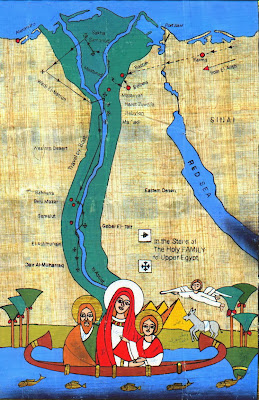 It
seems the Holy Family traveled with a midwife named Salome who isn't
mentioned in the Gospel but plays a role in the Coptic stories. Instead
of heading straight to Egypt to escape the wrath of Herod, they seem to
have zigzagged to the Plain of Jericho, then Ashkelon, then Hebron (at
least according to the various churches and monasteries situated in
those places), then proceeded to enter Egypt via the Land of Goshen, en
route to the town of Bilbays. Along the way they had an encounter with a
dragon in a cave, and were approached by wild lions, but of course
they all bowed down to the Baby Jesus. At Bilbays they rested under a
large tree, which was venerated in the Middle Ages by both Muslims and
Christians as the Virgin's Tree, which stood until 1850. Then they
headed to Samannud, where there is a church on the site of a well
blessed by Jesus. (Early Christian apocryphal infancy Gospels, as well
as the Qur'an, have Jesus talking while still in the cradle.) Then they
detoured northward to the Mediterranean coast at Burollos, stopping
there according to the monks of the place. Then, perhaps at Basus or
Sakha in Gharbiyya (Meinardus speculates on the place), Jesus left his
footprint on a stone.
It
seems the Holy Family traveled with a midwife named Salome who isn't
mentioned in the Gospel but plays a role in the Coptic stories. Instead
of heading straight to Egypt to escape the wrath of Herod, they seem to
have zigzagged to the Plain of Jericho, then Ashkelon, then Hebron (at
least according to the various churches and monasteries situated in
those places), then proceeded to enter Egypt via the Land of Goshen, en
route to the town of Bilbays. Along the way they had an encounter with a
dragon in a cave, and were approached by wild lions, but of course
they all bowed down to the Baby Jesus. At Bilbays they rested under a
large tree, which was venerated in the Middle Ages by both Muslims and
Christians as the Virgin's Tree, which stood until 1850. Then they
headed to Samannud, where there is a church on the site of a well
blessed by Jesus. (Early Christian apocryphal infancy Gospels, as well
as the Qur'an, have Jesus talking while still in the cradle.) Then they
detoured northward to the Mediterranean coast at Burollos, stopping
there according to the monks of the place. Then, perhaps at Basus or
Sakha in Gharbiyya (Meinardus speculates on the place), Jesus left his
footprint on a stone.
Needless to say, they could not ignore the Wadi Natrun, the Coptic version of Mount Athos, where the four great monasteries of the Desert Fathers still stand (but of course didn't then as Christianity hadn't been founded yet), though why they were wandering in the desert instead of the delta in those days isn't explained. Passing by from a distance, Jesus said to his mother, "Know O my Mother, that in this desert there shall live many monks, ascetes and spiritual fighters, and they shall serve God like angels." (Apparently Mary would have known what a "monk" was, though it's hard to know why.) Anyway, you can ask the monks if you doubt any of this.
Even though Cairo wasn't there yet, you know Cairo isn't going to let all these other towns have a claim and not find some of its own, don't you? First they went to On, the ancient Heliopolis, not on the site of the modern suburb of that name but on the site of Matariyya. There Jesus took Joseph's staff, dug a well, and planted the staff, which grew into a tree which became a goal of pilgrimage and was venerated by Muslims as well as Christians. (The Qur'an has a story of Mary resting under a palm tree, and this and the Matariyya tree became conflated in later folklore. The Matariyya tree is a sycamore.) The present tree, still venerated, is alleged to be grown from the shoot of an older tree:
From there, the Holy Family went to a site
where, centuries later, the Harat Zuwaila quarter of Cairo would rise;
the Church of the Virgin there is one of the oldest in Cairo proper, and
the convent has a well blessed by Jesus.
(If you're wondering why I haven't mentioned their stop in the Fortress of Babylon, in a church many tourists visit today, it's because they stopped there only after their tour of Upper Egypt. Trust me, it's coming.)
Next they went to Ma‘adi, today an elite southern suburb of Cairo, and attended a synagogue. Joseph got to know some Nile boatmen, who offered to take them to Upper Egypt. (You're wondering how an exiled carpenter and family fleeing from King Herod can afford all this Grand Tour? Don't be so cynical: the legend has it covered: using the gold, frankincense and myrrh brought by the Magi.)
I'm going to condense a bit here since every Church of St. Mary up the Nile seems to mark a site where the boat stopped and they visited a well or a palm tree. But since Upper Egypt remains one of the more Christian parts of the country, they couldn't skip such Christian centers as Sammalout, Asyut, al-‘Ashnmunein, or the great monastery known as Deir al-Muharraq.
One of the legendary sub-stories here deserves telling, though. Up near al-‘Ashmunein, two brigands who had been pursuing the Holy Family since Matariyya (must be the gold, frankincense and myrrh again) tried to rob them. They grabbed Jesus and Mary cried, and one of the robbers repented, and they left them. And — as any folklorist should have figured out by now — these were the same two thieves, including the same Good Thief, who would be crucified alongside Jesus! How could it be otherwise?
The
constant travels were finally relieved when the Holy Family were taken
in by a devout Jew and lived for six months (and ten days: I told you
the stories are detailed) at the site of the Monastery of Deir al-Muharraq, south
of al-Qusiya. The monks of the monastery say it was the first monastery
in Egypt, built just after the arrival of Saint Mark as the Apostle of
Egypt. If you doubt that, take it up with the monks, not me. Or with the monks at St. Anthony's in the Eastern Desert, which is usually seen as the earliest.)
Then
the angel came to Joseph and told him it was safe to go back to
Palestine. (That part actually is in the Gospel of Matthew, unlike
everything else in this post.) They stopped at pretty much every Coptic
village that would ever have a Church of the Virgin on their way back
down the Nile, and feeling they had not yet done enough for future
Cairo tourism, they stopped inside the Roman fortress known as Babylon
and, perhaps having run out of gold and frankincense, stayed in a cave
that is today the crypt of the church of Saint Sergius (Abu Sarga),
conveniently adjacent to the Coptic Museum and included on many Cairo
tours.
I hope I don't sound too cynical here: the stories are charming and are clearly a pious attempt to elaborate on a brief reference in the Gospel in order to make the Christian link to Egypt more tangible to believers. On the other hand, the sense that every Church of Saint Mary in Egypt actually sheltered the Virgin and Child seems a bit credulous.
I hope my Coptic friends recognize that I am helping spread knowledge of your tradition, even if I may not accept every detail as historically attested. I'd really like to know more about that dragon.

Since we're in between Western Christmas and Eastern Christmas, I thought it might be a useful time to call to your attention the extremely detailed traditions Egypt's Copts maintain about the Holy Family and the Flight into Egypt. There is hardly a Christian church in Egypt — and there are some mosques, too, since Jesus and Mary are highly venerated in Islam — that doesn't claim that Jesus, Mary and Joseph dropped by for a while. They must have been constantly on the move to have covered so much ground, but you can't build up a good pilgrimage trade if you don't stop frequently.
Now, the Flight into Egypt gets only a couple of verses in the Bible and is only mentioned in one Gospel, Matthew, (Matthew 2, 13-14 and 19) so the extremely detailed accounts of the Coptic stories have more to do with pious elaboration — or pilgrimage tourism — than history, but the stories can be quite charming. Some are based on an apocryphal Armenian infancy gospel, some on local traditions, etc. The Coptic traditions hold that the Holy Family spent three years in Egypt.
I am shamelessly cribbing this from Chapter XXXI of the late Otto Meinardus' Christian Egypt Ancient and Modern, (Cairo: AUC Press, 1965; Revised Edition 1977). Meinardus was a major figure in Coptic studies; German-born, he wrote mostly in English or French, taught at the American University in Cairo, and was an ordained Lutheran pastor. (Judge for yourself what Martin Luther would have thought of some of these stories.) He died in 2005. But I have to condense all the details considerably; his chapter runs over 40 pages. There's also a detailed online site, with pictures (text approved personally by Coptic Pope Shenouda, they say), for those interested. And tours are available;this site also offers a travelogue.
 It
seems the Holy Family traveled with a midwife named Salome who isn't
mentioned in the Gospel but plays a role in the Coptic stories. Instead
of heading straight to Egypt to escape the wrath of Herod, they seem to
have zigzagged to the Plain of Jericho, then Ashkelon, then Hebron (at
least according to the various churches and monasteries situated in
those places), then proceeded to enter Egypt via the Land of Goshen, en
route to the town of Bilbays. Along the way they had an encounter with a
dragon in a cave, and were approached by wild lions, but of course
they all bowed down to the Baby Jesus. At Bilbays they rested under a
large tree, which was venerated in the Middle Ages by both Muslims and
Christians as the Virgin's Tree, which stood until 1850. Then they
headed to Samannud, where there is a church on the site of a well
blessed by Jesus. (Early Christian apocryphal infancy Gospels, as well
as the Qur'an, have Jesus talking while still in the cradle.) Then they
detoured northward to the Mediterranean coast at Burollos, stopping
there according to the monks of the place. Then, perhaps at Basus or
Sakha in Gharbiyya (Meinardus speculates on the place), Jesus left his
footprint on a stone.
It
seems the Holy Family traveled with a midwife named Salome who isn't
mentioned in the Gospel but plays a role in the Coptic stories. Instead
of heading straight to Egypt to escape the wrath of Herod, they seem to
have zigzagged to the Plain of Jericho, then Ashkelon, then Hebron (at
least according to the various churches and monasteries situated in
those places), then proceeded to enter Egypt via the Land of Goshen, en
route to the town of Bilbays. Along the way they had an encounter with a
dragon in a cave, and were approached by wild lions, but of course
they all bowed down to the Baby Jesus. At Bilbays they rested under a
large tree, which was venerated in the Middle Ages by both Muslims and
Christians as the Virgin's Tree, which stood until 1850. Then they
headed to Samannud, where there is a church on the site of a well
blessed by Jesus. (Early Christian apocryphal infancy Gospels, as well
as the Qur'an, have Jesus talking while still in the cradle.) Then they
detoured northward to the Mediterranean coast at Burollos, stopping
there according to the monks of the place. Then, perhaps at Basus or
Sakha in Gharbiyya (Meinardus speculates on the place), Jesus left his
footprint on a stone.Needless to say, they could not ignore the Wadi Natrun, the Coptic version of Mount Athos, where the four great monasteries of the Desert Fathers still stand (but of course didn't then as Christianity hadn't been founded yet), though why they were wandering in the desert instead of the delta in those days isn't explained. Passing by from a distance, Jesus said to his mother, "Know O my Mother, that in this desert there shall live many monks, ascetes and spiritual fighters, and they shall serve God like angels." (Apparently Mary would have known what a "monk" was, though it's hard to know why.) Anyway, you can ask the monks if you doubt any of this.
Even though Cairo wasn't there yet, you know Cairo isn't going to let all these other towns have a claim and not find some of its own, don't you? First they went to On, the ancient Heliopolis, not on the site of the modern suburb of that name but on the site of Matariyya. There Jesus took Joseph's staff, dug a well, and planted the staff, which grew into a tree which became a goal of pilgrimage and was venerated by Muslims as well as Christians. (The Qur'an has a story of Mary resting under a palm tree, and this and the Matariyya tree became conflated in later folklore. The Matariyya tree is a sycamore.) The present tree, still venerated, is alleged to be grown from the shoot of an older tree:
 |
| The Virgin's Tree, Matariyya |
 |
| Harat Zuwaila Church of the Virgin |
(If you're wondering why I haven't mentioned their stop in the Fortress of Babylon, in a church many tourists visit today, it's because they stopped there only after their tour of Upper Egypt. Trust me, it's coming.)
Next they went to Ma‘adi, today an elite southern suburb of Cairo, and attended a synagogue. Joseph got to know some Nile boatmen, who offered to take them to Upper Egypt. (You're wondering how an exiled carpenter and family fleeing from King Herod can afford all this Grand Tour? Don't be so cynical: the legend has it covered: using the gold, frankincense and myrrh brought by the Magi.)
I'm going to condense a bit here since every Church of St. Mary up the Nile seems to mark a site where the boat stopped and they visited a well or a palm tree. But since Upper Egypt remains one of the more Christian parts of the country, they couldn't skip such Christian centers as Sammalout, Asyut, al-‘Ashnmunein, or the great monastery known as Deir al-Muharraq.
One of the legendary sub-stories here deserves telling, though. Up near al-‘Ashmunein, two brigands who had been pursuing the Holy Family since Matariyya (must be the gold, frankincense and myrrh again) tried to rob them. They grabbed Jesus and Mary cried, and one of the robbers repented, and they left them. And — as any folklorist should have figured out by now — these were the same two thieves, including the same Good Thief, who would be crucified alongside Jesus! How could it be otherwise?
 |
| Deir al-Muharraq Today |
 |
| Abu Sarga Church Crypt |
I hope I don't sound too cynical here: the stories are charming and are clearly a pious attempt to elaborate on a brief reference in the Gospel in order to make the Christian link to Egypt more tangible to believers. On the other hand, the sense that every Church of Saint Mary in Egypt actually sheltered the Virgin and Child seems a bit credulous.
I hope my Coptic friends recognize that I am helping spread knowledge of your tradition, even if I may not accept every detail as historically attested. I'd really like to know more about that dragon.

A Coptic Christmas Hymn
As promised, we'll be noting many of the traditions of Eastern Christianity as the Eastern date for Christmas approaches next week. A Coptic hymn to the Virgin, E Parthenos:
Egypt Starts the New Year by Launching War on Muppets
Well, not actually Muppets™; the Jim Henson folks weren't involved, but Egypt's defenders of truth, justice and the Egyptian way have uncovered a sinister plot by one of the country's biggest telecom companies to send coded messages to Muslim Brotherhood plotters of terrorist attacks via high-budget, professionally produced television commercials using puppets. I am not making this up. From AP:
Yes, it started with paranoid talk show hosts, but now the Ministry of the Interior is going after the alleged offenders, Vodafone. George Orwell, please call your office.
I've been trying to decide how to comment here. Options:
The Economist notes the issue; (their Pomegranate blogger "M.R." sounds a lot like Max Rodenbeck), and one of the fuller explanations comes from Zeinobia, who also provides us with the offending ad:
Oh. My. God.
Sarah Carr, who has been far too silent of late, nails it as usual:
Ahmed "Spider," a self-styled youth activist known as a strong supporter of ousted President Hosni Mubarak, says code about an upcoming attack is included in the details of the puppet ad.
Fahita and her daughter Karkoura search for her deceased's husband sim card, while explaining to her friend over the phone about another character "Mama Touta." In the background, a radio anchor explains how to make "stuffed turkey" for Christmas while sitting next to a cactus from which ball ornaments were dangling. She says she asked the building guards to get a sniffer dog of a shopping mall to search for missing things and gets money in return.
Spider explained the alleged code on the Al-Tahrir network on Tuesday night: the mall and the dog refer to the planned site of the attack, and "Mama Touta" is the Brotherhood's secret name.
Because television ads by major telecom companies are how terrorist groups communicate secret plans to their plotters."The dog, garage, guard, mall and next to us these are elements tell us that there will be a big mall and an explosion after a dog . fails to find the bomb in a car," Spider said. He said he filed a complaint with Egypt's prosecutor general who referred it to state security prosecutors, who handle terrorism and other political allegations.
Yes, it started with paranoid talk show hosts, but now the Ministry of the Interior is going after the alleged offenders, Vodafone. George Orwell, please call your office.
I've been trying to decide how to comment here. Options:
- Scathing sarcasm skewering the stupidity of it all seems appropriate until you realize the innate menace of delusional paranoia in high places, especially high places with powerful coercive apparatus at their disposal.
- Spewing incoherent rants and extreme profanity: seems personally and emotionally satisfying but contributes little to the debate.
- Finally realizing I love Big Brother and hate puppets as enemies of the state.
- Just taling about it and letting you make up your own mind, but then the puppets might brainwash you!
The Economist notes the issue; (their Pomegranate blogger "M.R." sounds a lot like Max Rodenbeck), and one of the fuller explanations comes from Zeinobia, who also provides us with the offending ad:
Oh. My. God.
Sarah Carr, who has been far too silent of late, nails it as usual:
Sometimes it seems that Egypt does extreme tragedy and extreme comedy and nothing in between. As a result, living in this country is a bit like cohabiting with someone with a hormonal imbalance.
Egypt dazzled the world today with the revelation that a puppet is under criminal investigation. The particulars of this case are too traumatic to recount in detail, and can be read about here, but in summary telecom giant Vodafone is accused of employing a popular puppet, Abla Fahita, to send coded terrorism messages in one of its adverts. As evidence of this the instigator of the case mentions:
1.A cactus tree
2. A christmas bauble
3. Mama Toutou
The instigator concerned is non other than Ahmed ِElsayed AKA Ahmed Zbaydar, apprentice of late night television king and Freemason botherer Tawfik Okasha. Zbaydar is a lisping streak of piss who is no stranger to hair gel and who fancies himself a spy hunter.
He has been wafting about in the public sphere since 2011 when he shot to somewhere roughly 392 kilometres north of fame by appearing with Okasha and dropped earth shattering revelations about Freemasonry. He went on to fight the good fight for his beloved country by defaming opposition activists on his Facebook page. Both he and Okasha really came into their own after June 30 when their dire warnings about the Muslim Brotherhood being a secret Freemason organisation directed by Israel and America merged with popular suspicion of, and discontent with the group. And so they were brought out of the twilight slightly, along with that other grand wizard of bollocks Amr Mostafa, a music composer who also runs a Facebook page where he currently spends most of his time wishing death on members of the Muslim Brotherhood and getting many likes for doing so. His latest coup (insert joke here) was a series of illegally-got recordings of telephone conversations between opposition types in which nothing of any import was said. They were broadcast on a satellite channel with much fanfare.
And so it seems that this grand civilisation of 7,000 years is once again being held hostage by buffoons. Every country has its Glenn Beck type public figures, the difference in Egypt is that they are taken seriously where it suits the political ambitions of those at the reins and serves a useful purpose. Thus we have the Public Prosecutor accepting a complaint about a finger puppet while nobody has been charged for the deaths of nearly 1,000 people at Rab3a, because the current mood is almost fascistic in its reverence for the state and for state hegemony and for state opponents to be eliminated. If there was a page equivalent to We Are All Khaled Said now it would be Turns Out We Are All Adolf Hitler. Comedy and tragedy often overlap.
Tuesday, December 31, 2013
Happy New Year, Dubai Style

Dubai, restrained and self-effacing as ever, modestly decided to mark the new year with a fireworks display that would break all world records. They say they did it:
The show began with a dazzling falcon conjured through pyrotechnics, flying around Palm Jumeirah. Thousands joined the countdown in unison, reflecting an atmosphere that could be seen at big football matches.
It was a huge show and stretched for miles, but most shots are of the Burj Khalifa, the world's tallest building.The show lasted for six minutes, but it took only one minute for the 200 technicians to break the record held by Kuwait as over 100,000 shots were fired in just sixty seconds compared to Kuwait’s record of 77,282.
Overall around 400,000 shots were fired, with the show broadcast live on Dubai TV and Youtube to millions of spectators.
Monday, December 30, 2013
A Note on the Remaining Christmas(es)
If you're thinking Christmas is over, you're obviously steeped in a Eurocentric perspective. Even in the Western tradition, Christmas isn't over. Remember the "Twelve Days of Christmas"? While you already have several partridges in pear trees and are scrambling to find recipes for roast partridge in pear sauce, the maids-a-milking and my personal favorites, the lords-a-leaping, are still in your future, for even in the Western Christian tradition Christmas lasts until the Feast of the Epiphany (in the Eastern tradition. the Theophany), known in older times as Twelfth Night and marking the visit of the Magi and also, in the East. Jesus' baptism by John the Baptist; our Hispanic neighbors call it Three Kings Day. And the day you get those twelve drummers drumming, so it may be hard to sleep.
But Epiphany, January 6 in the Western (Gregorian) calendar, is not the same as the Eastern Churches' date for Christmas, though several centuries the date coincided and many still confuse them. Eastern Christmas (for the Eastern Orthodox ["Chalcedonian"], Oriental Orthodox or Miaphysite ["Jacobite" or "Monophysite"], Church of the East ["Nestorian"] and some Eastern Catholic churches), is also December 25, actually, but in the Julian Calendar, now falling on January 7 of the Western calendar. Most of the names in quotes and brackets are appellations used by those outside the faiths in question, used here for clarity only.
Thus most Easterners will celebrate Christmas on January 7, and Christmas Eve, when most Eastern traditions hold the primary or only Christmas Liturgy, coincides with the night of the Gregorian Epiphany.
Then there are the Armenians, who traditionally celebrate their primary Christmas celebration on the Epiphany. Most Armenians outside the Holy Land celebrate January 6, but most in the Holy Land region do so 12 days after Julian Christmas on Julian January 6 (Julian Theophany) on Gregorian January 19. So folks in Jerusalem and Bethlehem can, if Ecumenically minded, get three celebrations over more than three weeks.
Few do; turf wars often trump ecumenism, as in this clip of a broom fight between Greek and Armenian clergy in the Church of the Nativity in 2011 over who gets to clean the Church:
Ah, the spirit of Christmas. Since Christmas for so many beleaguered Christians in the Middle East is still coming, I'll be posting Christmas music from most of these traditions, especially those facing major challenges in Iraq, Syria, and Egypt, and other reflections on Eastern Christianity from now to January 7.
Those posts will mostly try to stay within the culture and liturgical traditions of those faiths, but the large and increasing diasporas of Middle Eastern Christians mean the ancient Christian East and the modern commercial Christmas West tend to merge in the diasporas. There will be enough bad news ahead, so to start on a lighter note, here's a truly multicultural Armenian Christmas pageant: dancing Santas and female Santas (or elves?), a full nativity scene reenactment, traditional Armenian Christmas music, Western carols in Armenian, Silent Night in Armenian and English, and a ballet dancer. I didn't spot the dancing mice from Nutcracker, but there's so much going on here I may have missed it. Christmas isn't over in the Middle East!
.
But Epiphany, January 6 in the Western (Gregorian) calendar, is not the same as the Eastern Churches' date for Christmas, though several centuries the date coincided and many still confuse them. Eastern Christmas (for the Eastern Orthodox ["Chalcedonian"], Oriental Orthodox or Miaphysite ["Jacobite" or "Monophysite"], Church of the East ["Nestorian"] and some Eastern Catholic churches), is also December 25, actually, but in the Julian Calendar, now falling on January 7 of the Western calendar. Most of the names in quotes and brackets are appellations used by those outside the faiths in question, used here for clarity only.
Thus most Easterners will celebrate Christmas on January 7, and Christmas Eve, when most Eastern traditions hold the primary or only Christmas Liturgy, coincides with the night of the Gregorian Epiphany.
Then there are the Armenians, who traditionally celebrate their primary Christmas celebration on the Epiphany. Most Armenians outside the Holy Land celebrate January 6, but most in the Holy Land region do so 12 days after Julian Christmas on Julian January 6 (Julian Theophany) on Gregorian January 19. So folks in Jerusalem and Bethlehem can, if Ecumenically minded, get three celebrations over more than three weeks.
Few do; turf wars often trump ecumenism, as in this clip of a broom fight between Greek and Armenian clergy in the Church of the Nativity in 2011 over who gets to clean the Church:
Ah, the spirit of Christmas. Since Christmas for so many beleaguered Christians in the Middle East is still coming, I'll be posting Christmas music from most of these traditions, especially those facing major challenges in Iraq, Syria, and Egypt, and other reflections on Eastern Christianity from now to January 7.
Those posts will mostly try to stay within the culture and liturgical traditions of those faiths, but the large and increasing diasporas of Middle Eastern Christians mean the ancient Christian East and the modern commercial Christmas West tend to merge in the diasporas. There will be enough bad news ahead, so to start on a lighter note, here's a truly multicultural Armenian Christmas pageant: dancing Santas and female Santas (or elves?), a full nativity scene reenactment, traditional Armenian Christmas music, Western carols in Armenian, Silent Night in Armenian and English, and a ballet dancer. I didn't spot the dancing mice from Nutcracker, but there's so much going on here I may have missed it. Christmas isn't over in the Middle East!
.
Never Post Your General Sisi Post Early in the Morning ...
...as I did today, because it will surely get worse:
 Egypt's Al-Wafd (not a state-owned paper!) headline today:

2014 Year of Destiny
Egypt Awaits the Word of Al-Sisi
The People Want a Hero in the Ittihadiyya [Presidential] Palace
And the Yearners Await the General's Decision on Presidential Candidacy
Egypt's Deepening Splits as the Year Winds Down
Egypt's year is ending badly; key figures from Al Jazeera English's Cairo Bureau have been arrested for "reporting false news" and meeting with members of the now banned Muslim Brotherhood. And while Al Jazeera's Arabic services have already been suppressed, leftist and secular critics are also under fire, as are Islamic charities. The violence at Al-Azhar and other universities during final exams and the recent wave of bombings is not reassuring to those of us who keep telling ourselves that "Egypt is not Algeria in the 1990s."
 So has everybody associated with Morsi and the Brotherhood been arrested? Well, no, not quite, but you won't see this picture in the state media these days.
The Sisi cult continues to reach levels not seen since the Nasser era, aided and abetted by people who used to be reformers, liberals, and even revolutionaries.
As will be seen in in this, via The Arabist, not a great way to start a week, let alone a new year:

The Sisi cult continues to reach levels not seen since the Nasser era, aided and abetted by people who used to be reformers, liberals, and even revolutionaries.
As will be seen in in this, via The Arabist, not a great way to start a week, let alone a new year:
Saturday, December 28, 2013
Speaking of Fethullah Gülen . . .
Just yesterday I was talking about the feud between Recep Tayyip Erdoğan and Fethullah Gülen; now here's a background piece at The New Republic: "A Guy Who Lives in Pennsylvania May Be Taking Down the Entire Turkish Government."
Friday, December 27, 2013
Remember Aliaa Elmahdy? Apparently Der Spiegel Still Does
Remember Aliaa Elmahdy? In 2011 she was the "naked blogger" who briefly rocked the Middle East and feminism and then was overtaken by more serious events; her daring and courage, while in Egypt, demanded admiration whatever you might think about her judgment. (Early posts here and here.) It once seemed exciting:
 She had put her career and perhaps her life on the line for a cause, and paid the price of voluntary but perhaps wise exile. Exactly a year ago I posted a piece on "Aliaa Elmahdy Revisited: The First Time as Tragedy, the Second as Farce?", after she stripped down in front of the Egyptian Embassy in Stockholm, where the heroism seemed less daring and the exhibitionism more obvious. (None of these links include the photos, but the dirty-minded among you will find links there to the photos.) My comments included:
I thought it was sensationalist and exaggerated, exploitative as well. Apparently I wasn't alone;
 From the Der Spiegel piece:
Now, at least, she says on Facebook that she lives in Gothenburg, which is the second largest city in Sweden, not "a Swedish village that could be reached after driving for an hour through a coniferous forest," and is involved in a relationship with a Norwegian musician, so if she's really deep in hiding she could learn a few things from, say, Ayman al-Zawahiri (and wouldn't you like to imagine that meeting?).
I must give her credit for continuing to make her point, though in a country where her exposing herself poses few risks other than goosebumps; the Spiegel account seems over dramatized to say the least, and her continued self-exposure (which is her right) hardly suggests she is cowering in terror of Islamist assassins; if anything she's flashing her boobs at them in defiance. In fact, she seems hardly to be someone frightened of vengeance, but rather someone who wants to throw down the gauntlet. (Language below NSFW, and my words though she's said similar things): This isn't a scared young girl hiding from Islamists: she may not be in Egypt but she still has an "in-your-face, fuck-you-for-your-fucking hypocrisy, as you gawk and drool over my boobs you fucking hypocrites" message, not that of the terrorized exile the Der Spiegel article implies. (Pardon the language, but that's the message I think, not one of timidity.) A girl on the run from Islamist assassins doesn't strip down publicly in the Stockholm mosque, painting anti-Sharia slogans on her breasts, and give interviews to Der Spiegel. Her denunciations of Islam and all religion put her beyond yet another pale if her sexual views hadn't already done so. She may not be in Egypt but she's not shy about revealing either her opinions or her body. She may or may not be relevant but she hardly seems frightened.
True, it's not as daring sending that message from Sweden, but even if Morsi's gone, she's cut her links to Egypt for a long time. So is she irrelevant now, just an exhibitionist in Sweden where nudity isn't that much of a shock, or still an (exiled) voice in Egyptian affairs? I think Egyptians need to decide that, and many Egyptian women activists see Aliaa as an embarrassment, not a Joan of Arc.
Der Spiegel again:
 She had put her career and perhaps her life on the line for a cause, and paid the price of voluntary but perhaps wise exile. Exactly a year ago I posted a piece on "Aliaa Elmahdy Revisited: The First Time as Tragedy, the Second as Farce?", after she stripped down in front of the Egyptian Embassy in Stockholm, where the heroism seemed less daring and the exhibitionism more obvious. (None of these links include the photos, but the dirty-minded among you will find links there to the photos.) My comments included:
Remember Aliaa Elmahdy? She’s been back in the news again (and back in the nude again) by demonstrating at the Egyptian Embassy in Stockholm . . .
Yes, Stockholm. It just doesn’t seem quite the same. The first time she risked life and limb; this time she mostly seems to have risked frostbite. (It’s December, after all.)
The new photo certainly is not "seductive" either, but it is loud, and it's rife with messages. Messages written on the women's bodies; messages held in front of their privates; and the whole scene is a message. The first photo can be seen, I think, as a personal protest of sorts, though only due to its public posting: her body is her body, no more, no less. But this is a political protest that also attacks religion: in an age when sex is regularly used for advertising, this is advertising a political/religious message using sex. And the female body: Aliaa, in the center, has "Sharia" written across her breasts as if to make sure no one can miss it. (In that respect I suspect she’s quite right. [Link is also NSFW/nudity.] The whole message reads “Sharia is not a Constitution.”) But the message seems different. The first photo seems to say, "This is just me. Make of it what you will, or not." It suggests the body is natural and normal and not shameful. The second says, "my body is a megaphone: read my angry message as you ogle it." Instead of a natural, ordinary thing, her body has become a billboard, a placard. In the first picture she is seemingly simply saying "this is who I am." In this one, her main political message has become, to be a little bit crass about it, “Read my tits.”
. . . Last year she seemed a genuinely transgressive protester, proud of her body but not flaunting it, just displaying it. This year she's a FEMEN exhibitionist, not just denying religion but attacking it. Yes, I and lots of others have reported on her both times. But while I recognize the shock-waves she created last year, I fear her 15 minutes were up some time back.But perhaps not entirely; nearly a year after that last post the German newsweekly Der Spiegel (once the Time of Germany, now, I'm afraid, still the Time of Germany after 40 years of deterioration of both magazines, has published an article called in English, "From Icon to Exile: The Price or a Nude Photo In Egypt."
I thought it was sensationalist and exaggerated, exploitative as well. Apparently I wasn't alone;

When this story is published, Aliaa Elmahdy will have wiped away the traces of her former life and will be living in a location unknown to us. She will continue to flee and fear the day when one of the men from her native Egypt tracks her down and stands in front of her to take her back.
Meanwhile, she maintains an active social media presence, periodically demonstrates herself or with the topless Ukrainian protest group Femen, and doesn't seem intimidated by anybody.
For the last two years, 22-year-old Egyptian Aliaa Magda al-Elmahdy has been a hunted woman because she used the delayed-action shutter release of her digital camera to take a photo of herself, which she then posted online. She is only wearing stockings and shoes in the photo.
Did they try her Facebook page? (Well, yes, they say they did.) Her Twitter account? Her English and Arabic conversations on Ask.fm? Maybe she didn't answer because she thought they'd sensationalize it?...Most recently, she lived in a Swedish village that could be reached after driving for an hour through a coniferous forest. It's a place that rarely sees outsiders. It was difficult to contact Elmahdy. Many people have attempted to write her emails or messages on Facebook. But Elmahdy ignores messages from strangers, because most strangers berate her.
Now, at least, she says on Facebook that she lives in Gothenburg, which is the second largest city in Sweden, not "a Swedish village that could be reached after driving for an hour through a coniferous forest," and is involved in a relationship with a Norwegian musician, so if she's really deep in hiding she could learn a few things from, say, Ayman al-Zawahiri (and wouldn't you like to imagine that meeting?).
After fleeing from Egypt, Elmahdy applied for political asylum in Sweden, where she hardly left her apartment for six months. She kept the curtains drawn, and whenever she heard a loud noise, she was afraid that her pursuers had come to get her. Sitting behind her closed curtains, she wondered what would become of her.
She no longer had a family, was no longer a student, and she had no job or home to return to. She had no friends in Sweden. Her boyfriend, who she sees only occasionally, lives in Norway. Her life is in tatters.But this follows immediately and with no obvious irony:
It would be understandable if Elmahdy were to change her name and try to forget the past. Instead, she decided to do the opposite. She searched for an organization to join and found the group Femen, which originated in Ukraine and fights against religion and for more equality for women. The women of Femen became famous for their topless protests. They are trying to construct icons in series.
Elmahdy joined the Femen women in a topless protest for the rights of homosexuals in Russia. On another occasion, she snuck into a Stockholm mosque disguised in a burqa, undressed and staged a protest against Sharia. Elmahdy had learned that only a small group of people knew about these protests in advance, which made her feel safe from her pursuers . . .Nor has she stopped her public protests:
On a fall day in 2013, Elmahdy made an appearance at a book fair in the Swedish city of Göteborg. Security guards had been hired for protection. There was a panel discussion on a small stage in which four women talked about feminism. The moderator asked whether bare breasts could be hiding the real message. Elmahdy placed her microphone on the table, pulled up her sweater and stood topless in front of the moderator and the audience. The audience members held their smartphones above their heads and snapped her picture. "The body is merely a symbol," Elmahdy said to the moderator.Flashing a book fair press conference does not suggest she's living in terrorized anonymity.
When asked what she achieves with her protests, Elmahdy replies: "People become more courageous and express their feeling. The goal is to break the taboo."
True, it's not as daring sending that message from Sweden, but even if Morsi's gone, she's cut her links to Egypt for a long time. So is she irrelevant now, just an exhibitionist in Sweden where nudity isn't that much of a shock, or still an (exiled) voice in Egyptian affairs? I think Egyptians need to decide that, and many Egyptian women activists see Aliaa as an embarrassment, not a Joan of Arc.
Der Spiegel again:
After the conversation in the café, Elmahdy is standing on the shore of a lake outside the Swedish village. She watches the ducks, and when she discovers a playground, she climbs onto a jungle gym and sits on a swing. The icon of the Arab Spring giggles as she swings back and forth. What was the meaning of her gaze in the photo? "It means that I am not ashamed to be proud to be the woman I am."
From now on, Elmahdy could very well change her address every few months. Fleeing from others threatens to become the focus of her life. But unlike the screaming child on the photo from Vietnam, little of Elmahdy's deed will remain in the world's collective memory. The symbolic power of the image will gradually fade away. The photo hasn't changed anything -- not Islam, not Egypt, not the city of Cairo and not even Elmahdy's parents. Before long, her naked breasts will be nothing more than naked breasts.Except maybe for Der Spiegel, I think that's all they've been for a couple of years now. The original message was sent in 2011 and, as I noted at the time, it was not just her breasts: it was her full frontal nudity that broke all the taboos. And since her breasts are not the only ones on the Internet (or so I'm told), I find the Der Spiegel article sensational. I've seen her breasts; much of the world has seen her breasts, and unless you're blocked by your national carrier, prudish, or can't click a mouse, so have you. Women have mammary glands and nipples, as any art museum will display. What's new here, and why raise fears for a 22-year-old girl who is already in exile and apparently found the article inaccurate? Those who need to hear her message are hearing it; let's the rest of us let it go. Her message is out there.
Is Erdoğan's Invulnerability Unraveling?
Because of the holidays I haven't posted anything about the latest Turkish corruption crisis, which seems a fitting conclusion to a rough year overall for once-untouchable Prime Minister Recep Tayyip Erdoğan. From the demonstrations in Gezi Park through the open feud with his one-time allies in the Fethullah Gülen movement, to this latest corruption scandal resulting in dismissals and cabinet resignations, Erdoğan's seeming political invulnerability (and even the unity of his AKP Party) seem in jeopardy.
Erdoğan has been lashing out at the danger of a "foreign plot" aimed at Turkey (or his grandiose vision of Turkey), blaming his onetime allies in the Gülen Movement (who shared the AKP's emphasis on a greater role for Islam and helped him scale back the Army's power, but have now fallen out with him), and hinting that somehow Israel and the US are linked to Gülen (who lives in self-imposed exile in the US).
For the past decade, Erdoğan has enjoyed a sort of political invulnerability at home and an international reputation for increasing democratic freedoms in Turkey; the latter has been unraveling since Gezi Park, and now even the former could be threatened; there is growing pressure on the media and opposition and Erdoğan's control of his own party seems less certain than before; the liras and stock market are suffering and there is even murmuring about new elections, despite the AKP's overwhelming dominance in the Grand National Assembly.
It may not be the end of the Erdoğan era, but he does seem to be challenged as never before.
Mohamad Chatah
Qifa Nabki remembers Mohamad Chatah, the Lebanese political figure assassinated in Beirut's latest car bombing. To say that the deepening violence in Lebanon is a spillover of the Syrian conflict is trite by now, though of course Lebanon had a long history of assassinations dating back to the civil war era. Since Chatah was a close ally of the Hariri family, Hizbullah and the Syrian regime would appear to be the prime suspects.
Thursday, December 26, 2013
Business as Usual in Our Region
Now that Christmas (at least the Western one) is past, I hope everyone enjoyed their holiday as you try to figure out what to do with all those partridges and lords-a-leaping and other gifts, but I fear the Middle East does not spend very long focused on peace on earth,
Egypt has, of course, banned the Muslim Brotherhood as a terrorist organization in the wake of the bombing of theReichstag Security HQ in Mansura, even though credit for that attack was claimed by the Jihadi Ansar Bayt al-Maqdis, and the referendum on the new constitution is being pushed as a test of loyalty; in Iraq, Christmas saw multiple attacks on churches; and South Sudan is coming apart.
Back to business as usual.
Egypt has, of course, banned the Muslim Brotherhood as a terrorist organization in the wake of the bombing of the
Back to business as usual.
Tuesday, December 24, 2013
A Better Turnout in Bethlehem?
For those readers who celebrate Christmas on the Western or Latin date, Merry Christmas! Since most of the Middle East's Christians celebrate on the Orthodox date, Christmas-related posts will continue into January, but for those of you on the Gregorian calendar, Christmas greetings.
A number of reports suggest a larger Christmas Eve turnout for Bethlehem than in some recent years, which is good news for the town. Since the bulk of the pilgrims come from Jerusalem they, plus the Latin Patriarch and his procession, have to pass through a checkpoint in the Israeli separation wall, leading to lots of dramatic pictures, since the barrier between Jerusalem and the Bethlehem and Bait Jala areas is marked by some of the most formidable parts of the wall and watchtowers, leading to plenty of commentaries along these lines:

As Robert Frost put it, "Something there is that Doesn't Love a Wall ..."; but while I find the barrier deeply disturbing, I should note that Bethlehem is not actually walled in, just walled off from Jerusalem and Israeli settlements nearby:

On the other hand, the separation barrier has some strange routing, such as running down both sides of a road and then enclosing Rachel's Tomb, a Jewish holy site on the northern edge of Bethlehem, as shown in this Google Earth shot from a few years ago:

A number of reports suggest a larger Christmas Eve turnout for Bethlehem than in some recent years, which is good news for the town. Since the bulk of the pilgrims come from Jerusalem they, plus the Latin Patriarch and his procession, have to pass through a checkpoint in the Israeli separation wall, leading to lots of dramatic pictures, since the barrier between Jerusalem and the Bethlehem and Bait Jala areas is marked by some of the most formidable parts of the wall and watchtowers, leading to plenty of commentaries along these lines:

As Robert Frost put it, "Something there is that Doesn't Love a Wall ..."; but while I find the barrier deeply disturbing, I should note that Bethlehem is not actually walled in, just walled off from Jerusalem and Israeli settlements nearby:

On the other hand, the separation barrier has some strange routing, such as running down both sides of a road and then enclosing Rachel's Tomb, a Jewish holy site on the northern edge of Bethlehem, as shown in this Google Earth shot from a few years ago:

Monday, December 23, 2013
Mikhail Kalashnikov has Died; His Creation Survives Him

His most famous creation lives on, The Avtomat Kalashnikova 1947 (more commonly, the AK-47) and its variants, the AK-74, AKM, and the like, have sold in the hundreds of millions; variants and clones are produced in many countries (Egypt, Iraq, Iran and Pakistan among them) or copied (Israel's Galil is an unofficial derivative). It is by far the most widely-used weapon in the world.


More Fairuz for the Holidays
An Arabic version of "Go Tell it on the Mountain":
And of "God Rest Ye Merry Gentlmen":
And of "God Rest Ye Merry Gentlmen":
A Christmas Rerun: Why Do Western Christians So Often Forget Eastern Christianity?
The Middle East Institute will be closed through January 1, but this blog will not. I'll be posting both original posts and a few seasonal reruns from nearly five years of blogging; this month and next will mark my fifth Christmases (Western and Eastern dates) on the blog. Here's a rerun from last year on the tendency of many Western Christians to forget (or never have known) the traditions of the East, though the earliest Christians (including the Jesus, the 12 Apostles, and Paul) came from Palestine, the term "Christian" was first used in Antioch, and even Saint Nicholas was an Anatolian bishop. I have left in dated references to the 2012 elections of the new Coptic Pope and Antiochian Orthodox Patriarch.
In a year [2012] in which both the Coptic Pope and the Greek Orthodox Patriarch of Antioch have died, it may be useful to repeat a story I know I've told before. I once had a friend, a devout Palestinian Christian, who back in the day would encounter, in various American Christian communities in which he moved, well-meaning ladies and gentlemen who, on learning he was a Christian Arab, would naively ask, "which missionary group converted your people?" He would respond (knowing his sense of timing, I presume after waiting a couple of beats): "Perhaps you've heard of them: Jesus Christ and the Twelve Apostles."
Over the next week or so most US news organizations will have at least one clip from a city in the West Bank known as Bethlehem. They will show the Church of the Nativity, interview a few olive-wood souvenir sellers about the decline in the tourist trade due to the stalled peace process, and, because it is almost impossible to show pictures of Bethlehem without it, show how the Israeli Separation Wall cuts along the side of town. It will be the only report from Bethlehem you see until next December. There are fairly good odds it will also be the only picture of the Separation Wall you see until next December.
If it had not been for the election of the Coptic Pope, which got some limited coverage, it might be the only Western media coverage all year of Christianity in the region where the faith began.
If the Gospels are to be believed, the central figure
of the Christian faith was born in Bethlehem, spent some time in
infancy in Egypt whither his parents had fled (for three years in the
Coptic tradition, which provides a detailed if apocryphal itinerary),
was raised in Nazareth in Galilee, now northern Israel, and ventured no
further afield than across the Jordan, north to Tyre and Sidon, and
into what are now the Golan Heights. Saul of Tarsus became Paul after a
vision on the road to Damascus. Christian apostles and early
missionaries spread the faith further, and Christ's followers were first
called "Christians" in Antioch (Antakya, Turkey), while Alexandria,
Edessa (Şanlıurfa, Turkey) and other cities of the east were citadels of
the early faith. The first ruler to become a Christian may have been in
Edessa but the first major Kingdom to officially become Christian was
Armenia, which preceded Rome. Within a few centuries the Roman Empire
had converted, but so had Ethiopia, and Christian missionaries had
reached Xi'an, the capital of the Chinese Empire, and left an inscription
there in Syriac. (But they were "Nestorians," and so forgotten by
Western Christians.) Of the five ancient patriarchates (Rome,
Constantinople, Antioch, Alexandria, and Jerusalem), only one was in the
West.
Saint Nicholas of Myra (shown above) reportedly gave secret gifts to needy Christians, including dowries. He is also said to have slapped Arius, leader of the Arian heresy, at the Council lf Nicaea. (Coal in Arius' stocking? [Rephrased from earlier reference to whipping pagans, That may be untrue, Not taking any chances so close to Christmas.] It's a fair bet he never heard of a reindeer. But he lived in what is now Turkey.
In 400 AD Christianity was not only the dominant faith in the Roman Empire (including southern Europe, North Africa, and the whole Middle East), as well as Armenia and Ethiopia, but had many adherents in the Persian Empire, Central Asia, coastal India and China. There were almost certainly more Christians in Arabia than in England. [Sorry, I meant Britain. No Angles there yet.]
All that changed with the rise of Islam, but Islam was mostly (with massive and tragic exceptional interludes) tolerant of Christianity as a fellow "people of the book." Though tolerated in most of the Islamic world, Christianity was not permitted in Arabia proper, but survived and sometimes flourished elsewhere. (Its disappearance in North Africa while thriving in Islamic Spain and Sicily is a subject for a much longer discussion at a later time.)
Yet many Western Christians still mentally divide the Christian world into Catholic and Protestant. There may be a general understanding that the Eastern Orthodox exist (at least the Greeks and Russians anyway, who are in Europe); some Latin Catholics (but by no means all) may know the Eastern Catholic churches with their different rites and married priests at least exist, but Oriental Orthodox churches like the Copts or Armenians or the separate traditions of the Assyrian Church of the East remain largely unknown. Readers who've read me through previous Christmas seasons will be aware that I try to illuminate the traditions of the Christians who live in the region where Christmas began. I'll be doing so again, through both Western and Eastern holidays.
In a year [2012] in which both the Coptic Pope and the Greek Orthodox Patriarch of Antioch have died, it may be useful to repeat a story I know I've told before. I once had a friend, a devout Palestinian Christian, who back in the day would encounter, in various American Christian communities in which he moved, well-meaning ladies and gentlemen who, on learning he was a Christian Arab, would naively ask, "which missionary group converted your people?" He would respond (knowing his sense of timing, I presume after waiting a couple of beats): "Perhaps you've heard of them: Jesus Christ and the Twelve Apostles."
Over the next week or so most US news organizations will have at least one clip from a city in the West Bank known as Bethlehem. They will show the Church of the Nativity, interview a few olive-wood souvenir sellers about the decline in the tourist trade due to the stalled peace process, and, because it is almost impossible to show pictures of Bethlehem without it, show how the Israeli Separation Wall cuts along the side of town. It will be the only report from Bethlehem you see until next December. There are fairly good odds it will also be the only picture of the Separation Wall you see until next December.
If it had not been for the election of the Coptic Pope, which got some limited coverage, it might be the only Western media coverage all year of Christianity in the region where the faith began.
 |
| The Real Saint Nick was Known to slap Heretics: Ho, ho, ho! |
Saint Nicholas of Myra (shown above) reportedly gave secret gifts to needy Christians, including dowries. He is also said to have slapped Arius, leader of the Arian heresy, at the Council lf Nicaea. (Coal in Arius' stocking? [Rephrased from earlier reference to whipping pagans, That may be untrue, Not taking any chances so close to Christmas.] It's a fair bet he never heard of a reindeer. But he lived in what is now Turkey.
In 400 AD Christianity was not only the dominant faith in the Roman Empire (including southern Europe, North Africa, and the whole Middle East), as well as Armenia and Ethiopia, but had many adherents in the Persian Empire, Central Asia, coastal India and China. There were almost certainly more Christians in Arabia than in England. [Sorry, I meant Britain. No Angles there yet.]
All that changed with the rise of Islam, but Islam was mostly (with massive and tragic exceptional interludes) tolerant of Christianity as a fellow "people of the book." Though tolerated in most of the Islamic world, Christianity was not permitted in Arabia proper, but survived and sometimes flourished elsewhere. (Its disappearance in North Africa while thriving in Islamic Spain and Sicily is a subject for a much longer discussion at a later time.)
Yet many Western Christians still mentally divide the Christian world into Catholic and Protestant. There may be a general understanding that the Eastern Orthodox exist (at least the Greeks and Russians anyway, who are in Europe); some Latin Catholics (but by no means all) may know the Eastern Catholic churches with their different rites and married priests at least exist, but Oriental Orthodox churches like the Copts or Armenians or the separate traditions of the Assyrian Church of the East remain largely unknown. Readers who've read me through previous Christmas seasons will be aware that I try to illuminate the traditions of the Christians who live in the region where Christmas began. I'll be doing so again, through both Western and Eastern holidays.
Friday, December 20, 2013
Yalda and the Winter Solstice
 Most everyone who has had any exposure to Iranian, Kurdish, Turkish, and Central Asian cultures or to adherents of the Zoroastrian and Baha'i faiths knows about Nowruz/New Year's/the Spring Equinox in March. Those outside the Irano-Persian cultural sphere may be less familiar with the Winter Solstice festival. As I noted last year,
For Iranan readers, the Iranian Diaspora and those from countries whose cultural traditions derive from Iran (in Central Asia and the Caucasus), greetings for Yalda, or Shab-e Yalda (شب یلدا, Yalda Night) the ancient Iranian celebration of the Winter Solstice. Originally marking the Birth of Mithra (that is, the annual "rebirth" of the sun at the solstice), it survives, like Nowruz in the spring, as a seasonal celebration of winter, marked by pomegranates, watermelon, and other traditional foods.I ended last year's post with "Take that, Mayans." (Some of you may have already forgotten that the Mayan Calendar, and the world with it, ended a year ago, although personally I hardly noticed.)
Saturday is the solstice, so Yalda greetings to those who mark it.
The Wikipedia article offers the following:
Yalda (Persian: یلدا), Shab-e Yalda (Persian: شب یلدا), "Night of Birth", or Zayeshmehr (Persian: زایش مهر) "Birth of Mithra", or Shab-e Chelleh (Persian: شب چلّه, Azerbaijani: چیلله گئجهسی; lit. "Night of Forty") is the Persian winter solstice celebration which has been popular since ancient times. Yalda is celebrated on the Northern Hemisphere's longest night of the year, that is, on the eve of the Winter Solstice. Depending on the shift of the calendar, Yalda is celebrated on or around December 20 or 21 each year.
Yalda has a history as long as the religion of Mithraism. The Mithraists believed that this night is the night of the birth of Mithra, Persian angel of light and truth. At the morning of the longest night of the year the Mithra was born.
Following the fall of the Sassanid Empire and the subsequent rise of Islam in Persia/Iran, the religious significance of the event was lost, and like other Zoroastrian festivals, Yalda became a social occasion when family and close friends would get together. Nonetheless, the obligatory serving of fresh fruit during mid-winter is reminiscent of the ancient customs of invoking the divinities to request protection of the winter crop.I think that may be a little confused since Zoroastrianism is much older than Mithraism, and the feast relates to both faiths.
The traditional fruits:


Thursday, December 19, 2013
The Armenian Churches of India
The Armenian Diaspora is broad and in some cases quite ancient, but were you aware of the network of Armenian churches in India? I certainly wasn't. From the website of the Armenian College and Philanthropic Academy in Kolkata (ex-Calcutta). They do get around. I'm not sure now where I got this link (though probably via an Armenian friend on social media somewhere), but thanks, and in time for Christmas.
From the site:

From the site:

1707
ARMENIAN HOLY CHURCH OF NAZARETH, KOLKATA
2 Armenian Street, Kolkata – 700 001, WB, India
Among all the Armenian Apostolic churches in India, The Armenian Holy
Church of Nazareth, the oldest Armenian church in Kolkata, plays a
unique and important role as it is considered to be the Mother Church of
the Indian Armenians. St. John’s Church, the first Armenian church was
built by the contribution of the people, on June 22, 1688. But,
unfortunately, being a wooden structure, the church was completely
destroyed by a devastating fire in 1707. Seventeen years later, in 1724,
The Holy Church of Nazareth was built on the old burial ground of the
Armenian community by Agha Nazar, hence its name, Nazareth’s church. The
architect was an Armenian from Iran named Mr. Levon Ghevond. The belfry
and the steeple were added ten years later in 1734 by Mr. Manuel
Hazarmall. In 1763 the church was repaired and renovated by Khojah
Petros Arratoon, who also embellished the church and built two altars,
one on the right hand side of the main altar, in memory of his brother
Gorgin Khan, the Minister and Commander-in-Chief of Nawab Mir Kasim of
Bengal (1760-1763) and the other on the left hand side, in his own
memory. Khojah Petros Arratoon was called “the earthly god of the
Armenians in Calcutta” by Joseph Emin. In 1789, Agha Catchik Arakiel
presented an English clock to the church which he had ordered from the
firm of Alexander Hare of London. The clock arrived in Kolkata in 1792
and was fixed in the clock tower, but Arakiel, who built the surrounding
walls and added the houses for the clergy, did not live to see it as he
passed away on July 25, 1790. A special feature of the churchyard is the
tomb of Rezabeebeh, the wife of the late Sookias. This tomb, dated July
21, 1630 is said to be the earliest Christian tomb in Kolkata.
Three Takes on Syria and its Regional Repercussions
The recent snows made a bad situation so much worse for the roughly one-third of Syrians who are now refugees that I find it hard to bring myself to write about it, so I'll let some people who know the country better than I do, anyway, pick up the slack:
- Marc Lynch and POMEPS on "The Political Science of Syria's War." Lynch on the project here; POMEPS main page here; a .pdf of the multiple papers in the project published as a POMEPS Brief here.
- Joshua Landis has a guest post on Elias Muhanna's Qifa Nabki blog: "The Great Sorting Out: Ethnicity and the Future of the Levant," Elias has some rebuttal, and both comments grew out of an earlier post around a PBS discussion by Josh and Murhaf Jouejati on "Syria and the Lessons of Iraq." And if you're at all interested in Syria and/or Lebanon you need to be reading Josh Landuis' Syria Comment and Elias' Qifa Nabki regularly, anyway.
- Finally take a look at Jeffrey White, a military analyst at WINEP, on "The Syrian Regime's Military Solution to the War." As grim and depressing as it sounds from an ex-DIA analyst who used to think the rebels had the upper hand.
Janet L. Abu-Lughod, 1928-2013
It has been announced that Janet Lippman Abu-Lughod died December 7. Though she wrote widely on an amazing variety of subjects, students of Cairo and of Egypt will always remember her for her magisterial Cairo: 1001 Years of the City Victorious (Princeton, 1971), which I discussed in my 2011 post on essential readings on Cairo. It was and is an essential study down to 1970, and should be read with David Sims' 2010 Understanding Cairo: The Logic of a City Out of Control, for which Abu-Lughod wrote the Foreword and which continues the narrative. Her 1981 study Rabat: Urban Apartheid in Morocco dealt with the Moroccan capital, and her 1991 Before European Hegemony: The World System A.D. 1250-1350 rounded out her studies of Middle East interest; she also studied several American cities. Her teaching career was spent at Northwestern and later at the New School of Social Research. A New School colleague remembers her here.
She was married for 40 years to the late Palestinian academic Ibrahim Abu-Lughod; one of their four children is the Columbia anthropologist Lila Abu-Lughod.
She was married for 40 years to the late Palestinian academic Ibrahim Abu-Lughod; one of their four children is the Columbia anthropologist Lila Abu-Lughod.
Wednesday, December 18, 2013
Three Years Since Mohamed Bouazizi Set Himself on Fire
 |
| Mohamed Bouazizi |
Three years later, Tunisia is still struggling to make democracy work. Egypt is still; trying to write a constitution. Libya is in disarray and Syria destroyed. The monarchies, except Bahrain, remain largely unscathed.
The Arab World has surely changed, but the course is far more muddled than it once seemed.
Another Fairuz Christmas Song
More for the season: a clip of a young Fairuz singing Silent Night in Arabic:
Subscribe to:
Posts (Atom)


 Posts
Posts


