A Blog by the Editor of The Middle East Journal

Putting Middle Eastern Events in Cultural and Historical Context

Tuesday, April 14, 2015

On This 150th Anniverary of Lincoln's Assassination, Did You Know One Accused Conspirator was Arrested After Fleeing to Egypt?

John H. Surratt, Jr.
One hundred and fifty years ago tonight, John Wilkes Booth shot Abraham Lincoln at Ford's theater, while one of Booth's co-conspirators stabbed Secretary of State William H. Seward while another assigned to kill Vice President Andrew Johnson lost his nerve.

A massive manhunt for Booth and the other conspirators followed, and a vast literature about the plotters and their trials has been amassed over a century and a half.

Most people know that Booth died in a burning barn and that four of the conspirators were hanged, including a woman, Mary Surratt.  But this isn't a US history blog, so now let's get to the Middle East connection. The last of the accused conspirators, John Harrison Surratt, Jr., son of Mary Surratt, had fled the United States and evaded arrest until November 1866, when he was arrested by US authorities in Alexandria, Egypt,

Though Egypt's connection was largely accidental, it's a tale worth telling.  The Surratts were Confederate sympathizers, and Mrs. Surratt ran a boarding house on H Street in Washington and also owned a tavern at Surrattsville (now Clinton) in southern Maryland. Both buildings are still there; the much remodeled H Street house is now a Chinese restaurant and karaoke place in Washington's small Chinatown, while the old tavern is now the Surratt House Museum.

Southern Maryland was the slaveholding part of the state and had many Confederate sympathizers; it was a favored route for Confederate intelligence to pass messages into rebel Virginia just across he Potomac. John H, Surratt was one such courier, and had carried messages to Virginia and also had links to the Confederate Secret Service's spy network based in Canada. He was young; he turned 21 on April 13, 1865, the day before the assassination.

In March he had joined John Wilkes Booth in a plot to kidnap President Lincoln and trade him for Confederate POWs, but that plot failed. Surratt always claimed he had no knowledge that Booth had decided to kill rather than kidnap,

Surratt was in Elmira, New York on the day of the assassination, returning from a courier mission to Canada, and immediately on hearing the news he proceeded to return to Montreal, reaching Canada before the Federal manhunt knew where he was (they thought he was around Washington.)

Surratt as a Papal Zouave
In Montreal he relied, apparently, on the Confederate Secret Service and also on sanctuary from a Catholic priest. (The Surratts were Catholic and John had once studied for the priesthood.) After Mary Surratt was hanged, ex-Confederate agents smuggled him out of Canada using a pseudonym and he sailed to Liverpool, eventually reaching the Papal States (still separate from Italy until 1870), where he became a member of the Pontifical Zouaves under the pseudonym John Watson.

An old friend recognized him and the Papal authorities arrested him. But before he could be turned over to the US authorities in Rome he escaped, allegedly by jumping from a precipice, but with many believing friendly papal guards let it happen. He crossed into the Kingdom of Italy and made his way to Naples. The US Minister to the Papal States, Rufus King, advised the US consul in Naples Frank Swan, to be on the lookout. On November 19, 1866, it was learned that Surratt had sailed from Naples the evening before, on a British ship, RMS Tripoli, bound for Alexandria with a coaling stop at Malta.

The US representatives were keeping the undersea cables busy, now entreating the British to arrest him at Malta. But the British Agent at Malta informed the American representative that he needed more evidence and that vague claims of conspiracy were insufficient to arrest an American. Besides, he had boarded the ship and found no "Walters or Watson" aboard and the only Zouave was a "John Agostini from Candia." Candia is in Crete (the Italian name for Heraklion); Surratt had been posing as a Canadian. The  typo, if that's what it was, further delayed things but John Agostini was indeed Surratt's new alias. The Tripoli proceeded on to Alexandria.

US Consul-General Hale
A temporary break in the undersea cable between Malta and Alexandria also delayed communication, but when Surratt arrived in Alexandria on November 23, he and the other passengers were required to undergo a six-day quarantine. While there, he was visited by the US Consul-General in Egypt, Charles Hale, and admitted that he was an American.

The frustrations of Rome, Naples and Malta did not apply once Surratt acknowledged he was a US citizen. (Had he continued to claim to be Canadian, that might have complicated matters)

But this was the era if the Capitulations, prior to the 1875 founding of the Mixed Courts of Egypt, and the US Consul-General had absolute authority to arrest American citizens. Surratt was duly arrested. He remained in consular  custody until the US Navy's USS Swatara transported him to Washington in early 1867,

After so long a manhunt, several things had changed. In 1866 the US Supreme Court had ruled, in Ex Parte Milligan, that it was unconstitutional to try civilians before  a Military Tribunal if the civil courts were operating, so unlike his mother and the other conspirators, he could not be tried by a military court. And in the intervening years, many of the charges leveled at the others had seen their statute of limitations expire. The one charge that could be brought was the murder of Lincoln, and while Surratt admitted to the kidnapping plot, he denied knowing of the plan to kill, and was far from Washington on April 14, 1865.

After a two month trial, the result was a hung jury, splitting eight to four for acquittal. The government decided not to seek a new trial. You can find the trial transcript at Google Books.

He then planned a lecture tour, giving a first lecture at Rockville, Maryland in December 1870. You can read it here.

Surratt in Old Age
After similar lectures in New York and Baltimore, he canceled one planned for DC after protests. He lived quietly, teaching at a Catholic school, farming tobacco, and married, raised seven children, and worked for a steamship line in Baltimore. He died at age 72 in 1916, and is buried in Baltimore.

The Battle of Shaiba, Iraq, April 12-14, 1915

As we move through April, we'll be marking several centennials of developments in the Middle East in World War I during April 1915, including the beginnings of the Armenian tragedy and the landings at Gallipoli. April 12-14 marks the Battle of Shaiba in southern Iraq, a British victory which led to a Turkish withdrawal from the Basra front and an end to the last effort to retake Basra. But it also led to a British decision (unwise, as it would prove at Kut to advance deep into Iraq in the direction of Baghdad.
Gen. Sir Arthur Barrett
Last November I discussed the operations leading to the Basra campaign and the fall of Basra itself, but haven't returned to the Mesopotamian theater of operations since. In December the British had taken Qurna, and settled in, their primary mission having been to protect the refineries at Abadan and the port of Basra. At Qurna, they captured the local Ottoman commander, Subhi Bey.

Süleyman Askeri Bey (Turkish Wikipedia)
On January 2, Ottoman War Minister Enver Pasha named a new area commander in  southern Iraq, Süleyman Askeri Bey, a colonel with ties to the Young Turks, himself the son of a general, born in Kosovo, he had served against the Italians in Libya. The main Ottoman headquarters under Khalil Pasha was far away in Baghdad.

The overall commander of British forces in the area was General Sir John Barrett with the 6th Poona Division.

Süleyman Askeri decided to attempt to retake Basra by an end run to the west, through a British position at Shaiba fort, where about 7,000 men under Brigadier General C.I. Fry with the 18th Indian Infantry Brigade was stationed.

Shaiba Fort and British Camp, 1915
The British were encamped with about 7,000 Indian Army troops around the old fort. But spring floods in the lowlands had flooded much of the ground between Basra and Shaiba, making communications difficult, The Ottoman force gambled that this would work to their advantage. But the British camp was surrounded by barbed wire, and while Süleyman Askeri nominally had some 18,000 men, only 4,000 were Ottoman regulars, including the elite Constantinople Fire Brigade Regiment; the remainder were Arab irregulars, mainly local tribesmen.

Mesopotamia 1915 (West Point)
The idea of striking the British from the flank might have made sense if he had a stronger, more professional force, but the Ottoman troops in southern Iraq were dispersed, with some holding the Qurna front and others trying to cut through Iranian territory towards Abadan.

Once it became obvious that there was a threat to Shaiba, the second in command of the 6th Poona Division, Major General Charles Melliss was sent to reinforce Fry at Shaiba. Defeated by the flooded ground, he returned to Basra and eventually reached Shaiba by boat. Melliss was the ranking officer on the scene and took command,

Gen. Fry and Staff
The Ottoman attack began with an assault on the camp on April 12, but after considerable fighting failed. On the 13th the Ottoman forces pulled back to the cover of a nearby wood, but sought to use their Arab irregulars to bypass Shaiba. Melliss, by now on the scene, sent the 7th Hariana Lancers out, but the cavalry unit was badly beaten by the irregulars;  and the 104th Wellesley's Rifles did little better.
Gen Charles Melliss
But the tide turned when Melliss ordered the 2nd Dorsetshire Regiment and the 24th Punjabi Regiment against the Arab irregulars. this time they captured 400 and dispersed the rest. The Arab irregulars faded away.

That left the Ottoman regular forces. On the morning of the 14th it was discovered they had withdrawn to the nearby Barjisiyya woods. Fighting lasted from midmorning until 5 pm. As things seemed desperate and the British artillery was running out of shells, the 2nd Dorsets lunched a bayonet charge and carried the Turkish position. The Ottomans retreated upriver, never to threaten Basra again.

But the British learned the wrong lesson. Convinced the Turks were poorly organized, they decided to advance up the rivers and try to take Baghdad. General Sir John Nixon  took command of a reinforced force in Mesopotamia, and General Sir Arthur Barrett yielded command of the 6th (Poona) Division to General Charles Vere Townshend, who would soon make a name for himself. Unfortunately that name would be Townshend of Kut the man who surrendered more British Empire troops than anyone else up to that time.

A couple of key links:

There's a great collection of photos from Shaiba at this site honoring the Indian Army.

The Indian Army report can be found as"Report on the Operations in the Vicinity of Shaiba 12th-14th April 1915. Simla: General Staff India, 1915," at the  Qatar Digital Archive. The detailed maps unfortunately do not reproduce well,

Monday, April 13, 2015

At Jadaliyya: "Cairo: The Myth of a City on the Edge of Explosion."

Since Egypt announced its ambitious project for a new administrative capital  in the desert I've posted links to several articles arguing the pros and cons, here and here.


Now comes a thoughtful piece not so much aimed at the capital project as at the whole concept of satellite cities and the flight to the desert. It's worth a read:  Jon Argaman at Jadaliyya, "Cairo: The Myth of a City on the Edge of Explosion."

Today is Sham al-Nassim

Today is Sham al-Nassim, the ancient Egyptian spring holiday celebrated on the Monday following Coptic Easter Sunday. It is not a Christian holiday; its origins are said to be with the Ancient Egyptian Shemu or spring holiday, later in the Christian period localized around Easter; Muslims celebrate equally with Christians and, until their exodus in the Nasser era, Egyptian Jews also participated. Like Nowruz in the Irano-Turkic worlds, it's an opportunity to cerebrate the arrival of spring.

It's usually said that only two Egyptian holidays date back to the days of the pharaohs:  Sham al-Nassim and Wafa' al-Nil in mid-August, which marks the Nile flood (though the Aswan High Dam ended the annual inundation in the 1960s.) Both, like so much of Egyptian history, center on the Nile. On Sham al-Nassim Egyptians picnic on the river, stroll in parks, gardens, or the zoo, and eat seasonal foods: a dried salty fish called fassikh, green onions, lettuce, tirmis (lupinis), and (a borrowing from Easter? Or vice-versa?) they dye colored eggs. (See the photos below.) Even the foods may be ancient. Supposedly Plutarch somewhere wrote that the Ancient Egyptians had a spring holiday involving dried fish, lettuce, and onions, but I've never found a citation to confirm that story, beloved of Egyptian websites, even government ones.

Sham al-Nissim delicacies (Al Kahira-Cairo-LeCaire)
Even the name is interesting. In Arabic sham al-nassim means "smelling the breezes," a delightful description of a spring day on the river. But if it is truly a descendant of Shemu, that Ancient Egyptian word meant "harvest." In Ancient Egypt, the harvest was not in the fall as in most agricultural societies; it was in spring and summer, before the Nile rises in August. Shemu is presumably the origin of the Coptic word for "summer," Shom, and despite the appropriate "smelling the breezes" meaning in Arabic, likely the origin of the Sham part of Sham al-Nassim. This should of course in no way deter anyone from using the day to smell the breezes.

Friday, April 10, 2015

Tin Hinan, Legendary Ancestress-Queen of the Tuareg, and Her Tomb, and Women Leaders in Amazigh History

Hocine Ziyani, La reine Tin Hinan, (Wikimedia)
Let's do a cultural post far from any of the current (and slowly merging into each other) wars. (And a hat tip to Diana Buja for calling this to my attention.) A post at the Ancient Origins website discusses "The Monumental Tomb of Queen Tin Hinan, Ancient Ancestress of the Tuaregs."

Besides being an interesting story in its own right, it gives me a chance to talk about the prominent role women leaders have played in the history of North Africa's Amazigh ("Berber") people.

In 1925 a monumental tomb was excavated in Abalessa in southern Algeria near Tamanrasset in the mountain region known as Hoggar (Arabic) of Ahaggar (Berber/Tamazight/Tamasheq) by archaeologist Byron Khun de Prorok. It contained the remains of a woman buried with fine jewelry, and inside an elaborate structure that may have been a Roman frontier fort. Coins and later carbon dating suggest a 4th or 5th century AD date.

The Tuareg, the nomadic Saharan Amazigh people who live in southern Algeria and Libya, Niger, Mali, Burkina Faso and some neighboring countries, consider this the tomb of their legendary Queen Tin Hinan, who is considered the ancestress of the Tuareg people and the ruler of the Hoggar region. In Tuareg tradition, the monumental tomb is that of Tin Hinan, or T'in Hinan, ancestress and Queen of the Tuareg people. Tin Hinan literally means "she of the tents," or "she of the camp," and she is also known as Tamenukalt,  or "Queen."

Some of the traditions relating to Tin Hinan, such as those which make her Muslim, are unhistorical if the identification of the tomb (4th-5th centuries AD) is accurate. In Tuareg tradition she is said to have come from Tafilalt in the Atlas to the Ahaggar, along with a servant, Takamat. Tin Hinan was held to be the ancestress of the Tuareg nobility, and Takamat of the commoners.

There is no certainty, other than popular identification, that the monumental tomb is really that of Tin Hinan or even that Tin Hinan is a historical figure, and some have even suggested the skeleton may be male. But there is an interesting coincidence. The skeleton found in the tomb, now in the museum in Algiers, shows a deformity that may  indicate that the  woman in question was lame. Now, in Ibn Khaldun's universal history Kitab al-‘Ibar, the most famous parts of which (after its "Introduction," the famous Muqaddima) are the sections on Berber genealogies and history, translated into French by de Slane as Histoire des Berbères, Ibn Khaldun says that the Huwwara, Lamta, Sanhaja and other Berber tribes all claim descent from a single woman, a queen he calls "Tiski the Lame." Many students of the Hoggar region, including Charles de Foucauld, the famous missionary at Tamanrasset who studied the languages and traditions, have assumed or argued that Tiski may be identical with Tin Hinan (which is a title, not a personal name). And Ibn Khaldun says the place name Hoggar derives from Huwwara.

Clearly, a monumental female tomb adorned with jewelry suggests a powerful queen, The Tuareg traditions of Tin Hinan and Ibn Khaldun's tale of Tiski the Lame both speak of an ancestress Queen of the Tuareg of the Hoggar. And the skeleton found in the tomb appears lame.Separating out legend from fact is difficult.

it is a reminder, though, that Amazigh history in the pre-Islamic period witnessed instances of strong female leadership. Another example at the time of the Arab conquest of the Maghreb is the woman resistance leader called by Arab historians al-Kahina (the priestess or sorceress; a cognate of "cohen") who led the resistance in what is now Algeria and is variously considered Berber or Byzantine or both,

Some further readings and videos, in French except for a couple:

Dida Badi, Tin-Hinan; une modèle structural de la société touarègue," in Etudes et documents berbères, pp. 199-205.(at academia.edu)

M. Gast, entry "Huwwâra, Houuara, Houara, Hawwâra," in Encyclopédie berbère.
 
Ibn Khaldun, Histoire des Berbères et des dynasties musulmanes de l'Afrique Septentrional, translated by Wlliam MacGuckin Baron de Slane, Vol. I (Algiers, 1852), pages 272-273 (Google Books).

Daily Kos; "The Tuaregs I: Tin Hinanm the mother of us all:"

El Watan (Algiers),  "Tin Hinan, une reine ou un roi ? 

Wikipedia,"Tin Hinan"


Greetings for Orthodox Easter Weekend

More posts are coming but let me begin by extending Good Friday wishes today and Easter greetings on Sunday to Christian readers who observe according to the Eastern calendar, those from the Eastern Orthodox and Oriental Orthodox families of churches and he Assyrian Church of the East.

Thursday, April 9, 2015

Mohamed Mahmoud Graffiti Walls Spark New Controversy

Back during the turmoil of the Egyptian Revolution in 2011 I posted several posts about revolutionary street graffiti in Cairo, especially the much-decorated walls of the American University's downtown campus along Mohamed Mahmoud Street. Now they're the subject of anew controversy. A group known as the Women on Walls Project, founded by Swedish journalist and photographer Mia Grondahl, author of a book on Cairo graffiti, aims to celebrate women and the struggle against harassment through street art. It's a worthy idea, but many revolutionary artists charge that in some cases revolutionary graffiti dedicated to those ho died in Mohamed Mahmoud Street in November 2011, and other memorials to the dead, are being painted over. They are also painting on adjacent Yusuf al-Gindy Street, where I once lived. Grondahl denies that intact graffiti are being painted over and defends the project to both Ahram Online and Daily News Egypt; both are illustrated.

Since I'm reliant on media and social media reports I can't claim to judge the facts from far away. I'd urge you to read the linked articles and judge for yourselves and will welcome comments from those on the ground.

Whatever the merits of the two sides, I'm sorry to see supporters of street art quarreling among themselves, when there are plenty of state institutions who'd paint it all over in a minute if AUC didn't provide a welcoming wall.

On the 150th Anniversary of Appomatox, Remembering the Union and Confederate Officers who then Joined the Egyptian Army

Today, April 9. marks the 150th anniversary of Robert E. Lee's surrender of the Confederate Army of Northern Virginia to Ulysses S. Grant at Appomattox Court House, Virginia on this date in 1865, an event which for many Americans symbolizes the end of the American Civil War. It wasn't, but is a good reason to retell the tale of the ex-US and Confederate officers who were recruited into the Egyptian Army, which wanted Western officers with experience but distrusted Britain and France. But first, why Appomattox was only the beginning of the end.

Though because of its activity in the critical theater between Washington and Richmond, Lee's Army got the most attention, it was the first major army to surrender (since Vicksburg), not the last. Mosby's Raiders disbanded April 21, a week after the assassination of Abraham Lincoln; Joseph E. Johnston did not surrender the Army of Tennessee  until April 26. after the Battle of Bentonville. Other Confederate Forces in the southeastern states surrendered between May 2 and May 12, with Union troops capturing the fleeing Confederate President Jefferson Davis on May 5. The last land battle of the Civil War took place at Palmito Ranch in Texas on May 12-13, and General Kirby Smith surrendered the main armies west of the Mississippi on May 26. The last Confederate land force of any size to surrender was Cherokee Brigadier General Stand Watie's Cherokee and allied Indian force, which surrendered June 23, more than two months after Appomattox.

The last shots fired by a Confederate warship were fired by the Confederate naval raider CSS Shenandoah in, of all places, Alaskan waters on June 22. She attacked a fleet of Union whaling vessels. After taking some as prizes, a San Francisco newspaper on one of the captured ships was found on June 27, and the Shenandoah learned of Lee's surrender. That paper dated from before the other surrenders, however, and her captain James Waddell planned to raid San Francisco but on August 2 was hailed by a British ship and learned of the other surrenders and the capture of Davis. Fearing to surrender at San Francisco lest a US court charge him with piracy, Waddell then removed the ship's guns and, appearing as a merchant vessel, sailed her around Cape Horn bound for Britain. The last Confederate naval ship also became the only Confederate warship to circumnavigate the globe. He surrendered her on November 6, 1865, almost seven months after Appomattox, to the Royal Navy. She had fired the last shots in Alaskan waters, and made the last surrender months later — in Liverpool.

Still, the image of Lee and Grant at Appomattox is most people's sense of how the war ended and besides, today is as good a day as any to retell the tale I told five years ago. And given the discursus above, it may be worth noting that the CSS Shenandoah ended her life in the service of the Sultan of Zanzibar. She was not the only Civil War veteran to find an afterlife in the east.

The rest of this post is a rerun of my original post in 2010, "Stone Pasha and the Khedive Isma‘il's Yanks and Rebs,"  with few changes beyond correcting typos.

Charles P. Stone, US Army
This is going to be one of my "And now for something completely different" posts. I've mentioned an interest in military history and you know my interest in Egypt. This post combines the two.

At left, Brigadier General Charles Pomeroy Stone of the Union Army, early in the US Civil War. Below, Lieutenant General Charles Pomeroy Stone (Stone Pasha) during his 13-year tenure (1871-1883) as Chief of Staff of the Egyptian Army under the Khedives Isma‘il and Tawfiq.

Probably relatively few Americans, other than Civil War buffs and historians interested in 19th century Egyptian history, are aware of Isma‘il's recruitment of a number of American officers, both former Union and former Confederate, in the years after the American Civil War.

Charles P. Stone, Egyptian Chief of Staff
It's not hard to understand why the Khedive was interested in Americans. He hoped to keep up the expansionist policies of his predecessors Muhammad ‘Ali Pasha and Ibrahim Pasha, especially in the Sudan; the country was already incurring large debts in Europe, that would ultimately lead to a British (unofficial but de facto) protectorate, and therefore France and Britain were not a good source of military advice since you don't want your potential colonizers to have intimate knowledge of your military. The United States, on the other hand, had no visible interests in the Middle East (except for Christian missions) in those days.

And having just fought the bloodiest war in its history (which proved a temporary boon to Egypt since Southern US cotton was blockaded from the world market), the US also was a source of experienced and underemployed military officers. To the Egyptians, which army they had served in was moot. It would be nice to say it was moot to the Americans as well, but there was one notorious shootout in Alexandria [2010 link now dead in 2015] between ex-Rebs and ex-Yanks.

According to the most detailed study of the Americans who served in Egypt, William B. Hesseltine and Hazel C. Wolf's The Blue and the Gray on the Nile (University of Chicago Press, 1961; still some copies listed on Amazon), around 50 Americans eventually were recruited for Egyptian service. A few of them were prominent enough that the average Civil War buff may know them, among them Stone (more on whom in a moment); Henry Sibley, inventor of the Sibley tent and who, as a colonel, led the Confederate invasion of New Mexico until defeated at Glorieta; William W. Loring, who reached Corps command in the Confederate Army; and a few others. Some would make their name in Egyptian service, however, notably Charles Chaillé-Long, who only rose to be a captain in the Union Army, but achieved lasting fame as an explorer of sub-Saharan Africa, serving under Gordon in Equatoria, then exploring the great lakes (he was the second explorer to visit Lake Victoria), and writing a number of books. (Though I suspect Central Africa: Naked Truths of Naked People would not be given that title today.)

Many prominent ex-Confederate generals reportedly considered Egyptian service, among them P.G.T. Beauregard and Joseph Johnston, but didn't go. William Tecumseh Sherman, General in Chief of the US Army in the late 1860s (under the Presidency of his close friend and predecessor, U.S. Grant), encouraged the Egyptian adventure and even released some serving officers to participate.

The driving force of this whole adventure was Thaddeus P. Mott. Before the Civil War he had lived in Constantinople, was a favorite at the Ottoman Sultan's court, married a Turkish wife and was reportedly quite at home in the East. He went home to serve in the Civil War, rose to colonel in the Union Army, then returned to Turkey after the war. There he met the Khedive Isma‘il and soon found himself in Egyptian service in time for the grand opening of the Suez Canal. He became Khedivial chamberlain and went to the US to recruit for the Egyptian Army.

Which brings us back to Charles Pomeroy Stone. Stone had been badly treated by the Army and the political authorities, so much so that later some would refer to him as an "American Dreyfus" for his alleged culpability in the military disaster that was the Battle of Ball's Bluff, up the Potomac from Washington, on October 21, 1861.

Stone's war started well: a West Pointer and a Mexican War veteran, he was considered a favorite of General-in-Chief Winfield Scott. He famously secured the City of Washington before President Lincoln's arrival, and helped set up its defenses.

But Stone was no politician, and he fell out with two key figures from his home state: Massachusetts Governor John Andrew and Senator Charles Sumner, both Radical Republicans and abolitionists. The exact details are not so important as that he made powerful political enemies early on, but among the charges were that he returned runaway slaves in Maryland. But Maryland was a Union state which had slavery, and its law required that, as did Federal law.

In October, with George McClellan having replaced Scott, Stone was given command of a "Corps of Observation" and sent up the Potomac to observe the fords of the river. He was ordered to make a "demonstration" against Leesburg, Virginia.

Stone held a position south of Leesburg and sent half his force, under Colonel Edward Baker, to the north to make a landing and push towards Leesburg from the river. Now, Colonel Baker was also a sitting United States Senator from Oregon. (Yes, a sitting Senator was commanding an Army regiment.) But Colonel/Senator Baker had friends in high places. He'd started out as a lawyer in Springfield, Illinois, and had worked with a chap called Lincoln. Abraham Lincoln's son Eddie's full name was Edward Baker Lincoln. Is a picture starting to emerge?

Now it's important to realize that, though ultimate command was his, General Stone was not present at the Battle of Ball's Bluff. Baker was the senior officer on the scene. If you go to the Battlefield today, you will find it still fairly unspoiled (though a Leesburg subdivision is creeping closer) and what you see is this: a steep bluff over the Potomac which required men to physically haul cannon up the cliff face while making an opposed landing on a hostile shore with a river at their back. My nine-year-old daughter [as of 2010 posting; now 15 and even better at tactics] has commented that that makes no sense. She's quite right. One look at the position should have been enough to warn off anyone over age nine. Let's see: steep bluffs we had to climb and drag our cannons up, check; superior enemy forces to our front, check; river at our back and no retreat possible, check; let's attack.

At first things seemed to go all right, and then the Confederates noticed the Union troops were there. The Confederate commander was Nathan "Shanks" Evans, who had a reputation (whether justified or not) for sometimes going into battle drunk, but given the situation at Ball's Bluff, that was no impediment to victory.

In the heated battle that followed, the Union troops found themselves pushed off the steep bluff, some falling to the river below. It's said that for a day or two bodies were washing up on the bridges of Georgetown. During the battle, Senator Baker made his only good career move of the day: he got himself killed, heroically of course. (I'm sure the image at right is highly accurate historically.)

Now, here's a powerful Republican senator and old personal friend of Lincoln (despite his actually having beaten Lincoln for a nomination in earlier years). He has proceeded to die a martyr's death. The war was only some six months old at this point and the carnage to come was only beginning. Somebody had to take the blame.

And it wasn't going to be the ruling party's newly martyred Senator/General.

And Stone, remember, had powerful enemies. The Radical Republican-controlled Joint Committee on the Conduct of the War, a Congressional watchdog, called hearings.

Ball's Bluff was a disaster, and professional officers naturally may expect a disaster on their watch, even if due to a subordinate's incomprehensible decisions, to affect their career. But Ball's Bluff didn't just tarnish Stone's career. Amid charges of suspicious links with Confederates (his wife's father had been a roommate of Jeff Davis at West Point or something like that, but of course Jefferson Davis had later been the US Secretary of War) and hints of treason, Stone was arrested and confined to prison.

That was in January of 1862. He served in various fort-prisons until August when, no charges ever having been filed against him or specified, he was released. No apologies, explanations, or charges were ever forthcoming.

Of course his military career in US service was over. So when the war ended, he was looking for a way to vindicate is reputation. And Mott showed up, recruiting for the Khedive.

Stone became Chief of Staff of the Egyptian Army in 1871 and served in that post until 1883, serving Isma‘il and, from 1879, his son and successor Tawfiq. He built up a general staff (though it drastically countered the traditional command structure of Egyptian military forces) and also participated in some campaigns.

General Loring, CSA
Most of the Americans did not stay as long as Stone Pasha. Ultimately, when Colonel ‘Urabi's revolt broke out in 1882, Stone stayed with the Khedive in Alexandria though his wife and children were in Cairo.

The British intervention ended the ‘Urabi revolt, but also brought new masters to Egypt. Frustrated by the emerging British protectorate-in-all-but-name, Stone finally stepped down in 1883.

His reputation seemingly redeemed in his homeland, Stone later directed the construction of the base on which the Statue of Liberty stands in New York harbor.

General Loring, Egyptian Army
Since I've shown the US and Egyptian photos of Stone above, it is perhaps appropriate to do the same for one of his Confederate analogs: General William "Old Blizzards" Loring, one of the more senior Confederates in Egyptian service (probably the most senior since he'd held Corps command in the CSA), first as a Confederate General, then as Loring Pasha, variously Inspector General of the Egyptian Infantry, chief of Coastal Defenses, and a field commander. (You may note the empty sleeve in both pictures: he lost his left arm in Mexico City in his first war. For those of you reading this outside the US or Mexico, the US-Mexican war of 1846-48 was the training ground for a lot of Civil War generals, then junior company and field officers for the most part.)

There was a fan site in 2010 for Old Blizzards in fact, [link  appears dead in 2015] with the motto "Three Flags, Four Continents" (the flags are the US, the Confederacy, and Egypt, though they (correctly for the era) use the Turkish flag. I think the continents are North America, Europe, Asia and Africa).

The name "Old Blizzards" comes from the early days of the Civil War when, opposing George McClellan in what was to become West Virginia, he supposedly gave the battle cry, "Give them blizzards, boys! Give them blizzards!" (Wouldn't have worked in Egypt, I fear.)

The site says he's the only one of the Americans who actually commanded Egyptian troops, but I'm not certain about that as some of the other Americans went on Egyptian operations from Sudan to the Indian Ocean.

Wednesday, April 8, 2015

Manial Palace: A Cairo Gem

Prince Muhammad ‘Ali Tawfiq
Prince Muhammad ‘Ali Tawfiq (1875-1995) was a son of Khedive Tawfiq of Egypt, a brother of Khedive ‘Abbas Hilmi II, and was more than once regent or heir presumptive to the Khediviate/Sultanate/Kingship of Egypt, though he never reached the throne. Even as late as 1952 he was heir presumptive to his cousin King Farouq until the birth of Egypt's last King, Ahmad Fuad II.

Egyptian Streets  reminds us that he also left a gem to Cairo: the Manial Palace on Roda Island, built between 1899 and 1929: "The Palace of Gold in the Heart of Cairo."

The link contains stunning photography of the palace, recently reopened after a 10-year restoration,  by photographer Mohamed Nour, and while recognizing copyright (©FORMA|Photos) I hope I can show one to persuade you to go see the website:
And of course, if you're visiting Cairo, to the Palace and Museum itself.

Headline of the Day: "Turkish University Students Demand Jedi, Buddhist Temples"

This article probably can speak for itself once you know a couple of things: Hürriyet Daily News is an English-language paper and website of the Turkish newspaper Hürriyet, and it is politically secularist, Kemalist and aligned with the secular opposition Republican People's Party (CHP) founded by Atatürk. It is not then, a fan of the religious policies of President Erdoğan's ruling AKP. With that in mind, enjoy the story: "Turkish university students demand Jedi, Buddhist temples amid mosque frenzy."

Paris Court Rules "King of Raï" Cheb Khaled's First Big Hit was Plagiarized

Blogging has been light due to deadlines, but there's big trouble in the Arabic music world, especially for fans of the Algerian folk form known as raï. A court in Paris has ruled that Algerian-born singer Cheb Khaled, known as the "King of Raï," is guilty of plagiarizing his 1993 hit "Didi," the hit that made him an international star.

See also this report and, in French, this one and this one. The court ruled the song was plagiarized from another another singer, who sings as Cheb Rabah, and that the song's success deprived Cheb  Rabah of the opportunity for a more lucrative career. The court imposed €100,000 in compensation and another €100,000 in punitive damages. Cheb Khaled (born Khaled Hadj Ibrahim: raï  singers are called "Cheb" or "young man" though Khaled is now 55) reportedly will appeal.

I'll link to this YouTube video though they may well take it down now:

Monday, April 6, 2015

Brian Whitaker Mines Wikileaks for US-Salih-Houthi Interactions

Brian Whitaker has been searching the Wikileaks trove of US leaked diplomatic cables for what ight it may shed on the evolution of the Houthi revolt during President Salih's long rule over Yemen. (Salih, long the Houthis' worst enemy, is now their ally, of course. Walid Jumblatt would understand). It's illuminating: "Yemen, the US and the Houthis: What the Wikileaks Cables Reveal."

Egyptian Tobacco Trade Association: Legalizing Hashish Could Drastically Reduce Deficit

Most of my readers are probably aware that the US state of Colorado, followed by Washington and Alaska, legalized the recreational use of marijuana. Many others have legalized it for medical use, and while it is still against Federal law, the Feds tend to have better things to do. There seems to be a grass roots movement (OK, sorry, obvious) under way.

When I was young, the only legal gambling in the US was in Nevada. Then Atlantic City jumped in. Then most states realized that the numbers racket could be renamed the State Lottery and taxed. Indian Reservations were allowed to open casinos, and some states allowed "riverboat gambling," often with the loosest possible definition of a riverboat. (In Missouri and Mississippi, some part of the casino has to extend into the river, I think.) Revenue-strapped states realized, as they did long ago with alcohol (after Prohibition) and cigarettes, that people are going to indulge their vices, so you might as well regulate and tax it.

Egypt is economically critically strapped, and today the head of the Cairo and Giza Tobacco Traders' Association dropped a neat little bombshell that nearly broke the Egyptian social media: "Legalise hashish trade to combat budget deficit: Tobacco Traders."

Also see here.


It's the same argument: people are going to do it anyway, so why not tax it? (Though the spokesman in question acknowledges that cigarette smuggling is already an issue.) He wants to start with a 10% tax and raise it to 50% over 10 years.

Hashish is cannabis, made from the resin from the stalk of the plant, while marijuana comes from the leaves and buds. It is generally stronger.

I suppose he may be floating a trial balloon to see how the religious elements respond. I'm sure the government would welcome the revenue, and maybe a populace too stoned to notice what's going on, but I'm dubious it could actually happen. In the absence of a Parliament (elections are coming soon, maybe), it's fairly unlikely I think.

Egypt Says it Killed "Founder" of Ajnad Misr on Same Day Group Claimed Credit for Killing a Policeman

 On Sunday, a bomb on the may 15 Bridge in the Cairo neighborhood of Zamalek, killing a policeman. The jihadist group Ajnad Misr (Soldiers of Egypt) claimed credit. Later the same day, Security forces claimed that they had killed the "founder" of Ajnad Misr, identified as Hanan Muhammad.

Ajnad Misr  has claimed credit for numerous attacks on police and Security Forces in the capital region, mainly in Giza and Cairo Governorates. It's clearly an urban-based movement, unlike Ansar Bayt al-Maqdis, which operates in Sinai. It claims to target only police and Security Forces and has issued warnings to warn civilians away from targeted areas. It claims to seek retribution for the killings at Raba‘a in 2013 which has led the government to link it with the Muslim Brotherhood, though an Interior ministry official claimed Hanan Muhammad had been a member of Ansar Bayt al-Maqdis before he founded Ajnad Misr. See also here.

Friday, April 3, 2015

Passover and Easter Greetings

Passover begins this evening and Sunday is Easter Sunday for those who follow the Western calendar (and Palm Sunday for those following the Orthodox date), so best wishes to both Christian and Jewish readers.

Zarif's Hero's Welcome includes a Green Movement Chant

Iranian Foreign Minister Javad Zarif and the Iranian negotiating team from Lausanne were welcomed at Tehran's Mehrabad Airport as conquering heroes.

The crowd seems to have chanted several different slogans, but one is particularly interesting: The video below clearly includes a chant of "Ya Hossein! Mir Hossein!" a slogan used in the Green Movement protests of 2009 to support defeated Presidential candidate Mir-Hossein Moussavi, currently under house arrest.

Hat tip to Trita Parsi and several others.

ویدیوی فرستاده شده به #گزارشگر Manoto TV از استقبال مردم در #ایران در فرودگاه مهرآباد تهران از جواد #ظریف Javad Zarif و ...
Posted by Manoto TV on Friday, April 3, 2015

Thursday, April 2, 2015

The Deal: A Glimmer of Hope?

I'm unsure whether the fiercest opposition to the Lausanne deal is going to come from the Republicans in the US Congress or the hardliners in Tehran, and it's far from set in stone, leaving aside he Israeli and Saudi opposition for now. But with so much going from bad to worse in the region, it's a  glimmer of hope, though one many will be working hard to extinguish.

But I think an important indicator is not how the Iranian government has responded, but how ordinary people in the streets of Tehran responded: with celebration. That puts even more pressure on the hardliners not to backslide, and gives Rouhani and Zarif more leverage to sell the deal at home.

Today is the 100th Anniversary of the "Battle of the Wasa‘a," When ANZACs Trashed Cairo's Red Light District

Today marks the 100th anniversary  of the event known, to those who've ever heard of it, as the Battle of the Wasa‘a or Wazza, or, Down Under, the Wozzer. Not an official battle of World War I, it's nevertheless a memorable story I first told back in 2011. Today's version is updated, corrected, enhanced with new photos and maps, and some broken links have been fixed.

Though it took place in Cairo, few Egyptians know about it; unless you're an Aussie or a Kiwi you probably don't know it, and even then only if grandpa was unusually candid. Hence, one of my wanderings down the forgotten (and somewhat censored) side alleys of Middle Eastern history. And side alleys are definitely involved.

Brace yourselves. This one requires a lot of historical background.

If you are, or have ever been friends with or worked with, an Australian or a New Zealander (I've worked with both), you will know ANZAC Day, April 25, the shared national day/remembrance day of the two great nations Down Under, memorializing the day the ANZACs (the Australia and New Zealand Army Corps in World War I) were thrown ashore under Turkish guns at ANZAC Cove on Gallipoli on April 25, 1915. April 25 is, in both countries, the analog not only of Armistice Day/Remembrance Day but also a bit of the Fourth of July, for it was out of the crucible of World War I that both the Aussies and the Kiwis found their modern national identities. Though it marked a signal defeat, that was not the fault of the soldiers but of their utterly incompetent commanders, who were from neither of the countries involved. I will not at the moment comment on the degree to which the incompetence of the bloody Pommy Bastards British High Command led to unspoken disdain for the motherland and their growing independence of their colonial patrons. Except to say that the occasional ANZAC Day parties to which I was invited rarely mentioned the Turks at all, but rather Mother England. (Though the Turkish Republic itself has its genesis in the same events.)

April 25 will never be overshadowed, at least not soon, in the national mythology of either nation. But many of the veterans of the ANZAC Corps,  remembered another "battle" in that same month: on April 2, 1915, a mere 23 days before the debacle of Gallipoli, the ANZACs fought another battle in the Middle East, this one in Egypt. No Turks were involved. It was remembered by those who ever spoke of it as the "Battle of the Wasa‘a" to be scholarly about it, or in the speech of our Australian cousins, the "Battle of the Wazza." Or, even more colloquially, "the Wozzer."

Like all Great War veterans all the ANZACs are gone now. The last Australian Gallipoli vet, a Tasmanian named Alec Campbell, died in 2002. Though a Gallipoli vet, he didn't land there till November 1915. The last Aussie and the last Kiwi to land on April 25 died in 1997, and Australian Jack Ross, who enlisted in 1918 but never left Australia but still served in the Great War, died in 2009 at age 110. Good on them all. And their opponents too who died for their country. Brave men, stupid war.

Neither as glorious nor as bloody as Gallipoli, the "Battle" of the Wozzer may, however, have been almost as stupid, and even more pointless in its objective, and it certainly was something only a few veterans spoke of very much. For on the eve of their great sacrifice at Gallipoli, the Australian and New Zealand troops violently trashed the Red Light district of Cairo. On Good Friday. And their own troops, along with British military police, were called out to stop their destruction of the neighborhood.

The ANZAC units, Australians and New Zealanders, a great many of whom had never been far from their own hometowns before, found themselves in Cairo. Because Britain's own troops were tied down on the Western Front, and the Indian Army in "Mespot," (Mesopotamia, Iraq), the "colonial" troops were sent to the Middle East, where they would play major roles in both the Gallipoli and Palestine campaigns. Australian films like Gallipoli and The Lighthorsemen have helped make them known in the Northern Hemisphere.
The ANZACs were trained in camps near the Pyramids (photo) and other areas, the Australians mainly at Mena near the Great Pyramid and the New Zealanders at Zeitoun northeast of Cairo. So, not unnaturally, they spent their free time in Cairo which could be reached by tramway. Below right is a photo of a tram overflowing with Australians, including on the roof.
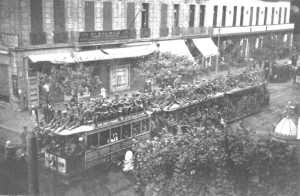
It would be nice to say they spent their time sightseeing, but they spent their time the way many soldiers have in many wars, drinking and seeking women, especially of the sort whose virtue was negotiable.

Lest you approach this tale with a "boys will be boys" snigger, let me deliver the downside up front: though tolerated houses of prostitution were supposedly subject to medical checks, the rate of venereal disease during the war was enough to create major problems for the British and colonial forces. ANZAC units reported an average incidence of VD across the Corps as 12%, or one man in eight; one unit is said to have had a rate of 25%. And penicillin hadn't yet been discovered.

Camp at Pyramids, Kangaroo Mascot
Cairo in 1915 was rather different from the Cairo of today. Many of its residents, whether foreign born or Egyptians of foreign ancestry, claimed the protection of foreign consulates under the system of "capitulations," under which they were subject to the laws of their protective country, not of Egypt. Disputes with Egyptian nationals were settled in a system known as the "Mixed Courts." This naturally created complex jurisdictional issues for law enforcement.

Sir Thomas Russell (Russell Pasha), was the British Deputy Chief of Police for Cairo, later becoming the Chief. (Egypt, until the war nominally Ottoman but under de facto British rule, was declared a British Protectorate when Turkey joined the Central Powers.) Russell's memoir, Egyptian Service, 1902-1946 is a very readable view of the British era from the inside. (His wife, Lady Dorothea Russell, wrote a readable guide to the Islamic monuments, a predecessor of later works by Richard Parker and Caroline Williams). As a police officer, his memoir deals a lot with the seedier side of things, including prostitution and the hashish trade.

Egypt had developed a licensed brothel quarter in the late 19th century, where the houses were nominally subject to medical inspection. Beyond the licensed quarters, there were areas where prostitution was semi-tolerated. Even when, in 1916 (the year after the events described here), a crackdown was introduced, the capitulations got in the way. Russell Pasha:
One particular house of some size and popularity defied Bimbashi Quartier, our chief detective officer, and myself for months by ringing changes on the nationality of the padrona [the Madam]. Police could not enter a foreigner's house without the consent and presence of the Consul or his representative. When we arrived with the French consular cavass to demand admission from the French padrona, the spy-hole in the front door would be opened and a husky voice announce that Madame Yvonne had sold the business to Madame Gentili, an Italian subject, without whose Consular representative we could not enter. Next week we would arrive with the Italian cavass to be met by another change of nationality by the padrona. Picqued beyond the ordinary, Quartier one night assembled seven Consular cavasses at the fast-closed door, and one by one the fictitious landladies were defeated, entry gained, and the law enforced.
A linguistic note: "Bimbashi" is not detective Quartier's first name. It's a rank which in the Egyptian Army and Police was equivalent to lieutenant colonel. (Though binbashi today in the Turkish Army is a major.)

Now, to further set the scene for the Battle of the Wozzer, we need to introduce the Red Light District of the Day (or the Red Blind Quarter as it was known). The area may come as a surprise to those who know Cairo today, since it included the once-elegant colonnaded street of Clot Bey (named, ironically given those VD rates above, for the French doctor who introduced European medicine to Egypt in the age of Muhammad ‘Ali), and other streets to the north of the Ezbekiyya Gardens.

Back in Ottoman times, Ezbekiyya had been a lake, and the area to its west was mostly flood plain; Bulaq was an island. Under the Khedives Isma‘il and Tawfiq in the late 19th century the area to the west was filled in and became the Ismailia Quarter, what today we think of as downtown Cairo. (Midan al-Tahrir was originally Midan Ismailiyya.) The Ezbekiyya Lake became the Ezbekiyya Gardens, formal gardens with promenades, surrounded by the foreign consular quarters and the big foreign hotels, including the famous original Shepheards, burned in 1952, opposite its northwest corner. (The later Shepheards was placed on the Nile instead.)

The area to the north of Ezbekiyya was known as Wagh al-Birka, "fronting the lake," because it was once the site of palaces and villas on the lake. The name itself actually needs a little note as well. Literally, the original name was named وجه البركة (Wajh al-Birkat in Arabic) which normally would be pronounced, in Cairene dialect where the jim is pronounced as a hard 'g', as Wagh al-Birkat. But in this case, the jim acquired an sh sound, so that the usual pronunciation was Wish al-Birkat. In fact, the engineer and planner of much of modern Cairo, ‘Ali Pasha Mubarak, in his street-by-street masterwork on Cairo, Al-Khitat al-Tawfiqiyya al-Jadida, actually spelled it that way: وش البركة.

Ezbekiyya remained fashionable, with Shepheards being the HQ of the ANZAC command (who may or may not have known that in 1798 Napoleon had his headquarters just to the west)

The general area of the Wajh al-Birkat and the streets to its north, though once fashionable, were also in the area where the new city of Cairo and the elegant foreign hotels rubbed up against the older quarters of town. It led to unusual juxtapositions: one reason the military command could respond so quickly to the riot we're about to describe is that they were in Shepheards only a couple of blocks away; just north of the area under discussion sat the main Coptic Cathedral for Cairo (the church is still there, but it was replaced as seat of the Coptic Pope by the new Cathedral in ‘Abbasiyya in the Nasser era). It was also an area where the tolerated brothel quarters around Clot Bey and the Wajh al-Birkat merged into a more unregulated area known as the Wasa‘a, literally the "wide area" which apparently once referred to the old fish markets when the Nile came much farther east. The actual "battle" in question started in a street called the Darb al-Muballat, but most of the troops knew the whole area as the Wasa‘a. Or, since the ‘ayn would defeat them, as the Wazza or the Wozzer. As Russell Pasha put it, the Wajh al-Birkat
. . . was populated at the time with European women of all breeds and races other than British, who were not allowed by their Consular authority to practice this licensed trade in Egypt. Most of the women were of the third-class category for whom Marseilles had no further use, and who eventually would be passed on to the Bombay and Far East markets, but they were still European and not yet fallen so low as to live in the one-room shacks of the Wasa'a which had always been the quarter for purely native prostitution of the lowest class.
He tells us the area was "ruled" by a "king," "a huge, fat Nubian named Ibrahim al-Gharbi," who dressed in women's clothes and wore a white veil.

Now, we come to April 2, 1915. The ANZACs were getting ready to ship off to the Greek islands of Lemnos and Mudros to prepare for the Gallipoli landings. According to some of the accounts I will be quoting below, there had been some incidents leading up to the "battle," but since April 2 was Good Friday, there was no training that day and large numbers of men had leave for the Easter weekend. So all the resentments came to a head.

Depending on the version, and there are many, the immediate provocation was one or more of the following:
  • Anger over the extremely high rates of VD, already mentioned;
  • An Englishman was trying to rescue his sister from one of the houses;
  • Claims the beer was watered or even stretched with urine;
  • A New Zealand unit was outraged because one of its Maori soldiers was rejected by a girl as too dark-skinned;
  • Arguments over price.
Perhaps it was some combination of all these, or just the imminent deployment.The fight began with an attack on a house at Number 8, Darb al-Muballat, for whatever reason. Soon sofas were burning in the street, a piano came crashing out a window, and as many as 2000 ANZACs were torching brothels and fighting with natives and each other. Both mounted British military police and Australian units eventually put the riot down; the whole thing started between four and five in the afternoon (remember, the men had the day off and doubtless started drinking early) and ended by eight. What may be the nearest thing to a photo of the scene: From the Australian War Memorial collection. Caption: "Cairo, burnt buildings and carts possibly the aftermath of the riot later known as the Battle of the "Wozzer", which took place in the street known as the Haret El Wasser near Shepheard's Hotel, Cairo 2 April Good Friday 1915."

The lady (well, woman anyway) in the foreground in what might be a nightgown invites speculation. I'm pretty certain she's not a man in a galabiyya.

Now, some accounts, including eyewitness ones, from those who were there. Oddly enough, more of those on guard duty who put down the riot seem to have written about it than the participants.

Another view of the post-riot damage is at right.

An account from a website dedicated to the Australian Light Horse:
First Wassa (also Wozzer or Wazzir), the appellation given to the first of two unheroic riots in the Haret el Wassa (the brothel quarter of Cairo, Egypt) involving troops from Australia and New Zealand. The initial incident occurred on 2 April 1915 (Good Friday), after units of the Australian & New Zealand Army Corps (ANZAC) received news that their period of training was at an end and that orders had been received for them to embark for long-awaited action. Causes of this disturbance reportedly lay in a desire to exact revenge for past grievances arising from dealings with the district's denizens-such as diluted liquor, exorbitant prices, and high rates of venereal infection-although wild rumours of stabbings of Anzac men by locals also appear to have played a part.

Trouble began soon after 5 p.m. when soldiers began evicting whores and their pimps into the street, and tossing their possessions out after them. Bedding, furniture and clothing-even pianos-were thrown from windows of buildings several storeys high. These materials were piled in the road and set alight. The town picket, drawn from the Australian 9th Light Horse Regiment, came on the scene and tried to clear the men out of the houses being attacked. Five arrests were made, although the crowd-growing larger by the minute refused to let these men be taken away, snatched rifles from some of the troopers and threw the weapons onto the fires, and succeed in freeing four of the prisoners.

British military police (MPs) were summoned, about 30 arriving on horseback to choruses of abuse and a shower of stones and bottles. An ill-advised effort by the MPs to gain control by firing their pistols, supposedly over the rioters' heads, resulted in the wounding of four men in the throng estimated at 2,000-3,000. This only served to further inflame matters, and forced the police to hastily withdraw. Efforts by the Egyptian fire brigade to douse the bonfires were also frustrated, its hose-lines being cut, its members manhandled (especially after they turned a hose onto the crowd), and the engine itself finally pushed into the flames.

Left to themselves, the more unruly elements began to loot some shops and put the torch to a Greek tavern. Shortly after 7 p.m. a second fire engine arrived, this time under cavalry escort which exercised extreme tact, and the various fires were tackled while a still sizeable crowd looked on. Since the `Wassa' was close by Shepheard's Hotel, where the Anzac commander had his headquarters, armed troops had also been called out. After the  Lancashire Territorials (non-regular British troops who were popular with the colonials) were drawn across the road, the rioters wisely began to disperse and order was eventually restored by 10 p.m.

A formal inquiry was convened the following day under Colonel Frederic Hughes, commander of the AIF's 3rd Light Horse Brigade, to investigate the causes of the riot and establish responsibility for its outbreak. Many New Zealand officers attempted to disclaim that their men had played any part, although the evidence of their presence was quite conclusive - the officer leading the Australian picket was adamant that `New Zealanders predominated'. In any event, nine-tenths of those present had been merely spectators. Apportioning blame was next to impossible, however, with few of the 50 witnesses able (or willing) to provide precise information. As the number of men injured by the MPs' bullets (three Australians and one New Zealander) was roughly in proportion to the size of the respective contingents, it could be said that the ‘honours' were about equally shared. So too was the damages bill of £1,700.
The Lancashire troops were the 42nd East Lancashire Territorials.

From a letter by Jack Jensen, from Wasley in South Australia, written in England recovering from wounds in Gallipoli:
The last few days we had in Egypt I shall never forget as three nights running there were riots in & about Cairo. On good friday there was a big row in one of the main streets in Cairo. I think I told you once before that Cairo is a very immoral place in fact they say that it is the worst town in the world. Some streets there are nothing but brothels & houses of infamy where every possible vice under the sun exists. Of course some of our men had been going to these places & had got diseases of different kinds & as a (what?) our chaps had a grievance against these places. Finally to finish up with one of the Manchester soldiers who were also stationed in Egypt found his sister in one of them. She had left England as a servant to some lady who had taken her to Egypt & left her there. I dare say you have heard of that sort of thing it is called the white slave traffic here in England. Anyway this girl went from bad to worse until finally she way found dancing in what they call a Can-Can hall that is a dozen or so women dancing perfectly naked in a big hall & exposing their person to every kind of indignity both by themselves & also the onlookers. It is just as well that I cannot tell you everything that goes on here as it would only grieve you. This Manchester chap managed to have a talk with his sister & tried to get her away. She was only too willing to go but the people she was with would not let her & they threw the brother out of a window as a result he was in hospital for nearly a week. When he got right he came in the camp & told our chaps & asked them to help him. At first they could not find the girl again but at last she was found in a particularly vile house. This was a day or two before Good Friday & that day being a holiday about 500 of our chaps & some New Zealanders & English troops went in to raid these houses. When they got in there a good many got drunk & they were joined by a great many more also drunk so the affair ended in a riot. They got the girl out first & then set fire to the houses. The affair started about four oclock in the afternoon & was kept up until nearly midnight Shops were raided & windows broken everywhere. I was on guard that day & we were called out to go & stop it but only twenty of us could do nothing against nearly two thousand. They had a fire in the street & were throwing the furniture out of windows two & three storeys high on to it. Some of us went in & tried to put it out & a chair came out of a window three storeys high & hit one chap & nearly killed him. We carried him away & a few minutes after piano came out of the same window & fell with an awful crash on the pavement. All the strings seemed to break at once & it went off like a cannon. After that the Military Police charged the crowd on horseback firing their revolvers into them but the crowd threw broken bottles & stones at them. One policeman got badly hit & one eye cut out with a broken bottle & two of our chaps were hit by the revolver shots.

About eight oclock five hundred Manchester troops came with fixed bayonets & were told to charge. They charged alright but they wouldn’t go for our men so they gave them rifles & our chaps threw them on the fire. Then they turned & ran & our fellows followed them up with sticks A while after the South Australian Light Horse came but the horses wouldn’t face the fire & smoke A little after eleven oclock the Westminster Dragoons came. They looked all right as they were coming down the street with all their swords drawn & their horses going straight through the fire & smoke. This very soon cleared the street & then we went for the houses & took everybody prisoner that we found. We got about fifty Australians & some New Zealanders.

The girl who was the cause of all the trouble was sent to England. She was taken charge of by the Y.M.C.A. The men in camp collected over forty pounds to pay her passage & expenses back to England Of course the money was handed over to the Y.M.C.A.

Next night a riot started in the canteen of the Abbasieh camp. Somebody caught an Arab who was employed at the canteen making water in a tub of beer. The Arab was at once pulled & half killed. All the beer casks & tubs were broken & spilt & all the groceries & goods stolen & the place burned down.

The guard was called out again but by the time we got there everything was over & the camp was quiet except for the fire still burning.

On Sunday evening the New Zealanders burned down a picture show. The man had advertised a boxing match & doubled the admission & then showed just the same pictures as he usually did. So they burned his place down.
The "Manchester" troops Jensen refers to are presumably the Lancashire Territorials mentioned in the earlier quote as being more popular with the ANZACs than British regulars; before the British government started messing with the historical counties, Manchester was in Lancashire.

You can also find the original contemporary diary of Australian War historian C.E.W. Bean on the Australian War Memorial site; Diary Number 3, including the Wozzer (which at one point he calls the Wozzy), is here.This has gone on too long and transcribing a PDF manuscript would take me all night, but it's there if you want more detail. His account of April 2 begins on page 25 of the PDF link.

At right, troops in evidence in the Wasa‘a after the riot, via Australian Light Horse Studies Centre.

Now, for the sake of completeness, I should note that there was a second Battle of the Wozzer fought on July 31. This was a much smaller affair, and took place after most of the ANZACs were ashore at Gallipoli.It also has its own website, The 2nd Battle of the Wozzer, complete with some of the testimony, so I'll just refer you there. The medallions at the top of this post are from his site.

Source here
Now, a discursus on the area in more recent times, in case any of my readers want to visit the scene.

When I first went to Cairo back in the 1970s, Ezbrekiyya still had traces of its former glory, though once the Opera house burned down it was less of a draw. Nearby Cafes and bookstalls surrounded the gardens.

When the new Azhar Flyover was built, I think sometime in the 80s, the south side of Ezbekiyya was dominated by its on-ramps and nearby Midan al-Ataba dwarfed by the highway. But the area to the north, site of our story, has changed less (though of course Shepheards has been gone since 1952, two revolutions ago). I've scanned in a section of a Survey of Egypt map from the late 1960s. It's in Arabic, but so for non-Arabists who nevertheless know Cairo, here's a brief guide:

The large street with a tramway down the middle at the right is Clot Bey. The street running westward and intersecting Clot Bey at the lower right corner, today the extension of Naguib al-Rihani Street east of Gumhuriyya St. was the old Wajh al-Birkat street. Gumhurriya (then Sh. Kamel) and Clot Bey reach the northwest and northeast corners of Ezbekiyya a couple of blocks south of the lower edge of the map. The big building complex in the right center of the map is the Coptic church of Saint Mark, formerly Cairo's main cathedral, now replaced by the big one in ‘Abbasiyya. The north-south street through the middle of the picture, running from Naguib al-Rihani to Clot Bey, is Al-Kanisa al-Marqusiyya, named for the church which is on it. If you'll look between Naguib al-Rihani (Wajh al-Birkat then) and Qabila street to its north, you'll see a small back street, the third to the right counting from Al-Kanisa al-Marqusiyya. The print here is too small to read, but it is Darb al-Muballat. The original brothel attacked and burned in 1915 was at number 8, Darb al-Muballat. I don't know if the street numbers have changed; today's number 8 is on the west side of the street. It's a pretty staid neighborhood today, or was the last time I saw it. Illegal brothels were cleaned up in 1916 and prostitution made illegal in 1924. (Therefore there was no prostitution in Egypt during World War II when Cairo again filled up with foreign troops. After all, it was illegal.)

The overall area from Google Earth  (copyright Google):
And Darb al-Muballat today (again, street numbers may have been changed so Number 8 may not be in the same spot, and the copyright is Google's):

Wednesday, April 1, 2015

Updates on the Ongoing Threat to Antiquities in Syria and Iraq

It's been some time since I've blogged about the threat to antiquities and archaeological sites in Ira and Syria by ISIS and by ongoing warfare by other parties. Here are a few useful readings and references.

The Association of Art Museum Directors (AAMD), Archaeological Institute of America (AIA), Society for American Archaeology (SAA), American Schools of Oriental Research (ASOR), American Anthropological Association (AAA), and Oriental Institute of the University of Chicago issued a joint statement deploring developments a few weeks ago.

While ISIS has circulated video of some of their destruction, other reports have come from the Iraqi government and my be exaggerated. The Assyriology blog Gates of Nineveh offers a rundown and assesses the reports, providing a number of videos: "Damage around Tikrit, Destruction in Mosul."

Eleanor Robson at the Times Literary Supplement examines the question: "Modern War, Ancient Casualties."

It's also worth remembering that ISIS is not the only combatant, and that there's much propaganda in play, and in anarchic situations looting may be a temptation to all sides, as several headlines at Conflict Antiquities make clear:

"A Photoshopped frame of the destruction of a lamassu at Nergal Gate"

"Islamic State-looted antiquities on eBay? ‘The stories are absolutely false and defamatory.’ Multiple libel actions will follow."

"Conflict antiquities from Apamea do not finance the Islamic State – they finance the Assad regime."

 "Was most of the looting at the most extensively looted site in Syria conducted under the Islamic State or the Free Syrian Army?"

"State arms-for-antiquities trafficking between Turkey and Syria?"

I can't testify to the accuracy of these posts, and of course, whoever does it, the world loses.