A Blog by the Editor of The Middle East Journal

Putting Middle Eastern Events in Cultural and Historical Context

Tuesday, April 26, 2016

Souag on Arabic Colloquial Folk Etymologies

 Scholars routinely lament the lack of a really good, scholarly, dictionary of etymology for Classical and Modern Standard Arabic. Even more wanting are decent studies of etymology for the spoken colloquials; there are many dictionaries, but few that are very helpful for etymology of distinctive dialectal terms. Instead there are many websites that offer assumptions with no sourcing cited, and many of these are popular folk etymologies. Linguistics blogger Lameen Souag has a very interesting post at Jabal al-Lughat on this theme: "Arabic Substrate Etymologies as Urban Legends."

As he notes:
In Arabic as in English, social networks have a constantly flowing undercurrent of poorly sourced, manipulative stories being shared and reshared by people who vaguely think they sound right. Over the past, say, five years, I've noticed the emergence of a linguistically interesting new subgenre within this miasma of lies and half-truths: etymological tables purporting to prove the massive contribution of Berber, or Syriac, or (more rarely) Coptic, or perhaps some other pre-Arab substrate to the local Arabic dialect. These tables, in my experience, never cite an academic source, and rarely cite anything at all; closer examination generally reveals a farrago of correct etymologies and bad guesses. 
He links (included in the post, and all in Arabic) to social media posts for Berber, Coptic, and Syriac, and then examines some of the assertions, finding some of them valid, others unsubstantiated, or just plain wrong, concluding:
The optimistic take on this is that it shows that there's a real public demand in the Arabic-speaking world for information on etymology and on substrate influence. The pessimistic take is that people just want "information" confirming what they want to believe - in this case, that they're not really that Arab after all. (The converse case also exists, of course - recall Othmane Saadi - but I haven't seen as much of it circulating on social media, though that may just reflect my own bubble.) The reality is probably somewhere in the middle.
But read the whole thing, especially the case studies. I should note that Dr. Souag himself started a blog on the historical origins of Algerian colloquial (الأصول التاريخية للدارجة الجزائرية), but there have been no posts since last year.

Frederic Hof on Syria in Oslo

The Atlantic Council has posted the transcript of an address by Atlantic Council Resident Senior Fellow Ambassador Frederic C. Hof opening the Aspen Ministers' Forum in Oslo, addressing the Syrian peace process and refugee issues. It's a concise and incisive analysis and I recommend you read it. As I have noted previously for full disclosure, I have known Fred since undergraduate days and consider him extremely well-informed on Syrian (and Lebanese) issues, so I acknowledge a certain bias.

France24 English Documentary on YPG Victory in Shaddadi

The Kurdish YPG and its allies in the Syrian Democratic Forces recovered the northeastern city of al-Shaddadi from ISIS at the end of February. France24 English has broadcast this week a documentary by its journalists accompanying the YPG. There are clearly Western special forces accompanying the Kurds.

Monday, April 25, 2016

Holy Week Greetings to Orthodox and Other Eastern Christian Readers

Bethlehem: Palm Sunday at the Church of the Nativity yesterday
Greetings for Holy Week to readers in the Orthodox, Oriental Orthodox, Church of the Est and other Christians who celebrate Easter according to the Eastern tradition. This year, the two dates of Easter fall a full month apart (the maximum).

Friday, April 22, 2016

The Regeni Case Refuses to Go Away

Although Egypt has offered various attempts to explain the disappearance of Italian researcher Giulio Regeni, including blaming it on a criminal gang (all conveniently now dead), Italy has remained openly dissatisfied with the explanations, summoning its Ambassador home for consultations and expressing anger when Egypt refused to supply requested information from mobile phone tower data, which  Egypt claims would violate privacy rights. For all its efforts, the suspicions will not go away.

Regeni, of course, is not the only "disappeared" victim found dead in mysterious circumstances, but he s one with a major European trading partner of Egypt pressing his case. Yesterday, Reuters broke a major story citing three intelligence and three police sources:
All six intelligence and police sources told Reuters that Regeni was picked up by plainclothes police near the Gamal Abdel Nasser metro station in Cairo on the evening of Jan. 25. Security had been heightened that day because it was the anniversary of the beginning of the 2011 Arab Spring uprising that toppled President Hosni Mubarak.
An Egyptian man was picked up at the same time. Three sources gave his name but Reuters was unable to verify the man's identity. His connection to Regeni, if any, is unclear. 
It is also unclear why the men were picked up, though all the sources said the two had not been specifically targeted but were detained as part of a general security sweep. 
One of the intelligence officials said the two men were taken to the Izbakiya police station, a fortress-like compound located beneath a flyover near downtown Cairo.
"They were transported in a white minibus with police licence plates," he said.

The three police sources said officers on patrol in the area that night confirmed to them that Regeni had been taken to Izbakiya.
"We were told that an Italian was arrested and he was taken to Izbakiya police station," said one of the police officers, who confirmed the detainee was Regeni. 
A senior police official in the Izbakiya station told Reuters that he recalled an Italian being brought in and said he would check the records to confirm the name. He subsequently declined to comment.
"I don't know anything about it," he said. "I checked the books. Regeni's name was not there. 
One of the intelligence sources said that Regeni was held at Izbakiya for 30 minutes before he was transferred to Lazoughli, a state security compound run by Egyptian Homeland Security. 
The sources did not say what happened to the Italian after that. Reuters was unable to obtain information on the whereabouts of the Egyptian.
A few glosses: I assume by Homeland Security Reuters means National Security, the former State Security. Gamal Abdel Nasser station is located near the High Court at Tal‘at Harb Street and 26th of July Streets. Izbakiya refers to the neighborhood also spelled Ezbekiyya.

Now, the US State Department, asked about the Reuters report, called for resolution "through an impartial and a comprehensive inquiry."

The Reuters report, dismissed offhandedly by Egyptian officials, was quickly cited by Egyptian opposition websites and went viral on social media. Th Regeni case will not go away.

Passover Greetings

Best wishes to my Jewish readers for Passover, which begins at sundown, More posts coming later.

Thursday, April 21, 2016

Newly Available Details on JFK and Israel's Nuclear Program

I have periodically cited pieces by Avner Cohen here since Avner is the go-to expert on the Israeli nuclear program, and last year I noted the inauguration of the National Security Archive's collection of documents on the program, which Cohen edits. Their latest release of documents is "Concerned About Nuclear Weapons Potential, John F. Kennedy Pushed for Inspection of Israel Nuclear Facilities." 

Given Israel's well-known cone of silence around its nuclear program, these accounts with their supporting documents from declassified US sources are often the best documentation we have; Haaretz has a report here (paywalled).

Tuesday, April 19, 2016

April 19, 1916: The Death of Von der Goltz (Goltz Pasha): Was He Murdered?

Prussians: Count von Zeppelin, Baron von der Golst, Kaiser Wilhelm II, Helmuth von Moltke

A century ago today, the Prussian officer commanding Ottoman operations against the British in Mesopotamia, Field Marshal Colmar Freiherr (Baron) von der Goltz, died in Baghdad at the age of 72, reputedly of typhus.

We have met von der Goltz before. In 2014 I ran three posts on the siege and surrender of Kut (Part I; Part II; Part III); because I told the story then I have not noted the centennials of each of the failed British attempts to lift the siege. I'll return to the story soon to mark the surrender anniversary.

Field Marshal von der Goltz
Born in East Prussia in 1843, he followed his father into the Prussian Army and fought in the Austro-Prussian and Franco-Prussian wars. After the victory and German unification he served at the military school in Potsdam and the Historical Section of the General Staff. There he wrote a number of works on the history and theory of warfare, some quite influential.

After the Ottoman defeat in the Russo-Turkish War of 1877-1878, he was sent to train the Ottoman Army, serving as head of the German Military Mission in Constantinople. He held the position for 12 years, learning Turkish and training a generation of young Ottoman officers, many of whom would form the core of the Young Turk Revolution. Before returning to Germany in 1895 he had achieved the title of Pasha and the Ottoman rank of Müşir (Field Marshal).

He held various commands in the German Army and wrote on Ottoman affairs, welcomed the 1908 Young Turk Revolution, and in 1911 retired from the Army with the rank of Generalfeldmarschal.

Retirement proved short-lived, however. Recalled to active service at the outbreak of war in 1914, he became Military Governor of Belgium, where he became notorious for reprisals against civilians.

He was soon sent to Constantinople as a Military Adviser to the Sultan, a meaningless position. There was personal friction between von der Goltz, the original head of the German Military Mission decades earlier, and the current incumbent of that post, Otto Liman von Sanders. War Minister Enver Pasha also wanted Goltz Pasha out of Constantinople. The friction was resolved by transferring Goltz to the command of the Sixth Army in Mesopotamia, where he took over as the siege of Kut was under way.

Goltz Pasha oversaw the campaign but did not survive to witness the surrender. He took ill and died in Baghdad on April 19, 10 days before Townshend surrendered on April 29.Goltz was replaced as Sixth Army Commander by Baghdad Governor Khalil Pasha (known after the war as Halil Kut), who had been in command at Kut and accepted the surrender.

The official cause of Goltz's death was typhus, though cholera and typhoid were sometimes mentioned. But almost immediately there were rumors that Baron von der Goltz had been poisoned, purportedly by a cabal of Young Turk officers. This rumor seems to have been spread among Germans; no evidence was ever forthcoming, but suspicions persist nonetheless.

The Funeral in Baghdad
Oddly enough, British General Frederick Maude, who eventually took Baghdad in 1917, came down with cholera on a later campaign and died in November 1917, in the very same house in Baghdad where Goltz had died.

The Tomb
A funeral was held in Baghdad (above left), and then von der Goltz was transported with an escort, to Constantinople, where in accordance with his will, he was buried on he grounds of the German consulate in Tarabya, overlooking the Bosporus.

There's a final irony to the Goltz story. When Field Marshal von Schliefen retired as Chief of the German General Staff in 1906, one of the candidates to replace him was von der Goltz, but the job went instead to Helmuth von Moltke (at right in the photo at top). The "Younger Moltke," namesake but not equal in skill to his uncle the "elder Moltke," genius of the Franco-Prussian War. The younger Moltke was replaced after the Battle of the Marne by Erich von Falkenhayn. Given a desk job in Berlin, his health began to deteriorate.  On June 18, 1916, just two months after Goltz's death in Baghdad, Moltke was attending a memorial service for von der Goltz in Potsdam, when the 68-year-old Moltke collapsed and died.


Monday, April 18, 2016

April 1916: British Air Raid on Constantinople

Lts. Savory and Dickenson on Mudros with one of the B.E. 2c bombers
I haven't been noting every centennial date for the First World War in the Middle East, but one event which marked its anniversary a few days ago deserves note: on the stormy night of April 14-15, 1916, three aircraft of the British Royal Naval Air Service (RNAS) bombed Constantinople and Adrianople.
Operating from Mudros, two aircraft of C Flight attacked the Zeitunlik powder mills and the Demirkhan gun factory, while a third aircraft bombed the railway station at Adrianople (Edirne). The bombers were the B.E. 2-c.

Smyth-Piggott
Leading the raid was Squadron-Commander Joseph Ruscombe Wadham Smyth-Piggott (left), the other fliers on the raid were Flight Lieutenant Kenneth Stevens Savory, Flight Sub-Lieutenant Richard Sebastian Willoughby Dickinson (the two shown above), and Flight Sub-Lieutenant I.H.W. "Jacky" Barnato, a Jewish airman.

There had been other air raids against Smyrna and Gallipoli from Mudros and elsewhere in the Aegean, but this raid was a rund rip of 300 miles and drew attention at the time, though it would be overshadowed by another raid in 1917.  While doing little damage at the time, it reportedly alarmed the population of he Ottoman capital.

Later in the war, the RNAS was merged with the Royal Flying Corps, ancestor of the RAF.

Wednesday, April 13, 2016

April 13, 1975: The Lebanese Civil War Begins, 41 Years Ago Today

The Bus
Forty-one years ago today, a series of violent incidents in the mostly Christian and Druze Beirut suburb of ‘Ayn al-Rummaneh (عين الرمانة) between Phalangists and Palestinians would come to be seen as the opening shots of Lebanon's 1975-1990 civil war.

Of course, this was no more the first sectarian violence in Lebanon, any more than 1990 was the last. But it is conventionally seen as he outbreak of the war.

Like so much else in the war, the narratives of the incidents as preserved among the mostly Maronite Phalangists (Kata'ib) and the Palestinians and their allies. An initial clash in the morning between Phalangist militiamen of the Kata'ib Regulatory Forces (later known as the Lebanese Forces Militia) and Palestinians led to a second clash an hour or two later, both outside a church; in the second several were killed in a Palestinian reprisal. Later the same day, a bus full of Palestinians passing through en route to the Sabra refugee camp was attacked by Phalangists under Bashir Gemayel, son of the Phalangist leader Pierre Gemayel.

The Bus as Memorial
About 30 were killed, and over several ensuing days the Phalangists and their Chamounist Christian allies traded reprisals with Palestinians and their Lebanese allies. In later narrative, Phalangists saw it as an attack on Pierre Gemayel himself; Palestinians as a Phalangist attack on themselves. Still in the future were Syrian intervention, Israeli and Western intervention, and countless shifts in allegiance, but the die was cast and Lebanon had crossed its Rubicon.

Why Is Syrian Regime Shifting Priorities Back to Aleppo?

 Institute for the Study of War
Last month, after regime forces captured Palmyra from ISIS, I speculated that the regime forces would proceed from there to lift the siege of Deir al-Zor, which could cut ISIS communications between its capital at Raqqa and its territories in Iraq.

Another option could be to move directly on Raqqa from the north and south, coordinating between regime and YPG forces. The Wilson Center's Henri Barkey made the case for the US and its allies targeting Raqqa ahead of the campaign against Mosul.

But it now seems clear that the Asad government and its allies, which now include Special Forces units of the Regular Iranian Army (Artesh) in addition to the long-present IRGC, have decided on a different priority: completing the encirclement of Aleppo and recapturing the city. An assessment here.

Asad's Prime Minister, Wa'el al-Halaqi, has explicitly said that the regime and the Russian Air Force  are now determined to complete he encirclement of Aleppo. Many of the elite Syrian and Iranian forces that spearheaded the recapture of Palmyra have now been moved to southern Aleppo province, and the Syrian Army's elite Tiger Forces and its commander, Maj. Gen. Suheil al-Hasan, have reportedly been assigned the task of closing the ring around Aleppo.

Retaking Syria's most populous city (as it was before the civil war) would be a great symbolic victory for the Asad regime, but the intermingling of armed groups in the Aleppo fight makes a campaign there much more dangerous, with the potential of undermining the remaining elements of the cessation of hostilities, in place since February, with the new round of Geneva talks due this week. In Palmyra the only enemy was ISIS, which is not covered by the truce, but in Aleppo Jabhat al-Nusra, also not covered, is closely intertwined with Free Syrian Army forces, which are. So the Aleppo campaign could risk the fragile truce.

But it is worth noting that the capture of Aleppo is unlikely to be as simple as the capture of Palmyra. The Russian Air Force already faces criticism for striking civilian targets, and if Aleppo is completely cut off (there is currently only one road open), mass starvation could be a possibility. So there are clear dangers: of failure, of increased humanitarian suffering, of undermining the peace talks. There is a real possibility that, instead of following up its success at Palmyra with rapid further progress against ISIS, the rebimeand its patrons are choosing a potentially costly gamble they might well lose.

Tuesday, April 12, 2016

Israel Gives Green Light to Saudi-Egyptian Islands Deal

Defense Minister Moshe Yaalon and other senior Israelis have said Israel was informed in advance and is not concerned about the transfer of Tiran and Sanafir islands from Egypt to Saudi Arabia, since the Saudis are committed to maintaining the guarantees of the Egyptian-Israeli peace treaty. Saudi Arabia has said that this does not mean normalization with Israel, but it appears to be another instance of the growing commonality of interest between Israel and the conservative Sunni Gulf states.

Within Egypt there is growing criticism for the deal, with many charging that President Sisi "sold" Egyptian territory to the Saudis in exchange for aid.


.

Monday, April 11, 2016

Transferring Tiran and Sanafir: The Legal and Sovereignty Issues

Announcements during King Salman's visit to Egypt that the two countries are planning to build a bridge from Saudi Arabia to Sinai connecting their territories, and that Egypt was recognizing the islands of Tiran and Sanafir, in the Straits of Tiran, as Saudi territory, have raised some eyebrows, especially the latter.

The bridge,which would  bypass Jordanian and Israeli territory to connect KSA with Egypt directly, raises questions over a number of environmental issues, but the transfer of the islands is even more controversial, and has long claimed the islands, which are part of its Ras Muhammad National Park and which are often visited by tourists in Sharm al-Sheikh.

Besides being unpopular with the Egyptian public, the transfer of the islands (which still must be approved by Parliament), the islands are also part of Area C under the Egyptian-Israeli Peace Treaty, the area to be demilitarized.  Saudi Arabia is not a party to the treaty.

The islands have been in dispute since he British and Ottoman eras, and the Saudis had possession until 1950 when they allowed Egypt to occupy them to prevent possible Israeli occupation.Under Nasser, Egypt claimed them as its own territory. When Nasser closed the Strait in 1967, provoking the 1967 war, its blockade was made possible by Egypt's control of the islands. Israel occupied them along with Sinai. When it evacuated the last parts of Sinai in 1982, it returned them to Egypt, but Saudi Arabia reasserted its claims. At that time Israel indicated it would consider any transfer of the islands to be a violation of the Peace Treaty.

Is that still the case? Perhaps not, since the emerging tacit Israeli cooperation with the Gulf States over Iran may mean Israel was kept in the loop, but issues involving the treaty could resurface, though some reports say the status quo will remain undisturbed despite the transfer of sovereignty.

Egypt claims that the transfer is in keeping with a 1990 Mubarak-era decree on Egypt's territorial seas, but many Egyptians see the transfer as payment for continuing Saudi financial support for Egypt.

Wednesday, April 6, 2016

Syria Claims to Have Retaken al-‘Eis After Several Days, Loss of Aircraft

Syrian regime reports say that they have now recovered the strategic town of al-‘Eis several days after it was taken by Jabhat al-Nusra. Nusra launched a major offensive south of Aleppo as fighting has intensified and the cessation of hostilities has been unraveling. Al-‘Eis, about 12 miles south of Aleppo, and its adjacent hill are well positioned to control the M5 highway just to the west, the main motorway connecting Aleppo to Damascus via Hama and Homs, and thus the urban spine of Syria. The M5 is still in rebel hands in several places.

Pro-regime media say the town and hill were retaken after heavy fighting, by Syrian Army troops and the 65th Iranian Special Forces Brigade with support from National Defense Forces militia, Hizbullah, and elements of the Iraqi al-Nujaba' Shi‘ite militia.

Do the Rebels have Shoulder-Launched SAMs?

Assuming the reports of the recovery of al-‘Eis are confirmed, it was recovered in about three days after heavy fighting, according to both sides. Yesterday (April 5) both sides confirmed (and multiple videos documented) the downing of a Syrian Air Force Su-22 fighter-bomber over al-‘Eis. Although Nusra said it was shot down by anti-aircraft fire, but the Syrian Government said it was a missile. Shoulder-launched SAMs have not been confirmed to be in rebel hands, particularly jihadi groups like al-Nusra. If confirmed it could represent a significant escalation.

The pilot elected (video below) and is now held by al-Nusra.

Tuesday, April 5, 2016

Italy Appears to Be Losing Patience in the Regeni Case

The Italian Government and media appear to be losing patience with Egypt's failure to provide a satisfactory explanation of the bating death, with signs of torture, of Graduate student Giulio Regeni. After Italy rejected the "it was a criminal gang and they're all dead now. Case closed" explanation, Egypt. Now Italy appears to be upping the ante:
The foreign minister of Italy said Tuesday that his government would take “immediate and proportional” measures against Egypt if it failed to help uncover the truth behind the death of an Italian graduate student in Cairo two months ago.
“We will stop only when we will find the truth, the real one,” Foreign Minister Paolo Gentiloni told Parliament, adding that he would not accept any “fabrication.”

Egypt delayed one delegation to Italy, and even the Editor of state-owned  Al-Ahram dared to suggest that the case could have the kind of effect the death of Khaled Said ha on the Mubarak regime.

There are reports that Egypt would admit to having investigated Regeni.

Meanwhile the Association for Italian Tourism said it was suspending all package tours to Egypt.

The Regeni case, due to its international dimension, is also being increasingly embraced by the Egyptian opposition as a means of mobilizing foreign support in aneriod of increasing repression.

Assessing the Damage at Palmyra after a Week

A week after the recapture of Palmyra from the Islamic State, considerably more information is emerging about the degree of damage to the antiquities in the UNESCO World Heritage Site. My initial assessment last week seems to still hold true: the destruction is not complete, but it's bad enough.

ASOR, the American Schools of Oriental Research, today released their detailed assessment, based on journalists' reports, the Directorate-General of Antiquities and Museums (DGAM),  and military sources. In addition to the videos I posted last week, there are links to many more by Russian and Syrian media and an AFP photographer. You can read the ASOR report online here, or download the PDF here. This is probably the best overview I've seen to date,

You can also find extensive photographs at the DGAM web page, including photos of the damage to the ruins  (English; Arabic here) and to the museum (English; Arabic here); a more recent report here. (Arabic here).

DGAM also posted a Tribute to Khaled Assad, the octogenarian archaeologist  and Director of the site, who was executed last year by ISIS.

The Gates of Nineveh website also has a good survey with links, photos, and videos.

Not all sites have been fully investigated as mines are still being cleared.

Here's an overview video among many:

The museum was extensively damaged; however some reports say that many key exhibits were moved to Damascus and replaced by casts before the fall to ISIS.

Monday, April 4, 2016

Erdoğan's Washington Misadventure

Turkish President Recep Tayyip Erdoğan's trip to Washington last week was supposed to go better than it did. The trip, coinciding with the Nuclear Security Summit, was supposed to help enhance his image in the West but, as my MEI colleague Gonul Tol notes, it did the reverse. Not only did Erdoğan and the Obama Administration snipe at each other over the Syrian PYD and the issue of press freedom in Turkey, but an embarrassing series of confrontations outside the Brookings Institution between Erdoğan's security detail and protesters, and their attempt to exclude certain Turkish journalists from the event, merely reinforced the impression of Erdoğan as an increasingly autocratic "Sultan."

The trip compounds Erdoğan's recent missteps, such as his summoning the German Ambassador to protest a satirical video about him on German TV, which backfired badly by driving online viewing to over four million views, in a classic example of the so-called "Streisand effect." in which an attempt to suppress information backfires and leads to its being more widely publicized.


Wednesday, March 30, 2016

Two Posts on Diglossia in Algeria

A common theme here has long been diglossia, the problems created by the dichotomy between the spoken Arabics learned at one's mother's knee, and Modern Standard Arabic, the "Classical" or literary language used for writing and formal speech.

This is deadline week for our Spring issue, so in my own absence let me link to two more on that familiar subject from Algerian linguist Lameen Souag:

Tuesday, March 29, 2016

After Palmyra: What Next?

Now that Syrian forces have recovered Palmyra, where do they go from here? The campaign to retake Palmyra benefited from the inactivity on other fronts as a result of the ongoing cessation of hostilities (which excludes operations against the Islamic State and Jabhat al-Nusra), and certainly the Syrian government and Russia are claiming a significant victory. The Institute for the Study of War has an analysis of the Palmyra campaign as well as a useful map:
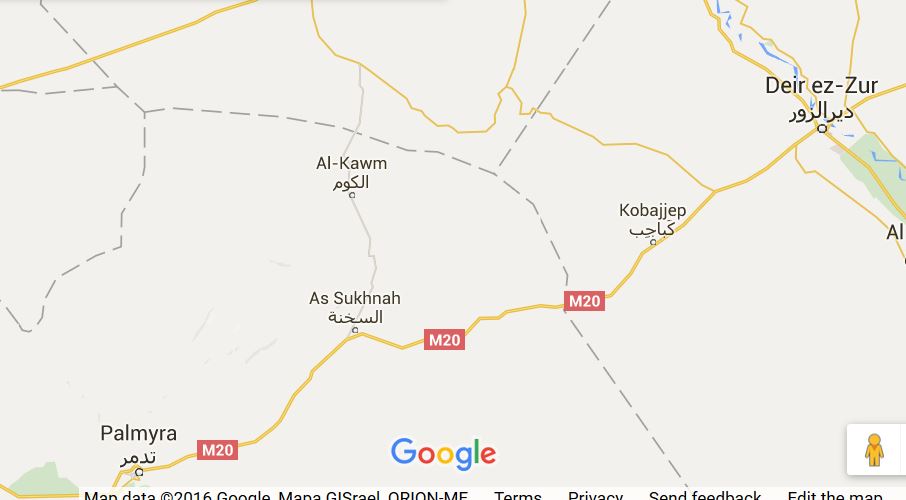
But once control of Palmyra is consolidated, where does the war against ISIS go from here? Syrian pro-government media are pointing in two directions from Palmyra: toward Qaryatayn to the southwest, and toward reopening the road to Deir al-Zor to the northeast in an effort to lift the ISIS siege of the Syrian Army garrison there.

Syrian forces were already pushing toward Qaryatayn from the west; a column from Palmyra could provide additional pressure.


But Syrian reports also say that forces from Palmyra are advancing in the direction of Sukhna, which would suggest an effort to clear the road to Deir al-Zor. It is also claimed that the besieged forces in Deir al-Zor are pushing westward.
If Syrian forces could clear the motorway to Deir al-Zor, they would end the siege, and open a route to the Euphrates, and also find themselves 140 kilometers downriver from the IS capital at Raqqa. Raqqa would then be vulnerable from the expanding area of regime control around eastern Aleppo, the YPG forces already threatening Raqqa from the northeast, and a potential column advancing upriver from Deir al-Zor.

That will not be accomplished overnight. The distances are substantial, though mostly across open desert. The Palmyra campaign relied heavily on elite Syrian Army forces, Hizbullah allies, and Russian air cover. (As part of the Palmyra campaign, Syria has recovered the Tadmur Air Force base, giving Syrian and Russian aircraft a forward operating base.)

As an aside they have presumably also recovered the notorious Tadmur Prison, once the regime's most notorious.

Monday, March 28, 2016

Palmyra Destruction is Not Complete, But Bad Enough

Now that the Islamic State has been driven out of Palmyra, there have been some reports suggesting that the damage to the ancient site is not as bad as had been feared.

Insofar as it proves to be true, that's good news, of course, but let's not sound too optimistic. We know the once beautifully well-preserved Temple of Bel was razed:
Temple of Bel (my photo, 1972)
And we know little was left:
 

Triumphal Arch (My photo, 1972)
We also know that the Temple of Baalshamin and the Great Triumphal Arch (above) were also turned to rubble.  ISIS also destroyed several tower tombs which, like the temples, they considered idolatrous. But the amphitheater received little damage, though it reportedly was used for executions, and while some exhibits in the museum were smashed, others are said to be intact.

Russia has released drone footage showing the site from the air. The first version, from RT, is in English without commentary; the second has fuller commentary in Russian, which I don't speak but some readers will.

Finally, I add an ASOR aerial shot of the site before ISIS for comparison.


Friday, March 25, 2016

Egyptian Police Say Regeni Killing Was Done by a "Criminal Gang" Disguised as Police, But the Gang is All Dead Now, So, Case Closed?

From the time Italian graduate student Giulio Regeni was found tortured and killed, the police have offered several explanations, but most have been dismissed or denied by prosecutors investigating the case.

The latest explanation goes like this: Regeni was kidnapped by a gang who dressed as policemen to abduct and rob foreigners. (Are other foreigners missing?) The police raided the gang's hideout and found Regeni's passport and other belongings. Conveniently the gang were all killed in the resulting firefight. Therefore, case closed, right?

The fact that the police have produced Regeni's passport could, of course, be just as easily explained if, as many suspect, they were responsible for his death. The Ministry of the Interior, which supervises the police, has given confused accounts of whether the gang was responsible. Blogger Zeinobia raises some of the obvious questions.

Nor is Italy satisfied. The whole thing seems too convenient, and now the Interior Ministry says the investigation is ongoing.

I don't think this case is closed, however much the police may want it to be.

Belated Purim and Early Easter Wishes

I'm a day or two late with Purim wishes and two days early with Easter wishes for those celebrating on the Western date. (Orthodox Easter is not until May 1 this year, five weeks, the maximum distance apart the calendars permit I believe.) Greetings for both occasions.

Thursday, March 24, 2016

Aiming for the PETA Vote? Rouhani Replaces Nowruz Goldfish with an Orange

Traditionally the Persian New Year Nowruz is celebrated with the Haft Sin table of seven items beginning with the letter "s," plus other traditional items such as the poetry of Hafiz and a live goldfish in a bowl. The goldfish are usually released into the wild at the end of the feast, where they are unlikely to live long. Many have called for a symbolic substitute, such as using a plastic fish.

Iranian President Hassan Rouhani's Nowruz greetings on Twitter included a photo of himself standing next to a Haft Sin table adorned with a goldfish bowl containing what appears to be an orange in place of the goldfish.
On her Twitter feed, Vice President Massoumeh Ebtikar also called attention to the substitution, and to the fact that the bowl contains very little water.
Rouhani will be eligible for a second term in the 2017 Presidential elections.  Is he vying for the PETA and Save Water vote?

 .

The Struggling Lebanese Press: Al-Safir Ceasing Publication as Al-Nahar Considers Going Online Only

Al-Safir, one of Lebanon's two biggest newspapers, announced just a week ago that it was considering major cutbacks; yesterday it announced that it is ceasing publication altogether, print and online, on April 1.

Lebanon's other big paper, Al-Nahar, has previously said it might consider going to an online-only version and dropping the print version. The two have been rivals: Christian-owned Al-Nahar, founded by the Tueni family in 1933, was a liberal-centrist paper staunchly opposed to Syrian influence in Lebanon, while Al-Safir, with a leftist orientation, long supported Syria.

The Lebanese media are suffering from Lebanon's economic woes and political paralysis (symbolized by the failure to elect a President or even collect garbage in Beirut), as well as the decline of print journalism worldwide.

Wednesday, March 23, 2016

Syria: Regime Forces Say They are on Verge of Retaking Palmyra

Syrian state media are reporting that Syrian Army elite troops and their Hizbullah allies are on the verge of recapturing the city of Tadmur and the ancient ruins of Palmyra.

Tadmur/Palmyra have been controlled by the Islamic State since May 2015, and their capture of Palmyra also cut the regime's supply line to the last regime garrison in eastern Syria, at Deir al-Zor. The subsequent destruction of ancient temples at the UNESCO World Heritage Site at Palmyra by ISIS provoked international outrage.

Deir al-Zor has been besieged by ISIS and resupplied only by Syrian and Russian air drops, but the fall of Palmyra could open the possibility of a rapid advance to open the road; the distance is 200 kilometers across generally open desert.

According to pro-regime reports, the attacking force of the Syrian Army includes the Tiger Forces and Desert Hawks units of Special forces, and Syrian Marines and Hizbullah allies. They claim to have surrounded Palmyra on the south and west and to have cut ISIS' line of supply and communication, including the Deir al-Zor road.

Tuesday, March 22, 2016

In the Shadow of Brussels

The Brussels attacks have been met with several disturbing responses from US Presidential candidates, particularly Donald Trump and Ted Cruz, raising questions about Muslim communities in the West. It is perhaps a good time to repeat that the whole purpose of terrorism is to spread terror, that Muslim countries are struggling with terrorist bombings as well (consider Turkey), and that if we descend into fear and suspicion we are doing exactly what the Islamic State wants. ISIS has lost much territory on the battlefields in Syria and Iraq, and these overseas terror attacks are a means of minimizing the effect of that. Let's stay level-headed, vigilant but not panicked.

Monday, March 21, 2016

The Forgotten, Silenced Uprising: Bahrain Five Years Later

Five years ago last week, Gulf Cooperation Council troops from Saudi Arabia and the UAE poured across the causeway into Bahrain, the only GCC state to experience a large-scale outbreak of protest during "Arab Spring." Within a week, demonstrators had been cleared from the Pearl Roundabout, center of the protests. Although protests have never completely disappeared, the Bahraini Spring was over. The GCC had made clear that if one of their member states is threatened internally, the others were prepared to intervene in favor of the status quo.

The Pearl Monument in 2011
The intervention was, at the time, a rare case of GCC military assertiveness except in the liberation of Kuwait in 1991. Today, with GCC forces (except for Oman) engaged deeply in Yemen and having flown missions in Libya,the Bahrain intervention seems, in retrospect, to have been something of a turning point.

On March 18, 2011, the Pearl Monument in the roundabout, which had become the rallying point of the protests, was torn down by government forces. Soon after, the roundabout itself was replaced with a junction with trafic lights.

Sunday, March 20, 2016

Nowruz Greetings

Nowruz greetings to all readers who celebrate the ancient Persian new year, Iranians, Kurds, Central Asians, Turks, and others.

Thursday, March 17, 2016

My Annual Saint Patrick's Day Post on the links Between the Early Irish Church and the Coptic Church of Egypt

Happy Saint Patrick's Day in this centennial year of the Easter Rising.
Coptic Wheel Cross
Every year since 2009, I have reposted or linked to my original 2009 post on the faint but apparently real links between the Coptic Church of Egypt, where monasticism was invented, and the early Irish church.
Celtic Wheel Cross

It's the sort of thing you do when you're a specialist on Egyptian history also named Michael Collins Dunn, but it's also been a popular post. Herewith, with some added illustrations, corrections and updates,  the original text:

Happy Saint Patrick's Day everyone, an appropriate wish here since the Irish Church Patrick founded seems to have been the religious and monastic daughter of the Church of Egypt (the Coptic Church).

Coptic Ankh Cross
Ah, you're thinking: he's really reaching this time, trying to find a way to work Saint Patrick's Day into a blog on the Middle East. My name is, after all, Michael Collins Dunn, and I'm therefore rarely assumed to have Greek or Japanese ancestry, but actually it's not a reach to find a reason for a Saint Patrick's Day post on the Middle East, since Irish Christianity has ancient, if somewhat hard to document, links to Egypt, and Saint Patrick himself may have studied alongside Egyptian monks. They say everyone's Irish on Saint Patrick's Day, but I'm going to explore how Egypt and Ireland have links dating back to the earliest days of Christianity in the West. And while some of the evidence is a bit hazy, none of this is crackpot theory. I warned you that I started out as a medievalist, and still have flashbacks sometimes. Forgive me if I can't footnote every statement here.

Irish Standing Wheel Cross
Anyone who has ever seen one of the standing crosses that are a familiar feature of medieval and post-classical Irish Christian sites will know what the Celtic Cross or "wheel cross" looks like; anyone who has ever set foot in a Coptic Church will know what a Coptic Cross looks like; unfortunately the illustrations at Wikipedia's Coptic Cross site don't include a precise example, but the wheel cross is common among Egyptian Copts as well, and can be seen on many churches in Egypt today. [Illustrations added after original post.] The wheel cross is not an obvious derivation of the Christian cross, and many think it is an adaptation of the ancient Egyptian Ankh symbol, so what is it doing on those Irish standing cross towers?

Sure, iconography can repeat itself: both Indians in India and Native Americans used the swastika long before Hitler did, and so on. But the Celtic Cross/Coptic Cross similarity is not the only link. There is pretty decent evidence that Christianity in Ireland, if not immediately derived from Egypt, was closely linked to the Egyptian Church. An ancient litany in the Book of Leinster prays for "the seven holy Egyptian monks, who lie in Desert Ulaidh." The place mentioned is somewhere in Ulster, with many placing it in Antrim: perhaps suggestively, "desert" or "disert" in Irish place names meant a place where monks lived apart from the world as anchorites, modeled on the Desert Fathers of Egypt and Syria. "Ulaidh" just means Ulster.Who these seven holy Egyptian monks were is unclear, but they died in Ulster and were sufficiently venerated to be remembered in a litany.

See also my post on "The Faddan More Psalter: More Evidence of the Coptic Links to Early Irish Christianity," posted about an Irish psalmbook with a cover stiffened with Egyptian papyrus.

St. Mena ampulla, the Louvre
It is often said (I haven't got a firm cite though) that holy water (or holy oil for anointing)  bottles found in Ireland carry the twin-camel emblem associated with the Shrine of Saint Menas (Mina) west of Alexandria. (Menas was one of the major patron saints of Egypt, his shrine a major pilgrimage center, and his cult extended far beyond Egypt.) If so, I don't think the Irish were using local camels as models. While I can't find the specifics on the Irish find, these ampullae of terracotta marked with the emblem of St. Menas have been found throughout Europe and the Mediterranean. The photo shows one in the Louvre.

 There are also said to be tombstones in old Irish ogham writing that refer to the burial of so-and-so "the Egyptian." The earliest Irish forms of monasticism included anchorite communities who withdrew from the world and venerated the tradition of Saint Anthony of Egypt; the early Irish church used an Eastern rather than a Western date for Easter; some aspects of ancient Celtic liturgy resemble eastern liturgies, and there are archaeological evidences (mostly probable Egyptian pottery in Ireland and British — Cornish? — tin in Egypt) of trade between Egypt and the British Isles. "Double" monasteries — where a monastery for monks and a convent for nuns were adjacent — first appeared in Egypt, and were common in Ireland. The evidence may be circumstantial, but there's a lot of it.

In the Royal Irish Academy in Dublin there is a pilgrimage guide to the Desert of Scetis, the Egyptian desert region of Coptic monasteries today known as the Wadi Natrun. That, along with the Saint Menas holy water bottles, suggests Irish monks made pilgrimages all the way to Egypt. And obviously those seven holy Egyptian monks in Ulster made the trip the other way.

But do these connections between Egypt and Ireland, tenuous as they may seem, really connect in any way with Saint Patrick, justifying this as a Saint Patrick's Day post? I'm glad you asked.

Saint Patrick's life has been much encrusted with mythology (the snakes, the Shamrock, etc.) and all we can really say for certain is what he himself told us in his autobiographical Confession: he was born somewhere on the western coast of Roman Britain (so the Apostle of Ireland was British, but before there was such a thing as an Englishman since the Angles and Saxons were not yet present: he probably spoke old British, an ancestor of Welsh), was kidnapped and enslaved in Ireland, later escaped and joined the church, and returned as the apostle of Ireland. But very ancient biographies (though not his own autobiographical account, one of the few vernacular Latin works to survive from the period) say that he studied for the priesthood at the Abbey of Lérins off the south coast of France. This was a Mediterranean island abbey much influenced by the church of Egypt and the rule of Saint Anthony of Egypt, and according to some accounts, many Coptic monks were present there. There's no certainty that Patrick ever studied there, but then, he studied somewhere, and this is the only place claimed by the early accounts. So Patrick himself may have had direct links to the Egyptian church. (And remember that until the Council of Chalcedon in 451 AD — by which time Patrick was already a bishop in Ireland, himself dying in 461 by most accounts — the Coptic Church and the rest of Christendom were still in full communion.)

There may be even more to it than this. A few linguists believe that the Celtic languages, though Indo-European in their basic structure, have a "substratum" of some previous linguistic element that is not found in other Indo-European languages, only in Celtic, but some aspects of which are also found in Afro-Asiatic languages, particularly Berber and Egyptian (of which Coptic, of course, is the late form). I'm certainly not qualified to judge such linguistically abstruse theories, and know neither Irish nor Coptic, and they seem to have little to do with the question of Egyptian-Irish Christian influences. But it helps remind us that the ancient world was more united by the sea than divided by it, and that the Roman Empire stretched from the British Isles to Mesopotamia.

While the links are tenuous, they appear to be real. Irish historians accept some level of Egyptian influence in the Christianization of Ireland, and Coptic historians love to dwell on the subject, since it lets them claim a link to the earliest high Christian art and culture of Western Europe. If Irish monasticism preserved the heritage of the ancient world and rebuilt the West after the barbarian invasions, and if the Irish church is a daughter of the Egyptian church, then the West owes more to Egypt than most would imagine.

I first heard a discussion of this in a presentation by the Coptic Church's bishop in charge of ecumenical outreach, Bishop Samweel, back in the early 1970s. I later ran across several references to it in British orientalist literature (Stanley Lane-Poole seems to have been particularly fond of it, and I think he places Desert Ulaidh near Carrickfergus), and continue to find it intriguing, if never quite clear enough to nail down precisely.

Bishop Samweel, mentioned above, met an unfortunate end by being in the wrong place at the wrong time, by the way. When Anwar Sadat deposed Coptic Pope Shenouda III in 1981, Sadat named Samweel — considered one of the Coptic church's leading figures after Shenouda — head of a council of bishops to run the church while the Patriarch was in exile. Due to this appointment, Bishop Samweel was seated on the reviewing stand behind Sadat on October 6, 1981, and died in the volley of fire which killed the President.

Like much of the earliest history of any culture or country, the links between Irish and Egyptian Christianity are fairly well-delineated but their precise origins are untraceable, but tantalizing. Since this is little known to most Westerners or even to Egyptians who aren't Copts, it seemed appropriate to mention it on Saint Patrick's Day.

Erin go bragh. Misr Umm al-Dunya

Wednesday, March 16, 2016

Several Takes on the Syrian Withdrawal

Here are several interesting reads on the Russian withdrawal in Syria: